By Kathleen Garness
Guest Contributor
What can you do with a sketchbook and a bag of professional colored pencils?
Well, what can’t you do???
When the call came after the 2012 ASBA conference in Chicago, saying that I had just been awarded $1,000 to bring botanical art experiences and materials to underserved audiences, I was shocked to say the least! But excitement set in too, because this had been a long-held dream of mine. You see, botany hasn’t been part of a Chicago high school curriculum since 1965, the year before I started. And I felt cheated. I had really wanted to take botany in high school, and it was gone.
In the first part of the 20th century, botany was a standard item in the high school science curriculum. Noted Chicago botanist and Lakeview High School teacher Herman Silas Pepoon had written and collaborated on several botany texts, stunning in their depth of detail, for the Chicago public schools. But as a thirteen year old rising freshman, I didn’t know any of that yet, just that I wouldn’t be able to study plants as I had hoped to in ninth grade. That took the wind out of my sails, scientifically speaking, for much of the next forty years. While I continued to pursue art, I also felt adrift from my inner purpose.
But then I discovered the citizen science program, Plants of Concern, at the Chicago Botanic Garden. A new world of rare plant conservation opened before me, and inspired me to start drawing and painting again. As I became more involved with natural areas stewardship, my experience as a young person still haunted me – how many other young people were we missing in not having botany as a part of a standard school curriculum? Who would be the next generation of environmental leaders and field botanists if there weren’t any early experiences and classes to excite young minds?
So I wrote the grant, inspired by a ‘Why not?’ from Suzanne Wegener, Nature Arts Education Manager at the Morton Arboretum. And I had NO idea what I was getting myself into.
This was what I wrote:
Grant Activity Description & Details
Description: Botanical Art Introduction for Natural Areas Stewardship Youth Programs
Date/Timeframe: April – September 2013 – selected days within that timeframe
Location: Volo Bog Youth Art Guild; Cook County Forest Preserves Education Offices
Goals of Activity:
Direct Aims:
To introduce new audiences to the use of botanical art to communicate scientific concepts – taxonomy, measurement, observation of species in habitat. (Examples of new audiences: people who enjoy drawing but aren’t familiar with plants, people who know plants but don’t know how to use drawing to communicate their understanding of same, and underserved high-school-age youth who will be enriched by both activities)
To familiarize participants with basic botanical art techniques and terminology.
To teach local flora with a view towards participants learning to understand the value of native versus non-native invasive flora and the value of biodiversity.
Indirect Aims:
To have participants become more involved in natural areas preservation, restoration and/or advocacy.
To nurture confidence in beginning artistic and scientific observation and documentation skills and encourage further participation in botanical art activities.
Our audience would likely be natural areas stewardship volunteers, high school students and the general public. I planned for two workshops of about 12 or 13 students each, for a total of 25 students. (I was pretty stingy about in-kind contribution expectations.)
But then when the funds were secured, I started calling around. And a very nice person at Dick Blick saw to it that they offered a better discount than anyone else I had contacted about it (Actually, they were the ONLY ones who offered a discount!). So instead of outreach to 25 students we would be able to provide outreach to 50! So I sent her a wish list and she sent me a quote. I started making color wheels – how few pencils could we use and still have the full spectrum we needed for the class? What brands? What colors? Sketchbooks? Tracing paper? So many decisions! Her first quote was $150 under the grant. I wanted the grant to exactly cover the materials. So I thought, just 50? What about 70??! I took a leap of faith that some in-kind donations would help offset any additional costs.
So there we had it. Seventy 25-piece sets of art supplies containing: Dick Blick and Prismacolor colored pencils, Derwent 4B and 4H graphite pencils, an inexpensive clickie pencil,  a kneaded eraser, a metal single-hole sharpener, a 6” clear ruler in inches and metrics, a Dick Blick zipper pencil bag to hold all the loose bits, and a spiral-bound sketchbook. Oh, and a folder full of handouts addressing how to’s, basic botanical nomenclature and diagrams, a bibliography and a few of the plant family pages I had developed for the Field Museum.
We ended up presenting the workshop at seven different venues in three Illinois counties (Cook, Lake and Will). The venues were one art museum, three different nature preserve centers with a variety of amenities, two forest preserves (yes, you can do an art workshop on a picnic table!) and the beautiful Forest Preserve District of Cook County general headquarters.
When we draw something we see it differently; we develop a relationship with it. A deeper interest and understanding evolves of our subject born of the time it takes to look, explore, draw, look again, learn context. And this evokes something deeper, more spiritual even, in us, bringing a new respect for our floral subjects to our life. If we and others do not love nature, how will we continue to protect it? Drawing can be a wonderful ‘gateway drug’ to botanical art and, from there, possibly advocacy and stewardship!
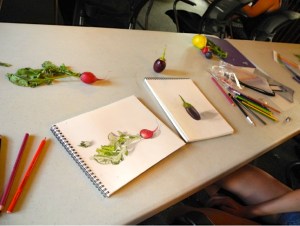
The handouts were key – we were giving them the tools, but more importantly, the visual language to describe their experience. First they worked on their grey value scales. Then a color wheel, then a color grid, showing the many nuances of color available with layering and blending, using their colorless blender. After a break, they put their new understanding of the tools to use rendering a piece of fruit in full color. I brought pears, radishes, tiny oriental eggplants, mushrooms, knob onions – depending on what was available at the fruit market. Less than two hours into their first colored pencil lesson, the results were impressive:

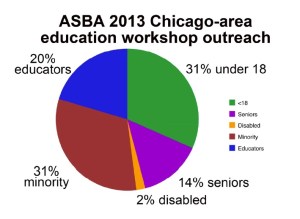
I think our outreach goals were met:
And an unexpected bonus was developing partnerships with area high school and college teachers, who were very interested in how the format of the class could be implemented in courses they were already teaching.
I’m already thinking about how I can do this again next year, and the next, and the next. The per-student cost was under $25, with professional-quality materials, donating my time and gas, still life materials and handouts. With what other introductory medium can you achieve such flexibility with comparable results? And what an enticing way to help people fall in love with plants!
There’s a part of me that hopes this concept will go viral.
What would you do if you believed you would not fail?
About Kathleen Garness:
Kathy is passionate about plants and conservation – and getting the next generation to be enthusiastic about them too. She enjoys being ‘boots on the ground’, conservation-wise, and has been a steward of Grainger Woods, an Illinois nature preserve, since 2003. She teaches watercolor, colored pencil and book arts. She is the current Artist-in-Residence at the Oak Park Conservatory and was an exhibitor in the international exhibition, Losing Paradise? Endangered Plants Here and Around the World, created by the American Society of Botanical Artists. Kathy received the 2008 Chicago Wilderness Grassroots Conservation Leadership Award and has served as president of the Palette and Chisel Academy of Fine Arts in Chicago. A selection of Kathy’s regional plant family illustrations can be viewed on the Field Museum’s website.
Related
Discover Plants of the Chicago Region
41.878114
-87.629798
 The US Department of Education has declared October Connected Educator Month (CEM) aimed at broadening and deepening educator participation in online communities and networks while providing opportunities for educators and education leaders to work together to move the field forward.


 ArtPlantae Today