Feeds:
Posts
Comments


This article was published originally in the November 2004 issue The Southern California Botanical Artist
which was the newsletter of the Botanical Artists Guild of Southern California. It has been updated and is reprinted below with permission.

East Coast Artist Taken with California’s Desert Wildflowers
Henry R. Mockel paints the desert landscape

By Tania Marien

Impressed with what she saw during a visit to California to attend a nursing conference, Beverly Mockel returned to Cooperstown, New York to talk her husband, artist Henry R. Mockel, into moving to the Golden State. When she succeeded at this task, they moved to the town of Calico in the Mojave Desert in 1958. While residents of Calico, the Mockel’s often took trips to Joshua Tree National Park to see the wildflowers. They made frequent stops so Henry could paint flowers along the way. Eventually they decided they should move closer to the flowers, so they moved themselves and their 47-foot house trailer to Twentynine Palms in 1961. After settling into their new home, Henry and Beverly opened the Pioneer Art Gallery in what is now the Historic Plaza. One can only imagine that this new exciting desert lifestyle was quite a change for Henry, a former bookbinder, farmer and cattle rancher.

Henry Mockel was not an artist when he immigrated to the United States from Germany in 1923. His interest in art did not begin until after he moved to New York where he first studied engineering at City College. He then studied art at Grand Central School of Art and continued his art studies for 15 years. His specialty was etching and woodblock printing. Unfortunately, a studio fire destroyed his work and his equipment. Only a few of his etchings survived. After the fire, Henry began creating serigraphs. His original serigraphs are available for purchase at Henry R. Mockel’s – the business that distributes Mockel’s note cards and prints.

What are serigraphs? Serigraphs are screen prints. The fine art version of screen prints, that is, not the T-shirt type of prints. A drawing is made into a stencil and ink is forced through the stencil onto paper. Each color in a serigraph is its own print. Some of Mockel’s plant portraits are the result of 45 separate printings!

Taken with the desert and its flora and fauna, Mockel spent many days studying plants and drawing them in the field. He studied botany and took copious notes on his desert adventures with Beverly. The culmination of 14 years’ worth of observations resulted in a book they co-wrote in 1971 titled, Mockel’s Desert Wildflower Notebook. This book contains illustrations, photographs and descriptions of 133 desert plants. Mockel’s renderings of these plants were done as watercolors, scratchboard, or serigraphs. The Mockels wanted to create a reference that could be understood by anyone with an interest in plants, so they deliberately avoided the use of technical language in their plant descriptions. While no longer in print, this book can be viewed at the following locations: Theodore Payne Foundation, Blaksley Library at the Santa Barbara Botanic Garden, UC Davis’ Shields Library, the California Academy of Sciences, UCLA’s Biomed Library, UC Riverside’s Science Library, and the Riverside County Library System. Check your local library to see if this book is available near you.

Very little is printed about Henry Mockel as a person or an artist. According to Rosemary Brockway, owner of Henry R. Mockel’s and friend of the late Beverly Mockel, Beverly kept Henry protected so that he could focus on his artwork. As a result, the residents of Twentynine Palms knew very little about him. Fortunately, Henry did share some of himself and his interests in the books he wrote with his wife and in the articles he wrote for Desert Magazine. Henry wrote five articles for the magazine from 1961–1965. In these articles, he shares with readers that the first desert flower he ever painted grew in Mule Canyon in the Calico Mountains. He also gives readers a glimpse of how hazardous botanizing can be at times:

The Hole-in-the-Sand (Nicolletia occidentalis) we discovered while proceeding on tip-toe on a short-cut from Pioneer Town to Big Bear. The road was recommended to us as being scenic. We had to build only one bridge, while the rest of the time, as occasion demanded, a short hasty prayer sufficed (Mockel, 1963).

In the Desert articles, Mockel does not describe in detail how he sketched desert flowers. He did, however, mention that he drew his plant portraits only from living plant specimens and he never broke the stems of any plant he drew (Mockel, 1965). He also mentioned he spent many hours in the field sketching next to his subjects. Mockel printed limited editions of 100 of each piece he created. He then destroyed the stencils upon the completion of each printed series.

The Borrego Desert Nature Center has an exhibit of Mockel’s work. Originally scheduled to end in June 2004, this exhibit is on-going (although not always available for viewing). Approximately 20 serigraphs are featured in the exhibit and they are for sale as prints at $100 each (members of the nature center receive a 15% discount). An additional 30 serigraphs are in storage, so if you are looking for something in particular, be sure to ask for help. The Borrego Desert Nature Center is located in Borrego Springs in the Imperial Valley west of the Salton Sea. It is run by the Anza-Borrego Desert Natural History Association.

Mockel’s work is included in the Botanical Art Collection at the Hunt Institute for Botanical Documentation at Carnegie Mellon University in Pittsburgh, PA. The Hunt has 47 pieces of Henry’s artwork in the following media: serigraph (paper), serigraph (illustration board), scratchboard, pencil on tracing paper, watercolor (paper), watercolor (illustration board). Henry had three pieces of artwork accepted into the 2nd Annual International Exhibition of Botanical Art & Illustration at the Hunt in 1968.

Mockel’s artwork has also been seen in local publications. Two of Henry’s plant portraits were featured on the cover of Lasca Leaves in Autumn 1963 and Summer 1964. Lasca Leaves is a periodical that used to be published by the, then, California Arboretum Foundation of the Los Angeles County Arboretum and Botanic Garden. The Arboretum gift shop also sold a special collection of note cards featuring twelve plants and shrubs that Mockel painted at the Arboretum.

Henry R. Mockel died on May 3, 1981 in Joshua Tree, CA. His wife Beverly continued to sell Henry’s work at their gallery. Two years before she died, Beverly sold the business and it is now operated under the name Henry R. Mockel’s. Beverly passed away in March 1990.

To learn more about Henry R. Mockel first-hand through his own words, see the following resources:

  • Mockel, Henry R. 1961. An Eastern artist discovers the Mojave. Desert Magazine. 25: 22-23 (June)
  • Mockel, Henry R. 1961. Our Eastern artist settles on the Mojave. Desert Magazine. 25: 14 (September)
  • Mockel, Henry R. 1963. An Eastern artist finds the desert’s real treasure. Desert Magazine. 27: 19-21 (February)
  • Mockel, Henry R. 1964. The story of the date. Desert Magazine. 28: 47 (March)
  • Mockel, Henry R. 1965. Artist reveals desert’s real treasure. Desert Magazine. 29: 27-29, 36 (March)
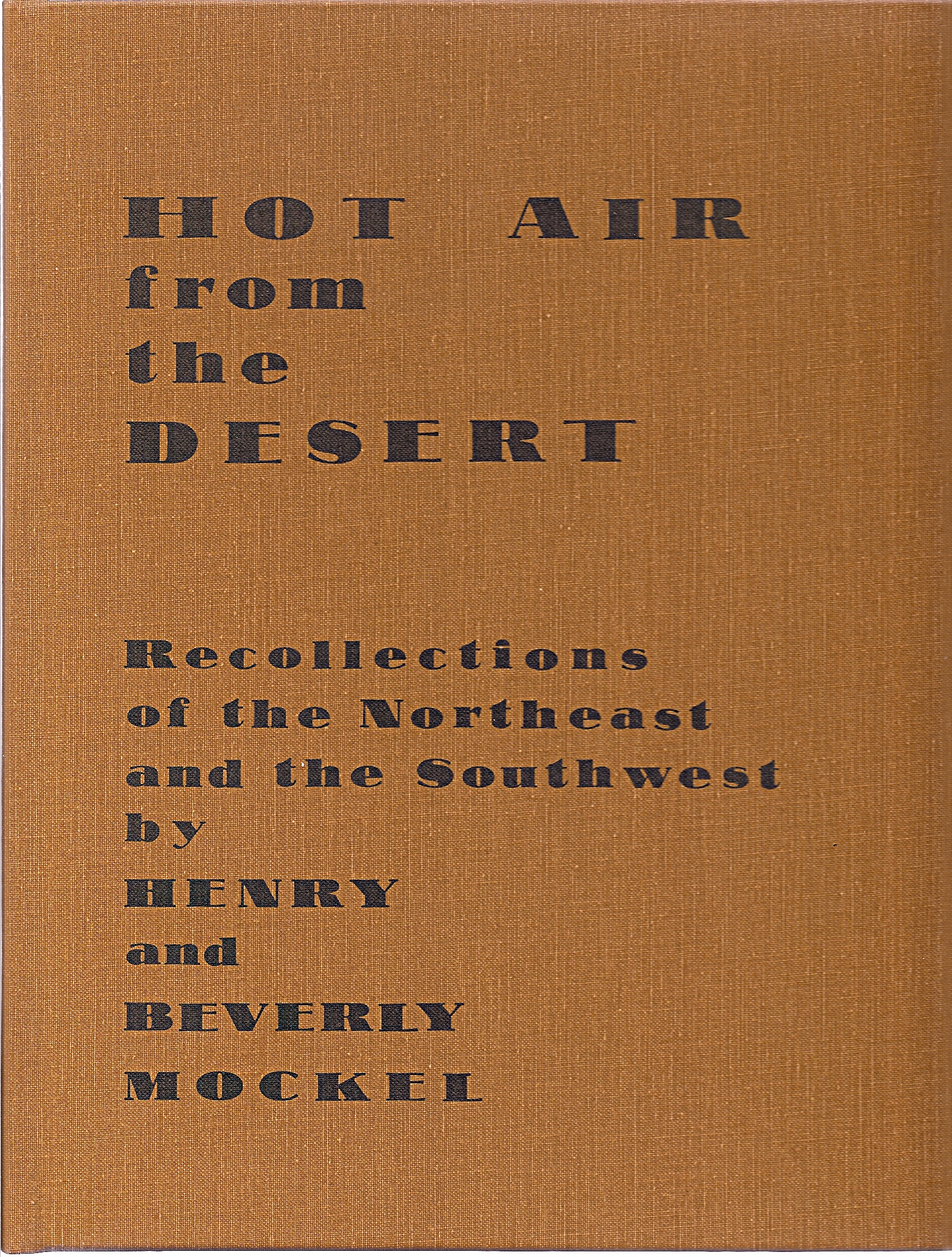
  • Mockel, Henry R. and Beverly Mockel. 1968. Hot Air from the Desert – Recollections of the Northeast and the Southwest. Self-published. Twentynine Palms, CA.
  • Mockel, Henry R. and Beverly Mockel. 1971. Mockel’s Desert Flower Notebook. Self-published. Twentynine Palms, CA.

*Note cards can be ordered from Henry R. Mockel’s in Twentynine Palms, CA. Request an order form by writing to: Henry R. Mockel’s, P.O. Box 726, Twentynine Palms, CA 92277 or call (760) 361-4832.


Related


UPDATE (March 2014)
:
Journalist Ann Japenga learns more about Henry Mockel. She writes about her discoveries in Henry Mockel: The Philosopher of Flowers at California Desert Art.

Caitlin Bergman Creating the Permasphere

Authentic Passion

Caitlin Bergman knows permaculture.

She lives it, she feels it, and she shares her authentic passion with others in her role as designer, instructor, and lead permaculturist at the Los Angeles County Arboretum and Botanic Garden. The enthusiasm Caitlin exudes for her subject couldn’t possibly exist in a purer form. Caitlin “does permaculture all day and dreams about it at night.”

A graduate of the University of Hawaii, Caitlin earned a degree in Botany, with a focus on Ethnobotany. While at UH, she researched native forest restoration, focusing on soil seed bank and community structure studies at Lyon Arboretum. She also did a year-long study on the unusual produce found within Honolulu farmers’ markets.

Since being hired to work as a propagation specialist two years ago, Caitlin has served as interim-curator of the LA Arboretum’s Grace Kallam Garden, and is concurrently the curator and designer of both the Vegetable Garden and the Permasphere, The Arboretum’s new permaculture garden. She received a certificate in permaculture design and has become a popular spokesperson at the Arboretum.

Current projects include designing Pasadena City College’s first permaculture garden, mentoring Barnhart School (a local elementary school) with the creation of a permaculture garden to serve as a teaching tool for students, as well as creating a food forest at Chateau Colombier, a bed-and-breakfast in Provence, France. Caitlin’s largest project at the moment is the creation of the permaculture garden at the LA County Arboretum & Botanic Garden.

The Arboretum’s permaculture garden has been designed to harvest rain. The placement of this garden is deliberate. It is to serve as a water retention garden whose primary function is to capture runoff from the compost area at the Arboretum. Currently, water flows freely from the piles of cut vegetation destined for mulching and redistribution throughout the Arboretum’s many gardens. When water flows out of this area, it flows rapidly down internal access roads, through the parking lot, onto busy Baldwin Avenue, and continues down to the ocean. Now that the permaculture garden is in place, water will enter the garden and be stored in swales carved out of an area that used to be a simple patch of flat dirt. Swales are channels on contour in which water pools. The water collecting in these gentle contoured areas percolates into the soil. Barrels will also be used to harvest water. These barrels will hold both rain water and gray water. Caitlin estimates the Arboretum will be able to capture hundreds to thousands of gallons of water and reduce street runoff which is the source of 70% of all the pollution entering the ocean.

In addition to serving as a rain garden, the permaculture garden will serve as an outdoor classroom. Visitors to the Arboretum will learn how to create food forests at home and learn how to prepare the food and other useful products growing in their urban forests. There are plans to build a cob oven in the new garden and this will enable visitors to learn new green building techniques as well.

What is permaculture exactly? The word “permaculture” is derived from the word perma meaning “permanent” and the word culture which refers to human culture or agriculture. This word was created by two Australians who use it to refer to “permanent culture” and “permanent agriculture” (Hemenway, 2009). Permaculture is about sustainability. It is a systems approach to creating a sustainable landscape for humans and other animals. Permaculture isn’t about planting a specific type of plant. It is about creating an “ecological garden” (Hemenway, 2009) that encourages biological processes observed in nature. Naturally occurring events such as the accumulation of leaf litter that creates habitat for earthworms (and eventually nutrients that will be used by plants) are allowed to happen. Caitlin constantly reminds people that Mother Nature does not own a weedwacker, a rake, or a rototiller. She explains that “permaculture is about unity and support of each other and of nature. Monocrops we depend on in agriculture (and in our gardens) are forced upon nature. Because this system is working against nature, it can not be separated from herbicides, pesticides, and a tremendous amount of work.”

Caitlin is documenting the progress of the new rain garden on her blog SayPermaculture.com. She has also documented the development of the Peacock Food Forest that was created in 2008. Be sure to read about this lush forest located near the Arboretum gift shop.


Would you like to learn more about creating a sustainable homestead? Save these dates!

Los Angeles Garden Show
LA County Arboretum & Botanic Garden
April 30 – May 2, 2010
9 AM – 4 PM
Visit the Permashpere! The new permaculture garden will be open this weekend. Demonstrations, lectures, hands-on activities and cooking lessons are planned. Also, attend Caitlin’s presentation, Enter the Permasphere: Portal to Permaculture in Ayres Hall on May 1 at 2:00 PM.

Permaculture Design Certificate (PDC) Course
LA County Arboretum & Botanic Garden
Saturdays, May 8 – June 26, 2010
Sunday, June 27, 2010
This 72-hr, hands-on course will cover: urban food forestry, landscape design, habitat restoration, rapid soil rebuilding, earthworks, sustainability, food production, rain and grey water use, and community integration. This course is open to anyone with an interest in sustainable, solution-based design. Cost: $200 non-refundable deposit due by May 3, 2010, plus $1000 tuition for this certificate course.

Water Harvesting
LA County Arboretum & Botanic Garden
Saturday, May 22, 2010
10am-12pm
Learn how to contour the earth to create water-collecting swales in the urban landscape. Also learn how to harvest rain water and how to use rain water and grey water at home.


Caitlin asks EE Week Readers
:
How does the Earth design gardens? Do we garden like nature? If not, what could we change to garden naturally?


Literature Cited

Hemenway, Toby. 2009. Gaia’s Garden: A Guide to Home-Scale Permaculture. Second edition. Chelsea Green Publishing. Learn More

Now at Classes Near You > Colorado and Classes Near You > New Mexico:


Maria Hodkins

www.windword.net
Ongoing classes in Nature Journaling, Nature Sketching, and Making a Hand-Made Art Journal, mostly in Colorado.

    Reflections in Rock Time: Nature Journaling Retreat – June 18-20, 2010; Pecos Canyon Area, New Mexico. About 1 hour from Santa Fe bordering the Pecos Wilderness.

    Spend this year’s Summer Solstice immersed in the wonders of the Sangre de Christo Mountains in New Mexico. Explore the artistic, scientific, and reflective pursuit of keeping a nature journal while on retreat. Sketch and observe the details of plants, flowers, birds, animals, skyscapes and land formations. Inhale the deep natural mystery of life reflected around you. And keep a journal of your observations to bring back that sense of wonder that you had as a child about the natural world. This retreat will acquaint you with basic tools and techniques, and includes both class and outdoor instruction in attuned observation, writing reflections, basic sketching, color, page design, and note-taking. Whether you are a beginning journaler or advanced naturalist/artist, you will deepen in an artful skill to use throughout the seasons. Keeping a nature journal reminds us to slow down and find balance in our lives by connecting with nature’s sacred rhythms. Contact Maria to register for this retreat.

The Green Scene Garden Show begins tomorrow at the Fullerton Arboretum on the campus of California State University, Fullerton. There will be over 80 vendors selling plants, vegetables, garden art, accessories, and books. Admission to Green Scene is $6. The show will be open from 10 am – 4 pm on both Saturday and Sunday.

ArtPlantae Books will end EE Week on the Orchard Lawn and will be having a storewide sale. Save 20% off your entire purchase all weekend. This offer applies only to sales at the Green Scene Garden Show during the show’s business hours. This offer is not valid online and is limited to stock on hand. This offer does not apply to notecards, notepads, and prints in the Sally Jacobs Collection. Pre-orders and special orders must be paid for during Green Scene business hours.

What will you find at ArtPlantae this weekend?

  • A display copy of Botany for the Artist by Sarah Simblet. This title is not released until April 19, 2010. Preview the book and pre-order this really, really nice reference.
  • Complete Sets of Marianne Wallace’s America’s series.
  • Nature Journaling Supplies
  • Children’s Books
  • Children Sketchbook Supplies
  • Botanical Art “How-To” Books
  • Botanical Art History Books
  • Hand-held Magnifiers and More!

Tomorrow is also e-Free Day, a new annual event launched by the American Booksellers Association to invite the public to participate in the community events created by independent bookstores. Leave your gadgets behind and spend at day at your local independent bookstore, the beautiful Fullerton Arboretum, or at a garden event near you.

Step into the herbarium at Rancho Santa Ana Botanic Garden (RSA) and you step into a world rich with history. This herbarium contains an impressive 1.1 million specimens. The collection is comprised of mostly vascular plants. Ancillary collections include 3,000 pickled cacti, seeds, pine cones, and a small collection of lichens. Of the more than one million specimens, it is estimated 600,000 are from southern California.


What is an herbarium and what happens in an herbarium?

An herbarium is a collection of plant specimens that have been pressed, dried, and mounted onto archival sheets of paper. An herbarium sheet is comprised of a pressed specimen and a label containing collection information, such as the name of the plant, the name of the collector, and location information. Often times, there will also be seed envelopes and fragment folders on an herbarium sheet. Seed envelopes hold loose seeds and fragment folders hold bits that may have broken off the mounted specimen or they may hold some other material the collecting botanist deemed to be important.

Mounting pressed plant specimens onto herbarium sheets is a never-ending task at any herbarium. At RSA, herbarium staff and dedicated volunteers spend countless hours mounting plants onto herbarium sheets. Each morning volunteers go to the herbarium’s workroom to mount whole plants, flowers, branches, leaves, and seeds. Specimens are attached to herbarium sheets with water-based glue that does not yellow with age. On average, 10,000 – 12,000 specimens are acquired by the RSA herbarium each year. Some specimens are collected by RSA botanists, some are donated by other individuals, and some are on loan from other institutions. This year RSA will acquire closer to 15,000 specimens because of the recent acquisition of the private collection of Dr. Robert F. Thorne, a former curator of the RSA herbarium.

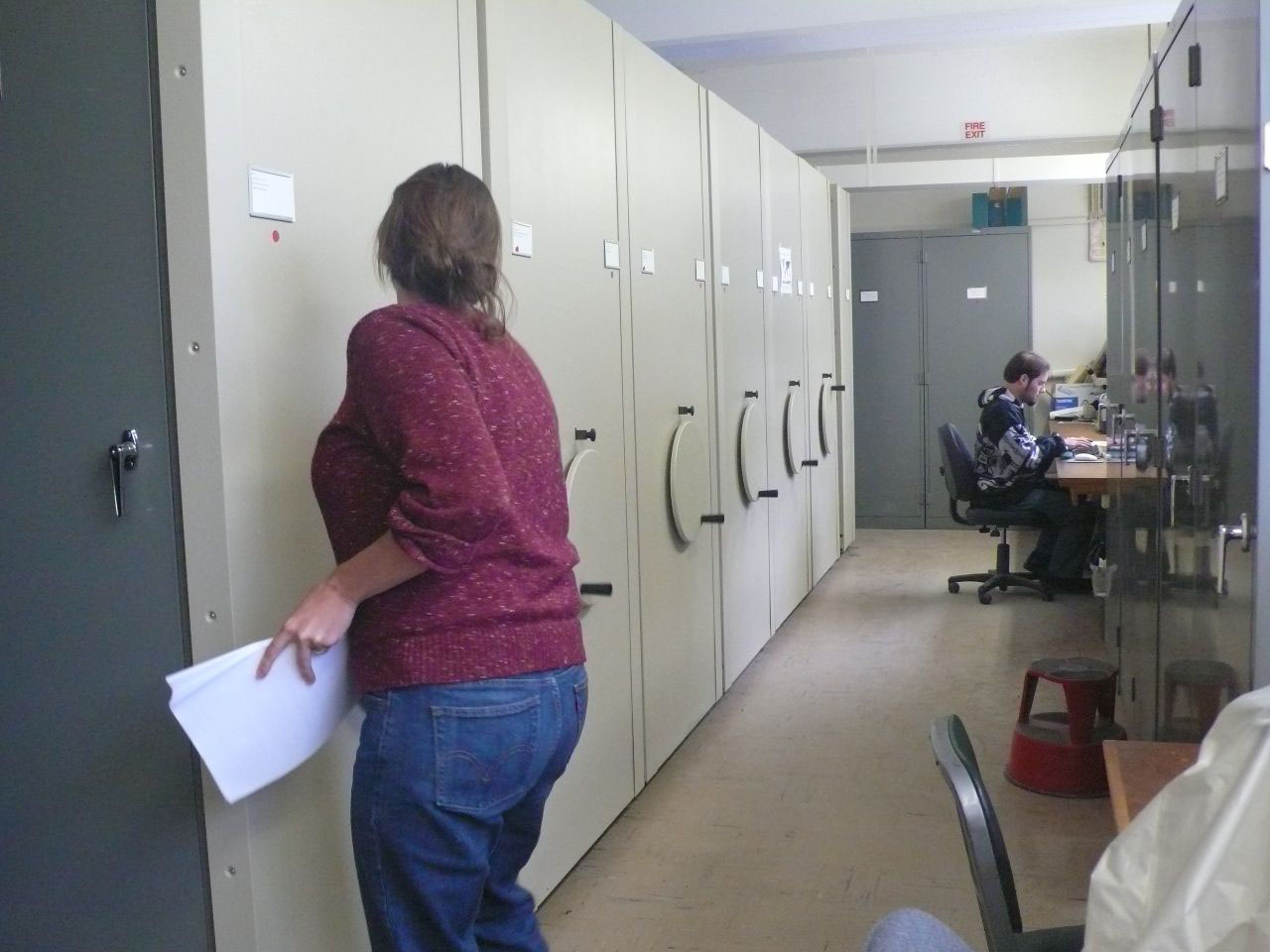
After herbarium specimens have been mounted, dried for a week, and all items securely attached, they are brought upstairs to the collection. The RSA herbarium occupies two complete floors. Here they are placed into cabinets for permanent storage. The herbarium’s more than 1 million specimens are arranged in a filing system of specially-designed cabinets. To maximize space, the cabinets line up next to each other the way the pleats of an accordion lineup next to each other. The cabinets slide and separate by turning the handles seen in this photo.

Open the door to one of the cabinets and you will find folders filled with mounted plant specimens. The large folders housing the herbarium sheets are called genus folders and they contain examples of species belonging to a given genus. For example, in the genus folder for Salvia, you might find mounted plant specimens of Salvia mellifera, Salvia nigra, etc. If you look at the genus folders located at the top of the cabinet, you’ll notice some of the folders are different colors. Genus folders are color-coded and each color represents a different region of the world.

Many of the plants in the RSA collection were collected by RSA botanists. Botanists collect three specimens of each species. They keep one and trade the other two specimens. RSA has been collecting this way since the herbarium opened in 1927. There was a collecting boom in the 1930s and 1940s. Collecting dropped off in the 1950s, however. Through continuous collecting and the acquisition of personal collections, RSA has become the 10th largest herbarium in the United States.


What happens with the specimens after they are added to the collection? Do they stay in a cabinet forever?

Not exactly. Although it may seem this way. Herbarium specimens are viewed and studied by botanists, graduate students, and other researchers. Specimens are also loaned to other herbaria. Sometimes a botanist cannot find an herbarium specimen where she/he is conducting research and they have to borrow the specimen from a distant herbarium.

Herbaria across the world have always worked cooperatively to aid researchers with their studies. The way herbaria work with each other is about to change as research facilities are using technology to their advantage. Soon researchers will no longer have to borrow specimens from distant herbaria. All they will have to do is go online to view the specimens they need. There is a huge scanning project underway and the RSA herbarium is helping to lead the way.

The scanning project is a collaborative effort of institutions worldwide. It is part of a larger movement called the Global Plants Initiative (GPI) headed by the Andrew W. Mellon Foundation. The RSA herbarium is contributing to this effort thanks to a grant from the Foundation. Rancho Santa Ana Botanic Garden has been able to obtain a digital scanner and fund the digitizing of all the type specimens at RSA. Type specimens are the original specimens used to describe a new species. In addition to the scanning of RSA’s 6,500 specimens, the type specimens at The Huntington Library, Art Collections, and Botanical Gardens, the San Diego Museum of Natural History, Santa Barbara Botanic Garden, UC Riverside, and UC Santa Barbara are also being scanned. This means that RSA alone will be responsible for digitizing 10,000 type specimens. The objective of the GPI project is to digitize representations of the world’s flora and to make these digital images available for viewing. The scanning project will not be available online to the public until 2013.

For this article, I met with Sula Vanderplank, Administrative Curator of the RSA herbarium, to learn about what goes on behind-the-scenes at the herbarium. During my visit, I had the opportunity to observe the scanning of one herbarium specimen. What a treat that was! The scanner used by the imaging team is much larger than the average office scanner, as it needs to accommodate herbarium sheets that are 12.5″ x 18″. Since dried plants are fragile and herbarium sheets cannot be placed face down on the scanner the same way a sheet of paper is normally placed onto a scanner, the scanner is the item that is inverted. The inverted scanner rests securely in place on a cart designed especially for the scanner. The scanner rests with the glass plate facing down. Herbarium sheets are placed on a platform and this platform is raised, thereby bringing the herbarium specimen to the scanner’s glass plate. The Scan button is clicked by the technician and the rest is magic. Each scan is 600 dpi and 200 MB. One scan takes 10 minutes to complete. The 10-minute scanning process includes the placement of the herbarium sheet, the actual scanning of a specimen, and the cataloging of an image. The imaging team can comfortably scan five specimens per hour.

If you have an image in your head right now about what a scanned herbarium sheet might look like, magnify the clarity of your vision by 10. The images created by the imaging team are crystal clear. The tiniest detail can be observed and when zoomed in upon, details can be viewed in an even more mind-blowing way. These herbarium images from Kew Botanic Gardens do not match what I saw in person, but they will give you an idea of what an herbarium scan looks like. Some of the images created by the RSA imaging team can be purchased in the garden’s gift shop. These images are of herbarium specimens of plants growing on the grounds at RSA. These images have been carefully mounted using archival materials and framed behind glass that protects the specimens from sunlight.

The Global Plants Initiative will not only open the world’s herbaria to researchers, but introduce the public to the diversity of plants on our planet.

Are you interested in learning more about how an herbarium works and how to create herbarium specimens? Then you might be interested in a special herbarium class taught by Sula and other key members of the herbarium staff. This class is offered only a couple times per year, so check the Rancho Santa Ana Botanic Garden Calendar regularly.


The RSA Herbarium Connects With Teachers

The Rancho Santa Ana Botanical Garden has a longstanding relationship with teachers and schools in southern California. School groups tour the garden and the herbarium during the school year. The herbarium has a special show-n-tell collection comprised of mounted plant specimens, one of the them having been collected by explorer Captain James Cook himself. To learn more about docent-led tours for K-12 students, college classes, youth groups, and adult community groups, visit the RSABG website.


Question for EE Week Readers in southern California
:
Would you like to take the herbarium class at Rancho Santa Ana Botanic Garden? If so, please add your name to an Interest List for this class.


April 2014 – Links to the RSABG website have been updated. The original link to ArtPlantae Books has been removed.

The Rancho Santa Ana Botanic Garden is more than a research facility for academics. It is an outdoor classroom for the general public. Look beyond the garden’s beautiful 86 acres of California native plants, and you will find a research library and a calendar full of learning opportunities for the public to enjoy.


RSA Library

The research library is located in the main building and possesses about 50,000 bound volumes. The collection’s strengths are its books about systematic botany, evolutionary botany, and the botany, taxonomy, and ethnobotany of California plants. The library’s horticultural collection is specific to California and features extensive information about gardening in this western state. The RSA library is actively cataloging gray literature and has a special interest in documents about California.

Illustrated botanical books are also included in the collection, however these are very fragile. Most of the illustrated books were published before 1923 and are therefore in the public domain. Harvey Brenneise, Head Librarian, says individuals interested in botanical books should view the holdings of the Biodiversity Heritage Library and the Digital Library of the Real Jardin Botanico of Madrid. The Biodiversity Heritage Library is a consortium of twelve natural history libraries, botanical libraries, and research institutions who are digitizing books in order to preserve documented records describing the planet’s biodiversity. The Digital Library of the Real Jardin Botanico of Madrid is a collection of antiquarian books from the Royal Botanic Garden.

While the RSA library is open to the public, it is open by appointment only. Most of the library’s visitors are researchers and grad students who benefit greatly from the wealth of information at Brenneise’s fingertips. It used to be that requests for information would take days to process. Now thanks to email and the Internet, Brenneise says librarians are able to share information with each other in record time. He says all he does is send a request out to his network of fellow librarians and a librarian from another part of the world will respond and provide exactly what he needs. What makes this quick response time even more impressive is that the information retrieved is often several decades old. In fact, the botanical information researchers need usually is quite old. According to Brenneise, “In botany, there is nothing too old or too obscure. In other disciplines, if it wasn’t published within the past five years, [researchers] don’t want to look at it.” The botanists at RSA are lucky to have Brenneise in their corner. One doesn’t need to speak with him for too long to figure out there isn’t anything he and his deep pool of resources can not track down.


So Much to Learn, So Little Time

Rancho Santa Ana Botanic Garden hosts many special events, garden activities, and workshops throughout the year. Year-round attractions include docent-led activities at one of the garden’s Discovery Carts. From October through May, weekend visitors can learn about native plants through special hands-on activities. Discovery Carts are located in the Container Garden and the Horticultural Garden and are available on Saturdays from 11 AM – 1 PM and Sundays from 1-3 PM. Another year-round event is the FREE Native Plant Clinic conducted on the first Saturday of each month from 10 AM – 1 PM. Gardeners can ask RSA experts their most pressing questions about native plant gardening. Garden admission is not required to attend a Native Plant Clinic.

Annual events include a wildflower show, art events, garden tours, a Mother’s Day Brunch, a Father’s Day BBQ, special autumn events, and plant sales at the garden’s Grow Native Nursery. For instance, tomorrow (April 16th) is the kickoff of the Meadow Gardens sale of plants suitable to create your own meadow garden. If you’re a fan of California’s native succulent plants, then be sure to put the Cacti and Agaves and Succulents! Oh My! plant sale on your calendar. This sale will be held April 30 – May 2 from 10 AM – 5 PM.

The garden also offers a variety of special workshops that includes topics in beginning botany, advanced plant identification, basketry, book arts, gardening, photography, and botanical illustration. Bookmark this page to keep up with the garden’s extensive course offerings.


Visitor Information:

Adults, $8; Students w/valid ID $6; Seniors (+65), $6; Children (3-12), $4; Free admission for members and children under 3. Rancho Santa Ana Botanic Garden is located in Claremont, CA (map)


Related
:

The current renaissance of botanical art began in the 1980s. Dr. Shirley Sherwood is credited with reviving the public’s awareness of botanical art. Since the first certificate program in botanical art was established at the New York Botanical Garden, programs have been established in Arizona, California, Colorado, Florida, Illinois, Maryland, Massachusetts, Minnesota, North Carolina, Pittsburgh, and Washington DC. Public workshops in botanical art are offered in almost every state across the country at botanical gardens, community centers, and even online. Regular readers of this website are treated to news of new workshops almost weekly and are not surprised by the rich offering of learning opportunities across the country.

Newcomers to botanical art and illustration, on the other hand, are surprised to learn there are certificate programs for this centuries old discipline considered by some to be merely a hobby of weekend art enthusiasts. Because ArtPlantae has the attention of such a large audience this week, I thought it would be a good time to address a question I’ve heard more than once which is:

So what is a certificate program in botanical art, anyway?

Answering this question for us today are Lee McCaffree and Catherine Watters, founders of the certificate program at the Filoli Estate in Woodside, CA. Lee and Catherine serve as the primary instructors and curriculum designers for this program. Here is what they have to say about Filoli’s certificate program and the value of botanical art education:

Botanical art emphasizes the connection between nature and art. Botanical artists develop the skill of observing nature in detail so they can create an accurate image of plants. This art form is a way to document the plants in our environment. Artists have an awareness and understanding of plants because they spend many hours observing and painting them. When these paintings are displayed in an exhibition, audience awareness of plants increases.

The Filoli Botanical Art Certificate Program gives students a way to learn this art form by offering a unique, in-depth study of botanical art through challenging, integrated and comprehensive courses. The curriculum includes the systematic study of artistic skills and concepts, basic botany and botanical art history. A certificate is presented upon successful completion of coursework (180 classroom hours plus homework) and presentation of a portfolio and final project. This program is for the serious student who wishes to develop knowledge and skills in botanical art. The minimum time for completion of the program is generally 2 years; there is no limit on how long a student may take to finish.

What makes the Botanical Art Program at Filoli unique is that it is taught in the beautiful Georgian country house surrounded by a spectacular 16-acre English Renaissance garden and 600 acres of open space. The certificate program has long been an essential part of Filoli’s mission to interpret and preserve the history of this country estate and its surroundings in the San Francisco area. Plants from the garden are used regularly as subjects in the classroom.

The program at Filoli teaches individuals how to “interpret and observe” in the same way explorers, botanists, and artists recorded their discoveries so many years ago. In addition to the integrated coursework designed by Lee and Catherine, the Filoli program invites highly acclaimed national and international interpreters/observers to teach at Filoli. Programs with visiting instructors are usually intensive multiple day courses and provide students with truly unique learning opportunities.

Filoli is participating in National Environmental Education Week through its nature education program which, like the botanical art program, encourages environmental awareness. View Filoli’s EE Week activities on their website. Be sure to also read about their Teachers and School Programs and the workshops for families and children, including a botanical art workshop for kids scheduled for April 24, 2010.


Related Information
:


Question for EE Week Readers
: