Feeds:
Posts
Comments

Philosopher Jean-Jacques Rousseau always had an interest in botany. His knowledge and passion for plants were captured in a series of letters he wrote to a friend between 1771 and 1773.

Rousseau wrote a series of eight letters to a friend who was teaching her four-year old daughter botany. In Letter One, he describes the parts of a flower. Letter Two is filled with descriptions about the characteristics of the Cruciferae (Brassicaceae; Mustard family). In Letter Three, Rousseau urges his friend to learn only from “the book of nature” and then continues to describe the plants in the pea family (Fabaceae). Letter Four is dedicated to the Laminaceae (Mint family) and the Scrophulariaceae (Figwort family). The Umbelliferae (Apiaceae; Carrot family) are the focus of Rousseau’s writing in Letter Five. The Asteraceae (Sunflower family) are described in Letter Six. Rousseau’s commentary about fruit trees (Letter Seven) and pressed plant collections (Letter Eight) close this series of educational and enlightening letters.

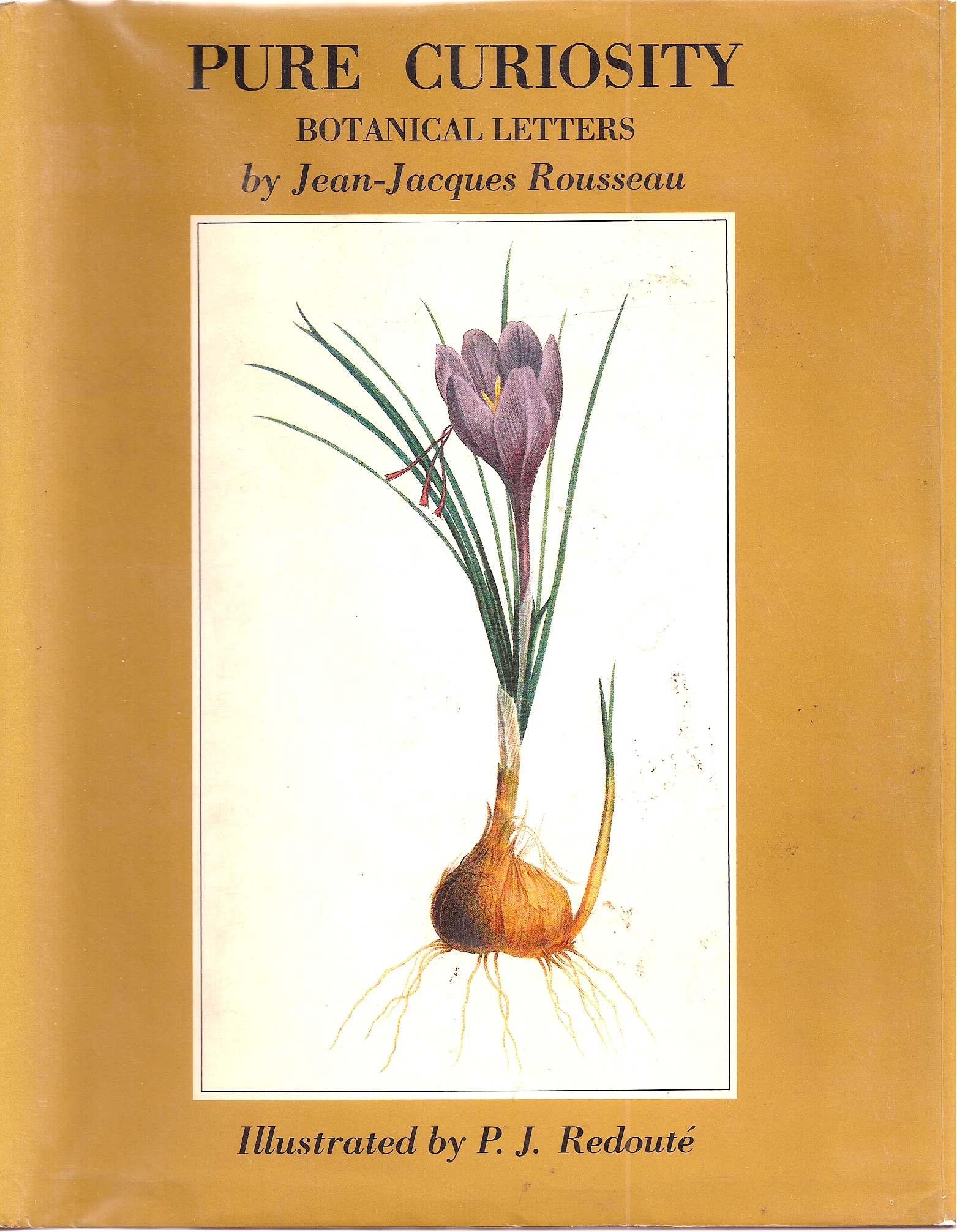
Rousseau’s letters were so educational, in fact, they were circulated in the intellectual salons that were popular at this time. Botany was very fashionable back then and bound collections of Rousseau’s letters were in high demand. His letters were first published in a collection of his work in 1782, five years after his death. The letters were then published separately in 1800 and 1802. In 1805, sixty-five color plates by Pierre Joseph Redouté were added to Rousseau’s collection of letters, which had by then become known as La Botanique. The book above, Pure Curiosity: Botanical Letters and Notes towards a Dictionary of Botanical Terms is a facsimile based on the third edition of La Botanique (1821).

When Rousseau died, he left behind drafts of what appears to be a dictionary of botanical terms. He was writing a dictionary so the layman could make sense of the terminology used by botanists. A portion of this dictionary is included in Pure Curiosity. Botanical terms are arranged alphabetically in English, with the French words used by Rousseau in parentheses. Redouté’s work is also featured in this section of the book.

Pure Curiosity is still available on the used book market and comes with a strong recommendation for anyone with an interest in botanical art history or an interest in informal science education.


Literature Cited

Rousseau, Jean-Jacques. 1712-1778. Pure Curiosity. Translation of La botanique de J.J. Rousseau. Copyright © 1979 by The Felix Gluck Press Limited.
ISBN: 0-448-22920-X


Related

The L.A. Garden Show will be held next week at the Los Angeles County Arboretum & Botanic Garden. There will be eco-gardening ideas, garden tours, garden chats, activities for children, a bustling marketplace, and the unveiling of the new Permasphere. There will also be botanical art. Lots of it.

Members of the Botanical Artists Guild of Southern California are currently showing their work in the Arboretum library, located near the main entrance. Their exhibition, Seeing the Details will be on view through June 30, 2010. The Guild will also be in the Marketplace conducting demonstrations, selling prints and cards, and discussing their work with garden show visitors.

ArtPlantae Books will be in the Marketplace as well. We hope to see you in the garden!

The L.A. Garden Show will be held April 30 – May 2, 2010. Admission is $3 (Ages 5-12), $6 (Students & Seniors), $8 Adults. Parking is free with shuttle. Preferred parking is $10. View all details here.
Directions to Arboretum

© Corinne Lapen-Cohen. All rights reserved

Botanical artist, Corinne Lapin-Cohen, will have a one-woman exhibition featuring over 60 botanical watercolor paintings and metalpoint pieces in the historic 18th-century Benedict family homestead situated on over 4,000 acres of fields and woodlands.

The Discoveries…Botanical Explorations exhibition will be held May 23 – September 6, 2010 at The Gallery in the Park, Ward Pound Ridge Reservation in Cross River, NY. The opening reception will be on May 23 from 2 PM – 4 PM.

Now at Classes Near You > Colorado:


Marjorie Leggitt, Leggitt Design & Illustration

http://www.science-art.com/leggitt

  • The COLORADO CHAUTAUQUA: Architecture in the Landscape – Saturday, June 26 & Sunday, June 27 (2 days); 9 a.m.–3:30 p.m. Chautauqua Park, 900 Baseline Road, Boulder, CO. Cost $185. www.chautauqua.com
    At the foot of the picturesque Flatirons in Boulder, Colorado, Chautauqua Park offers one of the most spectacular landscapes on the Front Range! In addition, 40 acres of landscaped parks, historic cottages, and century old buildings provide the perfect setting for a 2-day workshop on linear perspective. Starting from the ground up, and using a few simple tools, students learn how to draw both one and 2-point perspective by sketching simple structures and architectural features on location, out-of-doors. Additional instruction and demonstrations provide guidance for including various landscape features and plants into the sketch. A final assignment, provides students with the knowledge to take their new skills of linear perspective with them where ever they go! This is a MUST workshop for the local and world traveler alike!
  • BACK TO BASICS: Drawing with ConfidenceALMOST FULL. Tuesday, July 6 – Friday, July 9 (4 days); 9 a.m.– 2:30 p.m. (half-hour lunch). Volunteers for Outdoor Colorado (VOC), Dos Chappell Room, Washington Park, Denver, CO. Cost: $380
    You draw the “subjects” for your artwork, but it’s slow, you avoid difficult views, and still, you’re not sure it’s quite right. Have no fear! Whether your topic is a favorite lighthouse on Martha’s Vineyard, Aunt Millie’s pet dog, or a vase of autumn perennials for a still-life painting you plan to enter in an exhibit in Chicago, this back-to-basics drawing course will help you achieve your goal. In this fun four-day workshop, you will return to the drawing basics of Line, Shading, Perspective, and Composition to bolster your drawing skills and boost your confidence. Marjorie Leggitt and Susan Rubin will guide you through specific steps to better drawing. Understand how to “see” like an artist and turn on your artistic intuition to draw line correctly the first time. Revisit the principles of light, form, and depth to flesh out compositions both big and small. Practice linear and aerial perspective to accurately portray physical and atmospheric depth. Develop composition strategies to create dynamic artwork. We’ll look at subjects large and small, indoors and out. Instruction, exercises, practice, and individual guidance will assure that in just four days you’ll solidify those shaky skills and draw anything better and faster every time.
  • POSTCARDS FROM….Fairplay, Colorado: A Watercolorist’s Best Kept Secret – Thursday, August 26 – Sunday, August 29 (4 days). Workshop begins at 10 a.m., Thursday and ends at 2:30 p.m., Sunday. Location: Fairplay, Colorado. Price: $825 per person/double occupancy (Includes: instruction, handouts, double occupancy lodging, breakfast and lunch, a custom watercolor travel kit). Single Room Supplement for 3 nights: $175.00. Additional nights of lodging available upon request for an additional fee. Instructors Marjorie Leggitt and Leon Loughridge in one of the most intriguing and beautiful landscapes in Colorado, this 4 day painting workshop explores hidden lanes and spectacular high elevation scenery while students acquire the skills required to paint plein air landscapes with transparent watercolors. The first morning provides a discussion of the fundamentals for making good compositions. Teacher demos, and student exercises include finding compositions, and making value thumbnails to capture the lines, patterns, and shape within the landscape. After lunch the focus of the workshop turns to painting. Starting with a composition selected and demoed by the instructor, students soon discover the advantage of a limited color palette. Instruction details the step-by-step process from simple value washes, to 2-color “snapshots”, to layered mini “vignettes”, to larger paintings. Each day builds upon the previous day’s lessons while offering new painting locations – from vast plains and historic architecture to spectacular mountain settings. One-on-one critiques provide personal attention and help painters move to the next level. Daily group instruction, demos, critiques, and evening slide presentations provide multiple opportunities to observe and learn from the group.

National Environmental Education Week came to an end this weekend. Links to articles were posted to Twitter and Facebook, and were shared with environmental educators through other channels. I would like to take a moment to thank everyone who took the time to tell us about their careers and special projects and how they are making a contribution to environmental literacy through their activities. A special thank you goes to Christine Elder for responding to comments and questions this week.

And many thanks to all of you readers who shared links with friends and colleagues this past week.


Contributors to EE Week at ArtPlantae
:

Two summers ago, Wendy Hollender picked strawberries near the home of a fellow botanical artist. She immediately fell in love with farming and everything associated with connecting with the land and growing fruit and vegetables. Back home in Manhattan, Wendy kept having visions of a country farm where she could work the land, teach botanical art classes, and open a store with a botanical theme.

The following summer, Wendy looked for winterized homes. Realtors kept showing her weekend houses, but what Wendy really wanted was a farm where she could grow fruits, vegetables and teach classes. After eight months of searching, Wendy found her 4-acre homestead and 1860 farmhouse near the strawberry farm that first inspired her. Hollengold Farm is located in Accord, NY in a valley of farms with the Catskill Mountains on one side and the Shawangunk Mountains on the other.

Both of Wendy’s adult children studied permaculture, so they designed the 3,000 square foot vegetable garden established in the farm’s first year. About to enter its second growing season, the vegetable garden has been redesigned and is now one acre. Only hand crops will be grown and this means machinery will not be used to harvest the crops.

Managing a large garden is no easy task. Volunteers, family and friends helped to get the farm started and volunteers and interns keep the farm running. Requiring special attention and planning is the management of the farm’s water use. Last year drip hoses and sprinklers were used. Now that the garden has grown to over 10 times its original size, managing and assessing how water is harvested and used on site is a never-ending task. Recently, a new roof catchment system was established. A new roof was placed on the barn and this roof directs water runoff into special catchment buckets. This water is then used to irrigate growing crops.

Before Wendy purchased Hollengold Farm, the four-acre property was a horse farm. In fact, the barn used to be a horse stable. The former stable is currently being renovated to become the center of activity at the farm. The renovated barn will serve as the location for plant propagation, studio space, gallery space, a farm stand, a commercial kitchen, and a shop for botanical-themed items. Wendy’s daughter is a chef and she will soon be preparing tasty fresh entrees. A masonry oven is being built to make wood-fired pizza. She will also can fruits and vegetables to sell at the new store. Plans are in motion to create a “seed to grain” learning experience for children from nearby school districts. This program will be based on the children’s story The Little Red Hen and show students how seeds become wheat, how wheat becomes flour, and how flour becomes bread.

The planned studio and gallery space are where Wendy will teach her botanical art classes and showcase her work and the work of her students. Wendy is currently teaching one-day workshops at the farm. A popular teacher in-person and here at ArtPlantae Today (Wendy’s Ask The Artist Q&A is the most read article of all time), her popularity is sure to increase when her second book is released later this summer. When Wendy sat down to talk about the farm, she also talked about Botanical Drawing in Color: A Basic Guide to Mastering Realistic Form and Naturalistic Color. Here is what she had to say…

ArtPlantae: How did the idea for a new book materialize?
Wendy Hollender: I just finished the first book. I contacted Faber-Castell to tell them I recommended their pencils in my workbook. They invited me to do a demonstration at a trade convention. At the convention, many publishers were present and they expressed an interest in my workbook. Random House asked for a proposal and asked for a completed book within four months of accepting my proposal.

AP: Will the new book be similar in design to your first book? Will there be many steps broken down with descriptive illustrations?
WH: Yes. The steps will be broken down and will be very descriptive. Each step will be broken down to minute detail. Watching artists use the first book, I realized what I left out. Random House had a 25,000 word requirement, so this book has more text than the first book. I loved writing the book. I wrote in the morning. At first I began writing about my personal experiences with botanical art. I wasn’t sure if this was acceptable, so I told them what I had been doing. I was told to write the book the way I wanted to write it. In the end, all of the content and concepts I created stayed in the book. Only a few minor changes were made.

AP: What topics do you discuss in the new book?
WH: Perspective, plant structure, composition, color, drawing in the field, working with a microscope and how to draw white flowers on a white background.

AP: What would you like people to know about your new book?
WH: What is exciting about my book, and why Random House wanted to publish it, is that it focuses on botanical drawing in color. Colored pencil isn’t just a medium to use, it is also a learning tool. It allows you to teach drawing skills and teach about color at the same time.

Wendy also mentioned her new book took six months to write and six months to edit. With this book, Wendy hopes to take the struggle out of creating botanical art for artists of all levels. If you own a copy of Botanical Drawing: A Beginner’s Guide you already know how well Wendy can teach without even being in the same room with you. Join us as we anticipate the July 2010 release of Botanical Drawing in Color.


UPDATE
:
Wendy Hollender to Discuss “Botanical Drawing” Live!
August 18, 2010
Today is the last day of National Environmental Education Week. Celebrate EE Week through the weekend with ArtPlantae Books at the Green Scene Garden Show. We’re there today and tomorrow from 10 AM – 4 PM.

Pick up a brochure about TheMulch.com to learn more about this resource for gardeners. View and purchase complete sets of Marianne Wallace’s America’s series. Get a copy of Water: The Epic Struggle for Wealth, Power, and Civilization.

Save 20% off on books and journaling supplies this weekend. This offer is only good during Green Scene. Hope to see you on the Orchard Lawn!

The Green Scene Garden Show is located at the Fullerton Arboretum on the campus of California State University, Fullerton.