Feeds:
Posts
Comments

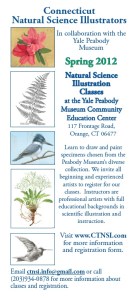
The Connecticut Natural Science Illustrators group has announced their Spring schedule. Here is what’s new at Classes Near You > Connecticut:

Download schedule


Connecticut Natural Science Illustrators

In collaboration with the Yale Peabody Museum
www.ctnsi.com

Connecticut Natural Science Illustrators LLC is composed of professional artists and scientists who have developed educational programs in natural science illustration. The members of CTNSI also provide illustrations, printed material, murals and exhibits addressing environmental and biological topics. The team at CTNSI works with environmental groups, nature centers, schools, and event managers. All classes are taught at the Yale Peabody Museum Education Center/West Campus, 117 Frontage Road, Orange, CT 06477. Register online at www.ctnsi.com or contact ctnsiprogramcoordinator@comcast.net.

Download Spring 2012 Schedule

  • One Day Sketching Workshop: Indoors or Outdoors
    March 17, 2012 or March 24, 2012; 10 AM – 1 PM. Practice the art of drawing quickly using graphite and conte crayon. Beginners and experienced artists welcome. Cost: $90 each one-day workshop.
  • Drawing and Painting Birds – Wednesdays, April 4 – May 9, 2012;
    1-4 PM. During this six-week class, you will learn avian anatomy while sketching birds in the field and sketching mounted specimens and museum skins. Participants will visit the Yale Peabody Museum ornithology collection. Prerequisite: Fundamentals of Natural Science Illustration or permission from the instructor. Cost: $275
  • Pen & Ink: Basic Techniques – Wednesdays, April 4-25, 2012; 1-4 PM. Applying skills learned in Fundamentals of Natural Science Illustration, students will learn traditional techniques used by scientific illustrators. Cost: $175.
  • Pen & Ink: Natural Science Specimens – Wednesdays,
    May 2-23, 2012; 1-4 PM. Applying techniques learned in Pen and Ink I, students will illustrate specimens from the Peabody Museum collection and learn how to prepare illustrations for reproduction. Prerequisite: Pen and Ink I or permission from the instructor. Cost: $175
  • Drawing from the Peabody Museum’s Dioramas – Saturdays,
    April 7-28, 2012; 10 AM – 1 PM. Draw from the dioramas and bird collection of the Yale Peabody Museum. Graphite, colored pencil and watercolor will be used. Open to beginners and to experienced artists. Cost: $175
  • Field Sketching – Saturdays, May 5-26, 2012. Sketch outdoor habitats at Yale’s West Campus using graphite, colored pencil and watercolor. Open to beginners and to experienced artists. Cost: $175

Adult education classes for the Winter term are now open for enrollment at the Gardens at Heather Farm. Included in the schedule are classes about plants and the environment. The following classes have been posted to Classes Near You > Northern California:


Gardens at Heather Farm, Walnut Creek

www.gardenshf.org
The Gardens at Heather Farm are comprised of twenty demonstration gardens. This six-acre garden is also an outdoor classroom. The garden offers many classes about plants, botany, botanical art and the environment. It also has its own florilegium. The florilegium project is managed by botanical artist, Catherine Watters. Visit the website to view the complete schedule of classes.

  • Discovering a Sense of Place – Saturday, March 17 – 9:00 AM – 2:00 PM. Learn about the Diablo Valley’s unique bioregion. Develop crucial knowledge about climate-appropriate plants for your home and garden as well as key facts about the soil, climate, watersheds, history and wildlife biodiversity of the region that help you create and maintain a beautiful landscape. Instructors: Patrice Hanlon, GHF Garden Manager and Susan Handjian, Garden Consultant/ Coach.
    Cost: FREE ($20 registration fee refunded at class).
    Early registration for Walnut Creek Residents ends 2/17
/12.
  • The Life of Roots and a Short Tour of the Soil Food Web – Saturday,
    March 31, 2012; 10:00 AM – 2:00 PM. Learn how roots provide for and partner with the Soil Food Web to create healthy soil and a thriving garden. Find out what you can do to support and promote the Soil Food Web to build a deep harmony into your landscape. Compost and compost tea, mulching and top dressing techniques will be explained. Transform your clay soil into rich beautiful topsoil! Instructor: Christine Finch, Bay-Friendly Landscape Professional & co-author of the East Bay Municipal Utility District’s Plants and Landscapes for Summer-Dry Climates.
    Cost: $25

The UC Botanical Gardens at Berkeley want you to know they have the cure for plant lust and you can get it at their annual Spring Plant Sale. Information about this popular annual event, as well as information about how you can visit the garden for free in April has been added to the Garden’s listing at
Classes Near You > Northern California:


University of California Botanical Garden at Berkeley

http://botanicalgarden.berkeley.edu
This 34-acre garden was established in 1890 and is now a non-profit research garden and museum. The botanical art classes below are taught by Lee McCaffree and Catherine Watters. View a detailed schedule and register on the Garden’s website.

  • Sick Plant Clinic – First Saturday of Each Month, 9 AM – 12 PM. Free.
    No reservations required.
  • Monthly Butterfly Walks – Fourth Tuesday of each month (March – October); 3 – 4 PM. Garden volunteer, docent, and caterpillar lady, Sally Levinson, will lead walks through the garden in search of butterflies. Space is limited. Children welcome. Free with admission.
  • Garden Strollers – Second Wednesday of Each Month,
    11 AM – 11:45 PM. A 45-minute tour of the garden for adults with young children (3 and under). Tour will end on the lawn for play and snacks (bring your own). Children must be in a stroller or carrier during the tour. FREE with garden admission. Meet in front of the Garden Ship. For more information, call (510) 642-7082 or email garden@berkeley.edu.
  • Garden Glasshouses: Members’ Walk – Thursday, February 16, 2012; 1:00 – 2:30 PM. A tour of glasshouse treasures with horticulturist, Christy Matasick. This tour includes the Orchid, Fern and Carnivorous Plant House and the Tropical House (Arid House not included). Registration required. Members only. Free.
  • Magnolias in the Garden: Members’ Walk
    Tuesday, February 28, 2012; 1:00 – 2:30 PM. Members only. Free.
  • Botanical Illustration: Introduction to Botanical Art with Catherine Watters – Friday & Saturday, March 16-17, 2012; 10 AM – 4 PM. Catherine Watters will teach you to observe, measure and draw plants in great detail and with botanical accuracy. Students will work with graphite, colored pencils and watercolor. All levels are welcome. Cost: $160 non-members, $150 members. Registration required.
  • Blue Chair Fruit: Jam 101 – Sunday, March 18, 2012; 10 AM – 12 PM. Preserve your homegrown fruit! Rachel Saunders of the Blue Chair Fruit Company will lead a demonstration on how to cook lemon marmalade with cardamom and lavender and instruct students on technique and flavor pairings. Participants will receive a small jar of marmalade and class notes. Rachel will also be signing copies of her book The Blue Chair Jam Cookbook. Books will be available for purchase. Registration required. Cost: $85 non-members, $80 members.
  • Horticultural Walk: Southern Africa – Tuesday, March 20, 2012;
    1:00 -2:30 PM. Horticulturist for Southern Africa, Cycads and Palms, Meghan Ray, leads this tour about the annuals and Spring-flowering bulbs of South Africa. Members only. Free.
  • Fiber & Dye Exhibition – March 24 – April 8, 2012; 10 AM – 4 PM.
    Learn more about the world of natural fibers and dyes. This exhibition connects culture with nature and will introduce visitors to the traditional uses of dyes and how dyes are used in eco-fashion and textiles.
  • NEW Cal Day – Saturday, April 21; 9 AM – 5 PM. Join Garden docents for free Plants of the World tours throughout the day as a part of this campus-wide event. Visitors will enjoy hands-on activities, demonstrations and special discounts. Stroll through the Garden, visit the Garden Shop, relax with your family and friends, and maybe even pick up a new passion for horticulture! Tours at 11 AM, 12 PM, 1 PM, 2 PM.
    Free Garden admission for everyone.
  • NEW Spring Plant Sale
    Public Sale: Saturday, April 28, 10 AM – 2 PM
    Cure your plant lust and shop at the Spring Plant Sale. Choose from a huge selection of unique and diverse plants and learn from expert advisors at the Bay Area’s most spectacular public garden. Free!

Interested in making scientific illustration a part of your classroom’s culture?

Then you will be interested in reading about the pilot program created by illustrators, Patricia Ferrer and Joseph E. Trumpey. Ferrer & Trumpey (1999) created a pilot project through which they taught observational drawing to third grade and fifth grade students. They discuss their program in Assessing the Effectiveness of Scientific Illustration as a Learning Tool in the Elementary School Classroom.

Through a learning sequence they developed, Ferrer and Trumpey (1999) taught students how to observe subjects, how to take visual notes, how to discuss their observations with their peers, how to apply new knowledge to new drawings, and how to continuously assess their understanding of a subject. Ferrer and Trumpey (1999) measured learning gains using an assessment tool that was administered three times during the sequence and once after the sequence was completed. The fourth assessment was administered to determine how much information students retained one week later.

The Ferrer & Trumpey Learning Sequence was integrated into a biology unit about grasshoppers and into a unit about the classifying characteristics of eight phyla of invertebrates. The grasshopper lesson prepared by Ferrer & Trumpey (1999) was administered to 24 third grade students. The grasshopper unit was designed to teach students:

  • Grasshoppers are insects.
  • Grasshoppers do not have a backbone.
  • The physical characteristics of grasshoppers.
  • How to make accurate observations and how to draw what is observed.

The lesson about invertebrate phyla was designed to teach both third grade students (n=46) and fifth grade students (n=54):

  • Invertebrates are classified according to a variety of characteristics.
  • All invertebrates lack a backbone.
  • How to make observations and to draw what has been observed.
  • How to engage in inquiry activities leading to higher-level thinking.

In both lessons, students followed the methodical and thoughtful steps of the Ferrer & Trumpey Learning Sequence. These steps included:

  • A pre-assessment quiz to establish students’ prior knowledge of a subject. The quiz included a variety of questions (fill-in-the-blank, multiple choice and questions calling for matching, observational drawing and written observation).
  • Unguided observation. Students were allowed to make their own observations without any instruction from the teacher. Students then shared observations with each other in groups.
  • A second assessment quiz. This second assessment was administered to determine what students “can learn on their own when given the opportunity” (Ferrer & Trumpey, 1999).
  • Guided observation. Classroom teacher provides formal instruction about a subject and corrects any student misconceptions about a subject. Students create new observational drawings applying their new knowledge.
  • A third assessment quiz. The key question here is, How do structured lessons aid the learning process?
  • A fourth assessment quiz. This assessment is conducted one week later to determine how much information students retain about a subject.

Ferrer & Trumpey (1999) assigned the objective questions of the assessment quiz a value of 2 points each. They created a rubric for the questions requiring students to make visual and written observations. Data collected indicate assessment scores improved between Assessment 1, Assessment 2 and Assessment 3. Students improved an average of 4.1 points between Assessment 1 and Assessment 2 and demonstrated an increase in knowledge between the unguided and guided assessments (Ferrer & Trumpey, 1999). While scores for Assessment 4 dropped an average of 0.9 points, data indicate an average overall point gain of 8.4 points between Assessments 1 and 4 (Ferrer & Trumpey, 1999).

Ferrer & Trumpey (1999) also observed that students spent more time doing science when drawing was involved, that student drawing ability increased over time and that students paid more attention to detail as the lessons progressed. Because of the results observed through their pilot program, Ferrer and Trumpey (1999) feel that scientific illustration-based activities are effective tools that can be used to teach science in the classroom.

The paper by Patricia Ferrer and Joseph E. Trumpey was published in the third volume of the Journal of Natural Science Illustration, an excellent publication published by the Guild of Natural Science Illustrators (GNSI). While back issues of Volume 3 are no longer available for purchase at the GNSI Store, other issues of the Journal are available, as well as GNSI Technique Sheets II, a publication highlighting the techniques used by scientific illustrators.


About Patricia Ferrier

Patricia received her M.F.A. in medical and biological illustration from the University of Michigan, Ann Arbor. She is the founder of ScientificIllustration.org and the owner of FerrerBeals Biomedical Illustration + Design. Follow Patricia on Twitter at @ScientificArt.


About Joseph E. Trumpey

Joseph is an associate professor at the School of Art & Design at the University of Michigan, Ann Arbor. He also serves as the Director of International Engagement at the school. Joseph received a M.F.A. in medical and biological illustration from the University of Michigan and prior to joining the faculty at the university, was the chief medical illustrator and director of graphic arts for the College of Veterinary Medicine at North Caroline State University. Joseph is the founder and director of Michigan Science Art, one of the largest groups of science illustrators working together in North America.


Literature Cited

Ferrer, Patricia and Joseph E. Trumpey. 1999. Assessing the effectiveness of scientific illustration as a learning tool in the elementary school classroom.
Journal of Natural Science Illustration. 3(1): 33-42.

Many years ago, I came across a reference to a book by botanist and illustrator, Michael Hickey, about how to draw plants in pen and ink. I began a diligent search for this book and couldn’t find it anywhere. I decided to take a chance and write to Mr. Hickey to ask about his book. To my surprise, he wrote back. He told me that while his book Drawing Plants in Pen and Ink was no longer in print, he had an extra copy lying around the house. He told me he would send it to me. Not long afterward, the book arrived. What was before a unique hard-to-find book became a one-of-a-kind treasure because of Mr. Hickey’s generosity and thoughtfulness.

Many of you are familiar with Mr. Hickey’s botany books. I have written before about the book he wrote with Clive King (The Cambridge Illustrated Glossary of Botanical Terms), and several of you are familiar with Mr. Hickey’s Botany for Beginners and Botany for Beginners II. Each of these publications are invaluable references for anyone interested in drawing plants.

This month, I have the honor of introducing you to the Institute for Analytical Plant Illustration, an institute founded by Mr. Hickey specifically to “encourage collaboration between botanists and illustrators” and to “encourage members to develop their skills in scientific illustration and to increase their botanical knowledge.”

Please welcome IAPI Chairperson, Sue Nicholls, and all members of the Institute for Analytical Plant Illustration, the Feature Group for February!


ARTPLANTAE
: Sue, thank you for introducing the group this month. Please tell us more about IAPI’s history.

SUE NICHOLLS: IAPI was founded in 2004, by Michael Hickey, to encourage the scientific illustration of flowering and non-flowering plants. He was also concerned that though there is a great interest in botanical art and illustration, the interest tends to be towards botanical art rather than scientific illustration and I think Michael wanted to raise the profile of botanical knowledge within the botanical art and illustration world.

Michael circulated an invitation to as many people as he could identify who might be interested, to attend a meeting in Cranborne Village Hall one Saturday in December 2004. Cranborne is a village in the Cotswolds, near Michael’s home. This meeting became the inaugural meeting of IAPI.

Unfortunately, Michael was taken ill very soon after that meeting, and was unable to take any further active part in its development. He died in summer 2005. Fortunately, there were enough interested people who shared Michael’s aims and ideals to take them forward.

IAPI prospered and in November 2009, which was five years since the foundation of the Institute, we held our first Michael Hickey Memorial Lecture, in Cambridge Botanical Garden, with which Michael had had a long relationship. IAPI continues to grow and develop in relation to current circumstances but also with Michael’s aims very much in mind and we maintain our connection with his family.

It is my regret that I was unable to attend the founding meeting, and so I cannot count myself a Founder Member, and in fact, I never met Michael.


AP
: How many members does IAPI have? Are all members from the UK? Will you accept members from other countries?

SN: IAPI is a comparatively small society at the moment. We currently have 45 members, all of whom are based in the UK. One of the strengths of IAPI is that membership is open to artists of all levels who are interested in scientific illustration and to botanists who are interested in illustration. Many members are also members of, and represent other botanical art or illustration societies.

Our membership is currently drawn mainly from those who can attend at least some meetings, though those who cannot attend meetings are also welcome. Meetings are held every two months, most often in Birmingham because of its central location, but we try to use other venues around the UK to accommodate as many people as possible. It will probably sound surprising to those who are not based in the UK that our geography can be limiting! The meetings programme usually includes lectures on topics of current interest, workshops on technical issues, field trips and visits to institutions of botanical or historical interest.

We have a bi-monthly newsletter, produced in months between meetings, to include members who cannot for whatever reason get to meetings. Nowadays it is easy to distribute this by email so any members overseas would not be at a disadvantage. Not only does the newsletter remind members of forthcoming meetings and other events of interest to IAPI, but it also serves as a record of past meetings, of equal value to those who attended and to those who were not able to attend.

We are currently looking at an affiliation scheme to enable us to formalise relationships with other societies.

IAPI would be delighted to accept members from other countries. It would be really interesting to collaborate with people from overseas.


AP
: In November, Anne Bebbington and Mary Brewin contributed to an article about their new curriculum, Botany for Botanical Artists. Now that the first 10-week course has been taught and feedback has been received, what is next for this exciting new program?

SN: I am interested that you find the Botany for Botanical Artists course exciting.

Since the inception of IAPI, the University Certificate Courses at Birmingham and Sheffield in Botanical Illustration which included botany, have been discontinued and there are now very few formal botany courses that can be accessed by illustrators.

Following Anne and Mary’s course, the IAPI Education Subcommittee is attempting to provide help to encourage tutors of equivalent expertise to run similar courses, and is seeking the recognition by a respected academic agency of the achievements made by the students on such courses. This is so that students will be able to convey their acquired expertise to others.


AP
: I have read all available issues of Eryngium, the journal of the Institute for Analytical Plant Illustration, and thoroughly enjoyed immersing myself into each issue. This is my kind of journal! The plant profiles are very informative and the how-to articles about illustration techniques contain the type of information any botanical illustrator would want to keep at their fingertips. Has the IAPI ever considered publishing a book that expands upon the journal’s format?

SN: It’s an interesting thought, but no I don’t think we have thought of that, though we are quite proud of our Journal. Eryngium itself is available to members as part of their membership, though we do have some back issues available and we are thinking of making back issues available via our website.

You mention keeping information at your fingertips, and this is something we have taken on by producing TipCards, laminated cards, A5 size, on topics that illustrators often want to keep to hand, with the drawing materials. Our bestseller is on how to make scale bars, something that illustrators often find difficult at first; and we have others on topics such as illustrating leaves, habit drawings, and some individual plant families. These are available for purchase by members and non-members and there is a list available on the IAPI website.


AP
: You and other IAPI members work a lot with botanists. Does the group work with members of the public as well? If so, how does IAPI work with the public?

SN: It’s not that IAPI members work with botanists, the IAPI membership includes botanists as well as artists and illustrators, though of course, we do also work with other botanists.

We have not yet looked at working directly with the public, though you could say that the Botany for Botanical Artists course represents an initiative to work with members of the public. We have regular exhibitions and demonstrations at BSBI (Botanical Society of the British Isles) exhibition meetings. We are also intending to publish a couple of small publications, based on previous illustration projects that will have a general appeal. Two members have recently published books, Lizabeth Leech’s Botany for Artists and Val Oxley’s Botanical Illustration.


AP
: The IAPI is dedicated to enhancing individuals’ knowledge about plants. I often ask people how they think people learn about plants best. I would like to turn this question around a bit and ask, drawing upon your experiences as a teacher and illustrator, what aspect of plant life do people seem to know the least about?

SN: This seems to be the knowledge of plant construction. It is of course dependent upon understanding the botanical (evolutionary) relationships which botanists of the past have spent so long establishing. The only way into this understanding is through the terminology and techniques of botany.

What about lower plants? I reckon the general public knows little about moss and fern life cycles, why they don’t have flowers, how they reproduce instead, or indeed how to identify them.

I think it is also important not to take plant life for granted; to keep a sense of wonder and a spirit of enquiry. It is tempting to assume we know enough about something and not be prepared to find out more. We so often seem to grow out of this spirit of enquiry, to look without actually seeing, and to not question what it is that we are looking at. I’d like to encourage everyone to look more closely, and to go on learning…


AP
: I enjoyed reading about the group’s project illustrating all methods of attachment used by British climbing plants. Has the group selected a project for the new year?

SN: Since completing work on the climbing plants project we’ve been engaged on a project to illustrate ‘nuts’, from Brazil nuts to walnuts and everything in between. The term ‘nut’ has a precise meaning botanically, and not everything that we are familiar with in the kitchen is a nut in that proper sense. Many of them are completely unrelated. It’s quite interesting exploring the relationships between all the different things we call nuts, and or course its quite important when we consider the development of various allergies to nuts.


Ask The Artist

IAPI Members Ask YOU Questions!

The IAPI wanted to begin their Ask the Artist session with readers by beginning the conversation a bit differently this month. This time, our guests are asking readers questions, first.

Consider these questions…

    1. How much do you need to understand a plant in order to illustrate it accurately?

    2. Some botanical art has departed from the process of being a totally scientifically reliable depiction, obeying rules and restrictions imposed by the botanical requirements, should it be judged now solely as an art-form?

    3. Traditionally, watercolour has been the medium considered most appropriate for accurate illustration of plant material. In the modern age, is watercolour still the best choice?

You are invited to participate in a casual month-long conversation with members of the Institute for Analytical Plant Illustration. Members are ready to discuss their new botany curriculum for artists and all aspects of botanical art and illustration. Visit the IAPI website to view members’ work and to learn more about IAPI members and their professional projects.

Tell your friends and colleagues about this learning opportunity by using the “Share This” buttons below.
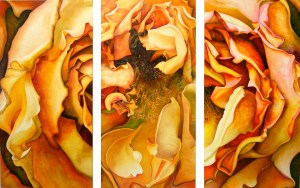
Centering © 2012 by Neena Birch. All Rights Reserved. Oil on canvas, Triptych, 48 x 24 inches, each panel.

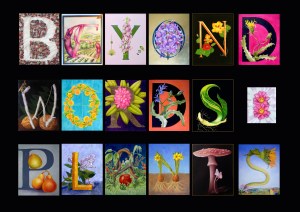
Inspired by artists’ use of plants as symbols across cultures and throughout history, the botanical artists of Studio 155 have created an exhibition dedicated to symbolic subjects in nature. The exhibition Beyond Words: The Symbolic Language of Plants includes works in watercolor, oil, tempera, and colored pencil. This exhibition opens Saturday at the Delaware Art Museum in Wilmington, Delaware.

In the ancient world, Roman artists used roses to represent Venus, the goddess of love; Egyptian art connected the lily to Isis, the goddess of fertility; and Asian art included lotus flowers to convey beauty. Plant symbolism reached a high point in Medieval Christian art when religious craftsmen and artists used plants to explain the meaning of church parables and doctrine to a largely illiterate population.

In keeping with this tradition, the seventeen artists of Studio 155 created drawings and paintings that bring attention to symbolic themes represented by flowers, trees, fruit, vegetables, herbs and vines. For example, museum visitors will see the whimsical watercolor painting by Wendy Cortesi of a pumpkin that recalls Dia de los Muertos, the Hispanic tradition “Day of the Dead”. They will also see Neena Birch’s rose painting symbolizing ancient spiritual contemplation and centering, as well as Michael Rawson’s painting of a white oak representing strength and endurance.

The artists of Studio 155 have also published a fold-out book called Small Works. This handmade book created by Elizabeth W. Carter features 4″ x 4″ plant idioms painted by each artist. Idioms include “Shrinking Violet” and “Apple of His Eye.” When viewing Beyond Words, museum visitors will be encouraged to match the idioms on the gallery’s list to a corresponding painting in the exhibition.

Studio 155 created the fun exhibition postcard at right by painting 10″ x 8″ letters in oil, watercolor or colored pencil and then mounting the letters on a panel. Learn more about the artists behind these letters on the Beyond Words website. The Small Works book is also available for viewing on this site, so be sure to visit and try your hand at matching idioms to their paintings!


Beyond Words: The Symbolic Language of Plants

Delaware Art Museum
Wilmington, DE
February 4 – April 8, 2012


Related

Learn traditional botanical painting techniques at Binders Art Supplies and Frames in Atlanta.


The Art School at Binders

www.bindersart.com
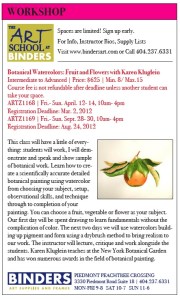
Award-winning botanical artist, Karen Kluglein will teach botanical painting classes at Binders Art Supplies and Frames, a fine art store in Atlanta, GA. Ms. Kluglein has designed packaging for companies such as Dannon, Hersheys, General Food, Tetley and Ragu. Her work has been exhibited across the US and is included in public and private collections. Ms. Kluglein is represented by Susan Frei Nathan Fine Works on Paper, LLC in Millburn, New Jersey.


Botanical Watercolors: Fruit and Flowers with Karen Kluglein

Choosing either a fruit, vegetable or flower as their subject, students will learn how to create a detailed botanical painting. Students will learn fundamental drawing techniques on the first day and learn dry brush techniques on the remaining two days. Instructor will demonstrate various techniques. Cost: $625. Minimum: 8 students. Limit: 15 students. Click on image to download details and to register.

Intermediate to advanced artists have two opportunities to learn dry brush techniques used by botanical artists. Please note registration deadlines. Course fee is not refundable after deadline unless another student can take your place.

ARTZ1168:
April 12-14, 2012 (10 AM – 4 PM)
Registration deadline is March 2, 2012.

ARTZ1169:
September 28-30, 2012 (10 AM – 4 PM)
Registration deadline is August 24, 2012.

This information can also be found at Classes Near You > Georgia.


Related

Susan Frei Nathan on Creating and Collecting Botanical Art