Feeds:
Posts
Comments


The Illustrated Garden, A Studio Blog

www.valwebb.com
Val Webb is Derwent Pencils’ Feature Artist for 2012!
She will post drawing tutorials each month at Derwent’s blog, Love Pencils. See Val Webb’s online tutorial, Botanical Drawing with Pencil and Watercolor. Connect with The Illustrated Garden on Facebook. For more information about the classes below, or to register, email Val Webb.

  • Nature Drawing Workshop: Winter’s Tale
    Saturday, February 25, 2012; 10 AM – 3 PM. Spend a day in one of Alabama’s most beautiful waterfront settings, using traditional drawing techniques to create elegant and accurate drawings of winter nature subjects in pen-and-ink. No experience necessary! All art supplies provided. Location: 5 Rivers Delta Resource Center (on the Causeway). Proceeds support wildlife education programs at 5 Rivers. Cost: $60
  • Draw and Paint Six Culinary Herbs
    Saturday, March 17, 2012; 10 AM – 3 PM. Learn the basic structure of a leaf, then put that knowledge to work as you create a color rendering of six culinary herbs in layered pen-and-ink with watercolor. No previous experience necessary, and all supplies are provided. Take home your completed botanical art and six potted herb plants at the end of the day. Lunch at the Ever’man Organic Cafe. Note: This workshop fills quickly. Location: Ever’man Natural Foods Co-op (Community Room), 315 West Garden St., Pensacola, FL. Cost: $60
  • Gift from the Gulf: Shells and More in Watercolor
    Saturday, April 14, 2012; 10 AM – 3 PM. Paint treasures from the Gult using watercolor on beautiful handmade Arches paper. Learn about color families, creating textures with salt and sponges, making spatter “sand” and how to use different brushes for different effects. No previous experience necessary! This is a relaxed and playful workshop, hosted in a private home on the riverfront in Moss Point, Mississippi. Bring a sack lunch and enjoy the view during our midday break. All art supplies provided. (Note: If you plan to attend, please email Val Webb; space is limited.). Location: Moss Point, Mississippi. Details will be provided upon registration. Cost: $60
  • Draw and Paint Wildflowers and Native Plants of the Gulf Coast
    Thursdays, March 1, 8, 15, 22, 29, and April 12, 2012.
    No classes on April 5.
    Sessions 2-5 PM or 6:30-8:30 PM
    Studio cottage in Mobile, AL
    Plus one optional Saturday field trip.

    Develop your powers of scientific observation and create realistic renderings of pitcher plants, wood fern, early-blooming wildflowers and more. Students will work from plant specimens in the classroom, and will draw wild orchids and bog plants during an optional field trip. No previous experience necessary! All supplies are provided. Classes will use pen-and-ink with watercolor. Returning students who prefer colored pencil are welcome to bring their own. Class size limited. Cost: $140

Val’s classes have also been posted to the Classes Near You sections for Alabama, Mississippi and Florida.

Artist Andie Thrams has announced her teaching schedule for the new year. The new schedule includes classes about botanical field studies, forest art and a special Hawaiian retreat designed to reconnect you with nature through art and yoga!


Andie Thrams, Coloma, CA

Andie is a painter and book artist devoted to creative work in wild places. She teaches in California, Oregon and Hawaii. Her work is widely exhibited and honored, and is held in many private and public collections. View Andie’s 2012 IN FORESTS calendar at her Etsy store.

  • Spring Retreat: Wildflowers, Watercolors & Field Journals
    April 13-15, 2012
    With field journal and lightweight tools in hand participants will gather on the South Fork of the American River poised to make marks, capture colors, record visions, explore habitats. Participants’ work will dance between care and abandon, using watercolor, ink and gouache to invite the magic of spring into our art practice. The pace will allow time for quiet meandering, optional Sunday morning yoga, and sunset painting by the river. Andie will share her ever-evolving field techniques for capturing light, color, gesture and detail, using the journal as a way to experiment and develop ongoing creative themes. Location: Camp Lotus, Coloma, California. Details & Registration: Contact Andie Thrams
  • Field Trip: A Day at the Museum
    April 17, 2012
    Spend a day at the San Franscisco Museum of Modern Art to view art, discuss trends in modern and contemporary art and learn about the Museum’s fantastic resources. Fill your field journal pages with sketches and observations about your day at the museum and compare notes with other artists. Limited to six students. Food and coffee at museum restaurant. Details & Registration: Contact Andie Thrams
  • Accordion Color Book
    April 28-29, 2012
    Learn how to create an accordion-folding book. Explore watercolor techniques through step-by-step exercises that will demystify color theory as you build a reference book of paint mixing strategies. Using watercolors, both systematically and intuitively, you’ll create spring-inspired color studies applying techniques that transfer to work in ink, gouache, acrylic and oil. You’ll complete a beautiful book, an inspiration source for future projects. Location: San Francisco Center for the Book. Cost: $260. View Details/Register
  • Native Botanicals: Field Studies in Drawing & Design
    June 2, 2012
    Create studies of native plants in black and white using pencil, ink and gouache. Discover field-friendly ways to render positive/negative space; reveal gesture and detail; create strong compositions; and explore your own creativity. Participants will leave class with an understanding of the principles of design and a collection of beautiful studies for future reference. Location: Regional Parks Botanic Garden in Tilden, Berkeley, California. Cost: $120 members, $130 non-members. Details/Register
  • Native Botanicals: Field Studies in Watercolor 
    June 3, 2012
    Create summertime watercolor studies in the garden. Working with watercolor and gouache, participants will learn how to mix color accurately, create beautiful shimmering surfaces, and build layers using wet into wet, dry brush and glazing techniques. Participants will go home with a series of studies that conjure up the complexity of wild flora and inspire future painting in the field. Location: Regional Parks Botanic Garden in Tilden, Berkeley, California. Cost: $120 members, $130 non-members. Details/Register
  • Watercolors in the Wild: Sierra Flora
    July 29 – August 3, 2012
    Create lively field studies of California’s Sierra Nevada mountains. Discover field-friendly ways to use watercolor and gouache to mix accurate color; create shimmering surfaces; explore light and shadow; build layers using wet into wet, dry brush and glazing techniques; render gesture and detail; and reveal your own mark with ease. We’ll consider botanical imagery in past and contemporary art and take gentle daily forays into the wild to work with new techniques. Participants will go home with a collection of Sierra flora watercolors to use for future reference. Location: San Francisco State University Sierra Nevada Field Campus, Sattley, California. View Details/Register
  • The Artful Cookbook: Celebrating Food, Community & Story
    Co-taught with Rebecca Welti
    August 18-19, 2012
    Bring cookbooks, treasured recipes, photographs, poems and other food-related memorabilia to use as inspiration. Participants will collage, paint, write and draw to create layers of embellished imagery within a series of projects on paper. Share meals and stories with fellow participants, sprinkle herbs and spices into your paintings and onto your food, savor flavors and ideas, while creating recipe-inspired art. Location: Sitka Center for Art and Ecology, Otis, Oregon. Cost: $215. Member registration begins February 27. Public registration begins March 12.
    View 2012 Schedule/Register
  • Book Arts for Kids & Adults: Creative Fun & Exploration
    Co-taught with Inga Dubay
    August 20-21, 2012
    Kids, teens, friends, siblings, parents, grandparents, aunties and uncles are all invited to celebrate the creative spirit through exploring the book arts. Families will discover easy and fun-to-make book structures. Participants will use ink, watercolor, sticks, feathers, reeds, pens, brushes and crayons to explore lighthearted and beautiful ways to make drawings, paintings and calligraphic writing. For all levels, ages 8 and up. Location: Sitka Center for Art and Ecology, Otis, Oregon. Cost: $120. Member registration begins February 27. Public registration begins March 12.
    View 2012 Schedule/Register
  • Wild Forest Wild Art: Tree-Inspired Painting
    August 23-26, 2012
    Andie will demonstrate her ever-evolving field techniques for working in layers to capture light, color, gesture and detail, evoking what is seen and felt under the trees. Working indoors and out, through sequenced studies, participants will create images revealing their own responses to the unique complexity of wild forests. Participants will complete a series of forest-inspired mixed media drawings and paintings. Location: Sitka Center for Art and Ecology, Otis, Oregon. Cost: $415. Member registration begins February 27. Public registration begins March 12.
    View 2012 Schedule/Register
  • Big Island Retreat: Wild Art & Wild Yoga in Hawaii!
    Co-taught with Dennis Eagan
    October 7-13, 2012
    Island of Hawaii
    Join Andie and her husband, Dennis, on the Big Island of Hawaii, and sink into that blissful place of wonder through the practices of art and yoga. Artists will explore art and yoga as pathways to deepening their connection to the energies of our planet: its plants, waters and creatures. Each day will offer art classes with Andie, yoga classes with Dennis, and open time for your own exploration; classes will be optional and open to all levels of experience. Art students will use field journals to record daily observations and experiences through drawing, writing and painting with watercolor. Subjects will include island color palette; sunrise, sunset and cloud painting; and tropical plant studies. Yoga classes will emphasize asana and pranayama for opening creative energies and for studying the five elements of yoga: earth, air, water, fire and space.
    Location: Kalani Honua Resort
    Details & Registration: Contact Andie Thrams
  • Field Studies: Autumn Leaves
    November 7-8, 2012
    During forays into Hoyt Arboretum, participants will collect leaves and inspiration for studio work. Learn how to paint the thousand ambers, crimsons and rusts of Fall while building layers of watercolor, gouache and colored pencil to capture glow and detail. Participants will create beautiful studies for future reference and inspiration. Host: Sitka Center for Art and Ecology, Otis, Oregon. Location: World Forestry Center, Portland, Oregon. Cost: $212. Member registration begins February 27. Public registration begins March 12. View 2012 Schedule/Register
  • Private Creativity Coaching & Artist Mentoring
    In addition to the workshops listed here, Andie also works privately with a limited number of students. This year individual instruction is offered in two eight-week sessions only.
    Session 1: March 15 – May 15
    Session 2: September 15 – November 15
    Details & Registration: Contact Andie Thrams

Andie’s classes have also been added to the Classes Near You sections for Northern California, Oregon and Hawaii.

Botanical Art in Hawaii

I have received inquiries about botanical art classes in Hawaii (specifically on the island of Oahu). Do you know of classes on this island? If you do, please let me know or forward this post to instructors teaching on the island.

Thank you!

The research team of Melanie A. Link-Perez, Vanessa H. Dollo, Kirk M. Weber and Elisabeth E. Schussler continue their analysis of nationally-distributed textbooks in What’s in a Name: Differential Labelling of Plant and Animal Photographs in Two Nationally Syndicated Elementary Science Textbook Series. Last month we learned how their evaluation of the life science units in these textbooks revealed that more text was dedicated to non-human animals than to plants and that the number of animal examples used in textbooks exceeded the number of plant examples used in textbooks.

Today we look at their analysis of the photographs used in Macmillan McGraw-Hill’s Science (2005) series and Harcourt’s Science series (2006). Both textbook series were versions specific to the state of Ohio (Link-Perez, et al., 2010).

Once again, Link-Perez et al. (2010) studied only the life science section of the textbooks in each series. This time the research team wanted to know:

  • Are there different numbers of plant and animal photographs in the textbooks?
  • Are plant and animal photographs labelled differently?

To answer their first question, Link-Perez et al. (2010) considered photographs where plants and animals were shown at the organism level. They excluded from their analysis, photographs of plants and animals shown at the cellular level. They also excluded diagrams and drawings because these depicted concepts or processes and not only images of whole organisms. Photographs were grouped into the following categories: Plant Subject, Animal Subject, Landscape as Subject, and Dual Subject. In the dual subject photos, the featured plant and animal were represented equally (e.g., a photo showing a bee and a flower) (Link-Perez, et al., 2010).

To answer their second question, Link-Perez et al. (2010) looked to see if a label was associated with an image. Labels were categorized according to how it described the subject of the photograph. For example, a label’s “level of specificity” (Link-Perez et al. (2010) was considered to be broad if it contained general terms like plant or animal. Intermediate labels were those containing terms “corresponding to a phylum, class or order” such as gymnosperm or mammal (Link-Perez et al. (2010). Specific labels were those containing an organism’s common or species name. The research team considered photos to be labelled if they had a caption (not just referred to in the text). Two coders were trained to code the images. The coders worked independently of each other.

Link-Perez et al. (2010) found that of the 1,288 images they evaluated, 59.6% were of an animal subject, 25.6% were of a plant subject, 7.1% were of a landscape scene, and 7.6% were of a dual subject. They also discovered that animals shown in animal subject photos had more specific labels than plants shown in plant subject photos. The research team also discovered that plants were often identified by the name of a plant part or a plant life-form (i.e., “tree”, “flower”, etc.) instead of a more detailed description. In fact, intermediate-level labels were not used with plant photographs in textbooks for grades K-2; these labels only appeared in 3rd, 4th and 5th grade textbooks (Link-Perez et al., 2010). In contrast, intermediate-level labels were observed with animal photographs in textbooks for all grade levels (Link-Perez et al., 2010).

Of the 92 landscape images identified, most had labels that did not name the organisms in the image, but instead described a habitat or biome (Link-Perez et al., 2010). Ninety-eight dual subject images were identified and even though the featured plant and animal were weighted equally, 75% of the images had labels where the animal was identified more specifically than the plant (Link-Perez et al., 2010). Only 6% of the dual subject images featured captions in which the plant in the image received a more specific description than the animal in the image (Link-Perez et al., 2010).

Link-Perez et al. (2010) also observed that a more diverse selection of animal images were featured in both textbook series.

Because animal photographs outnumber plant photographs and because they have more specific labels than the plant photographs do, Link-Perez et al. (2010) recommend educators speak about plants using their specific names and by referring to them as whole organisms instead of as merely plant parts. They cite research studies demonstrating that student interest in plants can be encouraged if students are exposed to a diverse selection and if students are provided with the actual names of plants.

Link-Perez et al. (2010) include in their paper interesting discussion about how photographs improve student learning and information about the importance of naming plants properly. You can buy a copy of their article from Taylor & Francis Online ($36) or get a copy by visiting the reference section at your local college library.


Literature Cited

Link-Perez, Melanie A., Vanessa H. Dollo, Kirk M. Weber, and ElisabethE. Schussler. 2010. What’s in a name: differential labeling of plant and animal photographs in two nationally syndicated elementary science textbook series. International Journal of Science Education. 32(9): 1227-1242.

Gymnosperms of the United States and Canada, a book written by author, artist and forester, Bruce L. Cunningham, and botanist Dr. Elray S. Nixon, has been nominated by the Council on Botanical and Horticultural Libraries for its outstanding contribution to the literature of horticulture or botany. It is one of 45 titles currently being reviewed by the Awards Committee for the 13th Annual Literature Award.

Gymnosperms was published in 2010 by
Bruce Lyndon Cunningham Productions.

Please join me in congratulating Bruce and Dr. Nixon on their nomination!

Related
Forest Connections: Gymnosperms of the United States and Canada

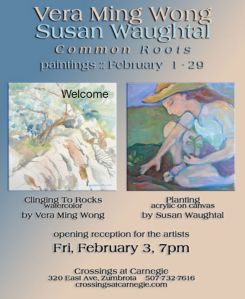
Artists and friends, Susan Waughtal and Vera Ming Wong celebrate art and more than 30 years of friendship in the exhibition, Common Roots, now on view at the Crossings Gallery in Zumbrota, Minnesota.

These two friends share many passions, art being one of them. Each takes a different approach to their art. Waughtal takes an “exuberant and sometimes even whimsical” approach to painting animals, gardens and life on her farm, while Wong takes a more meditative approach as she captures the moods and the mystery of the natural landscape.

Celebrate the artists’ Common Roots now through February 29, 2012.

Exhibit Hours: MTWF 10-5; Thursday 10-8; Saturday 10-4

Ragwort © 2011 Alison Day. All Rights Reserved


Botanical & Natural Studies 2010-2011

Limelight Gallery
Lewisham Library
Catford, London
February 28 – April 6, 2012

This exhibition features the watercolor paintings and pencil drawings of artist Alison Day. Native plants, cultivated plants and seashells are the subjects the artist has chosen to depict the textures, forms and intricate details seen in nature.

Through her work, Day brings attention to the “ordinary and (the) everyday” and encourages viewers to see familiar items in a new way. She explains:

For to be lost in an image is to be temporarily suspended from the miserable realities of the everyday world. Happiness, to home into to a pertinent contemporary concern, lies not in material wealth but looking beyond the veil that covers the visual world, to a place of imagination and dreams. These images of flowers and shells offer an opportunity to escape and to dream.

Meet Alison Day at the Limelight Gallery’s opening reception on
Sunday, March 4, 2012 (2-4 PM).


Exhibit Hours
:
Monday, Tuesday and Thursday (9-8)
Wednesday and Friday (9-6)
Saturday (9-5)
Sunday (1-4)