By Carol Gracie
From the time I was a child, plants have always interested me, first for their beautiful flowers, but then because I would always notice something interesting happening on or near the flowers: insects visiting them (sometimes eating them!), other insects mating on them (rather risqué for a 10-year-old), colors or shapes changing; I always wanted to know why.
As an adult, I began teaching children and other adults about plants, both informally on nature walks and then on a professional basis at The New York Botanical Garden. Many people already appreciated the beauty of plants, but few gave them more than an admiring glance and failed to get to know the stories behind their pretty faces. It was my job to introduce them to the rich lives of plants and give them a sense of their role in the environment. Like animals, each plant interacts with its environment in some way. Since plants are stationary they have had to evolve creative strategies to accomplish tasks like reproduction, dissemination of their seeds, and protection from predators that are more easily carried out by mobile animals. Plants are particularly important because they are the very basis of life for most other organisms on earth; they can manufacture their own food, and without them, life as we know it would not exist.
Most of the adults that I taught were in class because they already cared about plants and wanted to learn more about them. However, capturing the interest of kids at the Garden on a school field trip was often more of a challenge. What to do? I found that a “hands-on” approach was best. Let them touch — sometimes even pull apart — what they were studying. Ask them questions about it. Get them to look and discover. When outdoors, I gave them magnifying lenses and let them observe what the insects were doing on/in the flower. The latter idea is easier said than done. The only insect that some city kids knew was the cockroach— in their eyes a creature put on this Earth to be stepped on – and many kids (and some adults) have such a fear of bees that they instinctively flail about when approached by one. Showing them that I wasn’t afraid of 6-legged creatures, and that the insects usually paid no attention to me if I remained still, would often give them the courage to become observers. And what keen observers young plant detectives can be! Once “into it,” they spot things that most adults miss — an insect camouflaged on a tree trunk, one hiding beneath a leaf, ants cooperating to carry something too heavy for one to bring back to the nest alone, etc. Being in the field with an interested child can open one’s eyes. However, I must admit that if a snake suddenly slithered across the trail, an immediate halt to all botanical education ceased. Things that move – fly, crawl, run, and slither — are just inherently more interesting to children. Since snakes have little direct connection to plants, I would share their excitement about the snake and once it had disappeared from view, get them to think about what snakes ate — often frogs or small mammals — and then to consider what those animals ate until we got back to plants, thus following the food chain back to the miraculous plants that didn’t need to “eat” anything else but could manufacture their own food. Of course, someone would always ask about “meat eating” plants, and we were off on another discussion. Several species of carnivorous plants are on display in the greenhouses of The New York Botanical Garden, so I could show them how each traps its prey and explain that the green plants still made their own food and only absorbed certain nutrients, which were lacking in the poor soils where they grew.
Although I no longer teach in a classroom setting, I still lead occasional wildflower walks and lecture about wildflowers. I find that the same techniques are effective with adults. I’ve led or co-led over 30 ecotours with a botanical focus, mostly to places in South America, but also to more local destinations. The location is not important. It’s getting people to take the time to really look at things. Once they learn to “stop and smell the roses,” they become interested observers and can enjoy the excitement of discovering something new, even if that something is long known, and only new to them.
We have had several artists, particularly natural history artists, travel with us over the years. Because they always seemed frustrated that they didn’t have time to do proper sketches before we moved on, we decided to offer some ecotours that included a separate component for artists. We offered one of these tours to Trinidad and two to the Amazon. On the Amazon tours we had one with the artists traveling together on the same boat with us and one with artists traveling on a separate boat that traveled along with the general natural history boat but was able to take longer stops at places where the artists could complete comprehensive sketches or photos. The artists’ boat would catch up with the other boat later in the day. What we found was that the artists didn’t want to miss anything that people in the general boat were seeing, and they preferred to stay with us, clipping specimens and keeping them fresh in water along the way. We would travel from one locale to another during the heat of the day, with most people on the “regular” boat taking a siesta or reading, while most of the artists were busily working away on the morning’s specimens or attending workshops led by our friend and artist-in-residence (or rather artist-on-board), Katie Lee. In the afternoon, we would be off in the canoes again, enjoying more of the Amazon’s wonders side-by-side with the artists. Over cocktail hour and dinner together we would view what they had created that day and marvel how each chose to focus on different aspects of nature, or used different styles, media, or techniques to depict the same species. As most of us settled in for the evening, we would notice lights on until late into the night on the artists’ boat as they diligently completed their work for the day. We all learned from each other and had a great deal of fun together on those trips. The Trinidad trip was a bit easier since we were based at a lodge with more spacious facilities for the artists to spread out. Nevertheless, they generally accompanied us on all excursions, and we often enjoyed sitting in on their workshops.
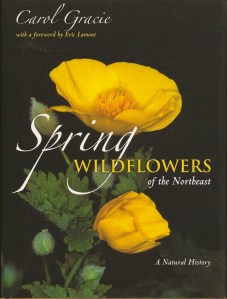
I hope to reach a larger audience with my latest book, Spring Wildflowers of the Northeast: A Natural History. In it I have included details about the lives of 35 plus wildflower species that have interested me over the years. As a photographer I’ve spent long hours in the field plant watching, and in the process learning about the plants’ lives. Knowing what pollinates them, how they reproduce, what eats them, etc. gives me a better understanding of how they fit into the environment and a deeper appreciation for their importance. It’s this information — from my own observations and that of many others — which I have written about in the book. Although I am not an artist I feel that depicting some of these interactions would make drawing or painting the wildflowers more interesting, both for the artist and for the viewer of his/her artwork.
About Carol:
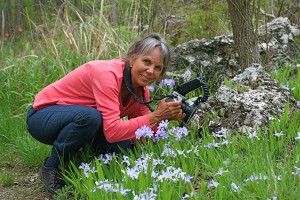 Carol Gracie is retired from The New York Botanical Garden, where over her three-decade career she served as Senior Administrator of Children’s Education, Foreign Tour Director, and a Research Assistant on tropical plant collecting expeditions. Aside from her current book, she is the co-author (with Steve Clemants) of Wildflowers in the Field and Forest: A Field Guide to the Northeastern United States (2006), co-author (with her husband, Scott Mori, and others) of A Guide to the Vascular Plants of Central French Guiana (Part 1, 1997; Part 2, 2004), principal photographer for Flowering Plants of the Neotropics (2004), and editor of Guide to the Natural Areas of the Lower Hudson Chapter of The Nature Conservancy, second edition (1981). Carol has five plant species named for her (and one named jointly for her and her husband) as a result of her work in the tropics. Carol and her husband live in South Salem, NY.
 Last week we learned how to


