Feeds:
Posts
Comments

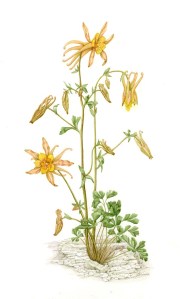
Aquilegia sp. (Sierra Columbine), watercolor, © 2010 by Joan Keesey. All Rights Reserved

Wildflowers of Mineral King
Botanical watercolors by Joan Keesey
Theodore Payne Foundation
March 30 – June 30, 2012

The Theodore Payne Foundation Art Gallery is proud to present a collection of watercolor paintings about the wildflowers of Mineral King Valley located in Sequoia and Kings Canyon National Park. Joan Keesey, a botanical illustrator in California, has studied the plants of Mineral King for many years and her exhibition will feature the paintings of spring and summer wildflowers she has completed to date. Paintings such as the Sierra Columbine (Aquilegia sp.) at left, for example, that grows out of the rock at 9,000-10,000 feet.

An opening reception will be held on Saturday, March 31, 2012 from 2-4 PM. The opening of Wildflowers of Mineral King will be held in conjunction with Poppy Day at the Theodore Payne Foundation, the much anticipated and well-attended annual plant sale where homeowners can find an impressive selection of native plants for their garden.

Learn more about Joan and her project at www.JoanKeesey.com.


Related

Discover Sequoia and Kings Canyon National Park

This summer, artists, gardeners and the curious have the opportunity to learn the traditional painting techniques used by botanical artists. The following information has been added to Classes Near You > New York:


Rose Pellicano

Rose Pellicano’s career as a botanical artist spans 20 years. Her work has been exhibited widely and is in the permanent collection of the Hunt Institute for Botanical Documentation. Learn more about Rose by visiting her profile in the ASBA Members Gallery. Rose is represented by Susan Frei Nathan Fine Works on Paper, LLC in New Jersey.

    Introduction to Botanical Painting (Beginner/Intermediate)
    Wednesdays, May 30 – June 27, 2012 (10 AM – 1 PM)
    Learn the basics in creating an accurate portrait of flowers and plants in watercolor. Rose Pellicano, a member of the American Society of Botanical Artists, will conduct painting demonstrations and teach students the techniques and skills of traditional botanical painting using clear stepwise instruction. The focus of this class will be observational skills, drawing and accurate color mixing. Students will receive individual attention and will work at their own pace. This class is suitable for beginning and intermediate students. Location: Southampton Cultural Center. Cost: $205. For more information, contact Rose Pellicano.

    The Southampton Cultural Center is located at the Levitas Center for the Arts in Southampton, NY.

The course listing for Greystoke Cycle Cafe has been updated. Two new classes have been added, including a new botanical painting course with Reinhild Raistrick, the artist who painted every known species of African violet growing in the East and West Usambara Mountains and the coastal region of Tanga and Pangani Districts of Tanzania.


Greystoke Cycle Café & Tea Garden

www.greystokecyclecafe.co.uk
You may remember learning about the Greystoke Cycle Café & Tea Garden during an interview with Billy Showell. This rest stop for cyclists not only provides everything a cyclist needs, it also provides a full schedule of workshops taught by artists and other professionals. The 2012 schedule includes botanical art classes and wildlife painting classes such as:

  • Botanical Illustration in Watercolor – June 14
  • NEW Painting on Vellum – Studies from Nature
    Monday, July 16, 2012. Details/Register
  • Painting in the Botanical Style of Charles Rennie Macintosh – July 18
  • NEW Botanical Painting Workshop with Reinhild Raistrick
    Monday & Tuesday, September 10-11, 2012; 9:30 AM – 3:45 PM.

Follow Greystoke Cycle Café on Twitter @QuirkyWorkshops.

Looking at plants isn’t always as simple as simply looking at plants. It can be when you have a cut flower from the florist staring back at you. However, when there is a bigger story to tell, it is helpful to know the life history of your subject. In Plants Alive! Revealing Plant Lives Through Guided Nature Journaling, educator and author Charles E. Roth teaches plant observation skills to amateur plant observers.

In his book, Roth encourages amateurs to move beyond being familiar with only one or two species. He teaches plant observers how to understand seasonal changes experienced by plants and how to observe a plant and its neighbors in their natural environment. Roth explains how to gather information about a plant’s life history, how to observe growth patterns, how to study plant communities, and even how to observe the ferns, mosses, aquatic plants and lichens one might encounter in the field. Roth presents a list of investigative questions for each of the life history stages he presents. These questions serve as prompts to help bring attention to specific elements of a plant’s life cycle.

The field techniques in Roth (2005) will be familiar to anyone who has studied population biology or plant ecology. Roth provides instruction about how to observe the life history of plants along a familiar route, as well as how to set up more formal study areas using quadrats, line transects and belt transects. All techniques, while appearing large-in-scope initially, are doable for amateur botanists and can be modified to a smaller scale by classroom teachers who have limited amounts of time to teach plant observation skills.

In the journaling section of this book, plant observers will learn how to create a field journal, how to press plants, how to record information using photographic techniques, how to incorporate field sketches, how to draw maps in the field, and how to mark the plants they are studying. To give plant observers a good start on their projects, Roth dedicates a section of his book to templates that serve as guides to the type of information plant observers should record in their journals. In this section, plant observers will find helpful guides to:

  • Building Life Stage Observations
  • Keeping Bloom Calendars
  • Observing Insect Visitors & Plant Diseases
  • Observing Seeds
  • Observing Plants Growing Near Your Specimen
  • Observing Trees
  • Observing Lichens
  • Observing Ferns
  • Observing Bryophytes (mosses, liverworts)
  • Observing Plant Communities
  • Reflective Journaling About Your Experiences Observing Plants

Included throughout Roth (2005) are hand-drawn illustrations by Roth and Mary Sage Shakespeare. Each clarifies related text and serves as inspiring examples of what plant observers could include in their own journals.

In the interest of providing a complete review, I need to mention one thing and this is the number of typographical hiccups present in the text. They are the types of hiccups usually observed in the unedited proofs distributed to bookstores by publishers. I am not sure why they are present in the final version of this title. This said, these typographical hiccups, while noticeable, do not reduce the value of the many skills Roth teaches to plant observers. If you are seeking a way to understand the “big picture” of a native plant and its natural habitat, Plant’s Alive! will help you paint this picture.


Literature Cited

Roth, Charles E. 2005. Plants Alive! Revealing Plant Lives Through Guided Nature Journaling. Lincoln, NE: iUniverse, Inc.

Plants Alive! is available at ArtPlantae Books. ($18.95)


Related Resources
Botanical illustration, birds, snakes and dragonflies!

See what’s new at Classes Near You > Washington.


North Cascades Basecamp, Mazama

www.NorthCascadesBasecamp.com
A bed-and-breakfast style lodge surrounded by acres of protected cedar forest, the North Cascades Basecamp serves as a homebase for outdoor adventures such as hiking, fishing, cross-country skiing and a host of other activities offered through the camp’s Ecology Center. Biologists Kim and Steve Bondi purchased the recreation center in 2010 and created the Ecology Center to offer learning opportunities for guests. The Spring 2012 schedule includes:

  • Wildlife Tracking Weekend Workshop – May 4-6, 2012. Instructor David Moskowitz of CyberTracker Conservation. Cost: $330 (includes lodging, 6 meals, course logistics, field trips and certificate), $335 private room, $240 no lodging. Details/Register
  • 2012 Citizen Science Snake Count – May 12-20, 2012; exact date to be announced. A Citizen Science Program to map and track snake distributions across North America. FREE.
  • Spring Bird Festival: A Watercolor Workshop Painting the Birds and Colors of Spring. One-day workshop, 10 AM – 4 PM. Two workshops are available, one on June 2, 2012 and the other on June 3, 2012. Learn how to paint birds in the field with artist, John Adams. Cost: $75/workshop. Details/Register
  • Nature in Art and Science: A Field Journaling-Naturalist Workshop
    May 25-27, 2012. Artist/writer Hannah Hinchman and natural science educator Bruce Thompson, will help you open the windows to nature’s many secrets and show you how to personalize your experiences through journal entries, both drawn, painted and written. Cost: $330/person, (includes 2 nights, 6 meals, instruction, and field trips), $355 singles room; $230 no lodging. Class begins at 3 PM on May 25, ends on Sunday at 11 AM. Details/Register
  • Botanical Illustration Weekend Workshop
    June 15-17, 2012. Review plant anatomy, ecological adaptations and develop drawing skills while exploring the flora on the east side of the Cascades with Quinn Fitzpatrick. Cost: $280 for shared room includes 2 nights, 5 meals, instruction and field trips; $295 private room; $175 no lodging. Details/Register
  • Dragonflies: North Cascades Institute Weekend Workshop
    August 3-5, 2012. Explore ponds, meadows and wetland areas to learn about dragonflies from the Northwest’s authority on odonates, Dennis Paulson. Cost: $350 singles (includes 2 nights lodging, 6 meals, field instruction & evening presentation). Commuter rate $275, Friday evening presentation $5. Details/Register

Visit the Ecology Center at North Cascades Basecamp to see their complete schedule for spring.


Ask the Artist with Mairi Gillies

Friday is the last day to send questions to Mairi Gillies about her work as a hortisculpturist, botany educator and museum educator. Interested in the subject of plant ethics? Ask Mairi about her work in this area.

Please send your questions no later than midnight on Friday, March 16, 2012. Thank you!

Nourishing Art
TAG Gallery
Bergamot Station
March 27 – April 21, 2012


Sally Jacobs
demonstrates her passion for painting and healthy living in
Nourishing Art, a watercolor exhibition opening on March 27 at the TAG Gallery in Santa Monica, CA. Sally’s paintings of fresh vegetables from farmers markets in Los Angeles accurately portray the shapes and vibrant colors of her subjects.

An artist reception will be held on Saturday, March 31, 2012 from 5-8 PM. Sally will take part in an artist panel on Saturday, April 14, 2012. The conversation begins at 2 PM.

Sally’s work has been exhibited in many juried shows. Sally’s work is included in Today’s Botanical Artists and has been featured on the CNNfn show, Your Money. Note cards, note pads, prints and a 2012 calendar featuring Sally’s paintings of fruit and vegetables are available at ArtPlantae Books.

Visit the TAG Gallery


In The Media