Feeds:
Posts
Comments

By Heeyoung Kim


Heeyoung Kim
, a botanical artist from Illinois, has been awarded a gold medal from the Royal Horticultural Society (RHS) at the 2012 RHS Botanical Art Exhibition in London.

Twenty-five botanical artists from six countries (Australia, England, Japan, Scotland, Turkey, and USA) were selected by the RHS exhibition committee. Artwork is judged as a group of drawings or paintings making up a complete exhibit. If one or two works in a group are of a lower standard than the others, this affects the way the entire exhibit is judged. Particular credit is given for botanical accuracy, exact color reproduction and attention to detail. Higher awards tend to be given to exhibits illustrating a particular theme or plant family. Gold medals are awarded only to exhibits of outstanding and consistent excellence. Seven gold medals were awarded this year.

Heeyoung’s collection of paintings focused on the common, rare and endangered plants of the American prairie. Since the late 1800s, the fertile tallgrass prairie has been converted into an intensive crop producing area. This region of the US is called America’s “breadbasket” or “corn belt”. What was once the largest ecosystem of the American continent with a biodiversity rivaling the richest rainforests, has yielded to commercial agriculture leaving its flora and fauna in peril. Heeyoung is devoted to documenting these rapidly disappearing plants. She draws public attention to this environmental issue by exhibiting her paintings both locally and internationally.

In this year’s RHS show, Heeyoung exhibited six watercolor paintings and two mixed media paintings featuring watercolor and graphite. Each were drawn and color recorded in situ and finished in the studio after extensive research and observation. Sometimes it took years to follow up on the full life cycles of a plant. Other times it took years of waiting for rare plants to grow and to bloom. Heeyoung says, “It was a great joy to be able to paint the unearthly beauty of Fringed Gentian (Gentianopsis crinita) and the two iconic yellow flowers of the prairie, Prairie Dock (Silphium terebinthinaceum) and Compass Plant (Silphium laciniatum).”

“Well done!”
This was the reaction visitors had to Heeyoung’s paintings at the RHS show. Visitors understood what a gold medal represented and repeatedly expressed enthusiasm and appreciation for the story Heeyoung was telling and how she told it through her paintings. For two full days, Lindley Hall was filled with the joy and the excitement of botanical artists, art lovers and plant lovers in attendance.

Heeyoung says the RHS exhibition was a great learning experience through which she gained confidence as a professional botanical artist.

Heeyoung teaches botanical art in the Chicago area at Noyes Cultural Arts Center, in Evanston, Illinois. Eager to be involved in any kind of activity involving plants and art, whether it be speaking with other artists and plant enthusiasts, sharing her work with garden clubs, or conducting technique demonstrations to art groups, Heeyoung believes showing her artwork and sharing her enthusiasm in every possible way helps make people more aware of the current crisis facing native plants.

View Heeyoung’s paintings of America’s prairie plants at www.PrairiePlantArt.com.


Related

Exhibiting botanical art at an RHS show
Georg Eberhard Rumpf was born in Germany to August Rumph and Anna Elisabeth Keller in 1627. The eldest of three children, he would grow up to create the first herbal of Indonesian plants and of Wallacea, an island region in eastern Indonesia that includes the Spice Islands.

The story behind the Ambonese Herbal is a long one and includes tales of many unfortunate events. The only reason we are fortunate enough to know about it today is because of the actions a few key people took many centuries ago and because of the incredible research by E.M. Beekman (1938-2008), a scholar of Dutch colonial literature at the University of Massachusetts, Amherst who translated the Ambonese Herbal into English from its original Dutch and Latin text. It is from Beekman’s English translation and other resources that we will come to understand Rumphius’ life and contributions.

When we think about Georgius Everhardus Rumphius (1627-1702), this is the Latinized version of his name, we need to think of him as a soldier first and a naturalist second because he was really a botanist trapped in a soldier’s body. Born in a region of Germany devastated by the Thirty Years’ War, Rumphius knew war all of this life. To escape the devastation, he exercised the only option he had to get away from home — he joined the military to see the world. During his lifetime, Rumphius experienced three wars: the Thirty Years’ War, the Portuguese-Spanish War and the Ambonese War. He spent his military service fighting for Portugal and the Dutch East Indies Company. Rumphius’ military contract with the Dutch East Indies Company ended in 1657. At this time, he applied to work for the civil branch of the same company. Fluent in many languages (Dutch, German, Malay, Portuguese, the local Ambonese dialect plus a working knowledge of many other languages), Rumphius was an invaluable asset. Rumphius was assigned to the island of Ambon in 1657 and it was during this time that he began to write about the flora and fauna of this island.

Insights into Rumphius’ story will be shared this month here on this website, for he is our Feature Botanist for April. Welcome Rumphius!

For the first time, our featured guest is not living. I hope to bring him to life this month so that he becomes more than just one of those old names one encounters every so often when reading about natural history.

For an in-depth look at the Ambonese Herbal, you are invited to join me at the Southern California Spring Garden Show on April 27 (7-8 PM) where I will discuss Rumphius’ herbal and have all six volumes available for you to review.


Other Viewing Opportunities

The Ambonese Herbal can also be viewed at:

    26th Annual Avocado Festival, Fallbrook, CA
    Sunday, April 15, 2012
    Visit ArtPlantae on the “Avenue of the Arts” at the wildly popular Avocado Festival. The herbal will be available for you to view. Stop by to see this special collection, plus other resources related to plants and botanical art. And don’t forget about the unlimited supplies of guacamole and avocado ice cream! Festival Hours: 9 AM – 5 PM. Location: Alvarado Street between Main & Vine (map)

    GROW! A Garden Festival, Arcadia, CA
    May 4-6, 2012
    ArtPlantae will be in the Marketplace at this brand new venue. Stop by to say hello and to view The Ambonese Herbal in person. While at the festival, don’t miss the guest speakers, landscape designs, gardening activities for families and kids, plant sale, and many other activities planned for this fun weekend. Hours: 9:00 AM – 4:30 PM. (details)


UPDATE (5/1/12)

View All April Posts About Rumphius

The quest to understand the attitudes people have towards plants gets a statistical boost from biologists Jana Fancovicova and Pavol Prokop in Development and Initial Psychomatic Assessment of the Plant Attitudes Questionnaire. This study marks the first attempt to systematically evaluate the attitudes students have towards plants (Fancovicova and Prokop, 2010).

Fancovicova and Prokop (2010) used their new assessment tool in a study to determine the following:

  • Do students from families who maintaiin a garden exhibit a more positive attitude towards plants?
  • Do females have more positive attitudes towards plants than males?

Attitudes towards plants are the focus of their assessment tool and research because attitudes affect behavior and changes in behavior are necessary for humans to take responsibility for their role in the loss of plant biodiversity (Fancovicova and Prokop, 2010).

The Plant Attitude Scale (PAS) they created contains 45 Likert-style questions addressing student attitudes about the importance of plants, interest in plants, plant use in society and the costs and benefits of urban trees. The structure and reliability of the PAS was assessed using statistical analysis. The attitudes of 310 Slovakian students were analyzed. Students age 10-15 years were surveyed specifically because this age group has been found to be “important in the development of children’s cognitive abilities and their ecological awareness of the role of animals in their natural habitats” (Fancovicova and Prokop, 2010) and the authors assumed this was also true regarding this age group’s awareness of plants. Student participation was on a volunteer basis and dependent upon whether or not a teacher wanted to take the time to distribute the PAS to his/her students.

Fancovicova and Prokop (2010) found that student attitudes towards plants was neutral overall. Children who came from families who maintained a garden had a more positive attitude towards plants than their counterparts. While more positive, the difference in attitudes was statistically significant only with respect to Interest in plants. These results are consistent with the results found in other studies about student interest in plants. The authors also found there was no significant difference with respect to interest level between male and female students.

These findings, as well as additional observations, are discussed in detail in Fancovicova and Prokop (2010). Overall results suggest students do not value plants and that educational programs aimed at increasing student appreciation towards plants are important and necessary (Fancovicova and Prokop, 2010). Fancovicova and Prokop (2010) make several suggestions for future research using the sound assessment tool they created. Suggestions include assessing teacher attitudes towards urban trees, assessing the effectiveness of gardening activities in schools, and assessing the effectiveness of outdoor education programs.

The paper by Jana Fancovicova and Pavol Prokop can be purchased online from the Journal of Science Education and Technology for $34.95 or obtained at your local college library.


Literature Cited

Fancovicova, Jana and Pavol Prokop. 2010. Development and initial psychometric assessment of the Plant Attitude Questionnaire. Journal of Science Education and Technology. Volume 19: 415-421.


Related Information

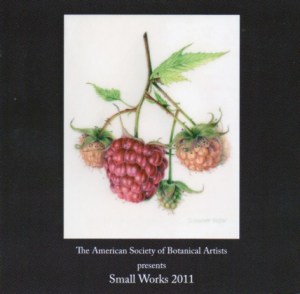
Rubus idaeus (Raspberries) by Denise Walser-Kolar

The success of the Small Works exhibition at the 2008 conference of the American Society of Botanical Artists in Pasadena, CA, inspired the inclusion of a similar exhibition at the 2011 conference held in Boston this past Fall. This non-juried exhibition of artwork small enough to fit in carry-on luggage, was organized by the New England Society of Botanical Artists (NESBA), hosts of the 2011 meeting. A color catalog about the exhibition has been created by NESBA and the American Society of Botanical Artists and can be previewed online.

Small Works 2011 is a 118-page collection of drawings and paintings by ASBA members. This self-published special collection can be purchased at Blurb.com for $29.95 (plus S&H).

Wave Hill Public Garden and Cultural Center is celebrating Mother Nature this year with a weekend full of learning opportunities for children and adults.

On Saturday, April 21, 2012, families can take part in the Family Art Project to hear stories honoring Earth’s trees. Families will then have the opportunity to create a tree tribute of their own. Also planned for Saturday are a kid-friendly Earth Day Garden Walk, a Wave Hill History Walk and a family tour of the exhibition in Glyndor Gallery that was inspired by Wave Hill’s Wild Garden.

On Sunday, April 22, 2012, families can go on a Garden & Conservatory Walk and attend Branch Dances at Wave Hill, a performance by award-winning choreographer Merian Soto and her dancers. A nature journaling class will also be held on this day. See details below:


Wave Hill: New York Public Garden and Cultural Center

www.wavehill.org
Wave Hill is a 28-acre public garden and cultural center in the Bronx. Their mission is to establish human connections with nature through horticulture, education and the arts. Visit their website to learn more about their gardens, special collections and art classes.

    Writing in Nature
    Thursdays, April 19, 26, May 3, 10, 17, 31, 2012 (1-4 PM)
    “To learn about a tree, go to a tree,” wrote famed Japanese poet Basho many centuries ago. Guided by his advice, writing coach and former New York Times editor, Joan Motyka, works with participants to more acutely observe and write about individual plants and trees, as well as the general impact of the landscape, including color, texture and design. Reading and discussing selected nature writers enhances the experience. Cost: $180 members, $210 nonmembers. Location: Ecology Building. Details/Register

    NEW! Earth Day Nature Journaling
    Earth Day Weekend at Wave Hill
    Sunday, April 22, 2012 (12:30 PM)
    Perkins Visitor Center
    View nature up close! Join naturalist Gabriel Willow on a journey through Wave Hill’s landscape, to observe and record the Garden’s plants, flowers and birds as you deepen your connection to nature. No drawing experience required; materials provided. Admission to Wave Hill on April 22, 2012 is FREE because it is Earth Day. Ages 8 and older welcome with an adult. $10 member/$18 nonmember. Details/Register

An updated listing for Wave Hill can also be viewed at
Classes Near You > New York.

Born in London, John William Lewin (1770-1819) had a passion for natural history. He left England to travel to Australia to document the country’s plants and animals. Lewin was a printmaker, a natural history artist and author. He had the thrill of painting koalas when they were first described in 1803.

This exhibition is a collaborative effort between the State Library of New South Wales, the National Library of Australia and others who have loaned items to the show. Their joint effort has created an exhibition featuring over 150 works created by John Lewin. Exhibition items can be viewed online at the Lewin: Wild Art website. Also available on the website are an exhibition brochure, educational kits for teachers, and a short PowerPoint presentation teachers can use to introduce students to Lewin and his work.

During this special event, artists Paula Church, Sally Gibbs, Beverly Allen, Deirdre Bean, Rebecca Holmes, and Susannah Blaxill will conduct botanical art demonstrations. Each artist will work in a studio setting four hours at a time. Special presentations and a 2-day botanical art workshop with Beverly Allen are also scheduled.


Lewin: Wild Art

Library of New South Wales
Sydney, Australia
March 3 – May 27, 2012

This month’s featured guest, Mairi Gillies, has responded to questions about the incorporation of philosophical issues and plant ethics into her art. Read her replies in the comment section below her interview.

View Mairi’s comments

You are welcome to join in the conversation as well.