Feeds:
Posts
Comments

Archive for the ‘Teaching & Learning’ Category

Wendy Hollender will show you how.

She will also spend the next year supporting you on your journey.

Wendy Hollender is a botanical artist, illustrator, author and instructor. She is the author of Botanical Drawing in Color: A Basic Guide to Mastering Realistic Form and Naturalistic Color and Botanical Drawing: A Beginner’s Guide. She is the co-owner of Botanical Arts Press, LLC and the co-creator of a wildly successful crowdfunding campaign. Wendy has years of experience introducing botanical illustration to new audiences. Now she is ready to help you make nature drawing a habit.

The meditative and relaxing effects of observing and drawing nature have long been known. Making it a part of your life practice, however, has always been a challenge and it seems to get worse with every technological advancement and with every holiday release of a new gadget.

So how can you slow things down a bit?

Consider Wendy’s new subscription program A Year of Botanical Drawing. Announced only two days ago, Wendy’s one-year program provides students with the structure and support to learn botanical illustration, to develop their new skills and to make drawing a life-fulfilling habit. Enrollment is now open. The program begins in January 2016.

When registering for this program, students can choose between two options. For Option One, students receive a printed hard copy lesson with an easel-style binder in the mail each month. This easel-style binder keeps the current lesson propped up while working. For Option Two, students receive their monthly lesson as a PDF document. The only difference between the two options has to do with the format in which students receive their lessons. Other than this, both options include the following:

  • Online monthly instructional video
  • Mid-month online group meeting with interactive features allowing for group participation and the review of student drawings.
  • A private page for students enrolled in the program. This page features the current lesson, instructional video and a place for students to communicate with each other and with Wendy.
  • Private image and comment sharing with Wendy.
  • Regional student drawing groups (when possible)
  • Option to take part in a summer drawing retreat (not included in subscription price)
  • Year-end online exhibition of student work.
  • Private critique available (not included in subscription price)

Give the gift of inner peace and stress relief this holiday season.
Learn more about this exciting new program at Drawing in Color.


Related


This new program has been added to the resource page Classes Near You > Online. Visit this page to view distance learning options in natural science illustration and botanical art.

Read Full Post »

Wild in the City Wild in the City: Fauna and Flora of Colorado Urban Spaces
Heidi Snyder & Dorothy DePaulo
Big Earth Publishing
November 2015

Wild in the City is a new book by
Heidi Snyder and Dorothy DePaulo. It is an urban field guide to the sights and sounds of Colorado’s Front Range. For those of us who do not live in Colorado, it is a fine example of what an urban field guide can be.

What makes this book special are the everyday discoveries and surprises the authors share with readers. Without their personal comments, the 91 species descriptions would be similar to the kind of information we’re accustomed to seeing in field guides. Because Heidi and Dorothy share their experiences as city-dwelling naturalists, Wild in the City is more than a regional resource, it is an invitation to explore the suburbs.

Complementing the inviting text are the authors’ true-to-life colored pencil paintings. Both authors are signature members of the Colored Pencil Society of America and have exhibited their work in many international exhibitions. Their colored pencil paintings are so engaging, you feel as if you could fall into them. Wild in the City is not packaged with sound, but if it were, we would hear waves lapping at the edge of a stream, hear the splashing sound water makes when ducks swim and hear the rustling of wind through cattails. On page 103, we would definitely hear the song of the Black-capped Chickadee. It would sound something like this (click “Typical voice”).

Here is a small sample of the flora and fauna featured in Wild in the City, plus a small tantalizing fact about each plant and animal:

Cottonwood Tree
The “cotton” seed production of this species may become a new source of biofuel.

Ring-billed Gull
The plumage of this species was once used to make ladies’ hats.

Northern Leopard Frog & Water Lilies
This species of frog was once collected by the food industry (frog legs).

Northern Leopard Frog and Water Lilies, ©2015 Dorothy DePaulo, all rights reserved

Northern Leopard Frog and Water Lilies, ©2015 Dorothy DePaulo, all rights reserved

Quaking Aspen

The wood from this tree has been used to make chopsticks.

American Avocet
Day-old avocets can walk, swim and dive.

White Ash
A favorite wood to use for baseball bats.

Want to learn more?

Get Wild in the City!


You might also like:

The origin of botanical field guides


Note

In 2014 Dorothy DePaulo and Heidi Snyder were awarded the Julius I. Brown Grant by the American Society of Botanical Artists. Wild in the City: Fauna & Flora of Colorado Urban Spaces was made possible in part by a grant from the American Society of Botanical Artists. (More about ASBA grants)

Read Full Post »

“We are in the midst of the sixth mass extinction, with plant species disappearing at alarming rates. We need botanists! We need young people to embrace the wonders of plant life and to be ambassadors for the ancient beings that make life possible on this planet we call home.”

— Susan Leopold

IsabellasPeppermintFlowers (1) Inspired by the Flora of Virginia Project, author and ethnobotanist Susan Leopold wrote Isabella’s Peppermint Flowers, a book introducing children to the plants of Virginia and the botanical history of this state.

The book is written as a conversation between a mother and her daughters, Isabella and Flora. Their engaging conversation occurs during their walk through the woods to see spring beauties, the plant whose flowers look like peppermints.

During their walk in the woods, Isabella and Flora learn the scientific name of their favorite plant (Claytonia virginica) and learn about the botanical history of their area. The girls’ mother tells them the story of botanist John Clayton (1694-1773) who wrote Flora Virginica in the 1700s. She also tells her daughters how Clayton’s relationship with English naturalist Mark Catesby (1682-1749), Dutch botanist John Frederick Gronovius (1686-1762) and Swedish botanist Carl Linnaeus (1707-1710) contributed to his landmark flora.

Isabella’s Peppermint Flowers distinguishes itself from other children’s books because Leopold’s story goes beyond bringing attention to a single plant. Leopold explores the insects pollinating Claytonia virginica and includes information about the plant’s corms and the eliasomes attached to the plant’s seeds. She then patiently describes the many ways this small plant contributes to the ecosystem in which it grows. Isabella’s Peppermint Flowers is a delightful story presenting ecological lessons easy for young naturalists to understand.

Today we have the opportunity to learn from Susan Leopold. You are invited to join the conversation. To do so, please enter your questions or comments in the Comment Box below.


A Conversation with Susan Leopold


ArtPlantae
: Susan, I really enjoyed your book. It think it’s a wonderful story and I especially like the big picture it presents. Your story encompasses many aspects of botany (i.e., plant morphology, pollination ecology, field botany and the history of botany). Why did you choose this approach for a children’s book?

Susan Leopold: I wanted to write a children’s book to celebrate the fact that Virginia was releasing its flora. When I was in school, there was no “Flora of Virginia”. I also wanted to tell the story of John Clayton and I thought it would be a great way to do this instead of talking only about spring beauties. My background is in ethnobotany and I wanted to include a historical perspective instead of telling the story of one plant. The more interdisciplinary we can make ecology and botany, the better. I wanted the book to be more than a fun story; I wanted it to be challenging and educational. We need to take the time to explain the interconnected relationship between plants and their environment. I did a lot of writing to make the story clear. I am happy with it. I had a lot of support from the Virginia Native Plant Society. They helped place the book in classrooms and libraries.


AP
: Was this book written as a stand-alone fundraising tool for the Flora project or as a complement to the traveling exhibition “Flora of Virginia”?

SL: My intention was to offer a children’s component to the release of the Flora. I am concerned about connecting with younger audiences. The book is my contribution to a larger vision. The book took 6-7 years to produce, with various degrees of momentum. The book does raise some money for the Flora project. Proceeds from the sale of the book are donated to the project. The book is sold at FloraForKids.org and in the bookstore of the Botanical Research Institute of Texas.

I wrote several versions of this story. The first version was written strictly from Isabella’s perspective. I might release this as an interactive story on the website “Flora for Kids”. I have considered writing an e-book, but I want people to understand the power of holding a book in their hand.

With regard to the traveling exhibition “Flora of Virginia”, illustrations by Nicky Staunton, the book’s illustrator, are included in the exhibition.


AP
: Tell us about the “Flora for Kids” website.

SL: Right now I am using the site to sell the book. It will become a site for resources in botany education and will be developed as a regional site. I hope it inspires people to create a resource about plants in their own region.


AP
: You are the Executive Director of United Plant Savers. What does United Plant Savers do?

SLUnited Plant Savers (UpS) was founded 21 years ago by herbalist Rosemary Gladstar because she and others were concerned about the harvesting of native plants for medicinal purposes. The focus of UpS is “Conservation through Cultivation”. We encourage the cultivation of medicinal herbals instead of the harvesting of native plants. We teach people how to use forests and land in a sustainable way. Many of our members are not herbalists themselves, but have an interest in plant conservation.  Some also have medicinal plants on their property they want to protect.


AP
: Readers of this website are distributed throughout the US. How can readers connect with United Plant Savers in their state? My impression is that visiting a UpS botanical sanctuary would be the best way to do this. What do you recommend?

SL: Readers can learn more about what we do by searching for a sanctuary in their state. We have 100 sanctuary members, however not all of them want to be listed on the website. Each sanctuary is managed by private land owners.

Readers in Ohio can visit the Goldenseal Sanctuary, the first botanical sanctuary established by United Plant Savers. It is located in Rutland, OH. We have cabins there and lead programs.

UpS manages a small grants program designed to help individuals and groups create an educational garden. Funds can be used to establish a school garden or a community garden. There is no limit on size or plant palette. Sanctuary members can also apply for a small grant if they want to create an educational garden within their sanctuary. The application process is ongoing and small grants are awarded once per year. Interested parties can visit the Awards and Grants page for more information.


AP
: Susan, thank you for taking the time to introduce us to your children’s book and to United Plant Savers.

Readers, to learn more about UpS, I recommend watching the video on the homepage for Goldenseal Sanctuary.

Do you have a question for Susan? Please enter it in the Comment Box below.


About Susan Leopold

Susan is an ethnobotanist who has worked with indigenous peoples in Peru and Costa Rica for over 20 years. In addition to serving as the Executive Director of United Pant Savers, she serves on the boards of Botanical Dimensions and the Center for Sustainable Economy.

Read Full Post »

Pinus strombiformis, No. 6/20

Pinus strobiformis, No. 6/20

Earlier this year the Botanical Artists Guild of Southern California, The Huntington Library, Art Collections and Botanical Gardens and the American Society of Botanical Artists collaborated to create the Weird, Wild & Wonderful Symposium, an art and science symposium bringing attention to the links between botany and botanical art. One of the organizations participating in the symposium was the International Dendrological Research Institute (IDRI). The IDRI team of botanists, photographers and botanical illustrators introduced the Institute’s work and taught workshops about photography and botanical illustration.

Two of the illustrators working on the Dendrological Atlas Project participated in the symposium — Li Aili and Fanni Vámos. Today’s column is about the work of Fanni Vámos. The biographical information that follows is provided by Dr. Zsolt Debreczy, botanist and co-author of Conifers Around the World. I would like to thank Dr. Debreczy for his help in gathering and translating this information.


Fanni Vámos, Botanical Illustrator

Fanni Vámos was born in Budapest in 1982. Her childhood, however, was spent a few miles away from the capital among the green gardens and flowering meadows of Nagytarcsa, where the old Danube riverbeds still hold ponds with constantly changing surfaces of fascinating colors. In addition to a passion for learning languages and mathematics, her talent for creating art with pencil and brushes surfaced as early as elementary school. Instead of going on to gymnasium (i.e., a college prep school), she went to the Barcsay Art School, a special school for applied art in Budapest, where she continued her training. Fanni was particularly fascinated both by the beauty of nature and by historical architecture, and these were major subjects of her artwork. In 2005 she traveled across Western Europe illustrating plants and classical architecture. In 2007 she visited the herbarium of the International Dendrological Foundation (IDF, sister institute of the International Dendrological Research Institute [IDRI, MA, USA] in Hungary) and joined the illustrator team of the Dendrological Atlas. She also joined the team of botanists and illustrators working on the two-volume reference, Conifers Around the World.

In 2009 IDRI sent her to its supporter in Mexico, Boone Hallberg of Ixtlan de Juarez, Oaxaca, to complete illustrations of Mexican conifers.

Fanni’s botanical drawings are spectacular – both artistic and botanically absolutely precise. She has developed into one of the most talented and knowledgeable botanical illustators of the Dendrological Atlas Project.

While in Mexico, Fanni also worked for art galleries and took private commissions for paintings. More recently, she has refreshed her knowledge of the classical methods of lithography, and with the help of one of the Oaxacan art galleries, has taken on the painstaking task of creating lithographs of her drawings of Pinus veitchii (collected above San Pedro Nexapa on the slopes of Iztaccihuatl and Popocatepetl), and Pinus strobiformis (made while working in Budapest and based on refreshed herbarium collections made by the Dendrological Atlas team in Durango, Mexico in 2004). Fanni’s use of classical techniques has imparted a special artistic character to her original drawings. Her Pinus veitchii is rendered in classic black and white; in contrast, her Pinus strobiformis lithograph – printed in Mexico City – is in vivid color.

A limited selection of Fanni’s lithographs are now available at ArtPlantae’s store. Proceeds benefit the research and illustration team of the Dendrological Atlas Project.


Link Update (June 2016)
:
The ArtPlantae store is closed.

Read Full Post »

Contribute to the Dendrological Atlas Project

Contribute to the Dendrological Atlas Project

“Every so often there comes into your life a reference work of such monumental scope and execution that you are initially rendered speechless. This is such a work…”

— Roy Lancaster, Royal Horticultural Society, United Kingdom

In 1971 botanist Zsolt Debreczy and botanical illustrator Vera Csapody (1890-1985) launched the Dendrological Atlas Project at the Hungarian Natural History Museum. Their aim was to create an illustrated Dendrological Atlas of the temperate zone’s woody plants. Photographer and botanist István Rácz joined the team in 1976 and, after documenting woody plants in Europe, they expanded their work to include Caucasus, West Asia, North Africa, and North America.

From 1991-2004 the Dendrological Atlas team traveled to temperate zones in both hemispheres and worked tirelessly to document tree species in their native habitats.

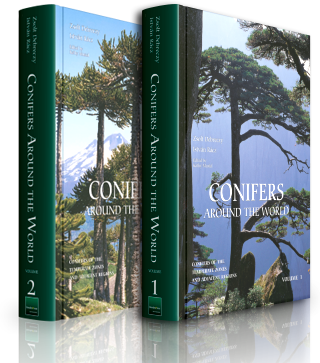
More than 30 years of research have resulted in two publications, “Conifers Around the Earth” (2000) and “Conifers Around the World” (2011). These publications were created to raise funds for the Dendrological Atlas. The atlas will consist of eight volumes. Volumes 1-4 will focus on gymnosperms and include detailed botanical illustrations and color photographs. Volumes 5-8 will focus on flowering plants and will also include illustrations and photographs.

Normally shipped from Hungary, Conifers Around the World is now available at ArtPlantae and shipping from California. Proceeds from sales of this title support the Dendrological Atlas Project and its team of botanists and botanical illustrators.


What’s Inside

Conifers Around the World is a two-volume set featuring 1,089 pages, 474 range maps, nearly 1,300 illustrations, and more than 3,700 color photographs.


Volume 1 addresses
:
Conifer identification and morphology, conifer families and genera, conifers from Europe, North Africa, Anatolia, Micronesia, Continental Asia, and Hainan, Japan and Adjacent Islands, and Taiwan


Volume 2 addresses
:
A bark gallery featuring 648 photographs, range maps, a glossary, and descriptions of conifers from North America, Mexico and Central America, West Indies and Bermuda, Chile and Argentina, Australia, Tasmania, and New Zealand.


Conifers Around the World
is an award-winning book accessible to both laypeople and scientists. It has received the following awards:

Council on Botanical & Horticultural Libraries

    • Outstanding Contribution to the Literature of Horticulture or Botany, Technical Interest Category 2013

California Horticultural Society
Writer’s Award 2011
Zsolt Debreczy & István Rácz

California Horticultural Society
Editor’s Award 2011
Kathy Musial

California Horticultural Society
Photographer’s Award 2011
István Rácz

California Horticultural Society
Publisher’s Award 2011
Dendro Press, Ltd.
Budapest, Hungary


Conifers Around the World

$250.00 + $14.65 shipping (shipping weight 16 lbs)
Buy


More about Zsolt Debreczy

Zsolt Debreczy is the Research Director of the International Dendrological Research Institute and has held this position since 1990.

Do you have the Book of Leaves (2010) by Allan Coombes in your library? If you do, then you are already familiar with Zsolt’s work. Zsolt edited this guide to 600 of the world’s great trees.


Link Update (December 2017)
:
Conifers Around the World can be ordered through the International Dendrological Research Institute.

Read Full Post »

View your invitation

Download your invitation here

Less than two weeks from now, weird, wild and wonderful festivities begin at The Huntington Library, Art Collections and Botanical Gardens.

The Botanical Artists Guild of Southern California, The Huntington and the American Society of Botanical Artists cordially invite you to the Weird, Wild & Wonderful Symposium to be held
July 23-26, 2015.

The fun actually begins a few days earlier with your choice of two pre-Symposium workshops taught by award-winning artists Elaine Searle from England and Mieko Ishikawa from Japan. Elaine will demonstrate how to create “liquid shine” and form using light and color. Mieko will introduce her students to Nepenthes, the wonder plant of the southeast asian rainforest. She will discuss her visit to the rainforest and show students how to draw and paint this popular carnivorous plant.

The Weird, Wild & Wonderful Symposium begins officially on Thursday, July 23 with a private dinner in the Chinese Garden and a special presentation about using art and technology to teach science. This special keynote address will be given by Dr. Jodie Holt, Professor of Plant Physiology and Divisional Dean, Agriculture and Natural Resources, University of California, Riverside who served as the botanical consultant to the movie “Avatar”.

This wonderful summer evening will be followed by three days of workshops, tours, and unique opportunities to learn from artists (and each other) during portfolio-sharing sessions and technique showcases. There will also be mid-day and evening keynote presentations. The focus of these presentations will be painting the plants of Borneo, the art of orchids, ancient plant representations, and how botanical art and photography are being used to document the conifers of the world. Download your invitation to learn how you can attend the keynotes for as little as $10!

Symposium workshops and tours are filling up quickly and wait lists have been activated. Do not miss this opportunity to learn from botanists, artists and historians whose work celebrates the intersection of botany and art.

If you cannot attend the Symposium, do try to visit The Huntington soon to view Weird, Wild & Wonderful: The New York Botanical Garden Second Triennial Exhibition, Botanical Illustrations of Remarkable Plants. This is the traveling exhibition curated by the American Society of Botanical Artists now on view in the Brody Botanical Center through August 23, 2015 (weekends only).


More about the Weird, Wild & Wonderful Symposium

Read Full Post »

TheFruitsWeEat It’s summertime!

Cherries, nectarines, peaches and apricots are in season and now available at local supermarkets and farmers markets.

Celebrate the fresh fruits of the season with the new book by author and illustrator Gail Gibbons. In this book, Gibbons introduces readers to fruit, how it grows, how fruit is harvested and how fruit arrives at the grocery store. Gibbons also touches upon the nutritious qualities of fruit and includes USDA recommendations for healthful eating.

Written for children ages 4-8, The Fruits We Eat is a balanced blend of themes related to botany, horticulture, gardening, and urban agriculture. Gibbons’ colorful illustrations and landscape scenes introduce readers to:

  • Trees
  • Plants, bushes and vines
  • The morphology of strawberries, raspberries, blueberries, pineapples, watermelon, grapes, apples, pears, cherries, peaches, lemons, and oranges
  • How pineapple plants, banana plants, and grapes grow
  • How fruit is harvested
  • How fruit travels from industrial farms to the grocery store

Gibbons also introduces readers to botanical terminology, as well as nutritional resources in the United States and Canada and includes Web addresses for further study.

If you are a long-time subscriber to ArtPlantae, you may remember reading about other books by Gail Gibbons at the former ArtPlantae Books, namely From Seed to Plant and Apples.

The Fruits We Eat is a colorful and informative introduction to the trees, bushes and vines producing some of our favorite fruit. It is also a nice introduction to the farm-to-store journey our food takes to the local grocer.


You May Also Like

Read Full Post »

« Newer Posts - Older Posts »