Feeds:
Posts
Comments

Archive for the ‘Special Articles & Interviews’ Category

To collect data to evaluate the use of drawing as a learning tool in a classroom setting, Jennifer had to create her own assessment tool. She created a tool called the Observational Skills Assessment. What did she think of this experience?

Ugh! That was the hardest part of my dissertation.


Learn more about Jennifer’s assessment tool

Read Full Post »

Jennifer Landin is the featured guest for September. Her research about using drawing as a learning tool in a biology classroom is based upon Posner’s Theory of Conceptual Research. I asked Jennifer what Posner’s Theory is all about. She replied:

Posner basically says that you start with a preconception. When you get some new information, you either integrate it with your current knowledge or you need to adjust your current understanding into something new. The problem is that the world often makes sense with our preconceptions, and changing can be kind of uncertain and scary. So in order to change, it’s got to really be worth it…

Learn more about Posner’s Theory

Read Full Post »

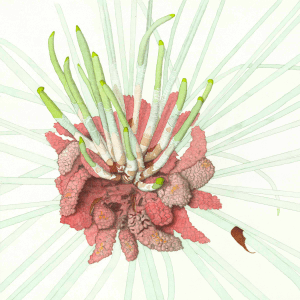
Red Pine New Growth, © Debra Greenblatt, all rights reserved. Courtesy MacRostie Art Center.

Red Pine New Growth, © Debra Greenblatt, all rights reserved. Courtesy MacRostie Art Center

Art from the Edge of the Boreal Forest: Reflecting Biodiversity
September 6-30, 2013
MacRostie Art Center
Grand Rapids, MN

MacRostie Art Center has announced its exhibitions for September, including
Art from the Edge of the Boreal Forest featuring the work of ten Minnesota-based botanical artists. These artists have created an exhibition of artwork based on the trees, plants, birds, and insects of the boreal forest to help educate the public about the disruptive factors – such as fire, invasive species, and stressful climate conditions – that are affecting this ecosystem. Boreal forests cross most of the upper parts of North America. The forests of Minnesota are uniquely positioned on the edge of the boreal forest ecosystem, which makes them especially susceptible to ecological disturbances.

The artists launched their studies of boreal forests in 2010 and have consulted with Dr. Lee Frelich, a forest ecologist with the University of Minnesota, Dr. Gerald Niemi of the University of Minnesota-Duluth, and Jana Albers, DNR Forest Health Specialist. The artists have created work featuring botanically accurate images of trees, plants, birds, and insects. The species depicted were identified as most at risk for disappearing from the northern woods of Minnesota.

The artists used the following media to create their work: watercolor, gouache, pastels, acrylic, graphite, colored pencil, pen and ink and scratchboard.

The work in this exhibition distinguishes itself from most floral art in its botanical and scientific accuracy. It also separates itself from descriptive botanical and scientific illustration in its reverential and artistic spirit.


Climate Change Project

In partnership with University of Minnesota Extension and the Itasca Private Woodland Committee, MacRostie Art Center is presenting two special events in conjunction with the opening of this exhibition. On Saturday, September 7, there will be a bus tour to the SPRUCE climate change project at the Marcell Experimental Forest. This project is a partnership between the US Forest Service and Department of Energy and is examining the effects of climate change on peatlands and forests. The tour will be given by scientists working on the project. The bus will leave MacRostie Art Center at 8 AM and return at 12 PM. Pre-registration and a fee of $10 are required to attend the bus tour.

At 1 PM, after the bus tour, there will be a presentation by Dr. Lee Frelich at MacRostie Art Center about the current and projected effects of ecological disturbances on the forests of Minnesota. There is no cost to attend the talk with Dr. Frelich.

Both events are open to the public. For more information contact MacRostie Art Center at 218-326-2697.


You’re Invited!

Downtown art galleries and businesses are open 4-8 PM on Friday, September 6, 2013 for First Friday Art Walk. MacRostie Art Center will have food, wine, a demonstration by botanic artist Vicki Barth and artist talks at 6 PM. The First Friday reception is sponsored by Children’s Mental Health Service and is free and open to the public.


About the MacRostie Art Center

MacRostie Art Center is a nonprofit organization dedicated to community growth through the arts in northern Minnesota. The MAC exists to support and advance the work of professional artists in the region and build a community that recognizes, appreciates and celebrates art. They believe that art is central to the quality of life in northern Minnesota – as it is everywhere – and that the artists who create, sell, and exhibit art play a vital role in society.

MacRostie Art Center presents exhibitions, workshops, classes, festivals, lectures, and other activities to engage the community in the arts. They support artists by providing a well-established venue for exhibition and sale of work and they work to keep the arts visible as a defining part of the community.

Learn more about the MacRostie Art Center

Read Full Post »

Our conversation with artist, teacher and landscape designer Kellie Cox-Brady continues…


I understand you are creating a coloring book about native plants. When will this book be available? How many species will be featured?


Kellie
: Yes! I am very excited about this project. I am working with a friend from college who is also a horticulturist, she is writing really fun descriptions of each plant and I am almost done with the illustrations. The coloring book should be available by November. There will be around 24 different plant species featured in the coloring book. My goal with the book is to educate kids on native plants while also bringing an artistic focus from each plant.


Learn more about Kellie

Read Full Post »

Kellie Cox-Brady’s professional life is divided between science illustration, freelance illustration and landscape design. How does she manage all this and stay inspired to create?


Kellie
: Fun question, as I have been asking myself this for the last few months! Over the last two years I’ve been working full-time as a landscape designer for a company in Ithaca, and on my free time creating my artwork and scientific illustrations. I have found in the last few months that I can no longer juggle everything into one day. As of two weeks ago, I am now working full-time as an artist – creating murals, scientific illustrations and other freelance work. I am also freelancing as a landscape designer for a few small projects, but working on my own. It is a bit scary to make that leap working as a full-time artist, but I seem to keep myself busy with projects. As for inspiration, I constantly need to create art work and illustrations; I usually have three or four projects going on at once. Ithaca is truly a beautiful place, so much inspiration including waterfalls, gorges, beautiful botanical gardens and more. I enjoy working in the garden and going on hikes, which can be also inspiring for my art! Another inspiration is working with local artists on joined projects.


Readers, how do you balance work and creativity?

Read Full Post »

You have completed many community projects. When I saw the utility box you painted, I immediately thought of the app Foldify. Fortunately the app immediately shows you how your marks will be placed on the finished 3-D object you are creating. If you don’t like it, you simply delete it. Painting scenes on large three-dimensional objects in real life isn’t this easy. How did you think through the placement of elements on your utility box when you created your design? 

What a fun app! I’ve never heard of this before, thanks for sharing. For painting on 3-D objects, I try to make the overall composition interesting and having the viewer want to see more, so for example…

Read more

Read Full Post »

Is there room for the expressive arts in the disciplined world of botanical art?

I asked Kellie Cox-Brady how she balanced technical botanical illustration with Cornell University’s semi-expressive approach to botanical illustration when she wrote the advanced course for them.

When creating the advanced course, I felt it was important to have those two avenues of self-expression and technical illustration as that is something I am constantly doing in my own work and I’m so glad you asked about it. That is one of the reasons I call myself a natural scientific artist…

Read More

Read Full Post »

« Newer Posts - Older Posts »