Feeds:
Posts
Comments

Now at Classes Near You > International > Scotland:


Royal Botanic Garden Edinburgh

www.rbge.org.uk
Established in 1670, the Royal Botanic Garden Edinburgh (RBGE) is comprised of four gardens that collectively represent one of the largest plant collections in the world. The garden is also home to the RBGE Diploma in Botanical Illustration. The diploma course is a two-year program emphasizing observational drawing and the creation of artwork in pencil, pen and ink, and watercolor. For detailed information about this program, download the Applicant’s Handbook 2010-2012 here.

  • Introduction to Botanical Art – July 5 – 9, 2010. Perfect for the beginner or returning artist.
  • Botanical and Nature Photography – July 12 – 16, 2010. For SLR and high-end camera users. Instructor will discuss how to photograph gardens, close-ups of plants & insects, and wildlife.
  • Painting Sweet Peas with Lizzie Sanders – July 19 – 23, 2010
  • Painting Fruit and Vegetables with Billy Showell – August 2 – 5, 2010
  • Painting Fungi – August 10 – 12, 2010.

Questions to think about as you read about the research study below:

  • What are the most common drawing errors made by new botanical illustrators?
  • How do new botanical illustrators approach their drawing of plants? What is their strategy?


Studying the Cognitive Factors Involved in the Drawing Process

Susan B. Roth, a drawing instructor at Ohio State University, created an experiment to research the potential cause(s) behind the most common drawing errors she was observing in her classroom. Drawing (no pun intended) on her classroom observations and her previous research, she formulated the following hypothesis: Inaccurate perceptual analysis is the cause of drawing errors.

In her classroom, she observed the following errors repeatedly:

  1. Cubes drawn with the top face too large and in the shape of a square.
  2. Cylinders with the top face too large.
  3. Cubes drawn too wide.

To test her hypothesis that “the inability to translate a perceived three-dimensional image of an object into a two-dimensional drawn image” accounts for common drawing errors, she created an experiment enabling her to examine the relationship between drawing performance and the following factors: visual perception, drawing strategies, type of stimulus, “previous experience with visual studies”, and gender.

Students from different academic departments at Ohio State University were selected at random (n=27). Roth (1992) tested her hypothesis by administering standardized tests and taping each subject’s approach to drawing. Each subject created 10 drawings in response to different stimuli. Two drawings were created upon receiving a verbal command to draw a cube and a cylinder from memory. Eight drawings were created in response to observations made of “a three-dimensional cube, a distorted three-dimensional cube, a line drawing of a cube, a line drawing of a cube with shading added, a three-dimensional cylinder, a three-dimensional distorted cylinder, a line drawing of a cylinder, and a line drawing of a cylinder with shading added.” Drawing errors were recorded. Error type was also recorded. Errors were categorized on evaluation sheets specific to this study. Errors were arranged in a checklist containing phrases such as the image is too wide, the image is too deep, etc.

Roth (1992) found that the order in which lines were placed during the drawing process was not related to drawing performance. Roth observed that cube drawings (regardless of stimulus) contained more errors than cylinder drawings. The most common error was the “top face too large” error (Roth, 1992), followed by errors in drawing the appropriate width of an object, errors in drawing diverging lines, errors in drawing an object’s accurate height, and errors in drawing an object’s accurate depth. In her analysis of drawing performance and gender, Roth observed that male subjects had more experience with visual studies (e.g., shop classes, drafting classes, model building), than female subjects and suggests this might be the reason why the drawing performance of maie subjects was significantly different than that of female subjects.

Roth’s findings support her hypothesis. If the inability to translate the perceived three-dimensional image of an object into a two-dimensional drawn image accounts for common drawing errors, Roth suggests the implementation of the following instructional techniques in drawing:

  • Students must be taught how to view objects “as a collection of relationships between end points and other elements” instead of as a whole object.
  • Drawing instructors must enable the critical analysis of form, perhaps by using computerized instruction to help students see form and spatial relationships.


Today’s Questions
:

  • What are the most common drawing errors made by new botanical illustrators?
  • How do new botanical illustrators approach their drawing of plants? What is their strategy?


Literature Cited

Roth, S.K. 1992. An investigation into cognitive factors involved in the drawing process. Journal of Visual Literacy. 11(2):57-76.
Article available online in Vol. 11 (2). See Journal Archives.

When asked about the title of her upcoming solo exhibition, Eva-Maria Ruhl explains:

I am aiming to show that a botanical can be abstract, modern, dramatic and elegant. A plant suspended, magnified, isolated, frozen in time is indeed in suspense. I love the ordinary. A leaf, a seed, something from the vegetable bin…all great subjects. People don’t really “see” and I love to show them what they overlook on a daily basis.

Twelve years ago, Eva-Maria launched her botanical art career after reading an article about Jessica Tcherepnine (ASBA) in a home magazine. She says, “I went straight to the next art store and bought everything identifiable on the photograph, including the magnifying glass.” Today Eva is a graduate of the Botanical Art & Illustration program at Corcoran School of Art + Design. Her work has been shown in art galleries and at the U.S. Botanic Garden. Her illustrations can also be seen in Paradise Under Glass by Ruth Kassinger (April 2010).


Related Links

Eva-Maria’s Blog
Botanical art at the Corcoran School of Art + Design
American Society of Botanical Artists (ASBA)

Updated information at Classes Near You > California:


Julie Schneider Ljubenkov, Art Nature Education

www.artnatureeducation.com
Julie is an artist, author, educator, naturalist, and native plant consultant. Read the Summer 2010 issue of Julie’s Art & Nature Newsletter to learn more Julie, her limited edition prints, and her projects.

  • Watercolor Painting for Kids – Friday afternoons; June 25 to August 13, 2010; 3:30 – 4:30. Ages 8 – 13. This 7-week course costs $59, plus $30 for watercolor supplies. No class 7/2/10.
  • Gardening & Landscaping with California Native Plants – Mira Costa Community College Community Services, Oceanside campus. Mondays, June 14 to June 28, 2010. Field trip on Saturday July 17. Class hours are 3 p.m. to 5 p.m. (Room 7001). To register, call (760) 795-6820.
  • Gardening & Landscaping with California Native Plants – City of Escondido, Community Services. Fridays, June 25 – July 16, 2010 (no class on 7/2/10). Field trip on Saturday July 17. Class hours are 5:30 – 7:30 p.m. To register, call (760) 839-4691.

Botanical artist, Debra Kopka, has announced she will continue to offer private lessons in botanical art through the summer. Debra provides customized instruction for artists wanting help with a project and provides instruction for homeschool students as well.

The following information has been updated at Classes Near You > Ohio:


Debra Kopka, DK Designs

www.dkdesigns.org
Botanical illustrator, Debra Kopka is the principal artist at DK Designs. Debra licenses her artwork, creates illustrations for publishers, and teaches botanical art classes through her design studio. Unless otherwise specified, all workshops are taught at Edgerton Art in Perrysbury.

  • Botanical Drawing I: Graphite – Mondays (10 weeks); April 12-June 21, 2010 (no class May 31); 6:30-9:30 PM. Learn natural science illustration techniques and create graphite drawings with graceful compositions. Demos and lots of practice during each class meeting. Special projects will be discussed. Limit: 7. Register Now (PDF)
  • Botanical Drawing II: Colored Pencil – Fridays (10 weeks), April 16-June 18, 2010; 9:00 Am – 12:00 PM. Learn how to shade, blend, and create layers of color using colored pencils. Complete a colored pencil painting by the end of this ten-week workshop. Limit: 7.
  • Private Lessons – Receive personalized attention in a customized learning environment. Request Information
  • Schedule a Workshop for Your Organization! Request Information
  • NEW! See schedule of summer classes at Edgerton Art (PDF). Deborah will resume her classes at Edgerton in Fall 2010.
  • NEW! – Download the June 2010 issue of Botanically Speaking, the quarterly newsletter of DK Designs.

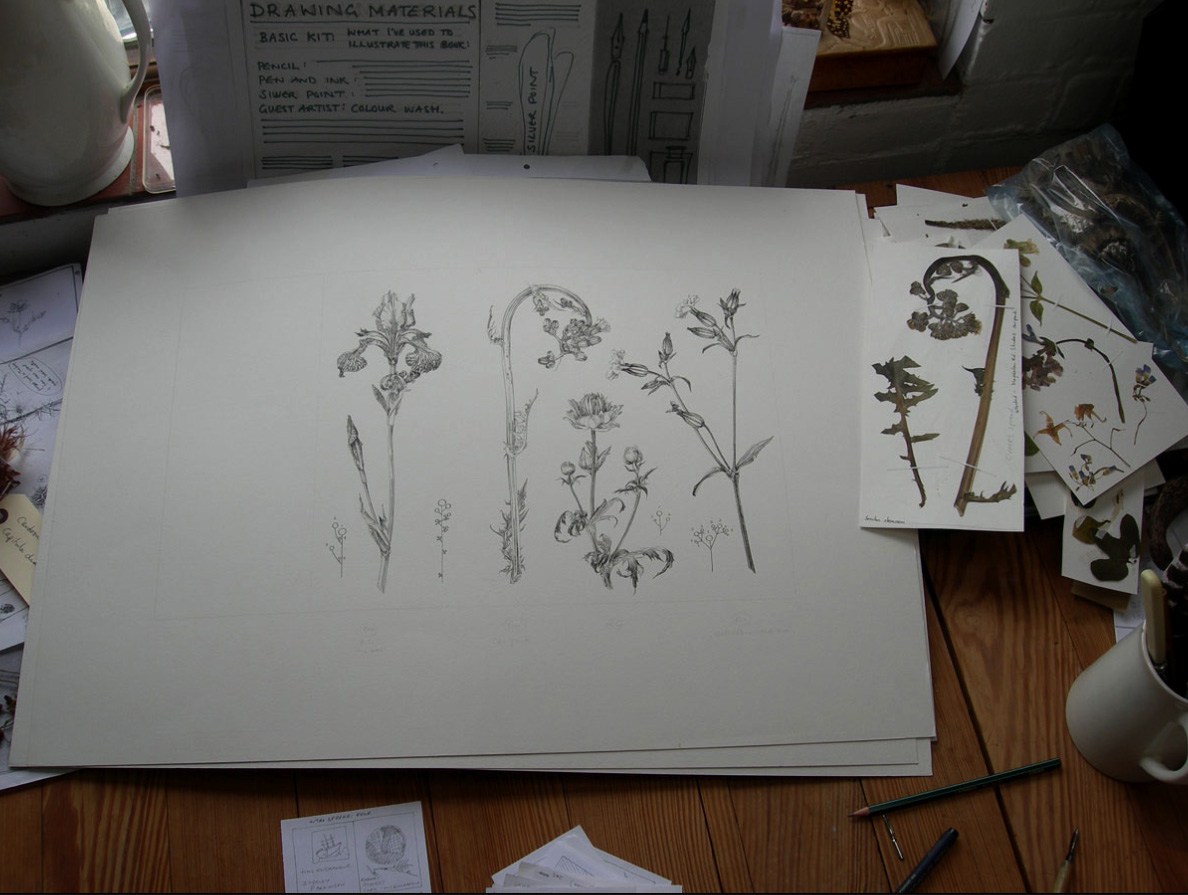
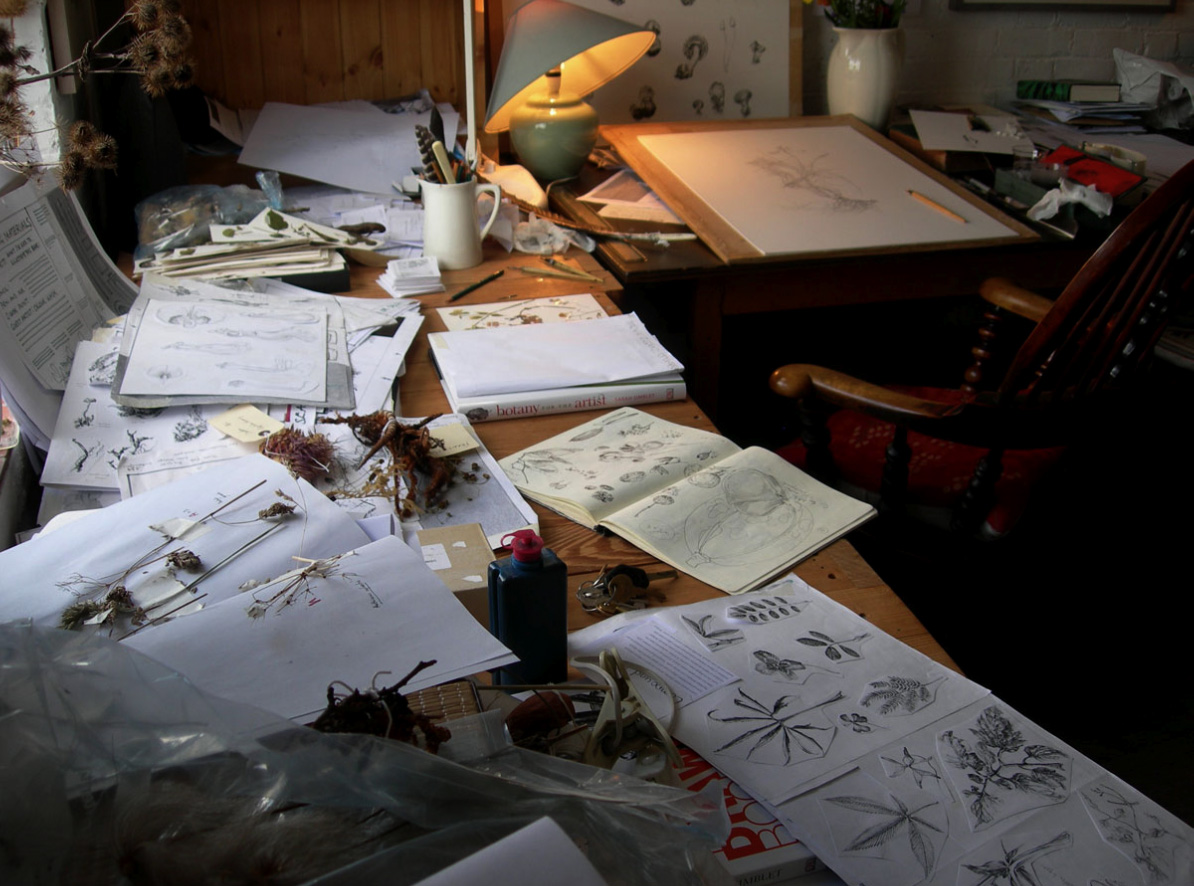
Author and artist, Sarah Simblet, stopped by for a visit last week. She took artists on a behind-the-scenes tour of the production of Botany for the Artist and what a tour it was!

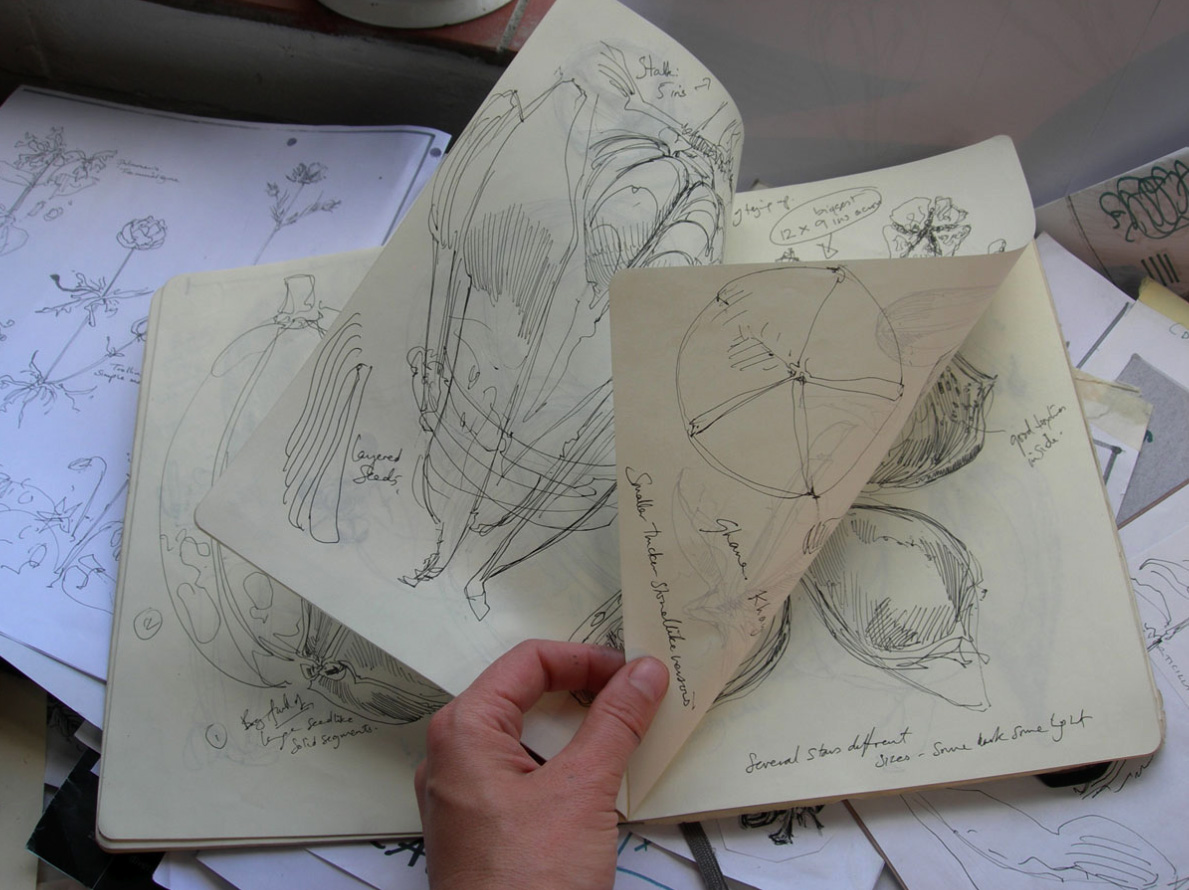
Sarah shared every step of the process with us. She described how she prepared thumbnail sketches of each idea and how these ideas were transferred to special cards she makes to keep herself organized. The ideas on the cards that were most likely to become part of the book were then transferred to sheets of 8.5″ x 11″ paper. Each sheet represented an entry into the book and these sheets were then taped to her studio wall.

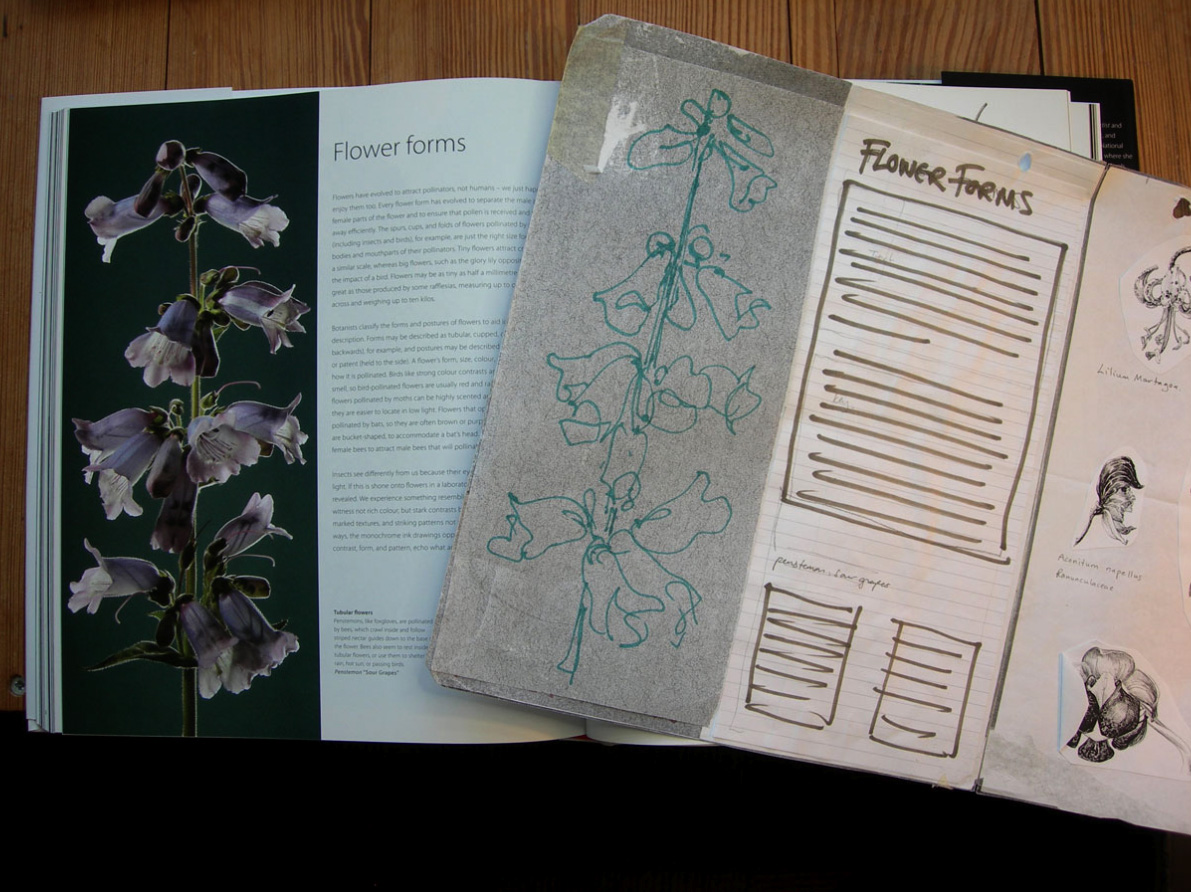
The page layouts covering her walls were incorporated into the big storyboard she drew by hand. This hand-drawn storyboard eventually became a miniature copy of the book, complete with color photographs, text, and illustrations.

Sarah designed her presentation around the questions submitted in advance by those who registered to attend this special author event. She answered follow-up questions at the end of her presentation as well. From the feedback received, artists enjoyed this opportunity to interact with Sarah and to learn in the company of other artists.

This is what Sarah’s studio looked like during the production of “Botany for the Artist”.

The illustrations in “Botany” began as sketches.

The placement of illustrations and photographs was discussed often throughout the project.

This is an example of Sarah’s finished sketches.

Get the rest of the story. Purchase a copy of Sarah’s book here.

Many readers have given me great information and I have learned so much. The Where Do You Live on the Web? poll will remain active in the column on your right. Please respond to this one-question poll if you have not already done so.

Thank you again for your insight. Keep it up!