Feeds:
Posts
Comments

Now at Classes Near You > California:


University of California, Riverside
UCR Extension

New Course at Classes Near You > England:


Lewis Hamart House, London

www.lewishamarthouse.co.uk
The Lewis Hamart House once served as the central library of Deptford. Designed by architect Sir Alfred Brumwell Thomas (1868-1948) and funded by Andrew Carnegie (1835-1919), this former library is now features a public gallery and studio space for professional artists. Artist studios are open to the public once per year. Exhibitions in the gallery are open to the public year-round, free of charge.

    From Plant Life…An Introduction to Botanical Illustration
    Mondays, January 24 – April 4, 2011; 1:30 PM – 3:00 PM.
    Taught by practicing artist and qualified botanist, Alison Day, this ten-week workshop provides an opportunity to learn about the art and science of plant drawing at a theoretical and practical level. The course is designed for beginners and people who would like to update existing knowledge. Participants must bring a sketchbook and basic materials. Additional course details and registration information are available here.

The holiday tour at the White House received a special touch this year. The book for the annual Christmas tour is graced with illustrations by students, alumni and faculty from the Corcoran Gallery of Art and the Corcoran College of Art & Design. The tour book, Simple Gifts: Holidays at the White House 2010, features detailed descriptions of the festive decorations in each room. A botanical illustration or a holiday scene accents every page. From the gingerbread men and women decorated by servicemembers’ children to the crimson cardinals in the foyer, decorations in the White House bring attention to the many simple gifts present in our daily lives. This includes recipes we share with friends and family. The White House shares two recipes in the tour book this year. One recipe is for homemade gingerbread ornaments and the second recipe is for apple cake with maple glaze.

Botanical artist, Eva-Maria Ruhl describes this very exciting 11-day project:

After a lovely White House tour with White House florist, Laura Dowling, who explained the basic concepts of the decorations to us, we were on our own. [The book] is lovely and we are indeed happy to have our work in the National Archives. One more triumph for botanical art and the Corcoran program!

Artists contributing to the 2010 tour book are: Roberta Bernstein, Wendy Cortesi, Leslie Exton, Charlotte Fremaux, Vicki Malone, Kappy Prosch, Eva-Maria Ruhl, and Ellen Saunders.

Pick up your own copy of Simple Gifts: Holidays at the White House 2010.

Learn more about Corcoran’s botanical illustration program on their website.


You May Also Enjoy…

The University of California Botanical Garden at Berkeley announces an updated course schedule at Classes Near You > California.


University of California Botanical Garden at Berkeley

http://botanicalgarden.berkeley.edu/
This 34-acre garden was established in 1890 and is now a non-profit research garden and museum. The botanical art classes below are taught by Lee McCaffree and Catherine Watters . Download a detailed schedule for October 2010 – January 2011 here.

  • Garden Strollers: Tours for Parents with Young Children
    Wednesday, December 8, 2010; 2:30 pm – 3:15 pm. A 45-minute tour of the garden for adults with young children (3 and under). Tour will end on the lawn for play and snacks (bring your own). Children must be in a stroller or carrier during the tour. FREE with garden admission. Meet in front of the Garden Shop. For more information, call (510) 642-7082 or email garden@berkeley.edu.
  • Winter Botanicals as Paintings – Friday and Saturday,
    December 10 & 11, 2010; 10 am-4 pm each day. We invite you to participate in our Fall series of classes in botanical illustration with the talented instructor Lee McCaffree. Take a break from the busyness of the holidays to explore the colors of winter through the painting of botanical subjects. Berries, evergreens, cones and dried plants are exciting subjects from the Garden. Use paint or colored pencils to capture the beauty in a painting of your own. Each student will work at his/her own level. A materials list will be posted on the website. Cost: $160 non-members, $150 members. Register for two or more classes and receive $10 off each.
  • Conifers and Caryota, A Few of My Favorite Things – Thursday, December 16, 2010; 1:00 pm – 2:30 pm. See plants you’ve never noticed before! Chris Carmichael, the Garden’s Associate Director of Collections and Horticulture, will lead a unique tour through the Garden. Get an insider’s look at the Garden’s often unnoticed treasures.
    Cost: $10 (free for members)
  • 2nd Annual Plants Illustrated Exhibition – Saturday, January 8, 2011- Thursday, January 27, 2011. Display of botanical artwork sponsored by the Northern California Association of Botanical Artists. Free with garden admission.
  • Botanical Garden Docent Training – January 10 – April 18, 2011; Mondays & Thursdays from 1 – 4 pm. Teach school children and the general public about plants and the natural environment. Training is provided by horticultural staff, experienced docents, plant specialists at UC Berkeley and plant specialists from the surrounding community. There are 24 training sessions. Cost: $250. For more information and to apply, contact the Volunteer Coordinator at (510) 643-1924 or email perry@berkeley.edu.
  • Botanical Art Through the Ages – Thursday, January 20, 2011;
    2:00 pm – 3:30 pm. Botanical artist Catherine Watters will present a collection of prints, slides, and other media highlighting the work of Pierre-Joseph Redouté and Maria Sibylla Merian. Her presentation about the history of botanical art will also touch on Tulipmania and the Age of Exploration. FREE with garden admission.
  • Introduction to Botanical Art – Saturday and Sunday, February 12 & 13, 2011; 10 am – 4 pm each day. We invite you to participate in our Fall series of classes in botanical illustration with the talented instructor Catherine Watters. This two-day class will teach you to observe, measure and draw plants in great detail with botanical accuracy. Work with graphite, colored pencils and watercolor. A materials list will be posted on the website.Cost: $160 non-members, $150 members. Register for two or more classes and receive $10 off each.

Now at Classes Near You > Michigan and Classes Near You > Ohio:


Deborah Kopka, DK Designs

www.dkdesigns.org
Botanical illustrator, Deborah Kopka is the principal artist at DK Designs. Deborah licenses her artwork, creates illustrations for publishers, and teaches botanical art classes through her design studio. Unless otherwise specified, all workshops are taught at Edgerton Art in Perrysbury, OH.

  • Botanical Drawing I: Graphite – Saturdays, January 22, 29 and February 5, 12, 19, 26, 2011; 9:30 AM – 12:30 PM. Learn how to create botanical drawings in graphite. Learn how to apply illustration techniques used by scientific illustrators and how to create graceful compositions. Location: University of Michigan Matthaei Botanical Gardens. Register Here
  • Botanical Drawing II: Colored Pencil – Saturdays, March 12, 19, 26 and April 2, 9, 16, 2011; 9:30 AM – 12:30 PM. Create beautiful botanical drawings with colored pencils. Students will work from live plant specimens and practice techniques used by colored pencil artists. Location: University of Michigan Matthaei Botanical Gardens. Register Here
  • Botanical Drawing II: Colored Pencil – Mondays, January 10, 17, 24, 31; February 7, 14, 21, 28, and March 7, 14, 2011; 6:00 PM – 9:00 PM. This 10-week class concludes with a three-week project. Students select their own project. Location: Edgerton Art, 26963 Eckel Road, Ste 301-A, Perrysburgh, Ohio. Phone: (419) 290-OILS (6459). Email: edgerton.art@att.net
  • Private Lessons – Receive personalized attention in a customized learning environment. Request Information
  • Schedule a Workshop for Your Organization! Request Information

What is a gymnosperm?

The word gymnosperm literally means “naked seed” (gymno=naked, sperm=seed). Gymnosperms have their seeds exposed unlike flowering plants, the angiosperms, which have their seeds enclosed in an ovary (i.e., fruit). The word angiosperm derives its meaning from angio=vessel, sperm=seed.

Pine trees are the most often cited example of a gymnosperm. But what about the other gymnosperms? How do we know when we see one? Do all gymnosperms have cones?

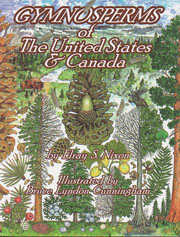
These questions and many others are answered in Gymnosperms of the United States & Canada. This user-friendly reference was written by Dr. Elray S. Nixon and illustrated by Bruce Lyndon Cunningham.
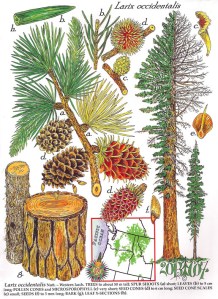
Lavishly illustrated, this guide is a welcome balance of botanical terminology and descriptive illustrations. Dr. Nixon’s jargon-free text is supported by Bruce’s informative illustrations. Dr. Nixon begins his book explaining what gymnosperms are and where they can be found. He then provides clear instruction on how to use identification keys and teaches readers how to begin thinking about cones, leaves, and bark — the three characteristics which are the focus of this book. Dr. Nixon focuses on these characters because they are observable throughout the year.

If you have used identification keys before, you are all too familiar with how easy it is to make a wrong turn while working through a dichotomous key. Fortunately in Gymnosperms of the United States & Canada, the likelihood of you going astray has been minimized by Bruce’s illustrations. If you ever doubt your progress working through any of the keys, all you need to do is refer to one of the 115 botanical plates Bruce created. Each plate includes a sketch of a mature plant and illustrations of leaves, cones, arils, seeds, and bark. A range map showing the distribution of each species is also included.

Dr. Nixon and Bruce describe 115 species of gymnosperms growing in coniferous gymnosperm forests, gymnosperm foothill (pinyon-juniper) forests, and gymnosperm (Ephedra) shrubland. The divisions, families and genera featured in this book are:

DIVISION: Cycadophyta
Family: Zamiazeae (Sago Palm Family)
    Genus: Zamia

DIVISION: Ginkophyta
Family: Ginkoaceae (Maidenhair Tree or Ginkgo Family)
    Genus: Ginkgo

DIVISION: Gnetophyta
Family: Ephedraceae (Ephedra Family)
    Genus: Ephedra

DIVISION: Pinophyta
Family: Taxaceae (Yew Family)
    Genus: Taxus
    Genus: Torreya

Family: Pinaceae (Pine Family)
    Genus: Pinus
    Genus: Larix
    Genus: Picea
    Genus: Tsuga
    Genus: Abies
    Genus: Pseudotsuga
Family: Cupressaceae (Redwood or Cypress Family)
    Genus: Taxodium
    Genus: Sequoia
    Genus: Sequoiadendron
    Genus: Juniperus
    Genus: Callistris
    Genus: Cupressus
    Genus: Chamaecyparis
    Genus: Thuja
    Genus: Calocedrus

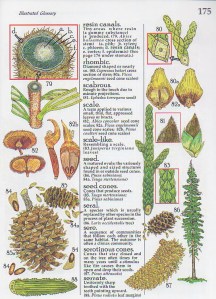
Abundant illustrations, easy-to-follow keys, and clear descriptive text make this guide a great resource to use when learning about the gymnosperms in your area. This guide also serves as a gentle introduction to dichotomous keys. If you have avoided plant keys because of the botanical terminology they contain, you might want to try the keys in this book. Dr. Nixon provides concise definitions to the botanical terms you need to know and Bruce provides an illustration for each term. This all-inclusive resource is sure to be a welcome companion on your next trip to your local forest or national park.


Learn How Bruce Creates Illustrations for Field Guides

Join us for Ask The Artist with Bruce Lyndon Cunningham on Monday December 13, 2010 from 12:00 PM – 1:00 PM (PST). Bruce has illustrated many field guides and during this live online event, he will discuss how he worked with Dr. Nixon to create the illustrations for this new book. This event is FREE. To join in on this conversation, register here. Event Closed


Gymnosperms of the United States & Canada
can be purchased at www.forester-artist.com.

New at Classes Near You > Scotland:


University of Aberdeen
Natural History Centre

www.abdn.ac.uk/nhc/
The Natural History Centre works with the university’s Cruickshank Botanic Garden and Zoology Museum to provide engaging learning opportunities for both children and adults.

  • Watercolor & Graphite – December 11, 2010; 10:30 AM – 4:30 PM. Study watercolor and graphite techniques with paleobotanical artist, Stephen Caine. For more information, contact Stephen Caine or Marie Fish at the Natural History Centre. Learn more about Stephen and paleobotanical art here.
  • Classes for 2011 – A 2011 schedule will be published soon. Specialty classes include a class about graphite and a class about watercolor and vellum.

You May Also Enjoy…
Stephen Caine Demonstrates Paleobotanical Art at Derwent Pencil Museum