Feeds:
Posts
Comments

High school teachers, Brian C. Dempsey and B.J. Betz, describe how they use drawing as a learning tool in Biological Drawing: A Scientific Tool for Learning. They observed that while a lot of time is spent drawing during a typical biology lab, biology instructors do not take the time to teach students how to draw. In response to this observation, they incorporated structured drawing activities into a biology class and successfully taught students how to observe, describe, and draw.


Overview

Dempsey and Betz taught introductory drawing techniques to students in a 9th-grade biology class to enhance their observation skills and to make them better learners. The drawing activities and homework exercises they created were administered over a five-day period. During this time, students participated in exercises addressing observation, drawing from memory, the recording of texture, contour drawing, and the drawing of negative space. Most exercises were completed as homework, while class time was spent conducting directed activities.

Detailed descriptions of each activity and illustrated examples are included in Dempsey & Betz (2001). Here is a quick look at the exercises students completed.

    Exercise 1: Observing & Describing
    Students were instructed to sit with their backs towards each other. Each student took turns describing an object from nature to their partner, who could not see the object being described. Students were required to incorporate art-related terms into their descriptions (e.g., form, value, and color). Prior to this activity, students received instruction about terms used by artists during the drawing process.

    Exercise 2: Drawing from Memory
    In this exercise, students studied an object given to them by their teacher. After studying the object for a while, they put the object away and drew it from memory.

    Exercise 3: Textures & Surfaces
    Students collected as many textured items as they could find in their natural environment. Their recorded observations and texture rubbings were used to create a master list of textures and to launch a discussion about observation skills.

    Exercise 4: Contour Drawing
    After observing a classroom demonstration, students were instructed to create a contour drawing of an object at home. The construction of a contour drawing required students to observe carefully and to draw slowly while drawing what they observed.

    Exercise 5: Negative Space Drawing
    Students learned what negative space was and how to observe it. They then practiced their negative drawing skills.

    Exercise 6: Color Blending & Shading Techniques
    This lesson was taught in the classroom. Students learned different shading techniques and learned how to mix and blend colors. The student handout for this exercise is included in Dempsey & Betz (2001).

To assess if students knew how to use contour drawing, negative space, shading, and color in a biological drawing, Dempsey & Betz created a two-part project requiring students to apply their new skills. The first project was a take-home project requiring students to complete a drawing of a plant growing around their house. Students were graded on their use of contour drawing and negative space, their use of color blending and shading, their attention to detail, and the correct identification of their plant specimen. Dempsey & Betz established grading criteria by which student drawings were assessed. Their rubric and a copy of the handout students received are included in their article.

The second part of the assessment project was conducted in the laboratory and required students to apply their drawing skills while observing and comparing insect-pollinated flowers to wind-pollinated flowers during two 50-minute class periods. A detailed description of this activity is included in Dempsy & Betz (2001).

Since this initial program was conducted, Dempsy & Betz have revised their technique as necessary. They have also incorporated drawing lessons into a unit about human anatomy. In this unit, students apply their drawing skills while learning about bones and the origin and insertion of muscles.

Getting Started
Dempsey & Betz (2001) recommend teachers read Drawing on the Right Side of the Brain by Betty Edwards, take introductory drawing classes, and collaborate with the art teacher at their school. I would like to add the following resources to their recommendation:

  • The Art of Botanical Drawing: An Introductory Guide ($19.95) by Agathe Ravet-Haevermans, scientific illustrator at the Museum of Natural History in Paris. Read about this informative sketchbook-style guide for beginners.
  • Botanical Drawing in Color: A Basic Guide to Mastering Realistic Form and Naturalistic Color ($24.99) by Wendy Hollender, botanical artist, author, and teacher. Read the review about this comprehensive guide.


Literature Cited

Dempsey, Brian C. and B.J. Betz. 2001. Biological drawing: a scientific tool for learning. American Biology Teacher 63(4): 271-279.

Search for The American Biology Teacher at a library near you (enter your location in the appropriate field).


Also See

Drawing with Graphite Eyes


How do you use drawing as a learning tool in your classroom?
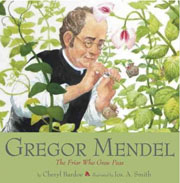


Gregor Mendel was a curious little boy. When he learned that growing two kinds of apple trees together made better fruit and that breeding sheep made thicker wool, he wanted to know how these results were possible. This curiosity lead to a lifetime of research that resulted in Mendel’s 8-year experiment with pea plants and his observations about how traits are passed from parents to offspring.

Gregor Mendel’s story is told by Cheryl Bardoe, Senior Project Manager of Exhibitions at The Field Museum in Chicago. Her book was published in conjunction with an exhibition the museum hosted over four years ago. The exhibition, Gregor Mendel: Planting the Seeds of Genetics, is still viewable online. Also online is the resource guide created specifically for Illinois teachers. This resource-rich guide has information and activities that can be incorporated into any biology classroom.

Bardoe provides young biologists with great insight into Mendel’s childhood and his life as a friar and a teacher. She also provides a succinct review of how genes are passed from parents to offspring. The colorful and lively illustrations of Jos. A. Smith complement her easy-to-follow explanation.

Gregor Mendel: The Friar Who Grew Peas is available at ArtPlantae Books.

Updates at Classes Near You > California:


Julie Schneider Ljubenkov, San Diego

www.artnatureeducation.com
Julie is an artist, author, educator, naturalist, and native plant consultant. Download Julie’s current brochure to learn more Julie, her limited edition prints, and her projects.

  • Eye on Nature, Beginning Watercolor Landscape Painting – Thursdays, January 20 – March 17, 2011; 6-9 PM. UC San Diego Extension, La Jolla. Cost: $275. Register
  • Watercolor Painting for Kids – Tuesdays, February 1-22, 2011;
    3:30 – 5:00. Ages 8-13. City of Escondido, East Valley Community Center. Cost: $30. Register online or call 760-839-4691.
  • Gardening & Landscaping with California Native Plants – Tuesdays, February 1-22, 2011; 6:00-8:30 PM. City of Escondido, East Valley Community Center. Includes field trip to a local nursery. Cost: $65. Register online or call 760-839-4691.
  • Mosaic Art – Mondays, March 21 – May 2, 2011; 5:30-8:30 PM. Mira Costa Community College Community Services, Oceanside campus. Cost: $109, plus $35 materials fee. Register online or call (760) 795-6820. Registration line open 24 hours.
  • Introduction to Mosaic Art – Tuesdays, April 5 – May 31, 2011; 6-9 PM. UC San Diego Extension, La Jolla. Cost: $275. Register
  • Gardening & Landscaping with California Native Plants – Mondays, May 9-23, 2011; 5:30-8:30 PM. Mira Costa Community College Community Services, Oceanside campus. Includes field trip to a local nursery. Cost: $57, plus $5 materials fee. Register online or call
    (760) 795-6820. Registration line open 24 hours.

New at Classes Near You > Texas:


Sibley Nature Center, Midland

www.sibleynaturecenter.org
This 49-acre site is home to programs educating the public about the southern Llano Estacado and surrounding area. Each course is 5 weeks in length. The five fundamental courses are listed below and are prerequisites to the advanced courses. Advanced courses may include: Nature Drawing, Pen and Ink, Colored Pencil, Textures in Nature, Drawing Animals, Drawing and Painting Animals, Botanical Illustration, and Scientific Illustration. Museum specialist and scientific illustrator, Michael M. Nickell, teaches the Center’s courses about nature drawing and journaling. He has been a professional practicing scientific illustrator and nature artists for over 30 years. He clients include National Geographic, Texas Parks and Wildlife, The Museum of Texas Tech University, Lubbock Lake Landmark, The University of Texas at Austin, The University of Oklahoma, the Carnegie Museum of Natural History, The Square House Museum, Encyclopedia Britannica, and others. Course Fee: $50 Sibley members, $80 non-members. Single Sibley memberships are $25/year. For more information, contact Michael Nickell.

  • Pencil Drawing II
    Saturdays, January 15 – February 12, 2011; 2 – 4 PM
  • Pencil Drawing I
    Saturdays, January 22 – February 19, 2011; 12 – 2 PM
  • Light on Form – TBA
  • Composition – TBA
  • Color Theory – TBA

The latest at Classes Near You > New York:


Lasdon Park and Arboretum

Lasdon Park Brochure
Located in Somers, NY, the 234-acre Lasdon Arboretum is home to the botanical art program directed by botanical artist Laura Gould. Laura is a botanical artist who works primarily in colored pencil, graphite, and watercolor. Detailed course descriptions, supply lists, registration information, and Laura’s online gallery can be viewed at Barking Dog Studio. Additional workshops are taught throughout the year by visiting instructors.

  • Colored Pencil for Experienced Students – Wednesdays,
    Jan. 26 – Mar. 2, 2011; 9:30-12:30. Prerequisite: Graphite Drawing (The graphite class is a foundation course taught on Thursday mornings. See below.) Cost: $215 Register
  • Graphite Drawing (All Levels) – Thursdays, Jan. 27 – Mar. 3, 2011; 9:30 – 12:30. For beginners and experienced students who love the beauty of graphite. This class prepares students for other courses in the program. Please join us. Cost: $215 Register
  • Graphite and Colored Pencil – Saturdays, Jan. 29 – Mar. 5, 2011; 9:30-12:30. Students of all levels are welcome to join the class. Learn at your own pace while enjoying the company of fellow artists. Cost: $215 Register
  • Watercolor – Wednesdays, Jan. 26 – Mar. 3, 2011; 12:30 – 3:30. For all levels, beginners to advanced. Students will learn color theory and how to use a limited palette. Supply list will be provided. Advanced students who already have their own palette are welcome to use the palette they have. Prerequisite: Completion of foundation courses in graphite. Register
  • Colored Pencil (Spring): Session #1 (March 9 – April 13, 2011), Session #2 (April 20 – May 25, 2011)
  • Watercolor (Spring): Session #1 (March 9 – April 13, 2011), Session #2 (April 20 – May 25, 2011)
  • Drawing (Spring): Session #1 (March 10 – April 14, 2011), Session #2 (April 21 – May 26, 2011)
  • Saturday Sessions (Spring): Session #1 (March 12 – April 16, 2011), Session #2 (April 23 – May 28, 2011)
  • Summer Break with Nature Journaling
      Pound Ridge Reservation – Saturday July 10, 2011; 10 AM – 1 PM. Sketch by the stream under the shade trees. Afterwards, see Corinne Lapen Cohen’s botanical art exhibition in the Main House. Bring lunch. $35 (entrance fee $4/car)

      The Hammond Museum Japanese Garden
      – Friday July 16, 2011; 10 AM – 1 PM. Payment must be made to the museum. No food allowed, however there is a café. $50

      Kitchawan Farm
      – Saturday July 31, 2011; 10 AM – 1 PM.
      Draw organic vegetables and herbs.

      Homes of Katonah
      – Saturday, July 31, 2011; 10 AM – 1 PM. Draw the homes of Katonah.

ArtPlantae will take part in the following events. The literacy dinner is a ticketed event designed specifically for teachers and librarians. The family book festival and environmental education fair are open to the public.
Hope to see you there!


SCIBA Children’s Book & Literacy Dinner

SoCalBookScene.com
February 26, 2011
An annual event for teachers and librarians. This wildly popular event grows each year. Teachers and librarians get to know local booksellers and meet with authors and illustrators. Cost: $85 per person


5th Annual Family Festival of Books

Chino Fairgrounds (map)
February 27, 2011
9 AM – 3 PM
This event is open to the public and is the only event in the Inland Empire region of California bringing together families, books, authors, illustrators, and exhibitors dedicated to education.


32nd Annual Los Angeles Environmental Education Fair

Los Angeles County Arboretum & Botanic Garden
March 12, 2011
9 AM – 4 PM
For educators, students, parents, and others interested in the future of our planet. This year LAEEF has partnered with Jane Goodall’s Roots and Shoots, a program encouraging youth to create community-based service learning projects. There will be prize drawings for teachers and hands-on activities, tours, and nature games for children. Free with Arboretum admission (see prices and directions).

A full year of exciting classes awaits botanical art enthusiasts at Field Breaks in the UK. The following has been posted at Classes Near You > England:


Field Breaks – Special Interest Art Breaks Derbyshire, England

www.fieldbreaks.co.uk
Enjoy like-minded company in a relaxing and friendly environment with experienced and approachable tutors. Details and pricing for all 2011 courses can be viewed here.

  • Early Hellebores, Snowdrops and Winter Pansies in Graphite, Colored Pencil or Watercolor – February 9-11, 2011 at The Nightingale Centre, Great Hucklow, Derbyshire with Sue Vize
  • Spring Flowers in Watercolor/Colored Pencil – March 14-16, 2011 at Losehill House Hotel in Hope, Derbyshire with Gael Sellwood
  • Luscious Leaves – Painting Realistic Leaves in Watercolor – March 21-23, 2011 at The Great House, Sonning on Thames, Henley with Anna Knights
  • Tulips & Daffodils in Graphite, Colored Pencil or Watercolor – March 23-25, 2011 at The Nightingale Centre, Great Hucklow, Derbyshire with Sue Vize
  • Drawing and Painting Nature from Life in Watercolor &/or Gouache – March 25-27, 2011 at Low Wood Hotel, Windermere with Simon Williams
  • Step-by-Step Botanical Painting – March 27-29, 2011 at Ockenden Manor, West Sussex with Vicky Mappin
  • Hedgerows in Spring in Watercolor – April 1-3, 2011 at Cwrt Bleddyn, Monmouthshire with Deborah Devauden
  • Painting Specialty Spring Bulbs in Watercolor – April 4-6, 2011 at Auchen Castle, Beattock with Sharon Bradley
  • Hellebores and Spring Flowering Plants in Graphite, Colored Pencil or Watercolor – April 6-8, 2011 at The Grants Hotel, Harrogate with Sue Vize
  • Flowers in Detail – May 9-11, 2011 at Losehill House Hotel in Hope, Derbyshire with Sue Vize
  • Colorful Spring Flowers in Watercolor – May 13-15, 2011 at Moorhill House Hotel, New Forest with Sandrine Maugy
  • Start Drawing with Confidence – May 16-18, 2011 at Leigh Park, Bradford on Avon with Jane Nicholas Barne
  • Botanical Studies of Seasonal Vegetables in Graphite Pencil – May 16-18, 2011 at Losehill House Hotel in Hope, Derbyshire
  • Tulips, Lilies & Spring Bulbs in Watercolor & Colored Pencil – May 18-20, 2011 at Barnsdale Lodge, Rutland Water with Gael Sellwood
  • Summer Flowers in Watercolor – June 5-8, 2011 at Bodrugan Barton, Mevagissey, Cornwall with Susan Hiller
  • Ferns in Graphite, Colored Pencil or Watercolor – June 8-10, 2011 at The Nightingale Centre, Great Hucklow, Derbyshire with Sue Vize
  • Summer Buds and Blooms in Watercolor – June 10-12, 2011 at The Park Hotel, Falkirk with Fiona Stickland
  • Botanical Painting in Acrylics – June 13-15, 2011 at Warwick Hall, Warwick on Eden, Carlisle with Margaret Watty
  • Vibrant Seasonal Colors in Watercolor – July 3-5, 2011 at Carberry Tower, Musselburgh with Clare McGhee
  • Summer Holiday: Sea Shells, Seaweed and Pebbles – July 13-15, 2011 at The Nightingale Centre, Great Hucklow, Derbyshire with Sue Vize
  • Garden Vegetables & Orchard Fruits – August 31 – September 2, 2011 at Horsely Towers, Surrey with Leigh Ann Gale
  • Feathers, Butterflies, Flowers & Fruits on Black Paper in Colored Pencil – September 14-16, 2011 at The Nightingale Centre, Great Hucklow, Derbyshire with Sue Vize
  • Late Summer Fruits or Flowers in Pen & Ink (colorwash optional) – September 19-21, 2011 at Losehill House Hotel in Hope, Derbyshire with Julie Small
  • Late Summer Border in Watercolor – September 20-22, 2011 at Cally Palace Hotel, Gatehouse of Fleet with Sharon Bradley
  • Autumn Fruits on Vellum or Paper in Watercolor or Colored Pencil – October 5-7, 2011 at Barnsdale Lodge, Rutland Water with Gael Sellwood
  • Fruit Good Enough to Eat! – Vibrant Realism with Watercolors – October 7-9, 2011 at Wotton House, Dorking with Anna Knights
  • Autumn Colors on the Island in Watercolor – October 14-16, 2011 at The Royal Hotel, Ventnor, Isle of Wight with Sandrine Maugy
  • End of Season Treasures in Colored Pencil – October 17-19, 2011 at Losehill House Hotel in Hope, Derbyshire with Susan Christopher-Coulson
  • Seasons Greetings: Seasonl Compositions in Watercolor/Colored Pencil – November 7-9, 2011 at Losehill House Hotel in Hope, Derbyshire with Gael Sellwood
  • Drawing & Painting nature from Life in Watercolor &/or Gouache – November 18-20, 2011 at The Eastbury Hotel, Sherborne, Dorset with Simon Williams