Feeds:
Posts
Comments

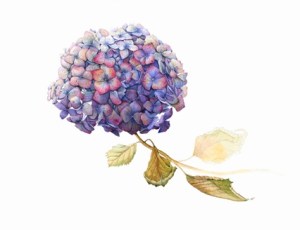
Blue Hydrangea © Mally Francis. All rights reserved

For the last 10 years, botanical artist Mally Francis has taught botanical art classes at The Wagon House, the bed-and-breakfast she operates with her husband, photographer Charles Francis. The B&B is located at Heligan Manor in beautiful Cornwall, England. Mally teaches her classes in a 250-year old renovated sawpit, a building where logs were once cut into planks and beams for the Heligan estate. When Mally is not teaching classes, she helps to document the plants growing in the Lost Gardens of Heligan.

Meet Mally Francis!

Mally, when viewing your new website, I am first taken by examples of your artwork, your working studio, and then the B&B. It is a dreamy arrangement. Let’s talk about your art first. What attracted you to botanical art?
This seemed the perfect answer to combining my love of flowers and of drawing. I remember that when I saw my first botanical drawing I marveled at the detail and, as soon as I started, I knew that this is what I wanted to do.

Do you have a background in the arts or do you come to botanical art from another discipline?
I would have dearly loved to have studied the arts but, at that time, art college was rather frowned upon. I qualified as a Speech & Language Therapist and used my drawing skills when working with children to encourage and stimulate their language as part of their therapy. I feel that my training as a therapist has helped to give me the ability to impart knowledge when I am teaching artists. I was lucky enough to attend classes with Anne-Marie Evans every week for several years.

In which media do you work? Which medium do you like to teach?
I work in pencil and watercolour and that is also my preferred medium for teaching although I can also teach the use of coloured pencil drawing.

What is your teaching philosophy?
My teaching philosophy is to encourage all students to develop their own skills to the highest level possible. There is never any competition in my classes and everyone can work at their own pace. The courses are always enjoyable and old friends meet each other year after year as they return to continue their studies. Everyone has their own aspirations and it gives me great pleasure to help them to achieve their own goals.

Describe a typical day in one of your multi-day workshops.
Classes begin at 9.45 with coffee and work begins in earnest at 10 o’clock. I usually begin the day discussing and demonstrating as my approach is very structured. We have no coffee or tea-breaks as I believe that it disrupts the morning, however, students can help themselves to a drink whenever they wish. There is a delicious lunch at about 12.30 and students can take a walk if they wish before the afternoon session. Formal class finishes at 4.00 but students are welcome to stay as long as they like.

I admire your spacious teaching studio. I like that it serves as both a fine art studio and a photography studio. Do you have any tips for artists who are creating a teaching studio of their own?
Light is most important and enough space to work comfortably. I also feel a good library is essential but we are increasingly dependent upon the Internet to access information about plants and artists. Broadband access is therefore extremely useful.

About the bed & breakfast…..how do you find time to operate a B&B, paint, and prepare for classes?
I am lucky enough to have an incredibly supportive husband, so we work as a team. When a course is in progress, I only take artists who are on the course for B&B.

What information would you like readers to know about your multi-day courses?
I would encourage interested people to look at my website www.thewagonhouse.com as this gives an overall picture. I have been teaching here in my studio at Heligan for ten years and I am always happy to answer questions by e-mail. I have had the pleasure of meeting a wonderful selection of artists over the years and they have produced some excellent work.

Thank you, Mally, for visiting with us today.


Take Mally’s advice and visit The Wagon House online! You will learn more about her classes and become immersed in slide shows featuring Mally paintings, The Sawpit Studio, the B&B, and Mally’s selection of greeting cards.

The current schedule of botanical art classes at The Wagon House is listed below. This information has also been updated at Classes Near You > England.


The Wagon House

Lost Gardens of Heligan, Cornwall
www.thewagonhouse.com
A bed-and-breakfast in the English countryside where you can eat breakfast at a time that is convenient for you, visit the gardens in Cornwall, and take botanical art classes too!

  • Four-Day Botanical Painting Course – March 18 – 21, 2011. Classes are taught in a renovated, well-lit studio. The studio building itself is a 250-years old. Cost: £280.00, includes lunch each day.
  • Four-Day Botanical Painting Course – April 8 – 11, 2011. Classes are taught in a renovated, well-lit studio. The studio building itself is a 250-years old. Cost: £280.00, includes lunch each day.
  • Four-Day Botanical Painting Course – May 6 – 9, 2011. Classes are taught in a renovated, well-lit studio. The studio building itself is a 250-years old. Cost: £280.00, includes lunch each day.
  • Four-Day Botanical Painting Course – June 17 – 20, 2011. Classes are taught in a renovated, well-lit studio. The studio building itself is a 250-years old. Cost: £280.00, includes lunch each day.
  • Five-Day Botanical Painting Course – July 13 – 17, 2011. Cost: £350.00 including lunch each day during the course. One day per week Termly Fees: £250.00 bring your own packed lunch.
  • Four-Day Botanical Painting Course – September 8 – 11, 2011. Classes are taught in a renovated, well-lit studio. The studio building itself is a 250-years old. Cost: £280.00, includes lunch each day.
  • Five-Day Botanical Painting Course – September 27 – October 1, 2011. Cost: £350.00 including lunch each day during the course. One day per week Termly Fees: £250.00 bring your own packed lunch.

Click for a behind-the-scenes look!

A Brush with Nature
Jan. 8 – Feb. 17, 2011
Chapman University Leatherby Libraries
An exhibit of botanical art by The Botanical Artists Guild of Southern California
Exhibit Hours
Parking

Twenty-two members of the Botanical Artists Guild of Southern California (BAGSC) are currently exhibiting their work at Chapman University Leatherby Libraries in Orange, CA.

Exhibiting artists are: Bonnie Born Ash, Cristina Baltayian, Margaret Best, Diane Daly, Akiko Enokido, Olga Eysymontt, Denise Genova, Irene Horiuchi, Barbara Jaynes, Clara Josephs, Morgan Kari, Joan Keesey, Suzanne Kuuskmae, Arillyn Moran-Lawrence, Norma Sarkin, Janice Sharp, Deborah Shaw, Mitsuko Schultz, Gilly Shaeffer, Gloria Whea-Fun Teng, and Leslie Walker.

Reception and Artist Presentations
Thursday, February 10, 2011 (7 PM – 9 PM)
Reception RSVP Required: brushwithnature@me.com by February 5. For more information please call 714-532-7742.

Exhibit Location:
Doy and Dee Henley Reading Room and Clarke Gallery Wall
Leatherby Libraries, 2nd Floor
Chapman University
One University Drive, Orange, California 92866

This weekend, four exhibitions will open at the Shirley Sherwood Gallery of Botanical Art at Kew Gardens. Kew artists and members of the Leicestershire Society of Botanical Illustration and the Hampton Court Palace Florilegium will exhibit botanical illustrations and paintings February 5 – June 1, 2011. Gallery visitors will be able to view contemporary botanical art, art from the 18th century, and illustrations created by Kew’s artists to aid in plant identification. For the first time, artwork will be available for sale. A portion of each sale will support the garden and the gallery.

Read about these exciting exhibits at What’s On At Kew Gardens.


You May Also Enjoy…

Shirley Sherwood Gallery of Botanical Art
Hampton Court Palace Florilegium

Many new botanical art and plant-related classes have been added to the Spring schedule at the UC Berkeley Botanical Garden.

Here’s what’s new at Classes Near You > California:


University of California Botanical Garden at Berkeley

http://botanicalgarden.berkeley.edu/
This 34-acre garden was established in 1890 and is now a non-profit research garden and museum. The botanical art classes below are taught by Lee McCaffree and Catherine Watters . View a detailed schedule and register on the Garden’s website.

  • Botanical Garden Docent Training – January 10 – April 18, 2011; Mondays & Thursdays from 1 – 4 pm. Teach school children and the public about plants and the natural environment. Training is provided by horticultural staff, experienced docents, plant specialists at UC Berkeley and plant specialists from the surrounding community. There are 24 training sessions. Cost: $250. For more information and to apply, contact the Volunteer Coordinator at (510) 643-1924 or email perry@berkeley.edu.
  • Introduction to Botanical Art – Saturday and Sunday, February 12 & 13, 2011; 10 am – 4 pm each day. We invite you to participate in our Winter series of classes in botanical illustration with the talented instructor Catherine Watters. This two-day class will teach you to observe, measure and draw plants in great detail with botanical accuracy. Work with graphite, colored pencils and watercolor. A materials list will be posted on the website.Cost: $160 non-members, $150 members. Register for two or more classes and receive $10 off each.
  • Horticultural Walk: The Arid House – Thursday, January 20, 2011;
    1 pm – 2:30 pm. Join Horticulturist Bryan Gim on a tour through the Garden’s Arid House. Explore colorful cacti, succulents and other plants from cool dry and warm dry areas of the world in this glasshouse adventure. Reservations required. Cost: $10 nonmembers, Free for members
  • Winter Bird Walk – Saturday, January 22, 2011; 9 am – 10:30 am. Winter is a surprisingly active time for birds in the Garden. Join Chris Carmichael, Associate Director of Collections and Research and Phila Rogers for this lovely morning walk through the Garden. Reservations required. Cost: $20 nonmembers, $15 members
  • Flora Felting Workshop – Sunday, January 30, 2010; 11am – 2pm. What do you do when it’s too cold and rainy for gardening outdoors? Bring the garden inside with GoGo Craft’s felt flower pin workshop! Make your own gorgeous felt flower pin inspired by the Garden collection. For crafters of any skill level. Materials & snacks included. Reservations required. Cost: $20 nonmembers, $15 UCBG Members & UCB Students
  • Valentine’s Day High Tea for Kids – Sunday, February 6, 2011;
    1 pm – 2:30 pm. Enjoy a special celebration of herbs and flowers at this afternoon tea party. We’ll use our senses to explore these fragrant edibles, talk about their uses and benefits, and see how they grow. Make fresh teas and herb finger sandwiches. Also make valentines from pressed botanicals to take home. Reservations Required. Cost: $20 nonmembers, $17 members for one adult and one child. $10 each additional child or adult per family.
  • Horticultural Walk: Treasures Under Glass
    Thursday, February 17, 2011; 1 pm – 2:30 pm. Tour the Garden’s glasshouses with expert horticulturist, Christy Matasick. Learn about plant collections at the Arid House, Orchid, Fern and Carnivorous House and the Tropical House. End your tour with coffee, tea and cookies in the Ornduff Room. Cost: $10 Public, Free members. Space is limited, registration required.
  • Asphalt to Ecosystems: Design Ideas for Schoolyard Transformation – Saturday, February 19, 2011; 1 pm – 3 pm. Asphalt to Ecosystems is a guidebook for designing and building natural schoolyard environments that enhance childhood learning and play experiences while providing connection with the natural world. Sharon Gamson Danks, Environmental Planner and founding partner of Bay Tree Design, in Berkeley, California, has visited and documented over 175
    green schoolyards in North America, Europe and Japan, and has shaped and facilitated the master planning process for dozens of ecological schoolyards. Free with garden admission. Books available for sale at the event.
  • Planning Your Edible Landscape – Wednesday, February 23, 2011;
    6 pm – 9 pm. Learn how to grow edibles in you ornamental garden with Kathleen Elliot, Horticulturist and owner of Hillcrest Ranch in Sunol. Learn about Bay Area plants, the difference between direct seeding and starting seeds in a pot. Enjoy herbal tea and create a small herb garden to take home. Cost: $30 nonmembers, $25 members.
  • Sustainable Home Horticulture – Saturday, March 12, 2011
    9 am – 12 pm. Learn how to meet the needs of your garden and your lifestyle. Horticulturists Anthony Garza and Dylan Ferreira will introduce you to the basics of composting. This session will introduce you to compost tea and vermi-composting techniques. Reservations required. Cost: $25 nonmember, $20 members
  • Horticultural Walk: Southern Africa – Thursday, March 17, 2011;
    1 pm – 2:30 pm. Learn about the early annuals and spring flowering bulbs that fill the Southern Africa section with color. Join horticulturist, Meghan Ray, on a walking tour celebrating this annual show of color. Reservations required. Cost: $10 nonmembers, Free members
  • Fiber & Dye Exhibit – Saturday March 19 – Sunday April 3, 2011;
    9 am – 12:00 pm. Plants are the origin of most of the fibers we use in our daily lives, and of the dyes that provide us with colors. Feel fabrics, see and smell dyes while learning about the many uses of plant fibers & dyes from around the world. Free with garden admission.
  • Garden Garments: Opening Reception, Workshop and Book Release with Sasha Duerr – Saturday, March 19, 2011; 1 pm – 4 pm. Learn to dye with creative alternative sources of natural plant dyes from your very own garden, or even urban sidewalk, with Sasha Duerr, textile designer and founder of Permacouture Institute. Create a surprising array of colors for a garden dyers sample book and artistically dye a plant colored and patterned textile to take home with you! Sasha will be speaking from her new book The Handbook Of Natural Plant Dyes: Personalize Your Craft With Organic Colors From Acorns, Blackberries, Coffee, And Other Everyday Ingredients. Reservations required. Cost: $25 nonmembers, $20 members. Books available for purchase.
  • Felting with Plant Dyed Wool For Kids – Sunday, March 26, 2011;
    1 pm – 2 pm. Learn how to make a beautiful felted textile using plant dyed wools from Thirteen Mile Lamb and Wool, using a wet-felting technique. For ages 6 and up. Reservations required. Cost: $20 nonmembers, $15 members. Price includes one adult and one child. $10 each additional child or adult per family.
  • Extreme Plants: Desert Gardens for Kids – Saturday, April 9, 2011; 1:00 – 2:30 PM. Children and their accompanying parent/guardian will learn about succulents, tour the Arid House and Desert Collections, eat refreshments made from edible succulents, and take home a garden project. Cost: $20 nonmembers / $17 members (one child w/one potted garden). Additional child/parent/garden, $12 each.
  • Naturally Dyed Easter Eggs – Sunday, April 24, 2011; 1:00 – 2:30 PM. Children will learn about plant-based dyes as they color eggs. $20 nonmembers / $15 members. Price includes one adult, one child, and 6 eggs. Each additional child and adult, $6.
  • Spring Plant Sale – April 29-30, 2011. Members’ Sale (Friday April 29; 5:00 PM – 7:30 PM). Public Sale (Saturday April 30; 10 AM – 2 PM).
  • National Public Gardens Day – Friday, May 6, 2011; 9 AM – 5 PM. Free one-time use passes will be handed out to all visitors today!
  • Animals of the Garden Children’s Walk – Sunday, May 8, 2011;
    1:00 – 2:30 PM. Learn about newts, butterflies, birds, frogs, lizards, snakes, and more! $10 each adult and child.
  • Botanical Illustration: The Rose – Monday & Tuesday, May 9-10, 2011; 10 AM – 4 PM. Paint roses from the Garden! Learn about morphology of roses as you create your colored pencil or watercolor painting. Cost: $160 nonmembers / $150 members
  • A Walk Through the Garden of Old Roses – Saturday, May 14, 2011; 10 AM – 12 PM. Horticulturiest Peter Klement will lead a walk through the garden and tell fascinating stories about the history of roses. Cost: $20 nonmembers / $15 members.
  • Introduction to Botanical Art – Wednesday & Thursday, July 6-7, 2011; 10 AM – 4 PM. Participants will learn how to measure and draw plants in detail as they work in graphite, colored pencils, and watercolor. Instructor, Catherine Watters, welcomes artists at all levels. $160 nonmembers / $150 members.
  • Sick Plant Clinic – First Saturday of Each Month, 9 am – 12 pm. Free. No reservations required.
  • Monthly Butterfly Walks – Fourth Tuesday of each month (March – October); 3 – 4 PM. Garden volunteer, docent, and caterpillar lady, Sally Levinson, will lead walks through the garden in search of butterflies. Space is limited. Children welcome. Free with admission.
  • Garden Strollers – Second Wednesday of Each Month, 11 am – 11:45 pm. A 45-minute tour of the garden for adults with young children (3 and under). Tour will end on the lawn for play and snacks (bring your own). Children must be in a stroller or carrier during the tour. FREE with garden admission. Meet in front of the Garden Ship. For more information, call (510) 642-7082 or email garden@berkeley.edu.

BEGINS THIS WEEK!


Los Angeles County Arboretum & Botanic Gardens, Arcadia

www.arboretum.org
Courses in introductory botanical drawing, beginning and intermediate watercolor, colored pencil, sketching and Chinese brush painting are taught throughout the year. Go to the Events & Classes for more information. The Arboretum is located in Arcadia, CA. To register, contact Jill Berry or call (626) 821-4624.


Introduction to Chinese Brush Painting
– Thursdays, February 3-24, 2011; 12:30 – 2:30 PM. In this introductory course the student will learn the difference between Chinese brush painting and other watercolor painting. Beginning students will learn how to use Chinese brushes and ink to create beautiful paintings on rice paper. At the end of this course, a completed painting will be ready to be framed and displayed. Experienced students, will continue to refine their work and learn new techniques.  Instructor, Gloria Whea-Fun Teng, is a very talented artist who has taught a variety of courses over the years. She has also studied botanical illustration at Otis College of Art & Design.
Cost: $120 members, $130 nonmembers

    Week One: Introduction to Chinese brush painting. Includes how to mix color, brush painting style and techniques, how to use the brush on rice paper, practicing on newsprint first, and how to paint a bamboo branch.
    1st assignment: bamboo branch

    Week Two
    : Bamboo branch with leaf: using black ink, learn to paint a bamboo leaf, single leaf, double leaf and how to paint a set of leaves. The student will learn how to control the water with brush.
    2nd assignment: bamboo branch and leaf

    Week Three
    : Flower (Rose): how to paint flower stems and buds; start to use color, practicing on a single petal flower, including different angles and shapes; learn the techniques of painting multiple layers of petals and different leaves.
    3rd assignment: Rose

    Week Four
    : Final Critique on bamboo painting in black ink and rose in color. Student will complete one painting in the class, and it will be ready to frame when the course is finished.

Last year we took a look at plant blindness — a phrase used to describe the observation that people are largely unaware of the plants in their surroundings. Botanical illiteracy is more than a topic botanists discuss over dinner. It is a subject with broad-reaching consequences. Dr. Gordon E. Uno of the University of Oklahoma outlines the consequences and offers solutions to this problem in Botanical literacy: What and how should students learn about plants? published in the American Journal of Botany. One of the issues Uno identifies is the fact that the plant sciences are taught less often in school. This contributes to a chain of events involving reductions in research, reductions in funding, fewer students majoring in botany, and fewer students pursuing graduate studies in the plant sciences (Uno, 2009). This paints a very bleak picture for the future. What could the future possibly look like in light of all of this?

Botanical Capacity Assessment Project
In 2009, the Chicago Botanic Garden, the U.S. office of Botanic Gardens Conservation International, and several partners launched a one-year project to assess the strengths and weaknesses of plant science education, research, and habitat management in the United States. A literature review was conducted and data collected from “non-profit organizations, university personnel, graduate students, and government employees involved in plant science research, education and/or natural resource management in the United States.” The findings published by this group are disturbing. Before we take a look at them, I need to explain the phrase “botanical capacity”.

What does “botanical capacity” mean? This phrase refers to all factors contributing to the support and advancement of plant science education, research, and management. Botanical capacity is necessary to enhance our understanding of the many roles plants play in our lives. Think beyond native plants and butterflies for a moment. Think food security, climate change, biodiversity, biofuel production, and sustainability. Without the botanical capacity to address these issues, we won’t be able to manage them.

What does a world without botanical capacity look like?
The way it looks right now. Here are some gaps in botanical capacity identified in the report:

  • Fewer botanical degree programs at colleges and universities.
  • A dramatic reduction in botany courses at colleges and universities.
  • A shortage of botanists at government agencies.
  • Applicants unable to apply for jobs as federal botanists because they cannot satisfy the requirement for 24 credit hours in botany.
  • The retirement of almost half of the U.S. workforce with botanical expertise within the next ten years.

For quick insight into this project and its findings, watch the short video of Marsh Sundberg’s poster presentation at Botany 2010. The Botany conference is the joint annual meeting of the American Bryological and Lichenological Society, the American Fern Society, the American Society of Plant Taxonomists, and the Botanical Society of America.

For a more detailed analysis, download the 102-page report of the Botanical Capacity Assessment Project. A summary of the report is also available.

Another presentation from Botany 2010 that may be of interest to you is Dr. Judy Skog’s presidential address about botany education in the 21st-century.


Literature Cited

Uno, Gordon E. 2009. Botanical literacy: What and how should students learn about plants? American Journal of Botany 96(10): 1753-1759. Download open access article   [Link updated 27 June 2024]

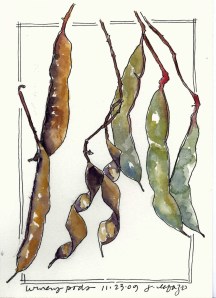
© Jane LaFazio. All rights reserved

Jane LaFazio responds to questions about style, drawing, creativity, and sketchbooks!

1. How does one tease out their “signature style”. This is a piece of advice I’ve been given in order to establish myself as an artist and for people to recognize my work (much like Georgia O’Keefe, Stephen Quiller, etc.). They have recognizable styles unique to them. They are clear and consistent, and even though they experiment and explore, one still recognizes their work/style. I love so many things (some of which I’ve learned from Jane :) that I’m finding it difficult to get clear on my unique style. Any insight on this would be very much appreciated.

In some ways, I’m the wrong person to ask this question! I have so many interests and go in so many directions! I love learning new techniques and exploring new styles and directions. I like to think that when I’m influenced by an artist I like, and try some of her technique or style, that very soon it becomes my work, as I integrate the new things into my existing style. I’ve been told, that even though I work in many different media, that my work is somehow recognizable. The colors, the feeling remain consistent whether it’s watercolor, cloth or mixed media. More and more I find myself working in a series (albeit a small, short series!) and that really helps my voice come through my art.


2. Doing your art in more than one medium, how do you organize your studio and your time? My word is “focus” this year and I think organized is linked to focus.

My time is a combination of studio work and teaching and marketing. I need to do all three to make a living as an artist, and I’m fortunate that I enjoy all three equally. My teaching is scheduled and I fit in chunks of studio time where I can, and I do work in the evening, hand stitching. Marketing (aka computer time) is usually done first thing in the morning.


3. Why do you use pencil first instead of going directly to ink? Seems like it would be easier.

With the pencil I can quickly sketch the object, getting the placement and organize the shapes. Then I can confidently use the pen to draw and capture the details. Using a pencil first takes the stress out of drawing, for me, and I’ve learned to do the pencil sketch quickly. I do enjoy ‘straight to pen’ drawings, and they can be delightfully wonky.


4. It sounds like you typically sketch “from life” rather than from photographs. Can you give any tips for capturing moving objects such as birds, children, dogs, etc. quickly? For example, are there certain aspects of a moving subject you sketch first? Are there certain things you always omit? Thanks!

When I draw a moving object, I start in pencil and as the animal moves, I draw a new drawing of that new pose, on the same page. I may have 4 or 5 or 6 drawings on the page. Eventually, most animals will return to a certain pose again, and then I’ll jump to that sketched pose. A horse in a pen, for example will stay within range and move, but return to a pose. When drawing, say koi in a pond, I use the same technique and end up with a composite drawing to create single koi, drawn from the other koi in the pond. Once I have a good pencil sketch, then ink and watercolor.


5. When you recommend creative resources to fellow artists, which resources do you usually direct them to when it comes to: Art Websites? Books? Blogs?

I always recommend Danny Gregory’s books and his blog. There are sooo many wonderful artists out there, that I occasionally do a blog post about someone I’m particularly interested in.


6. Sketchbook art and journaling is becoming increasingly popular. Why do you think this is? Or is this merely an artifact of the Web connecting all sketchbook enthusiasts?

It’s true. I really think 2011 is the year of the sketchbook! Word does spread, like wildfire, online. But I also think people are realizing that everyone can do a sketchbook/visual journal. There are so many ways to approach it, and so many playful ways to make art, that a sketchbook is a great and easy way to get creative.


7. Here are my questions for Jane. I am an avid reader of her blog…..

    Where do you get all your energy? Are you the ultimate multitasker?
    I’m blessed with a lot of energy and a very supportive husband. I work small. I stitch at night, while watching TV with my husband. I think I have a lot of drive, and feel a great sense of accomplishment when I’m making art.

    Do you take the time to set goals and plan a schedule around them?
    I don’t set specific goals. I plan my art making and life around my teaching schedule, as I mentioned above. I try to say yes to things that will forward my art career AND make me happy. I take risks, I say yes to things I’ve never done before.

    How do you stay motivated?
    It’s a natural state for me. And to be perfectly honest, teaching and blogging and sharing what I do is very motivating to me. I like feedback, I like to inspire others to make art and be creative.


8. I was wondering if you are self taught in watercolor or if you took some instruction? I really love your work.

Thanks! I have a degree in graphic design, and did a little watercolor in college. Since 1992, I’ve taken many watercolor classes from community center classes to classes with the pros. Since I began my watercolor journal, I’ve really simplified my approach to make it quick and spontaneous.


9. Are there any exercises one can do to “loosen up” when painting? I started painting botanicals and want to change my style but have a hard time “loosening up”. Also, how do you get in the mood to paint? Sometimes there is time but I am not in the mood to paint and sometimes I feel creative and motivated but have no time to paint.

One of my favorite things to do is draw directly in pen doing a continuous line drawing. You can look at the object you’re drawing and at your paper, but you can’t pick up your pen. It’s fun and great practice. If you use a water soluble pen, you can add a little water for shading. You’d be amazed how well you can do, and it definitely makes for loose, wonky drawings.

In the mood. For me, I can always pick up a pencil (or water soluble pen) and start drawing something I see. It can be quick or more lengthy. Doodling is also great, especially for a background in a journal.


10. Do you have a favorite brand or type of journal or do you bind your own?

I’ve used the larger watercolor Moleskine for years, and have recently gone to 5″ x 7″ individual hot press watercolor paper pages. Then I can create a portfolio or paper box for my sketches. I have done book binding, but I prefer a simple accordion fold with a long strip of watercolor paper, when I do “make” my own journals.


Thank you, Jane!

Thank you for sharing your work and so much of yourself with us this month. You have definitely taught us many different ways to observe and to create.

Readers should know that Jane is one of the hosts of The Sketchbook Challenge. If one of your New Year resolutions had anything to do with allowing yourself to live a more creative life, look no further than The Sketchbook Challenge and its hosts for your daily dose of inspiration. The Challenge began on January 1st and will continue throughout the year. A new theme will be announced each month, so be sure to visit to see how Jane and her fellow hosts tackle each challenge.

Looking for your own adventure in creativity? See the sketching classes & mixed media classes Jane teaches online and at various venues across the nation!


Also See…

Jane LaFazio Channels Passion Into a Career & Successful Outreach Program for Kids