Feeds:
Posts
Comments

The Botanical Capacity Assessment project identified the need for more botany instruction in the classroom and in college programs. Creating new courses is definitely an important step forward to ensure we can take part in the management of such issues as food security, sustainability, and biodiversity (Kramer & Havens, 2010). But how do you know students will want to take these courses, especially in light of research indicating that careers in natural resource management have very low appeal among high school seniors (Hager et al., 2007)?

Research intern and high school student Sarah Hager of the South Carolina Governor’s School for Science, and Mathematics (Hartsville, SC), professor Thomas Straka and research associate Heather Irwin, both from Clemson University in South Carolina, employed traditional research methods and social media savvy to answer a very important question…

What do teenagers think of environmental issues and natural resources management careers?

The Research Tool
Hager et al. (2007) created a survey format that would appeal to teenagers. Their survey was short and contained a mix of closed-ended questions, open-ended questions, and a list of environmental issues. They sent a draft of their survey to peers in the fields of forestry, natural resources, and environmental education. Feedback from these professionals helped to shape the final survey.


How They Got The Word Out

Hager et al. (2007) used Myspace to poll teenagers during summer vacation. Twenty surveys were sent to Myspace participants in each state (n=1,000). Hager et al. (2007) used the filtering capabilities of the social network to target 17-year old high school students across the nation. Random numbers were used to identify random zip codes within each state.


The Results

Of those polled, 14.8% responded (n=148). Sixty percent of the respondents were female and 80% of the respondents were college-bound. When presented with a list of environmental issues, more than half rated the issues as “somewhat important” (Hager et al., 2007). Respondents rated the loss of wildlife habitat, pollution, and sustainability as the most important environmental issues. Global warming, urban development, fragmentation, private property rights, and invasive species followed in the rankings.

Hager et al. (2007) included in their survey a component to evaluate student awareness of natural resource careers. Student awareness was measured by their ability to accurately define what each profession does for a living. Most students could define what soil & water conservationists, wildlife managers, foresters, and park rangers do in their respective professions. When asked if these professions appealed to them, respondents stated these professions did not appeal to them. Park ranger was the most attractive of the choices, with forester being the least attractive. Respondents thought being a forester would be “boring” and expressed sentiments such as “I don’t like bugs” or “I’m not interested” (Hager et al., 2007).


The Big Picture

While high school seniors seem to be interested in environmental issues and take part in environmental programs, they have little interest in pursing a career in natural resource management (Hager et al., 2007). Hager, Straka, and Irwin describe student interest in environmental issues as being a “popular interest” shaped by the media because most students reported that the media is their primary source of information about the environment. In response to this, Hager et al. (2007) recommends that careers in natural resource management are presented as options during career counseling in high school and that enhanced marketing efforts should be employed to make careers in natural resource management more appealing.

A thorough analysis of survey results and an explanation of how Myspace was used to conduct this survey is provided in Hager et al. (2007).

This article is available online from the Society of American Foresters ($29.50) or at a library near you (enter your location in the search field).


Literature Cited

Hager, Sarah, Thomas Straka, and Heather Irwin. 2007. What do teenagers think of environmental issues and natural resources management careers? Journal of Forestry 105(2): 95-98.

Kramer, Andrea and Kayri Havens. 2010. Assessing Botanical Capacity to Address Grand Challenges in the United States. A report by the Botanical Capacity Assessment Project. Website http://www.bgci.org/usa/bcap [accessed 26 January 2011].


Related Articles
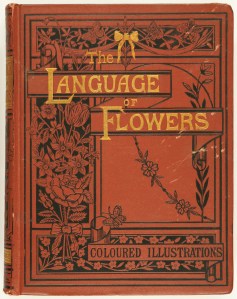
Cover of Robert Tyas’ The Language of Flowers, or Floral Emblems or Thoughts, Feelings and Sentiments (London, George Routledge and Sons, 1869), HI Library call no. DG21 T977L.

Courtesy of The Hunt Institute

FLORA’S LEXICON
25 March–30 June 2011

Flora’s Lexicon explores the 19th-century European and American phenomenon of The Language of Flowers, the common understanding that plants and blooms were charged with sentiment and meaning and held the potential to express emotion or to communicate privileged messages within the strict confines of social etiquette. Flower associations made their way into Victorian language from various sources, including Japanese, Middle Eastern, Turkish, Greek and Roman cultures, religions and mythology, as well as the literature of Shakespeare and the still-life painting of 17th-century Dutch artists. The result was a fashionable system of floral connotations that blossomed during a time of burgeoning public interest in botany and its scientific importance.

So pervasive and popular was The Language of Flowers trend that it launched the introduction of the floral dictionary or Language of Flowers book, a small, beautifully bound and illustrated volume devoted to the decoding of each flower’s secret meaning. This sentimental craze and the books associated with it originated in France, the most notable being Le Langage des Fleures of 1819 by Charlotte de Latour. This volume was reprinted in multiple editions, translated into English and imitated by other French, British and American authors until the trend waned in the mid-1880s, shortly after English author and illustrator Kate Greenaway (1846–1901) published her charmingly illustrated floral dictionary, The Language of Flowers (1884).

The Language of Flowers book phenomenon also attracted the skills of numerous

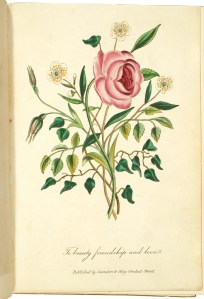
To beauty, friendship and love (rose, ivy and myrtle), hand-colored engraving published by Saunders and Otley, Conduit Street, from Anna Christian Burke’s The Illustrated Language of Flowers (London, G. Routledge and Co., 1856), HI Library call no. DG21 B959I.

respected botanical artists of the era, including Pierre-Joseph Redouté (1759–1840), Pancrace Bessa (1772–1846), Pierre-Jean-François Turpin (1775–1840) and Pierre-Antoine Poiteau (1766–1854). Although their illustrations for this genre differed slightly in scale and scientific detail from their major works, they were prized for their beauty and added to the appeal of these intricately bound and decorated volumes while serving to familiarize a large segment of the population with the artists’ talent.

Flora’s Lexicon presents books from the Hunt Institute’s Library and botanical portraits from the Art Department in an examination of the scope of The Language of Flowers phenomenon, from the influences on its beginning to its continued presence in 21st-century publishing. Differing approaches to the floral dictionary are displayed, while intricate systems of meaning are explored through artworks of many key 18th- and 19th-century botanical artists and illustrators.


Location & Hours

The exhibition will be on display on the 5th floor of the Hunt Library building at Carnegie Mellon University and will be open to the public free of charge. Hours: Monday–Friday, 9 a.m.–noon and 1–5 p.m.; Sunday, 1–4 p.m. (except 22–24 April; 15 and 29–30 May). Hours subject to change, please call or email before your visit to confirm viewing hours. For further information, contact the Hunt Institute at 412-268-2434.


Hunt Institute for Botanical Documentation

5th Floor, Hunt Library
Carnegie Mellon University
4909 Frew Street
Pittsburgh, PA 15213-3890
Telephone: 412-268-2434
Email: huntinst@andrew.cmu.edu
Website: http://huntbot.andrew.cmu.edu
Directions: View map

New at Classes Near You > Maine:

The Humboldt Field Research Institute / Eaglehill Foundation
Steuben, ME

www.eaglehill.us
The Humboldt Field Research Institute is a field research station providing field experiences for natural history professionals. The Eaglehill Foundation creates interdisciplinary learning experiences in natural history, including workshops and retreats for artists.

  • Botanical Illustration: Sketching and Painting Wildflowers in Their Natural Environment – July 24 – July 30, 2011
    This workshop will focus on sketching and painting wildflowers in the field with watercolors, with an emphasis on depicting them in their natural environment. With the inclusion of a plant’s surroundings in a painting, not only is the plant captured, but also the immediate habitat which supports it. This brings a new and intriguing dimension to one’s paintings. One can add just a simple suggestion of surrounding vegetation or a more detailed study of it, or even incorporate a larger-scale landscape, as in the orchid paintings by Martin Johnson Heade from the 19th century. The objective of field trips will be to gather inspiration and information which is essential in understanding and capturing the plant, its growth habit, and its interconnection with the natural world. Through close observation, participants will record what they see with pencil sketches, watercolor studies, and field notes. When possible, participants will be able to collect specimens from the field to continue working on them in the classroom. There will be daily sessions in the classroom during which participants can integrate their gathered information and observations and work towards one or more final paintings. The workshop will also focus on the importance of overall design, i.e., how to create the most effective composition to which the plant and its habitat lend themselves. There will be discussions of the importance of values in a painting, and of light tones, mid tones, and darks. There will be demonstrations on color mixing, brush strokes, and a wealth of other watercolor painting techniques. Through books and slides, there will be an opportunity to study and discuss the work of successful artists over generations who have depicted plants in their habitats, all within the context of works by contemporary artists. Participants of any level are welcome and will receive individual instruction and critiques as part of the workshop.

    Angela Mirro studied art and illustration at Parsons School of Design, while also developing a career as a textile designer. Over the past 20 years, her focus has been on botanical watercolor paintings of orchids, with a continued interest in landscape painting. When possible, she has combined the two in various degrees, painting orchids in situ as they grow in nature. Her work has been widely exhibited at such venues as: Losing Paradise? Endangered Plants Here and Around the World at the National Museum of Natural History, Washington DC (2010); The American Orchid Society, Delray Beach, FL (2008); the Brooklyn Florilegium Society, Brooklyn Botanic Garden, NY (2003, 2005, 2007-2008, 2010); Orchids in Contemporary Botanical Art, Longwood Gardens, Kennett Square, PA (2006); and the Ashmolean Museum, A New Flowering: 1000 Years of Botanical Art, the Shirley Sherwood Collection, Oxford, England (2005). Her work is also contained in many private collections. In addition to painting orchids and landscapes, she also creates textile designs at Polo Ralph Lauren for the home furnishing market. Registration Information

  • Scientific Illustration of Butterflies, Moths, and Other Insects
    June 26 – July 2, 2011
    This workshop focuses on scientific illustration of butterflies, moths and other insects from the instructor’s collection. Participants may work in the media of their choice. Preliminary sketching will be done in graphite. Instruction will stress drawing skills, accuracy, and technique, with instruction tailored to individual student needs, in order to produce exacting images of the chosen subject. Field exploration will include observing the surrounding beauty of the Humboldt Institute with the goal of discovering interesting insects in their natural habitat. Participants will be encouraged to explore mixed media options during the week’s studies. Microscopes will be available for up close observation of subjects in order to fully see the complexity of these delicate creatures. The instructor will provide hands-on demonstrations. Instruction is geared to all levels, beginner to advanced, and all participants will receive individualized attention throughout the week.

    Dolores R. Santoliquido is a freelance illustrator, an adjunct professor of illustration and drawing at Manhattanville College, Purchase, NY and an instructor in the Botanical Illustration Certificate Program at the New York Botanical Garden, Bronx, NY. She has a thirty-four year career in commercial art and her work has been exhibited extensively, including group shows at the Smithsonian Institution, Washington, D.C. and the Hunt Institute for Botanical Documentation, Pittsburgh, PA. She has illustrated over one hundred books including several in the National Audubon Society Field Guide Series and produced numerous illustrations for Fine Gardening Magazine. Her work has also been published on the May 2006 cover of Orchids Magazine. Registration Information

New at Classes Near You > Texas and Classes Near You > Guatemala:


Cynthia Padilla, Dallas

http://fruitflowerinsect.blogspot.com
Cynthia Padilla teaches painting and drawing classes at prestigious universities, major museums, arboreta, art societies across the US, Canada, Central America and internationally. She curates exhibitions, serves as a juror of exhibitions, lectures and conducts demonstrations, and leads painting retreats worldwide.

    Botanical Arts/ Nature Sketching the Tropical Flora and Fauna of Guatemala with Cynthia Padilla – March 31 – April 9, 2011. Central America, Guatamala – Antiqua. Join popular instructor Cynthia Padilla for a week submerged in the beauty of the tropical flora and fauna of Guatemala. Spend unhurried time, workingmen en plein air, lulled by the gentle breezes of “the land of eternal spring.” Days begin with an introduction to materials and demonstration of technique. Participants are welcome to document whatever catches their eye and imagination….ancient structures, tropical landscapes, colorful markets.

    Class will be based in lovely Antigua, a delightful bougainvillea-draped town with an international ambiance of internet cafes, art galleries, artisan crafts and warmhearted, welcoming people.

    Participants will also head into the highlands where volcanoes rise out of early morning mist and spend 3 days on Lake Atitlan.

    Begin a lifelong habit of journaling in nature and return home with a collection of sketches, tiny vignettes, notes & notations, measurements and musings, and frameable works of art in breathtaking detail. All media and all levels welcome.

    Registration/Information: Liza Fourré, Director, Art Workshops in Guatemala, call 612-825-0747 or contact Liza Fourré, Director.

Connecticut Natural Science Illustrators In collaboration with the Yale Peabody Museum
www.ctnsi.com

Connecticut Natural Science Illustrators LLC is comprised of professional artists and scientists who have developed educational programs in natural science illustration. The members of CTNSI also provide illustrations, printed material, murals and exhibits addressing environmental and biological topics. The team at CTNSI works with environmental groups, nature centers, schools, and event managers. Download the CTNSI Spring 2011 schedule for more information. All classes are taught at the Yale Peabody Museum Education Center/West Campus, 117 Frontage Road, Orange, CT 06477. Register online at www.ctnsi.com or contact ctnsicontact@gmail.com.

  • Fundamentals of Natural Science Illustration – Wednesdays, February 9 – March 30, 2011; 1-4 PM. All you need is a pencil. Learn to observe and render natural science subjects accurately by applying what you will learn about line, value, proportion, and perspective. Supply list provided. Cost: $275
  • Fundamentals of Natural Science Illustration – Saturdays,
    February 12 – April 2, 2011; 10 AM -1 PM. All you need is a pencil. Learn to observe and render natural science subjects accurately by applying what you will learn about line, value, proportion, and perspective. Supply list provided. Cost: $275
  • Botanical Illustration in Watercolor I – Wednesdays,
    February 9 – March 2, 2011, 1-4 PM. Sketch, draw and paint fresh flowers and plants. Cost: $140
  • Botanical Illustration in Watercolor I – Saturdays,
    April 16 – May 7, 2011; 10 AM – 1 PM. Sketch, draw and paint fresh flowers and plants. Cost: $140
  • Botanical Illustration in Watercolor II – Wednesdays,
    March 9 – March 30, 2011; 1-4 PM. Build upon what you learned in Botanical Illustration in Watercolor I, which a pre-requisite for this course. Learn about backgrounds, composition, and color. Prerequisite: BIW I or previous experience with permission of instructor. Cost: $140
  • Botanical Illustration in Watercolor II – Saturdays,
    May 14 – June 4, 2011; 10 AM – 1 PM. Build upon what you learned in Botanical Illustration in Watercolor I, which a prerequisite for this course. Learn about backgrounds, composition, and color. Prerequisite: BIW I or previous experience with permission of instructor. Cost: $140
  • Botanical Oil Painting – Saturdays, February 12 – April 2, 2011;
    10 AM – 1 PM. Systematic study of the methods and procedures used by 17th-century Dutch flower painters. Prerequisite: Fundamentals of Natural Science Illustration or permission of the instructor. Cost: $275
  • Pen & Ink I: Basic Techniques – Wednesdays, April 13 – May 4, 2011;
    1 – 4 PM. Master techniques used in scientific illustration using crow quill and technical pens. Prerequisite: Fundamentals of Natural Science Illustration or permission of instructor. Cost: $275
  • Pen & Ink II: Natural Science Specimens – Wednesdays,
    May 11 – June 1; 1 – 4 PM. Illustrate subjects from the Peabody’s museum collection. Create a note card or business card using the completed image. Prerequisite: Pen & Ink I or permission of instructor. Cost: $140.
  • Natural Science Illustration in Mixed Media – Wednesdays,
    April 13 – June 1, 2010; 1 – 4 PM. Capture birds, plants, reptiles, and other wildlife on paper with scientific accuracy. Learn how to combine different media so that they are suitable for publication. Previous experience helpful. Completion of Fundamentals of Natural Science Illustration is recommended. Cost: $275
  • Drawing and Painting Birds – Saturdays, April 16 to June 4, 2011;
    10 AM – 1 PM. Avian anatomy, field sketching, and drawing from mounted specimens and skins are the focus of this class. Prerequisites: Fundamentals of Natural Science Illustration. Cost: $275

Now at Classes Near You > Connecticut.

The state of Tennessee has been added to the Classes Near You section. Meet Mary Gwyn Bowen!


Mary Gwyn Bowen

www.marygwynbowen.com
Mary has a Bachelor of Fine Arts Degree with Honors from The Corcoran College of Art and Design in Washington, D.C. and is a member of the American Society of Botanical Artists. She is currently working on a research project she designed that employs the use of art in the cardiac rehabilitation process. Mary works works in oil and watercolor.

  • Botanical Watercolor – Thursdays, February 10 & 17, 2011; 6 -8 PM. Learn traditional botanical illustration techniques and experience how art and science work together. For artists age 15+. Students must bring basic painting supplies. Contact instructor for more information. Cost: $35, plus $5 materials fee. More Info & Register

Now posted at Classes Near You > Tennessee.

It was a great idea. Biology professor, Lyn Baldwin, created an assignment requiring her second- and third-year botany students to create an illustrated journal in lab. Yet when students told her their new drawing requirement made them uncomfortable, she needed to find a way to make them more comfortable with the drawing process.

To ease her students’ concerns, Baldwin partnered with Ila Crawford, a colleague in the Department of Visual and Performing Arts at Thompson Rivers University in British Columbia, Canada. Together they created a drawing tutorial and blended it into Baldwin’s botany course.

To relieve students of any anxiety that may stem from their “limited visual ability” (Baldwin & Crawford, 2010), the journal was pitched as “an exercise book in which you must practice looking at plants and recording what it is you see” (Baldwin & Crawford, 2010).

The drawing tutorial Baldwin and Crawford designed became the focus of the first two lab meetings. In the first week of lab, students were introduced to drawing techniques and drawing materials. They learned how to draw from observation, practiced contour drawings, learned how to sight and measure, and were introduced to media such as watercolor and pen and ink.

During the second lab, students evaluated each others work and shared their experiences with the drawing process. Student comments provided instructors with the opportunity to reinforce concepts and techniques introduced during the first meeting.

From this point forward, students worked in their journals on a weekly basis during their 3-hour botany lab. Students were assured that the quality of their observations mattered more than the quality of their drawings. Student journals were assessed using a rubric addressing an entry’s completeness, its presentation, and aesthetics. Of the 10 points possible for each lab, completeness was worth 6 points, presentation was worth 3 points, and aesthetics was worth 1 point. The rubric is included in Baldwin & Crawford (2010).

At the end of the school term, students provided feedback about the drawing tutorial and the illustrated journal assignment. Student comments indicate:

  1. The journal assignment had a positive impact on learning.
  2. Students became more aware of the morphological features found in plants.
  3. Students became more aware of their own learning.
  4. Drawing taught students to see and understand plants in a new way.

The positive feedback from students convinced Baldwin & Crawford that illustrated learning journals can complement traditional science activities. They especially praise their effectiveness in challenging students to become active learners instead of passive learners. They do make a special point in saying, however, that to effectively integrate drawing activities into a botany lab, instructors must provide continuous feedback. Baldwin’s students felt continuous feedback about their performance was very important.

Baldwin and Crawford are continuing their research and are collaborating on a project that will “relate the type of entries (visual vs. verbal, informational vs. reflective) students make in their learning journals and their achievement” in class (Baldwin & Crawford, 2010). Achievement will be measured using grades earned on quizzes, exams, and writing assignments.


Literature Cited

Baldwin, Lyn and Ila Crawford. 2010. Art instruction in the botany lab: a collaborative approach. Journal of College Science Teaching, 40(2): 26-31.

A copy of this article can be purchased online from The National Science Teachers Association for 99¢.


You May Also Enjoy…