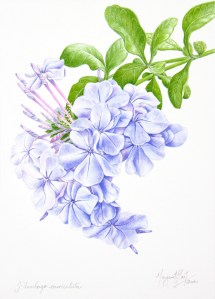
© 2011 by Margaret Best. All rights reserved
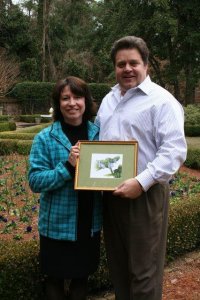
Margaret Best is an award-winning artist whose work is held in the permanent collection at the Hunt Institute for Botanical Documentation and in private collections around the globe. She holds a silver Grenfell medal from the RHS and her work has been shown in many ASBA juried exhibitions over the past decade. She is currently preparing for a solo show of drawings and paintings in Bermuda.
Margaret teaches graphite, color pencil and watercolor classes in Bermuda, Canada, the UK, and the US. She has developed a reputation for connecting with students, regardless of their skill level, and helping them generate their own forward movement.
Margaret is the Feature Artist for April and will also be a contributor to EE Week. Please join me in welcoming Margaret Best!
ARTPLANTAE: Margaret, you have established yourself as an authority on color. Your botanical painting classes are actually color studies. You teach classes about the colors green, red, purple, and blue. What made you decide to develop these color-specific classes?
MARGARET BEST: Actually, I also teach other important technical aspects of producing a botanical rendering such as drawing, journaling, brush techniques, form, composition, texture/detail, etc. However, it is directly through the teaching of these various aspects leading towards the creation of a complete botanical study, that I discovered very few had encountered any formal study of color. Even fewer had been taught how to make meaningful color selections. Most information readily available on the topic of color is often highly technical and very intimidating or too general to be useful to the unique needs of botanical artists.
Some of my students, in the context of botanical studies, have attended classes on color where they were presented with certain color palettes and shown how to achieve other colors through various blending combinations. But these mixing exercises tend to be laborious and result in almost robotic creation of color wheels, squares or strips and did not hold any real understanding of what actually caused the results and how it related to the plant kingdom. And little or no information was provided as to how and why the colors they were being required to mix, were selected in the first place. In essence, if you do not know something about the color you are using to mix other colors, how can you understand the results it provides?
When I first started to take a few botanical watercolor classes myself, I discovered that I would be provided each time with a supply list that included specific colors to purchase. I soon realized that this would change from teacher to teacher. Whenever I asked why particular colors and brands were chosen, I was seldom given a satisfactory explanation. For the most part, the answers appeared to be drawn from a teacher’s personal response to color or their own practical art background, rather than decisions based on sound testing or research of currently available materials.
As an artist I felt compelled to explore all the pigments available to me in watercolor and as a teacher I believed I was required to be able to provide solid reasons for my selections within the botanical context. So I set about testing every pigment I could find and some manufacturers, particularly M.Graham and Winsor and Newton, were very supportive of my interest and my process of testing. Other resources such as the Michael Wilcox books on watercolor paints and handprint.com were also useful, although I found I did not always agree with their test results. I then set about the process of acceptance and elimination of pigment colors based specifically on the interests of botanical art and my need to create a functional palette.
In my teaching, I decided the best way to impart my knowledge was to focus on the individual hues and to have my students explore the possibilities of each in separate workshops. We test and analyze the individual pigments for suitability to botanical art and then apply the knowledge in a botanical rendering to reinforce their findings.
AP: What is your opinion about the use of a limited palette for botanical artists?
MB: Unfortunately, Mother Nature provides a wider range of color than can be achieved with six primary colors. Full-spectrum color in painting just cannot be simplified that way – it is frankly too restricting and color accuracy is a distinct part of the scientific component of botanical art. I am aware that some teachers suggest the use of a limited palette of six primary colors to minimize the upfront investment in paints and also to encourage students to learn how to mix a wide range of color options by varying the ratios in the combinations of the chosen six colors.
Also, I have taken classes from teachers with this limited palette approach and watched the “pain” that fellow students (with minimal color knowledge) experienced from the limitations it imposed. But I know from years of experience in my own painting and also 22 years of teaching color matching in a commercial world, that this is a very complicated and stifling approach especially to beginners.
There are some fantastic secondary and tertiary colors available in permanent, mono-pigmented form right in a tube. These will add more vibrancy and life (as well as easily repeatable accuracy) to a botanical painting than most complex, blended primary color combinations.
AP: Besides the actual hue performance of pigments available on the market, are there any other properties of pigment that are important to know?
MB: Definitely. Most importantly permanency, transparency and toxicity.
I urge my students to avoid the allure of brilliance in colors like Opera that are not lightfast. The English artist Turner ignored warnings that he was using paint that would fade over time. Imagine having a legacy of being an artist that knowingly sold paintings that would fade!
The vast majority of my paints are transparent and I encourage students how to utilize that transparency to the fullest extent. Some colors offered in watercolor ranges could be arguably termed gouache – very opaque. I know some wonderful gouache painters but do not enjoy this medium personally or currently teach the use of paints that contain white pigment. I should also point out that I avoid paints that contain black pigment too.
On the topic of toxicity, I gave up cadmiums many years ago and took this message to my students – not only because of their toxicity but also because of their opacity. There are so many other wonderful options in yellow, orange and red hues to cadmiums that are transparent and very effective in color matching.
AP: Margaret, don’t you have a “white” class too?
MB: Indeed I do give a class on how to paint white flowers. But I offer this to more experienced students and those that have attended some of my color workshops. I believe you need a certain understanding of how to achieve the colors you want through exploring color before you can approach ways in which to “imply” whiteness with the appropriate degree of delicacy and light bias.
AP: You study color with such enthusiasm. What is it about color that gets to you?
MB: In my life BB (Before Botanicals) I was actively involved in a company with my husband, selling and distributing pigment to textile printers. This has spanned a period of 22 years. Incidentally, I remain involved in a technical , advisory capacity.
The demand on textile printers, by retailers and major clothing brands, for color accuracy is extremely high. I learned very quickly the value of consistent high quality pigment in order to be able to produce efficient and accurate color matches. I also became aware in a very hands-on way just how many colors were required in a basic palette to cover the blending of just about any color that was thrown at me. Vibrant, dull, muted, pastel or any other descriptive word – it had to get done with speed using the least number of pigments to make it easily repeatable. I trained color matchers, working for printers in all the major cities across Canada, how to accomplish this with our pigments.
So I guess this ability to respond to a demanding world of color accuracy became a part of me. I discovered also that pigments are universal to all color mediums and that the pigments used in textile inks were the same as those used in watercolor, oil paints, the automotive industry, etc. So all these pigments found in watercolors were already known to me. It was not long before I realized that our specific genre has unique color needs and that many paints offered by a number of manufacturers are of no use to us at all. And I felt that my students should know why some pigments can really do wonders for your artistic endeavors while others reduce your colors to a muddy mess.
My strict rule is:
Test and know every pigment you use intimately. Never test a color on a masterpiece!
AP: You learned about the work of contemporary botanical artists in the late ’90s. What type of art did you create before this chance encounter?
MB: I have painted all my life – starting literally when I was a child. My late father decided that few artists make a decent living so I was allowed art as a hobby and he steered me into teaching as a career. He generously paid for me to have weekly private art tuition. I stayed with the same tutor for 9 years and she exposed me to a wide range of mediums. But she encouraged me to focus on graphite, colored pencil and pen and ink rather than watercolor. She favored a loose and painterly style seen in skillful plein air landscapes and flower paintings and because I naturally lean more towards tight detail, I just could not pull it off to her satisfaction. But I could be as controlled and as detailed as I liked with graphite, colored pencil and pen and ink. I was also drawn to architectural studies in a strong way, but then also loved to do graphite and pastel studies of animals as well. Interestingly though through the years, I often sought botanical and found applying the intense detail very satisfying.
AP: Do you remember the botanical painting or drawing that caught your attention? What was it about this painting or drawing that moved you?
MB: I experienced a landmark moment but it was not one single painting that set me on this course. I remember (and will eternally treasure) the occasion when I realized that what I had been creating from time to time over a number of years was actually a defined genre called botanical art. I was amazed to discover that there were other crazy people like me around the globe that reveled in fine-detail depictions of flowering plants.
After immigrating to Canada some 30 years ago with my husband and then infant daughter, I was fascinated by the plethora of wildflowers that emerged in a burst of color each spring. So I began depicting them in colored pencil in fine detail. But believing them to be a personal record of my pleasure at the colorful emergence of life after a long, frozen winter, I kept them for my own and my family’s enjoyment and never attempted to exhibit them. They were framed and hung in our home and often drew admiring comments from friends. But they remained just that – records of the beauty of a spring awakening.
I consider my “chance encounter” with botanical art to be a gift from my mother. In the late 90’s, when visiting her in England to help her cope with health difficulties, I was encouraged by her to see an exhibition that had been promoted on a local BBC radio program. I was skeptical about the accuracy of my mother’s information but decided that a drive into the country with her on a sunny day was a great idea. If we could find the place she had noted on a small piece of paper, that would be a bonus.
After considerable searching we did find it. The exhibition was in a gallery in the grounds of a historical stately home at Twigworth and the artist featured was renowned colored pencil artist, Ann Swan. I took one look at her work and gasped at the fact that I had found another crazy person that had this intense love of detail in botanical subjects. And furthermore it appeared that she was successful at doing it .… for a living!!! I spent the next hour or more talking to her and pummeling her with questions. As a true educator and without hesitation, she generously gave me all the information I wanted to know about her materials, the existence of the botanical art organizations and so much more. I felt indebted, loved her work and bought a large print from her. I raced out the next day and bought all the colored pencils and paper she used. That was it – I have not stopped since – but I did make the switch to watercolors. Ann Swan is one of the leading botanical artists of our time in her particular medium and fully deserves her global recognition. I am not sure if she is aware of the impact she had on me as I have not connected with her since.
It was the legendary Anne-Marie Evans who helped me decide that the way I instinctively wanted to use watercolor would be highly suitable to botanicals and I made the switch of mediums. But I have never lost my love of both graphite and colored pencil and have returned recently to teaching both of these mediums.
Sadly, my mother has since passed away but I still have that piece of paper on which she wrote her note about the exhibition. A treasured reminder of her link to my future artistic endeavors.
AP: One of the things I admire most about your work is the movement in each of your pieces. There is always something flowing, bending, or swaying. How do you decide which aspect of a plant’s energy to capture?
MB: It is interesting that you have mentioned this aspect and that my work speaks to you in this way – quite a few people have said the same thing to me.
I believe it is linked to my intense study of every plant I depict before I commit to a final composition. And I feel it is essential in my teaching to have my students understand the importance of the observation and sketching/journaling stage. Many just want to get a drawing down in a hurry and start painting – that eternal pursuit of the instant masterpiece without having to earn it. But observation and sketching is the juncture at which you explore every facet of the plant’s unique structure and start to understand it – really understand it.
I distinctly remember Ann Swan saying that sometimes she takes up to a week or longer to work out a composition. That puzzled me at first. I felt I would possibly be too impatient for that approach and besides some specimens can die while the artist dithers about. But then I also read Margaret Mee’s book and how she relied heavily on journaling and photography to become fully acquainted with her subject and she insisted (as does another person I admire – Auriol Batten) on understanding where and how it grows. So it is rare for me to choose a subject in a pot or cut blooms from a flower shop. I prefer to experience firsthand how it grows naturally, how it adapts to a rocky cliff or how it hangs from the tree, etc. Living in Canada, that can be challenging as I have only 3 – 4 short months in which to do all this. So it is not surprising that most of my paintings involve plants found in other regions of the world. I have now been to Bermuda three times drawing like crazy (and teaching) in preparation for my upcoming exhibition.
I need to see how the flower holds itself naturally, how the stem curves, how the leaves are attached and the angles in which they are positioned relative to the rest of the plant. I never create just for the sake of creating – in other words I do not just start drawing on quality paper and pray that the composition will just magically evolve along the way. I “think” it all out through my sketching stage considering those unique angles, and any visual movement and flow. Like Ann Swan and most especially my mentor, Pandora Sellars, I give considerable time and effort to composition and how to capture the essence of the plant’s particular personality. On very rare occasions Mother Nature just presents me with a perfect composition in front of my very eyes. But they are unique gifts that do not happen very often.
I always do extensive sketches of the actual specimen and take numerous images with my trusty, little Olympus Stylus. But my drawings always tell me more than the camera. My digitals confirm certain finer details and sometimes interesting aspects of light that I may have missed or not remembered well. But my camera work never controls my color nor final compositions.
AP: Drawing upon your many years of teaching botanical art, how do students learn botanical art? Can your observations be grouped into “phases of learning”?
MB: The quick answer is that I have not sat down and formally attempted to categorize the adult art learning process in specific phases or stages. I am having so much fun with the hands-on teaching that currently draws from my own training as a professional educator, that at least in the short term, I will probably leave this to the academics of education. But I concede it is worthy of a doctorate study – if it has not already been done.
From my experience the defining phases of learning art is so much easier with children under the age of 12 that are still relatively free of inhibitions, fear of failure and other complex human behaviors that comes with adulthood.
I often say that when teaching art to adults it “can be like a box of chocolates” – you never know what you are going to get. Adults often come along with a mixed bag of just about everything ”The Good, the Bad and sometimes the Ugly”. I guess I have been hanging out in Hollywood quite a bit recently!! Joking aside, in teaching adults it is important to maintain a sense of humor and I have focused more on assisting my students to tear down the acquired obstacles and self-created barriers that get in the way of progress. I see this as essential for them to make the vital leap from knowing that to knowing how. And I then attempt to build the bridge between the two separate stages with my students but not for them.
Perhaps this can help explain. Most people remember with pleasure when they learned to ride a bicycle and the joy they felt to be in motion. Before getting on to a bicycle you observe and understand that it is the feet that keep the wheels turning and maintain the forward motion, that your hands steer the direction and that balance ensures you do not fall over. Putting it all together seems a monumental task until the exquisite moment when you experience the joy of the integration of all three key elements in one effective result. After that, you encounter all kinds of things that may try to slow you down, change your direction or even halt your progress, but once that controlled forward movement is felt and taken on board, the obstacles and any possible pain that comes with it, is taken in stride or put in context. The process of learning art is no different. But what bothers me most as an educator is that the half-hour solution and the need for instant gratification that many adults have learned to expect, sometimes permanently shuts down the process to carry on.
AP: Some notable teachers have created a step-by-step approach. Do you have one?
MB: I acknowledge the value of a step-by-step approach, especially with beginners. The success of this is seen in just how many “how-to” books are on the market. But I have not attempted to formularize my teaching approach and yet, given the amount of time and energy I put into workshop preparations, I sometimes wish that I had. I also believe that formularized art teaching tends to stifle the emergence of a uniquely identifiable style. At some point the student artist needs to embrace a wider circle of information sources that will enhance what they have acquired from the comfort zone that can become established by rigid step-by-step methodology.
I have heard many students say, “I can only paint well in the classroom and I am hopeless when I go home.” This is another manifestation of a rigorously disciplined teaching style. At some point the trainer has to let go of the bicycle saddle or take the training wheels off!
Rembrandt, for example, taught with a rigid approach that caused his students to paint so tightly in his particular style that it has taken experts centuries to separate his works from that of his students. I do not believe copying photographs or other renowned artist past or present, is the way to foster the meaningful learning of HOW TO.
But despite what I have said here, I should also point out though that in every class I offer a road map. My teaching is never directionless. I explain carefully what it is that I wish for (students) to learn from a particular exercise and how to fit it into their world. But I cannot make them fit into their world. They must be compelled to find the bridge and cross it and I feel honored if I can provide that opportunity. It is that moment that I find so rewarding – the moment when I know that I made a difference.
AP: If you were asked to provide a “Top 5 List of Suggestions” for classroom teachers and informal science educators wanting to incorporate botanical drawing and painting into their curriculum, what suggestions would be on your list?
MB:
- The need to nurture a fascination of plants and their importance to the survival of our planet, before a student even lifts a pencil. So the subjects chosen must have real significance in terms of their everyday lives.
- That botanical drawing is a scientific art form that is very literal and that it is a creative form of record keeping that has been with us longer than any other art form. This enforces its value.
- Educators need to foster the belief that every human has the ability to draw with meaning – it is only negative outside forces that can create a different belief system.
- The fact that every mark they make on a piece of paper with a drawing tool has value in terms of sharing information with somebody else. The more effective it is, the more information they can impart without words either written or spoken.
- That it is essential to fully understand the tools for drawing and painting before they can be applied effectively.
Also See…