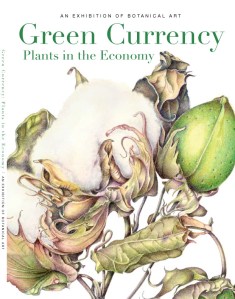
 Green Currency: Plants in the Economy, a juried exhibition of original contemporary botanical art depicting plants of economic significance, opens April 20, 2011 and runs through July 31 at The New York Botanical Garden (NYBG). Forty-three pieces of art featuring plants used for medicine, food, clothing and shelter will be on display as part of this exhibition organized and hosted by The New York Botanical Garden and curated by the American Society of Botanical Artists.
The NYBG Institute of Economic Botany (IEB) has focused research on the relationship between plants and people since its founding in 1981, so the selection of economic botany as the theme for the first botanical art exhibition organized by the Garden was fitting. The ASBA with its headquarters located at the Garden has over 14 years experience curating juried international exhibitions making the partnership between the two organizations on Green Currency a natural.
Green Currency capitalizes on the beauty of nature and the mastery of today’s most skilled botanical artists to portray plants upon which people depend for basic necessities and which fuel commerce around the world. ASBA member artists from the United States and 6 other countries, a number of whom are widely collected, are represented in the show. Works in watercolor, gouache, colored pencil, graphite, acrylic, oil, aquatint, and copperplate engraving demonstrate the variety of media employed by contemporary botanical artists, who create art that is both beautiful and botanically accurate.
An audio tour, interpretive material and a catalog have been produced to accompany the exhibition. Using their cell phones, “visitors will be able to listen to what each artist has to say about their experience in capturing that plant” explains Woodin. Signage throughout the Garden ties the living collection to plants featured in the exhibition. The catalog which has “a bit of an interesting story about each plant in the show, artists’ bios and bios for all the jurors” continues Woodin, will be available at the NYBG Shop in the Garden.
Featured on the catalog cover, Esther Klahne’s contemporary watercolor portrayal of cotton (Gossypium herbaceum), contrasts the delicate brittleness of the dried leaves with the fluffy softness of the ball of fibers, and captures reflected light and color throughout the composition. A graduate of the Rhode Island School of Design, she earned a Certificate in Botanical Art through the Wellesley College Friends of Horticulture Botanical Art Program in Massachusetts. According to the International Cotton Advisory Committee (ICAC), cotton fibers are used to make textiles for clothing, furniture and upholstery, medical applications such as bandages and swabs, and pulp for paper. In fact much of the paper on which botanical art is done is 100% cotton rag. Cotton seeds are used as animal feed, to condition soils, and in the production of cottonseed oil. The USDA reports that the United States produced 12.4 million bales (480 pounds/bale) of cotton in 2009 with the largest harvests coming from Texas, Georgia and Arkansas. The U.S. is the third largest producer behind India and China and the largest exporter according to the ICAC.
Inquiries regarding the purchase of artwork should be directed to asbaexhibitions@aol.com.
The New York Botanical Garden is located at Bronx River Parkway and Fordham Road, Bronx, New York.


