Feeds:
Posts
Comments

Creating learning experiences about the ocean is easy to do if you live near an ocean, can point to it, or lead students to an exhibit where they can see and touch marine life. But what do you do if the ocean is hundreds of miles away? How can you make the ocean relevant to students who may never see or hear waves crash against a rocky coastline?

Today we will address these questions with Captain Suzan Wallace.

Captain Suzan Wallace is a US Coast Guard licensed Captain, a science illustrator, and national board certified visual arts educator with 23 years in the public schools. She’s been teaching sailing and connecting young & old folks to the ocean in creative and exciting ways for over 30 years. Captain Wallace finds ways to integrate the arts into every environmental education program.

Please welcome Captain Suzan Wallace!


ARTPLANTAE: Captain Wallace, thank you for participating in this EE Week discussion about making Ocean Connections. What set in motion your passion for the ocean?

CAPTAIN WALLACE: Thank you for inviting me to share my passion for Environmental Education and the Maritime Arts.

First, I owe my love of water environments to my parents, who raised me on and around the Great Lakes. In between their busy lives as public school educator/coach and nurse, they found time to sail, dive and cruise with us five kids. It was on those precious summer voyages to distant islands that helped grow my love of the inland sea. However, I was also witness to the dramatic effect people and cities have on watersheds…and watching in horror as my hometown Cuyahoga River started on fire due to the amount of pollution the local industries were pouring into it. This single incident fueled my passion for protecting the environment from human carelessness. As a child, I wrote a letter to President Nixon, telling him of the incident and he wrote me back, asking that I become an environmental witness and watchdog for conservation issues. The sailing lifestyle allowed for this intimate relationship with the sea environment to grow within me…..and “we protect the things we love”.


AP: How long have you been working as a scientific illustrator? What type of marine illustration work have you created?

CAPT. WALLACE: I have always felt my science illustration skills grew from my habit of visualizing concepts within all my school reports and class assignments as a youngster. This filtered down into every job I had growing up. Working in a greenhouse gave me the opportunity to illustrate plant informational signage and conservation reports. Upon graduation from college, I started a Marine Graphics business, working with yacht owners, marina operators and folks in “green” industries. Eventually I noticed a steady decline in seafaring arts traditions and began focusing my efforts on more educational outlets. Revitalizing these traditions through the Maritime Art forms of Scrimshaw Graphics/Carving, Illustrated Captain’s Logs and Marlinspike, we were able to help preserve and inspire marine environmental issues in activities with schools, camps, festivals, university and museum venues.


AP: You have experiences with the ocean many teachers do not have. How do you draw from your experiences to teach your students about the ocean?

CAPT. WALLACE: Interestingly, all towns across America have water flowing through them….those “watersheds” all flow to the OCEAN. So whatever is happening to the water in your town, is also happening on a grander scale, to the OCEANS. Growing up inland in the midwest, “up a creek”, I was able to put together how water all flows down stream and eventually to the ocean. So the devastating effects on my river by industry, set an example for me on the human impact. Over the past 30 years I have lived on the Atlantic and Gulf coasts and have been witness to how humans make impact. When the children ask “real” questions, I can give them eyewitness accounts of what is happening, or refer them to fellow sailors across the world who are eyewitnesses to what is happening!


AP: Since many teachers cannot draw upon the same experiences that comes with spending years at sea, how can teachers create visual learning experiences for students that go beyond creating marine life out of construction paper and spending large amounts of money buying activities and visuals at a biological supply house?

CAPT. WALLACE: It is important as a natural science illustrator to document, understand and convey “real” knowledge about a species. The animal kingdom is a part of every school curriculum, and it only makes sense to seize the opportunity to investigate not just what an animal looks like, but to understand their habitat and how they interact within it. One particular project we do is called Tesselling Biomes, where the students have to create an animal sculpture (paper pulp clay) and place it within it’s natural habitat contained within a 3D box (poster board) created by tessellating shapes. Bringing home the metaphor of all things are connected….the web of life.

I also introduce the plight of the sea turtle by retelling an actual expedition experience we had on an island off the Carolina coast. As I tell the story, I am sculpting (modeling oil clay) a baby sea turtle in my hands, of course to size, and then place it in a tray of sand to represent a “boil”….then my students try it. The interesting part is that the story is really about a baby sea turtle whose shell had a rare deformity in the shape of a cashew and no matter how hard he tried to get to the water, his congenital deformity caused him to turn in circles in the sand…..even falling down into a ghost crab hole…(yes he did make it to the water)..of course for the little ones, this is a lesson on perseverance.


AP: You have excellent suggestions about how to create several layers of learning when teaching about the world’s oceans. Let’s say, though, a school lacks an Internet connection and cannot provide learning opportunities complete with sound and video. When ocean experiences can only revolve around books and posters, how can teachers create lively experiences without actually connecting live to outside resources?

CAPT. WALLACE: There are MANY wonderful books about sea life, and as more authors are becoming “green”, there are so many more options. The Environmental Education Week website has a wonderful list of resource books. The accessibility of multi-media downloads is absolutely wonderful today, but in years past, I have used both video, photography and film making to help re-tell the story. One aspect of Art Education 101, is the concept of motivation….we actively plan how to motivate our students. The Arts have a secret weapon….it’s called “emotional impact”. We use stories, poems, visuals, music, paintings, sculptures to help us evoke a sense of wonder and compassion.

But I cannot say how important actual experience will turn the tide in teaching about a subject like the OCEANS. When I first moved to the Carolinas 23 years ago, I lived inland in farmland. So I signed up for a summer staff development opportunity called OPERATION Pathfinder that was supported by Sea Grant. There are numerous workshops/grants that offer inland teachers these opportunities.


AP: The world has been watching events unfold in Japan as a result of the large earthquake and resulting tsunami. Have you ever experienced the effects of a tsunami during any of your travels? Is there anything the public should know about tsunamis that they have not yet been told? Or, is there anything about tsunamis that the public simply doesn’t get because of their limited experience with them?

CAPT. WALLACE: I have not actually been witness to a true tsunami, (have experienced many huge waves & hurricane tides). I take great interest in the comparison of those that use the ocean as a resource and those whose lives revolve around it. I am fascinated by documented maritime gypsy cultures that have an intuitive sense of the ocean and take action for safety well ahead of the tsunami’s impact. I believe, these cultures are “in touch” with the Oceans, and it saddens me that so many land-based cultures have lost this sensitivity.

In order to share the experience of a tsunami, I would have students build a sand castle (or other man-made material) structure and simulate a wave event in a sand box or pile.


AP: Recently I browsed through a sixth-grade earth science textbook. References to the ocean were made in discussions about plate tectonics, currents, water density, ecosystems, and food webs. There are no doubt an endless number of stories that could be told about our oceans. What do you think K-12 students should be learning about the ocean that they are not learning from standard classroom textbooks?

CAPT. WALLACE: We live on an Ocean Planet! Humans are so terrestrial, they forget that the majority of our planet and life is water. It is the cycles of recycled water, the flow of water, the cleansing of water, the refreshing of water, the replenishment of water and the water that is found within us that is all connected. The smallest micro-organism to the largest organism on the planet, cohabitate in water! When we contaminate the water with all forms of human waste and by-product, we contaminate ourselves. I have always believed that to study planet Earth, is to understand the fragile design of checks and balances, and purification process. Planet Earth is a giant ecological Recycling Center!


AP: What advice do you have for young student teachers writing their first lesson plans about the ocean environment?

CAPT. WALLACE: Spend time by the water and watch her flow. I am a firm believer in life-experience. As I always say to my sailing students, “You will not become a sailor until you get up out of your reading chair and get out on the water and into the wind. Then you will begin to understand Nature’s awesome power, and be humbled”.


AP: Thank you, Captain Wallace. Will you be available to respond to questions during this week?

CAPT. WALLACE: Sure, I welcome any questions on the issues of the arts & the sea environment.


Virtual Voyaging

Captain Wallace connects her young students with the ocean in many exciting ways. She utilizes technology to create a learning environment in her classroom that is live and in living color. This summer, she will make such a presentation to scientific illustrators to show them new ways they can explore, interpret, and illustrate the world’s oceans in the 21st century.


Update – September 22, 2013

Captain Wallace has set sail! Follow her and the voyages of the Sparrow on her by watching her video feeds at Ustream.tv.

Jeanne Baret was born in 1740 to very poor parents living in an agricultural community in France. Earning money only when their labor was needed, Baret’s parents often did not have food for their small family. Young Jeanne was destined for a life of poverty and near starvation. However one day, she crossed paths with botanist Philibert Commerson.

Commerson was a young, over-confident botanist who became interested in the medicinal value of plants after he was bit by a rapid dog and monks nursed him back to health with their herbal remedies. When Baret and Commerson crossed paths that fateful day in the field, Jeanne was in her 20s and was a knowledgeable herb woman. She answered Commerson’s questions about medicinal plants and taught him what he wanted to know. Over time, a relationship developed and this relationship set the stage for an adventure neither could have ever imagined.

In 1765, Commerson was chosen to travel with Commander Louis-Antoine de Bougainville on an expedition that was to last three years. Jeanne joined the expedition not as Jeanne, but as “Jean”, Commerson’s young male assistant. Baret went to great lengths to hide her identity and to pull her share of the workload on the Etoile, a storeship measuring 102 feet long and 33 feet wide occupied by 116 men. She collected plants, animals, and documented specimens the way a field assistant should, in spite of growing curiosity about young Jean’s less than male-like male features.

Author Glynis Ridley tells the story of Commerson, Baret, and the famous philosophers and naturalists of the Enlightenment Period in a well-researched and captivating saga based on the handwritten journals of people who traveled with the expedition and on the published accounts of 18th-century naval officers. Ridley transports readers back to the 1700’s and through engaging storytelling, provides readers with insight into the harsh living conditions of the 18th-century and the unfortunate laws defining women and their roles in society. Through her well-documented tale about Bougainville’s expedition, Ridley is able to recreate the tension generated by the spice trade and competing European countries as they raced to establish colonies across the globe.

The Discovery of Jeanne Baret is a lesson in world history, geography, oceanography, anthropology, and botany that is not to be missed.


Author Event with Glynis Ridley

We owe much of our understanding about biodiversity to early explorers. Learn more about botanist and herb woman, Jeanne Baret, in a live conversation with author Glynis Ridley on Saturday April 16, 2011. This live one-hour event will occur in the Discussion forum on ArtPlantae’s Facebook page at 11 am PST / 2 pm EST. You’re all invited!

UPDATE (4/21/11): Read interview with Glynis Ridley

Welcome to EE Week 2011!

National Environmental Education Week (EE Week) is organized by the National Environmental Education Foundation to connect K-12 teachers and their students to environmental resources informing the public about environmental issues affecting all of us. ArtPlantae is proud to once again serve as a national partner for EE Week.

This year’s theme inspires us to discover our oceans and to become more aware of the many ways we are connected to them, even though we may live miles and miles away. This year, like last year, I have had the opportunity to work with enthusiastic individuals committed to helping ArtPlantae show connections between plants, art, and the theme for EE Week. Please join me in welcoming each contributor as they are introduced.

We will discuss several interesting topics this week and learn a lot.

Let’s begin!

Plants are the most important, least understood, most taken for granted of all living things.

– Malcom Wilkens (1988) as cited in Babaian & Twigg (2011)

Biology professors Caryn Babaian and Paul Twigg describe how ethnobotanical topics and the arts can be used to encourage student interest in plants in The Power of Plants: Introducing Ethnobotany & Biophilia into Your Biology Class.

Babaian & Twigg (2011) state that topics in biology ranging from soil science, microbiology, seed biology, entomology, botany, and economic botany can be presented as relevant and timely issues using ethnobotany as a teaching platform.

Ethnobotany is the study of our cultural relationships with plants. The root word ethno– means “nation” (Borror, 1971).

The ethnobotany lessons and accompanying lab developed by the authors were created for a course whose main themes were ecology, culture, and our attraction toward living things (i.e., biophilia as described by biologist E.O. Wilson). Babaian & Twigg (2011) wanted to equip students with the ability to describe the concept of ethnobotany, articulate how plants are used in other cultures, become knowledgeable about local native plants, understand how humans are dependent upon plants for medicine, and experience how the arts can enhance student learning in biology.

To accomplish these objectives, Babaian & Twigg (2011) lead students through several activities.

Prior to studying whole plants, students studied the soil in which they grew. By studying the “rhizosphere” (Babaian & Twig, 2011), students learned about soil science.

Learning about the medicinal value of familiar foods such as onions and garlic, helped students gain appreciation for why medicinal plants must be protected.

A study of how plants are integral parts in the clothing, rituals, and beliefs of people in other cultures provided students a holistic approach to learning about plants.

Discussions about the symbiotic relationship between bacteria and plants served as the foundation for lessons in microbiology, and journaling enhanced the learning experience by serving as a record of what was learned and experienced.

Throughout the ethnobotany course, students kept an ethnobotanical journal in which they documented collection procedures, collected photographs, and illustrated their observations. Babaian & Twigg (2011) advocate the use of drawing as a learning tool because drawing allows students to “stay in the moment” and brings each “student to a more intimate level with the plant” (Babaian & Twigg, 2011). The authors have found this increases student awareness of plants and “increases biophilia” — student attraction towards other living things.

Sample pages of ethnobotanical journals and details about the authors’ lesson plans can be viewed in a free copy of this article now available on the website of The American Biology Teacher.


Literature Cited

Babaian, Caryn and Paul Twigg. 2011. The Power of Plants: Introducing Ethnobotany & Biophilia into Your Biology Class. The American Biology Teacher 70(4): 217-221. Web. 6 April 2011 <http://www.nabt.org/websites/institution/index.php?p=637#April_2011>

Borror, Donald J. 1971. Dictionary of Word Roots and Combining Forms. Mayfield Publishing Company. Palo Alto, CA.


Additional Resources You May Enjoy

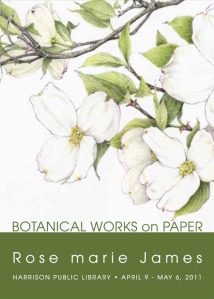
A Solo Exhibition by Rose Marie James
Harrison Public Library Gallery
Harrison, NY
April 9 – May 6, 2011

Rose Marie James is a New York botanical artist working in watercolor and colored pencil. When discussing the value of botanical art and how she works, Rose Marie states:

“I believe botanical art has the unique ability to bring the viewer’s attention to all the physical details of a growing plant – the shape of its leaves, the color of its petals, it’s growth processes. It also endeavors to illustrate the intangible – its manner, its stance, its aliveness, its beauty.

I collect specimens from my garden, from the roadside and woodlands, preserving them in pots and water jars, cooling them in my refrigerator or sunning them on my sun porch.

I start with detailed pencil line drawings on tracing paper, studying the live specimen and taking photographs to create a reference. Using a magnifying glass or printer’s loop to study details, I may dissect significant components that I want to add to the drawing, or I might unearth the plant to reveal its root system. I finally do a series of color studies to determine matches to the live specimen; the color mixes are notated for consistency and future reference. Finally the process of rendering begins. Working with watercolor paint, or watercolor pencils with colored pencils on Fabriano Artistico paper, I strive to bring the drawing to life, to illuminate the forms and colors – and the intangibles – so the viewer will see the plant anew and pronounce it beautiful.

I shall forever be a student studying with other botanical artists. I find that each artist has different skills and knowledge to offer. Along with studying and creating new work, I also teach classes in botanical illustration for the New York Botanical Garden.”


You’re Invited!

You are invited to meet Rose Marie James at the artist reception that will be held for her in the Main Library on Monday, April 11th, 7:00 – 8:45pm. All are welcome. Click on the image to download the postcard.

Rose Marie’s work can be viewed in the Members Gallery of the American Society of Botanical Artists.

Carol Creech of CCreech Studio is a part-time artist who works in pen & ink, colored pencil, and graphite. She is a member of the American Society of Botanical Artists and the Guild of Natural Science Illustrators. She is also a business woman and has generously offered to discuss her use of Zazzle.com, a service that enables designers to create one-of-a-kind products featuring their designs and artwork.

Please welcome Carol Creech!


ARTPLANTAE: Thank you for participating in a conversation about the business of art with ArtPlantae readers. How do you balance time spent on business-related activities with time spent drawing and painting?

CAROL CREECH: Hello and thanks for having me! To answer your question, it can be challenging to balance drawing time with business activities, especially when I am currently just working part-time. The To-Do list is long on both sides! But as much as I enjoy doing the artwork, it’s equally exciting to get things uploaded and “out there” on Zazzle. I have spent a good bit of time over the last few months getting my storefront up and running. Not only is my work available to the world at large, but I can order small quantities of my own products (note cards, or other items) to use as promotional donations locally, as well as personal gifts to family and friends. It’s a great tool.


AP: On your website, you show examples of the wonderful house portraits you have completed for homeowners. Do you create illustrations for commercial home builders as well? How long have you been illustrating homes?

CC: I have not ventured into illustrations for commercial home builders. The house portraits can be time consuming to do as I tend to be very detailed in my style. It’s what people love about them, and what I love to focus on when I draw them, but doing that on a regular basis would be more involved than I have time for at the moment.


AP: When creating your animal portraits, do you visit with the star subject for a while to get a sense of his/her personality (e.g., see camel)? How do you know when you’ve captured “personality” in a drawing?

CC: Interestingly, I usually create the animal portraits only from photographs. If I have a chance to take the photos myself (e.g., the camel) then I can tell when I have captured the right view of the animal for a good portrait. The key to any good animal portrait is usually the eyes. If you can render the eyes, which I always do first, and capture the essence of the animal there the rest of the portrait will fall into place.


AP: How did you learn about Zazzle.com? When did you open the CCreech Studio Store on Zazzle?

CC: I opened my store back in 2009, but just recently started working on building it up since last October. I had heard of Zazzle on one of the art lists I follow. I am embarrassed that I can’t remember which one! I did some additional research online, and it seemed like a good option. I had wanted to find a way to get good quality note cards of my work printed in small quantities, and I have to say that Zazzle’s cards are fantastic in their quality. I love how my artwork looks on them!


AP: You feature 23 product categories in your store. How many product categories are possible through Zazzle? How did you decide upon the product categories you have chosen?

CC: There are currently 45 product categories listed, but within each category there are often multiple options. For example, within the tote bag category you can choose from six different styles, and within each style, a variety of different colors. Plus, Zazzle is always coming up with more product categories, most recently adding keychains, necklaces and coasters. I decided on my product categories by choosing ones that I thought would look good with my drawings, many of which are botanical subjects. So, obvious products like cards, buttons, and stickers work well, but also items like aprons, mousepads, and letterhead. Bottom line is that you never know what might appeal to someone, so give it try and see how it looks!


AP: How many pieces of artwork have you used on Zazzle products?

CC: I think about 25. I also have done some simple enhancements by adding digital borders and backgrounds to a few pieces and that has been a great way to expand my offerings.


AP: What types of artwork works best on Zazzle products? Are there specific media or colors that reproduce better than others?

CC: So far, all of the media I have used seems to reproduce really well! I am a big fan of pen and ink and have been very pleased with how my ink and colored pencil combination drawings have reproduced. Although I have to say that the drawings using colored pencil alone look just as great! I think as long as you upload digital images that are of an appropriate resolution and make sure that they look good on the products you are designing, then you will be very happy with the results. One area that I am careful with is the T-shirt category as they have so many different color combinations available for customers. Some of my artwork only looks right on lighter colored shirts. Fortunately, Zazzle allows me to choose that as a limit, so I can assure that potential customers only see my work at it’s best.


AP: What types of plant images sell better — images more in line with traditional plant portraits or stylized botanical images?

CC: I know that Zazzle has many designers offering floral work, whether traditional photos, drawings or paintings, as well as stylized graphic designs of botanicals. I’m really not sure which sells better. I tend to prefer the traditional style and my work reflects that, so I am hoping that with some additional marketing I can draw in (no pun intended) people who appreciate the simple beauty of a single, well-drawn flower or plant. We shall see!


AP: Have you tried making prints or posters of your work? If so, how did your prints &/or posters turn out?

CC: I have not yet ventured into prints or posters. That is one of the things on my To-Do list! Zazzle does offer great quality prints and posters, so I’d like to explore that further.


AP: Is Zazzle easy to use? Briefly describe the designing process.

CC: Zazzle is very easy to use, in my experience. To start, you choose Create from the navigation bar at the top of the Zazzle page and follow the buttons and prompts to upload the image you want to use. There is a design view that lets you adjust the size of the image by reducing or enlarging it, dragging it around the product template until it fits properly. You can then choose to add text, customize font style and size, and even add background colors and borders, depending on the product. Then you can choose to order your product yourself, or post it for sale in the marketplace. When you post for sale, you select up to two subject categories, and add a title, descriptions and keywords so that potential customers can find your item. It’s surprisingly straightforward and easy to do.


AP: Does Zazzle allow sellers to keep selected items as on-site inventory so they can have products for sale at their studio for events such as studio tours?

CC: Absolutely! This is one of the things I love about Zazzle. You can order your own products, with a seller discount and possibly quantity discount depending on how much you order, and keep them in your studio or have them to sell at an art show, etc. I have ordered sets of my own note cards for blog giveaways as well as a couple of local fundraising events that I donated to recently. It’s a wonderful way to get high-quality products of your own work without having to invest in large print runs.

Thank you, Carol, for telling us about Zazzle and about your experiences with the service.


Would you like to ask Carol a question?
Please post your question below.

Click on the image to see Carol’s complete line of greeting cards.

A quick reminder that EE Week begins on Sunday and, like last year, I will post to this site everyday during EE Week. This means I will post daily through Saturday April 16, 2011.

This year’s EE Week theme is Ocean Connections. The generous and enthusiastic contributors to EE Week 2011 have made it possible to link plants, art, and the ocean in support of this year’s theme. I hope you enjoy learning from them as much as I have.

You are invited to participate in a live conversation with author Glynis Ridley on the Facebook page on April 16th. Glynis will discuss her new book, The Discovery of Jeanne Baret: A Story of Science, the High Seas, and the First Woman to Circumnavigate the Globe. The story of Jeanne Baret is fascinating and Glynis conducted several layers of research to piece together Baret’s story. You don’t want to miss this conversation. Mark your calendar and please join us on the Discussion page at 11 am (PST) / 2 pm (EST) on April 16.

If you’re in southern California, consider kicking off EE Week with ArtPlantae at the Spring Fair & Art Festival at Tucker Wildlife Sanctuary this weekend, April 9-10 (9 AM – 4 PM, daily). There will be live music, art & craft demonstrations, guided nature hikes, and more. Tucker Wildlife is operated by the College of Natural Sciences and Mathematics at California State University, Fullerton.

Can’t kick-off EE Week with a Spring festival? Then consider ending EE Week at the 25th Annual Avocado Festival in downtown Fallbrook in north San Diego County. ArtPlantae will on the Avenue of the Arts during this one-day festival occurring on Sunday April 17 from 9 AM – 5 PM. The Avocado Festival brings in about 70,000 people each year, so come early, bring your walking shoes, and your appetite!


And don’t forget your map…