Feeds:
Posts
Comments

© Karen Luglein. All rights reserved

Green Currency: Plants in the Economy, a juried exhibition of original contemporary botanical art depicting plants of economic significance, opens today and runs through July 31st at The New York Botanical Garden.

This exhibition is hosted by the New York Botanical Garden and curated by the American Society of Botanical Artists (ASBA). The exhibit catalog features each of the 43 pieces of art in the exhibition, as well as background information about each plant, artist bios, and information about each juror.

The corn painting above was created by illustrator, Karen Kluglein. Karen shows the luminous effect of watercolor on vellum in her painting of Corn (Zea mays). An instructor at The New York Botanical Garden, Kluglein received ASBA’s 2010 Award for Excellence in Botanical Art Painting and Best in Show at ASBA’s 13th Annual International Juried Exhibition at the Horticultural Society of New York.

Learn more about this exciting exhibition at http://www.asbagreencurrency.blogspot.com.


Also see…

“Green Currency: Plants in the Economy” Opens This Month

National Environmental Education Week at ArtPlantae came to a close on Saturday with a wonderful conversation about herb woman Jeanne Baret and the expedition led by Louis-Antoine Bougainville (1766-1769). My conversation with the gracious Glynis Ridley was held in the Discussions forum on the Facebook page and has been posted below for you to read here.

I would like to thank all contributors to EE Week 2011. I will always be grateful to them for sharing their time and expertise with us. The following individuals and organizations made it possible for ArtPlantae to bring attention to topics connecting plants, natural science illustration, and our oceans:

Saturday’s wonderful Facebook author event with Glynis Ridley has been posted below. This version has been reformatted so that the links appear in the appropriate places. I have omitted our encounter with technical difficulty. You can read the original version online.

Looking for an adventure with which to kick-off your summer reading? Look no further than Jeanne Baret’s journey on the Bougainville expedition! The Discovery of Jeanne Baret can be purchased online from independent bookstores at IndieBound.


AP
: Welcome to our conversation with author Glynis Ridley! 
Allow me to introduce to you Glynis…

Glynis Ridley is an Associate Professor at the University of Louisville in Kentucky. Her research interests are in 18th-century studies, the history of rhetoric, and animal studies.

Glynis was awarded the Institute of Historical Research Prize (University of London) for her book, Clara’s Grand Tour: Travels with a Rhinoceros in Eighteenth-Century Europe. Please welcome Glynis Ridley!

GR: Thanks for the kind introduction. I’m delighted to be here.


AP
: Glynis, I have thoroughly enjoyed your book and am excited to have the opportunity to discuss it with you. Here is my first question…

You first learned of Jeanne Baret from your husband who was preparing a paper about French explorers Louis-Antoine Bougainville and Jean-Francois de Galaup, comte de La Perouse. You mentioned you found almost nothing documented about Baret. Where did you begin your research? How long before you had enough information to articulate this biography of Baret’s life?

GP: My husband introduced me to Baret back in 2001, showing me the single paragraph in Bougainville’s journal that mentions her. When I realized the implications of Bougainville’s journal entry – that a woman disguised as a man had apparently remained undetected on board an sailing ship for a year and a half until frightened into revealing herself by the natives of Tahiti – I was just suspicious. It seemed improbable that a woman could successfully maintain her disguise in the close quarters of a sailing ship – a view only reinforced when I found out the dimensions of the ship she sailed on. The Étoile was 102 feet long and 33 feet wide with a compliment of 116 men. So when I was thinking about a new book project back in 2008, I kept coming back to Baret’s story as something that intrigued me. I began by reading everything I could find published about her (which is not much). Then I read the published accounts of the expedition – these have been collected and reprinted by various French publishers in the last two decades. They made me realize that Baret’s story was also the story of the first French circumnavigation of the globe, and I began to think that a book might be possible. The book was contracted at the end of 2008, on the basis of a 40-page synopsis (so the contours of Baret’s story had already emerged for me during that year). I completed research – and writing the first draft – across 2009. Then the first half of 2010 was devoted to editing – at which stage I had to take out any speculations I didn’t have good evidence for. You’ve just made me realize that’s 3 years of trying to find solutions to puzzles about Baret’s life and about the expedition.


AP
: Only eight written accounts of Bougainville’s expedition exist. One account belongs to expedition volunteer, Charles-Felix-Pierre Fesche. The journal of Charles-Felix-Pierre Fesche contains a lot of flowery, period-specific language. I am assuming all the journals were written in this way. How did you decipher the language of the 1700’s?

GR: Some of Fesche’s style is distinctively his – some is period convention. For example, this was an age when men and women with literary aspirations often peppered their writing with classical allusions in an attempt to show they knew their stuff. Travel narratives (both fiction and non-fiction) were very popular in the 18th century and Fesche undoubtedly toyed with the idea of publication. This may help to explain some of his literary flourishes. I’ve been specializing in study of the 18th century since I was an undergraduate and, since I read 18th century writers for work and pleasure, their language probably sounds less strange to me than to someone reading such writing for the first time. I promise you that if you were immersed in it for even a few weeks, it would start to seem perfectly normal!


AP
: Have you had the opportunity to view each handwritten account of Bougainville’s expedition?

GP: Yes. But I couldn’t have done this without my husband. Let me explain. He is a professor of French and, like me, he is also an 18th century scholar. When I realized that there was more material I needed from particular archives, I could always split the work with him: armed with a digital camera, he has spent many hours on my behalf taking pictures of some of the handwritten accounts. (I should stress that this was always with the agreement of the relevant museum or library.) The result is that, sitting at my laptop right now, I’m a couple of clicks away from images of the manuscript pages of Bougainville’s notebook and Commerson’s herbarium, among other texts. Between the two of us, we’ve seen and/or taken digital photos of all the main texts referred to in the book.


AP
: Pierre Duclos-Guyot was the son of the captain of the Boudeuse, one of Bougainville’s ships. Pierre traveled on the other ship (the Étoile) with Commerson and kept a joint journal with him. You mention this joint journal is now known for the watercolor paintings it contains. Are Commerson’s paintings of newly discovered plants and animals available for viewing, either in-person or online? (pg. 7)

GR: Let me address that previous question from before I lost the feed. Commerson’s papers are housed at the Muséum national d’histoire naturelle in Paris. Let me make a distinction between his manuscript notebooks, the herbarium he complied as a teenager, and illustrations and paintings he made in his expedition notebooks (or instructed Paul de Jossigny to make on Mauritius). All of these can be viewed in person at the Muséum though, as is common in all institutions that care for such unique historical artifacts, Muséum curators will want to know your reasons for needing to see the collection, and will want to satisfy themselves that you can handle them appropriately. Only a handful of images from Commerson’s expedition notebooks have been reproduced in books; even fewer have been digitized. That’s a great pity because it would be wonderful to be able to access this material online. When I was thinking about illustrations for the book, I found that only two pages from his teenage herbarium were circulating on the web, and only a single image he instructed Jossigny to make on Mauritius was available. The Muséum national d’histoire naturelle made three images from Commerson’s herbarium available to me but only one (showing pressings of hyssop and marshmallow) was finally used in the book. Unfortunately, color plates increase the cost of a book so the images in the book are reproduced in black and white. I’d love to see more images from the expedition available on the web in their full color glory.


AP
: The Wikipedia entry for Commerson states he was clueless about Baret’s sex. How often is it written that he was as shocked as everyone else that Baret was a woman?

GR: This story is everywhere. If you put ‘Jeanne Baret’ into your search engine of choice, you’ll end up finding a very short list of all the books that discuss her, in addition to my own. I’m the only person who has written on Baret to suggest that it is simply preposterous to believe that she concealed her identity for eighteen months before she revealed herself on Tahiti. Of course, when Commerson says that he was as shocked as everyone else, this could be – strictly speaking – true. If everyone suspected that Baret was a woman within a few days of the store ship leaving port, then Commerson was as shocked as everyone else because no one was shocked at all! But I digress. Let me illustrate the prevalence of the Wikipedia information in a different way. A couple of years ago, my husband was at a conference on French maritime history. In one of the coffee breaks, he found himself talking to a retired French naval officer who was familiar with details of the Bougainville expedition. My husband explained to the group that had gathered around them that I was working on a biography of Baret, and that I thought Commerson and Bougainville should not be believed when they claimed not to have known that Baret was a woman before the expedition landed on Tahiti in April 1768. The naval officer was not impressed and insisted upon the truth of the standard version of events i.e. the Wikipedia version. I was astonished to hear about this exchange – but an alternative version of events is clearly still too awkward to contemplate for many people. And there’s a lot of recycled and inaccurate information on the web.


AP
: While reading your book, I kept cross-referencing the people and events in your book to people and events related to botanical art. Your references to Jean-Jacques Rousseau prompted me to pull Rousseau’s Pure Curiosity: Botanical Letters off the shelf. The more history I read, the more I am surprised by who knew whom and how intertwined the lives of the big names in history seem to be. When researching a subject, how do you decide which cross-reference to explore? When do you know when to stop?

GR: I wanted to be able to give the reader enough context to be able to understand the importance of a particular character or to appreciate the relevance of certain information. Since you’ve mentioned Rousseau, and his interest in botany, let’s take him as one example in this discussion. He is an intriguing character – not to mention a major figure in 18th century France. Personally, I’m fascinated by his interest in projecting botanical images on magic lantern slides – the magic lantern was a sort of primitive projector. What it projected onto a big screen was typically an image painted on a glass slide. Rousseau enjoyed this as a solitary pleasure, but magic lantern shows were generally popular entertainments for groups in both public and private gatherings. But, you see, I’m already in danger of wandering off topic – I could spend a couple of pages describing magic lantern shows and Rousseau’s interest in them. I could talk about his well-documented interest in botany. But the aspect of Rousseau’s life story that best helps illuminate aspects of Jeanne Baret’s life and experience is the fact that Rousseau had a long term relationship with a woman considered his social inferior, and he persuaded her to give up their five children to the Paris Founding Hospital. Readers need to be able to see the relevance of information to the central character or central storyline. I might want to share my interest in Rousseau and botany, but I have to be aware that readers might be thinking, ‘why is Rousseau important to Baret’s story?’ Fortunately, writers don’t have to make these judgment calls on their own. The first draft of a manuscript might contain a lot of cross-references and apparent tangents. Editors bring a fresh perspective to a text and suggest where information can be cut – and also where it needs to be added. For me, it was helpful to keep reminding myself that I needed to put Baret’s experience at the center of things – in so far as this was possible.


AP
: If taxonomy was an obscene topic for women in 1768 (per William Smellie’s comments on page 9), when or how did it become fashionable?

GR: A lot of academics have asked the same question fairly recently and there’s an excellent book on the subject by Ann B. Shteir called Cultivating Women, Cultivating Science: Flora’s Daughters and Botany in England, 1760 to 1860 (1996). We need to distinguish between the ability to talk about the beauty of nature – which was always a fashionable accomplishment for middle and upper class women in the 18th and 19th centuries, and the pursuit of botanical knowledge, including an understanding of the principles of the Linnaean classificatory system. It was only at the end of the 18th century that books aimed at women readers started to take their potential interest in taxonomy seriously. Before this time, it’s possible to find women such as Lady Margaret Cavendish Bentinck, Duchess of Portland (1715-1785) corresponding with Rousseau about Linnaean taxonomy but she was an exception rather than the rule.


AP
: I have a book called The Little Botanist (1835) that celebrates a conversation between a mother and her young daughter. In this conversation, the mother teaches her daughter botany. This book was published 69 years after Bougainville began his expedition. When did female botanists stop being “a breach in the natural order of things”?

GR: When The Little Botanist was published, a woman called Marianne North was only five years old. In the course of her life, she would spend fifteen years crossing five continents to illustrate the world’s flora. Anyone who visits Kew Gardens in London – or who checks out their website – will find the North Gallery displays a selection of her watercolors. So the 19th century was a period of greater acceptance of women’s ability to engage with botany. And women’s interest in botany was undoubtedly stimulated by books on the subject aimed at young female readers. From the end of the 18th century, there are Charlotte Smith’s Rural Walks (1795) and Rambles Farther (1796). When the women who read these became mothers and grandmothers, they were better placed to provide instruction in botany than previous generations of women had ever been.


AP
: In your teacher’s guide to The Discovery of Jeanne Baret, you include a question about female botanical illustrators and 19th-century women travelers. The question you ask is, “Why do you think these women are not better known?” 


At the risk of oversimplifying things, I think there are two reasons why they are not better known — 1) During their lifetime, they challenged people’s assumptions about who they should be, and 2) I suspect they evoked a “Who does she think she is?” response from their peers. As a result, people were not motivated to learn more about these adventure-seeking women or to tell others about them. Is the explanation really this simple? How might a historian begin to answer your question?

GR: Your answers are really good ones in terms of thinking about responses to these women during their own lifetimes. But in suggesting this question in the teacher’s guide, I suppose I was thinking that a teacher might ask a class to consider not only the reception of these women by their contemporaries, but their treatment by successive generations of historians. Today, scholars who would define themselves as working from a feminist perspective might say that women like Baret have languished in historical obscurity because of both their gender and their humble social origins. It’s not just Baret’s contemporaries who showed a stunning lack of interest in her story – no 19th or early 20th century writers tried to investigate her achievement. A teacher might ask a class to consider the rise of women’s suffrage movement and the resistance it encountered, with women being told they lacked certain capacities and were somehow inferior. It’s harder than it should be to challenge such views if there are few histories of remarkable women around. Now there are women’s studies departments in colleges that ask students to think about how and why women’s histories have become an accepted part of publishing and teaching. A lot of students who take courses in women’s writing or women’s history today don’t realize how relatively recently these subjects have gained academic respectability.


AP
: Glynis, thank you for telling Jeanne Baret’s story and for speaking with us today. 

While I was reading your book and thinking about cross-references to this and to that, it made my yearning for a floor-to-ceiling whiteboard on a really, really long wall that much stronger. I enjoyed reading your book and I find I am relating other events to the year 1766.

To all of you who have followed our conversation, thank you for joining us. 

I would also like to thank everyone who has followed ArtPlantae during National Environmental Education Week.

Glynis, thank you for your time today and for teaching us so much.

GR: Thank you so much, Tania. Apologies for the glitch in the middle of the interview but I’m pleased we got it going again. Thanks for inviting me to discuss Jeanne Baret’s story and share it with more people. She deserves to be better known and celebrated and events like this will hopefully help with that.


You May Also Enjoy…

Students think plants are boring. To challenge this viewpoint, we need to find a way to generate student interest in plants. But how?

We can begin by contemplating the findings of Niels Bonderup Dohn at the University of Aarhus in Copenhagen, Denmark. In Situational Interest of High School Students Who Visit an Aquarium, he investigated the factors triggering situational interest during a field trip to a local aquarium. He created a systematic approach of documenting interest because evaluations of visitor interest in a museum setting is usually anecdotal. As Dohn (2011) points out, teachers and docents may have a sense about how they can get their audience interested in a subject, but there aren’t data supporting the accuracy of their hunches and observations. Because the specific factors generating interest in museum settings have not been well documented, he set out to observe high school students as they learned about local marine life during a class field trip. Dohn (2011) asked a simple research question: How is the situational interest of students triggered during a field trip to an aquarium?

To find out which elements of the museum experience generated student interest in the ocean, Dohn (2011) did more than just follow sixteen 12th-grade students around the aquarium. His research began in the classroom eight weeks before students visited the aquarium. He observed, interviewed, and videotaped students for ten weeks. He collected data in three phases. In Phase 1, he observed the lectures students received in preparation for their visit to the aquarium. The second phase of data collection occurred during the field trip to the aquarium. Data collected in Phase 3, occurred in the classroom and consisted of follow-up interviews with students and their teacher.

Dohn (2011) collected data by conducting informal conversational interviews with students, videotaping students in the classroom and at the aquarium, conducting formal interviews with students, interviewing the classroom teacher, and by reading student reports about their ten-week experience learning about ecology, population biology, and the ecology of the Kerteminde fjord.

To analyze the wealth of qualitative data he collected, Dohn (2011) conducted a chronological review the the data and then applied codes to the transcripts of his conversations with students to help him identify the factors, as stated by the students themselves, generating situational interest during their visit to the aquarium.


Dohn’s Observations

The following “triggers” (Dohn, 2011) were identified as factors generating situational interest in students:

  1. Social Involvement – Being in a group, belonging to a community
  2. Hands-on Activities – Handling objects provided for concrete learning
  3. Surprise – Learning the unexpected, having flash moments of insight
  4. Novelty – Learning something new, participating in unique activities
  5. Knowledge Acquisition – Building upon prior knowledge

Early interviews with students indicate students thought the subject of ecology was “boring” and “abstract” (Dohn, 2011). Student opinions about ecology changed after visiting the aquarium. All students said ecology was more interesting to them after the class field trip and their positive feelings about ecology and the ocean lingered for at least a couple weeks after their aquarium visit. It is not know if these feelings lasted longer or motivated students to learn more about the ocean on their own. Dohn (2011) did not investigate student interest after Week 10.

Dohn (2011) states his findings may not be applicable in all situations and cites his small sample size and the unique snorkeling opportunities at the aquarium as some reasons. He acknowledges that students visiting an aquarium without a snorkeling option may have fewer positive things to say about their experience. Nonetheless, Dohn’s investigation into factors triggering interest in students offers insight useful to not only museum docents and staff, but to informal science educators and all of us who strive to share information with the public.

Dohn’s article can be purchased online from the journal Science Education for $35 or obtained by visiting your local college library.


How can botanical artists use this information to generate interest in plants?

You are invited to post your comments below.


Literature Cited

Niels Bonderup Dohn. 2011. Situational interest of high school students who visit an aquarium. Science Education 95(2): 337–357. Web. 4 April 2011. <http://onlinelibrary.wiley.com/doi/10.1002/sce.20425/abstract>

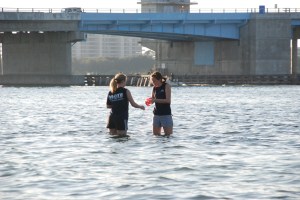
"Mommy & Me" students meet a tunicate for the first time while exploring the bay. (© Mote Marine Laboratory)

Mote Marine Laboratory is an independent, non-profit organization founded in 1955 by Dr. Eugenie Clark, a marine biologist known as the “Shark Lady” for her lifelong fascination with sharks and other fishes. The one-woman enterprise outgrew the tiny shed that once served as the main laboratory. Today Mote has seven centers for marine science, education programs for all ages, and the public Mote Aquarium. Mote has a 10.5-acre campus in Sarasota, Florida and three additional scientific facilities in the state. Concentrating on nearshore marine research, Mote’s scientific centers include:

    Aquaculture – Sustainably growing fresh and saltwater fish for food production and for supporting fish populations in the wild.

    Coastal Ecology – Research on Florida’s coastal ecosystems, including rivers, bays and estuaries, to inform the conservation and management of these environments.

    Coral Reef Research – Research, conservation and restoration of coral reef ecosystems.

    Ecotoxicology – The study of natural and man-made environmental toxins, their movement through marine environments and their impact on humans and marine animals.

    Fisheries Enhancement – The preservation and enhancement of economically-important coastal fish and invertebrate populations.

    Marine Mammal and Sea Turtle Research – Research on the biology and environmental needs of marine mammals and sea turtles to inform conservation and management of these species in the wild.

    Shark Research – This center studies sharks, skates and rays from many different angles ranging from molecular biology to ecology and conservation.

Our guest today is Natalie Fisher. Natalie is a volunteer marine science educator at Mote who is on sabbatical from Brecons Beacons National Park in Great Britain where she helps to run its busiest attraction – the National Park Visitor Centre.

Natalie has stopped by today to discuss how she creates intellectual and emotional connections between her students and the ocean.


ARTPLANTAE
: Thank you, Natalie, for speaking with us. Tell us what you do at Mote Marine Laboratory in Florida.

NATALIE FISHER: Thanks for inviting me. My job is to get involved in almost every aspect of the work of Mote’s Education Division. I develop new curriculae, teach visiting school, scout, and home-school groups, do outreach work, help out with public programs and events, set up and breakdown classes, the works! I also align our school programs to state standards and, am excited to take the lead in writing a new interpretive plan for the Aquarium.


AP
: Mote’s specialty is “nearshore marine research.” What does the phrase “nearshore” mean? Are there set boundaries that come with this area of study?

NF: A great deal of Mote’s research takes place in the shallow coastal waters of southwest Florida’s continental shelf, often near or within sight of the shoreline. For instance, Mote scientists have long-running research projects on the sharks, manatees, fishes, sea turtles and overall ecology of the waters along Florida’s Gulf coast. However, we don’t restrict our studies to that – several of our projects around the world have focused on species that travel far from shore. For example, Mote scientists have tracked whale sharks that migrate thousands of miles and spend much of their time in deep offshore waters.

Mote summer campers learn about the importance of Turtle Exclusion Devices in fishing nets. (Courtesty Mote Marine Laboratory)


AP
: Mote offers a range of learning opportunities. They offer classes for children as young as two-years old, conduct summer day camps, lead field trips satisfying Florida’s state standards, create overnight adventures for young children and teens, create custom programs for organizations, visit classrooms to deliver interactive marine science programs, and even offer live multimedia programs utilizing current technology. When working with preschool-age children, what do you want them to know about the ocean after exploring Sarasota Bay?

NF: First and foremost that being in the water is a positive experience. Secondly, that it’s fun to learn with other children. At this age, our classes are as much about learning and practicing social, motor and language skills as they are about learning about the ocean.

Thirdly, all our programs each teach one broad concept (or theme, to borrow from interpretation) which we’d like our students to remember – for example that an estuary is the ocean’s nursery. In the preschool classes we’ll reinforce that message through songs, stories, crafts and role-plays, but the experiential part of the lesson is often the most important in terms of making a connection.

Whatever the theme of the individual class or series of classes, the goal of the education division is to foster stewardship of the ocean, so all our programs have this at their heart.

Mote High School interns work on their research projects. (© Mote Marine Laboratory)


AP
: How does Mote make the ocean a “cool” topic for teenagers?

NF: By making it relevant. We use technology where it’s appropriate and we emphasize that the work they’re doing in class involves many of the tools and techniques that Mote scientists use for their research.

We’re currently developing an iPod Touch app for students to use during their visits. Students will be able to use the app during their program to add data they collect to an existing database, then use that information at school to compare their results to real data collected by students from earlier Mote programs, other schools or other sites.

We draw from current scientific studies in our classes — a cutting-edge approach that goes far beyond textbooks. The science we’re talking about is happening right now, right here at Mote. We simulate real research techniques as closely as we can, making our classes interactive and realistic for our students.

We also run an internship for high-schoolers, through which they get to experience working in different areas of the Laboratory and Aquarium (and earn community service hours towards college scholarships). Our interns learn how their school science lessons have real-world applications by conducting their own research projects.


AP
: Mote’s area of focus is nearshore marine science. Explain how you connect children and adults to the ocean existing beyond the bay and the exhibits in the Aquarium.

NF: Many of the animals we study and interpret (describe and discuss with students) help us to make that connection. For example, loggerhead sea turtles may nest on our beaches here in Sarasota, but they migrate throughout the Gulf of Mexico and beyond. We can tell their story by introducing students to Mote’s resident loggerheads. Students can learn about the human hazards faced by ocean animals through learning about our sea turtle, dolphin and whale hospital patients. All visitors to Mote Aquarium can meet our resident sea turtles, dolphins and manatees (our resident animals were deemed non-releasable by government officials). Summer-campers can also experience Mote’s science through our Center for Tropical Research in the Florida Keys, and the public can discover Mote’s coral reef research in the Florida Keys Eco-Discovery Center.


We emphasize the connectivity of the ocean, its currents and the migratory patterns of many of its animals to figuratively carry our visitors beyond the shallow waters of Sarasota Bay, into the Gulf of Mexico and beyond.


AP
: The amount of time you spend with children and adults is very brief. What is the primary message Mote aims to deliver to students, regardless of their age?

NF: That marine life has inherent value which makes it worth studying and conserving.


AP
: Many classrooms are miles away from the nearest ocean. If a teacher cannot take students to Mote on a field trip, how might a teacher engage students in a conversation about an environment they will never see, hear, smell, or feel?

NF: We run a series of interactive programs which aim to do just that. It’s important that our young people learn that their science studies have a practical application, and that they develop a sense of global citizenship, and there’s no better way to do both than by studying the ocean that connects us all. We use video-conferencing technology to engage with schools all over the USA and beyond through our award-winning SeaTrek programs.

SeaTrek, which was created by Mote’s Center for Digital Learning, offers students of all grade levels the opportunity to connect to the ocean through us here at Mote. The students learn scientific principles and processes through exciting and engaging programming delivered “live from inside the shark tank” (thanks to a little digital “magic”) directly into their classroom.

In addition to these structured means of outreach, we make education-focused materials and resources available through our YouTube channel (www.youtube.com/seatrek), where educators can watch samples of our programming and our new “Science Minutes” slots – short video clips (also available for purchase on DVD) teaching a range of science topics that can be integrated into their own lessons.

We also have traveling exhibits that tour schools and community centers across the country. Sanctuary Reef, Discovery Reef and Sea Monsters allow students to interact with and learn about marine ecosystems in a hands-on way without leaving school.


AP
: All fantastic learning opportunities! Thank you, Natalie, for sharing Mote’s programs and online resources with us.


Did you know?

A class enjoys an award-winning SeaTrek program. (© Mote Marine Laboratory)

  • You can download Mote’s education schedule for 2011? Visit their Marine Science Education page.
  • Information about SeaTrek programs and Mote’s traveling exhibits can be viewed at www.mote.org/seatrek?
  • SeaTrek received the 2009-2010 Pinnacle Award from the nonprofit Center for Interactive Learning and Collaboration. The award honors videoconferencing programs rated highest by teachers. This is the third consecutive year SeaTrek has won the prestigious award for outstanding performance by a content provider.

Margaret Best, EE Week Contributor

Different colours are generally associated with different emotional reactions in human beings. Not only that, the same colour may evoke different reactions in different people. As a result, a single colour can be associated with different and diverse emotions, some positive and some negative.

Blue is generally regarded as a colour of peace and tranquility, a calming colour. But it is also said that the impact of the colour can change as the shade of blue changes. For instance, electric or brilliant blues express exhilaration by becoming dynamic and dramatic. It has also been said that some shades of blue or the overuse of blue may come across as cold or uncaring.

The colour blue occurs in abundance in nature, two of the most obvious examples being the sky and the ocean. It is perhaps not surprising then, that it is apparently the most popular of colours with about equal appeal to both genders.

Blue has an interesting historical association with art, particularly as a result of the origin of the pigments used to produce blue paint. The most commonly referenced association of the colour blue with art, is in the religious symbolism of the colour in religious paintings of the medieval era.

Mary, the mother of Christ, a central theme in the many religious paintings of that period, was mostly depicted in blue. It is believed that it was because she was deemed worthy of the most expensive blue pigment available at the time, ultramarine. Ultramarine was acquired by means of the laborious grinding and processing of Lapis Lazuli, a relatively rare semi-precious stone mined in Afghanistan.

Some artists of the era could neither afford nor obtain this sought-after colour. They substituted with azurite, a more readily available, mineral-based pigment (copper carbonate) that was mined in vast quantities near Lyon in France. Unfortunately, blue paint made from azurite (commonly called azure) darkened over time to a dark grey or even an almost black appearance, depending on the environmental conditions to which the art was exposed. The result was a far cry from the striking brilliance and permanence of the more red-shade blue of Lapis Lazuli.

It is interesting to note that while it is sometimes assumed that the “marine” component of the name “ultramarine” has oceanic links, particularly with the Mediterranean, that is not the case. Its origin actually lies with the medieval Italian artists who referred to the highly-prized “Oltromarino” (“from beyond the seas”) as a pigment that had to be brought from a distant Afghanistan that was “over the sea.”

Today, artists have a wide range of blue pigments available to them. Fortunately, a less expensive source of the colour Ultramarine (PB29) has been manufactured synthetically for decades and, for the most part, has replaced the Lapis Lazuli source. The colour is vibrant, transparent and, equally important, it is permanent. It will not fade or change with age or as a result of exposure to ultra violet light.

The only downside is that for watercolourists, it can be a little annoying because it can easily separate if blended with other pigments and therefore requires constant stirring. But it is a vital component in mixing the deeper blues seen in the enormous waves of high-tide seas or in the brooding sky and water in the calm before the storm.

For seascape artists in particular, another vibrant pigment now readily available and which is perhaps closer to the more stereotyped colour of the ocean, is Phthalocyanine Blue (PB15:3). The jaw-breaking name is often shortened to Phthalo or Thalo Blue. This is a powerful green-shade blue that is rapidly gaining in popularity and showing up more frequently in the palettes of contemporary artists.

There are also a number of other blue pigments that have served artists well through the centuries. A quick visit to an art supply store will reveal a host of tempting names of blue options such as Cobalt, Cerulean, Indigo, Prussian, Turqouise and more. The choice of blue best suited to the artist’s individual needs and preferences often depends on the medium, for example, watercolour, gouache, acrylic, or oils. The key is to conduct tests and to follow the manufacturer’s advice on safety of use and its tendency to change over time.

Whether it is the blue of the sky, the blue of the ocean or any other blue subject, there are many choices available to artists who wish to capture it.


Learn More About Color

Margaret Best Discusses Color in Botanical Art

Today we are very fortunate to learn from sound recordist and engineer, Dan Dugan. Dan is a member of the Nature Sounds Society and serves on their Board of Directors. The Nature Sounds Society is based in northern California. Dan and other Society members travel to natural areas to record nature’s sounds.

Please welcome Dan Dugan!


ARTPLANTAE: Tell us about the Nature Sounds Society. How did it begin?

DAN DUGAN: The Nature Sounds Society (NSS) was founded in 1983 by Paul Matzner, then curator for the California Library of Natural Sounds at the Oakland Museum of California, and Marie Mans, retired from her first scientific career and actively pioneering nature sound recording to augment her photography and to assist natural scientists (such as Dr. Luis Baptista at San Francisco State University) to obtain data for their research. From their organizing work and interest in the conservation of natural quiet, they reached out to others to create an organization which would become a nexus for similarly interested professionals and amateurs in the scientific, educational, arts, and environmental arenas. The organizing committee that evolved decided that the principal purpose of NSS is to encourage the preservation, appreciation and creative use of natural sounds. The organization has been active and viable for almost 30 years and has members from all corners of the globe.


AP: How did you become involved with the Society?

DD: Paul Matzner brought the museum’s Nagra tape recorder to me for service 23 years ago. He invited me to join the Nature Sounds Society at their annual workshop at Yuba Pass in the Sierras. Technology and nature together? Sounded like a great idea. I’ve volunteered as a technical advisor ever since and more recently, as a Board member.


AP: How are recordings of nature’s sounds usually put to use?

DD: There are pure soundscape recordings that are appreciated by lovers of nature’s music in the raw. Species recordings that are used to help with species identification for scientists and birders. Smooth mixes used for relaxation by therapists and individuals. Many musicians like to mix nature sounds into their compositions. Radio producers, podcasters, and YouTubers use natural sounds to enhance their stories. National Public Radio (NPR) often features natural sounds in radio reports. The national parks need volunteer recordists to inventory and monitor their soundscapes. Visual artists — sculptors, painters, multimedia artists — use sound more and more in their installed works. Museums and teachers want nature sounds for their exhibits and demonstrations. Nature films depend on recordists to capture the sounds that go with their fabulous visuals.


AP: The theme for EE Week is Ocean Connections. When I think about the word “ocean,” I see and hear waves along a rocky coastline. I also hear seagulls and imagine a cool, damp, salty breeze. This scene is the default imagery in my head when it comes to any type of coastal scene. Drawing upon your experience as a sound recordist, what am I missing? What am I not hearing?

DD: OK, add a shreaking killdeer to your mix. How about a sea-lion barking in the distance? The hiss the sand and pebbles make as the edge of a wave recedes. The sounds of buoys or foghorns when the fog closes in. The changing rhythm of the waves as the tides turn over a 12-hour period. This very subject was the focus of a recent installation by Golden Gate National Recreation Area resident artist, Aaron Ximm.


AP: When you meet someone who is new to the discipline of sound recording or the practice of “listening,” how do you encourage them to open their ears?

DD: The most transformative experience for someone new to sound recording is to put on the headphones to a live recorder hooked up to a microphone array to experience what one of our members and educator, Arlyn Christopherson, calls “bionic ears.” Just as a field guide of birds magnifies each individual bird, the act of listening with bionic ears magnifies the soundscape elements. You suddenly become aware of things you’ve heard before, but never really listened to: birds, wind, water, and the intrusiveness of man-made noise. Putting on bionic ears is a bit like the aural equivalent of the moment the “Wizard of Oz” goes from black and white to color in film — a whole new world opens up.

Learning to listen to nature sounds requires a specific skill that takes some practice but is not hard to do. In our lecture-demonstration, we start by asking people to close their eyes and make an inventory of everything that they can hear in the (hopefully) quiet room. Then I play a brief rain forest recording several times over, each time pointing out a different element of the complex biophony, and how they fit together like the instruments of an orchestra. From there, we demonstrate the differences between mono, stereo and surround sound and begin a very general discussion about equipment and how to obtain the results that you are interested in hearing.


AP: One day in the eastern Sierra, I came upon an area possessing the purest and loudest silence I have ever experienced. It was different than simply a quiet spot along a trail. It was a startling experience. Paul Matzner, the founder of the Nature Sounds Society, writes about the value of quietude – “a state or situation where natural sounds can be heard uninterrupted” by the “technological sounds of humans.” He also writes that quiet places “are some of our most endangered habitats.” How does the Nature Sounds Society advocate for quietude?

DD: Paul’s description of the value of quietude — or natural quiet, the current terminology for quietude — is at the heart of the conservation efforts of NSS. Right now is a critical time for preserving natural soundscapes in our national parks. Federal regulations promulgated in 1999 defined soundscapes as a resource which requires preservation and management on an equal footing with other park resources. The parks are currently drafting soundscape management plans and putting them out for public comment. Recently, Zion National Park rushed through a plan that we objected to as compromising wilderness values too much in favor of the air travel industry. There is a draft environmental impact report open for comment right now regarding air tours in the Grand Canyon. If there can be no-fly zones over military reservations, why not have no-fly zones over national parks?

Members of NSS provide commentary individually and under the NSS umbrella regarding these plans and other topics related to natural quiet. They have also provided volunteer assistance to gather and present observational data for baseline studies and have provided opinion pieces. NSS provides a forum through its listening parties, lectures, technical discussions, workshops, listserve and partner with the Bay Area Sound Ecology (BaseBOT) group, the local chapter of the World Forum of Acoustic Ecology (WAFE), for discussions of these topics to take place.

Independent work includes a compelling short documentary “Hush” directed and produced by Stanford film school graduate, Mike Seely, featuring Paul Matzner narrating the importance of quiet places. A more recent documentary, “Soundtracker” (2010) by Nick Sherman, follows Gordon Hempton’s efforts to find quiet places to record. Bernie Krause, in his book Wild Soundscapes (which is also an excellent beginner’s guide to sound recording) describes the depredations to the natural soundscape over the arc of his career as an acoustic ecologist.


AP: You mentioned in an earlier conversation, you make regular trips to the Muir Woods. Your recordings indicate that old-growth forests are very quiet places. I don’t know how long you have been recording in the same location, but it seems to me that what you do not hear in your recordings speaks volumes. Your recordings provide valuable presence and absence data. Have old growth forests changed since you began recording data? If so, how?

DD: I haven’t been recording long enough to notice a major difference (about 5 years in this environment). Ask Bernie Krause, he’s been documenting soundscapes for forty years. Both Bernie and Gordon Hempton have noticed the increasing intrusion of man-made sound on even the most pristine landscapes and they have recorded all over the world as their life’s work.


AP: You are currently documenting the sequoia groves at Yosemite National Park. How do you go into the field to collect sound data? Do you have a structured approach and take samples for a specific amount of time? Or is your approach more relaxed? Briefly describe what a day in the field looks like.

DD: I do have a routine. I hike in to the location carrying between 30 to 50 pounds of equipment depending on the difficulty of the terrain. To avoid problems with bears, I carry only water. Not even a snack bar. I mount mics on my pack wired to a recorder on my belt, so if I hear something interesting on the trail I can catch it. I take pictures too. Everything is date- and time-stamped, and I slate my recordings extensively, describing the date, time, type of equipment being used, weather conditions, terrain, etc.

If it’s a new location, I go early so I can explore and find a good spot. I set up a four-channel surround array and a “cowboy camp” (no tent). I’ll record anytime something interesting happens, but I always start 90 minutes before nautical twilight and record the evening sounds till then.

Through the night I keep my recorder on standby. It has a ten-second prerecord buffer, so if I hear an owl, coyotes, or a tree falling, I hit record and I’ve already got it.

I set a timer to start recording at nautical twilight, in case I’m asleep. I’ll record the dawn chorus for 90 minutes. If there’s action and I don’t want to be somewhere else, I’ll continue beyond that. Then it’s pack up, hump the gear out and go for breakfast.

The most amount of time is spent in post-production back in the studio, which is never quite as much fun as collecting the recordings. I’ve developed, and stick to, a rigorous protocol documenting (in the field and in the studio) and transferring the recordings. I provide “raw” recordings to the National Park Service (NPS), but I put a lot of time in reviewing the recordings to mark events and will consult with experts on birds and animals to accurately identify what is recorded. I write a report following the NPS format which accompanies my submission along with the other written documentation.


AP: The Nature Sounds Society hosts listening parties. What happens at a listening party? Who attends these gatherings?

DD: Our members and friends. People bring their favorite recordings from the year to share. People out-of-town wire contributions, too. The mix is always lively — the rain forests and lemurs of Madagascar, ice breaking up, spiders dropping from a ceiling, thunderstorms, coyotes — and there’s always a great personal story to go with the sound. Oh, and the food’s pretty good, too.


AP: What recommendations do you have for teachers who may be interested in recording nature sounds for use in their classrooms?

DD: The NPS recently published a revised updated activity card for classroom use that was originally authored by educators and NSS members, Arlyn Christopherson and Mele Wheaton. They can get this card by contacting the NPS or the NSS.

Upcoming events for NSS include our Saturday May 14 Tech Talk and our annual Workshop at San Francisco State University’s Field Station at Yuba Pass, June 24-26. More information is on our website at http://www.naturesounds.org.

Anyone can subscribe to the Yahoo! group for questions and information.

Teachers can also subscribe to the Naturerecordists Yahoo! group and ask for advice there. This group is heavily technical and much of the discussion is about gear, but its members are always willing to help a newbie.


AP: Thank you, Dan, for making us better listeners.

DD: You’re welcome.


EE Week readers, do not miss…