Feeds:
Posts
Comments

PRESS RELEASE

Independent Bookstore ArtPlantae Books Selling Google eBooks™: “Cloud-Based” Library and Multi-Device Access Allow Indies to Compete in Growing eBook Business

June 8, 2011 – Customers and subscribers of ArtPlantae in Riverside, CA no longer have to choose between reading digital and supporting independent bookstores – ArtPlantae Books is now selling Google eBooks™ online. Google launched its e-book program on Monday, December 6, 2010, and is partnering with the American Booksellers Association so indie bookstores can provide an easy way for their customers to discover, read, and buy e-books at competitive prices.

“More and more consumers are buying e-readers and are looking to purchase e-books,” said ArtPlantae director, Tania Marien. “Google eBooks now allows us to remain the store of choice for our audience of teachers, artists and naturalists who are reading digital and utilizing technology in their classrooms and educational programs.”

“This partnership with Google allows independent bookstores that are our members to better compete with corporate retailers on selection, price, and convenience,” said ABA President Michael Tucker. “It levels the playing field.”

A Google eBook is a new form of cloud-based digital book that allows readers to access their libraries on almost any device from one single repository, regardless of where the e-book was purchased. Google is offering hundreds of thousands of titles for sale, ranging from new releases and bestsellers in every category to classics in the public domain.

Because Google eBooks work with myriad devices — tablets, smartphones, computers, even most e-ink devices — consumers are free to shop from a variety of retailers rather than being bound to one retailer. This opens up a wealth of indie recommendations and bestsellers to avid e-book readers.

In addition to e-books, readers can search through a database of five million titles of print books at ArtPlantae Books, peruse bestsellers, the Indie Next List, and a curated collection of resources about plants, botanical art, environmental education and natural history.


About ArtPlantae

ArtPlantae is a resource provider whose aim is to increase botanical literacy by encouraging an interest in plants and nature through illustration. Their educational website serves as a gathering place connecting artists, educators, and naturalists. Here you will find feature articles, interviews, interactive learning opportunities with artists and authors, and a weekly column about teaching and learning that explores the link between drawing and knowing.

ArtPlantae Books is an online independent bookstore complimenting the resources found at www.ArtPlantae.com. It serves a community of artists, naturalists and educators pursuing interests in botanical art, botany, environmental education, and natural science illustration.


Contact

Tania Marien
ArtPlantae LLC
ArtPlantae Books
(951) 776-4696
books@artplantae.com
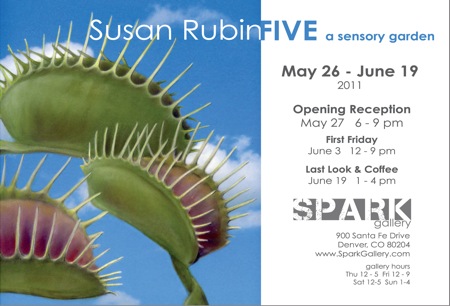
The botanical art exhibition featuring Susan Rubin’s look at the five senses is now on view at the Spark Gallery in Denver. The opening was a success and the show received a great review.

Susan Rubin has posted her exhibition pieces online and now we can view this exhibition too. Visit Susan’s online gallery to view FIVE: a sensory garden. Be prepared to be mesmerized!


Visit The SPARK Gallery

Learn botanical art and plant identification among Edwardian and medieval landscapes at the University of Leicester Botanic Garden.

University of Leicester Botanic Garden
http://www2.le.ac.uk/projects/botanic-gardens
Sixteen acres of landscaped grounds and greenhouses centered around an Edwardian garden. The Attenborough Arboretum is a satellite facility of the Garden. The Arboretum features an example of a medieval ridge-and-furrow field.

  • Introduction to Botanical Painting Summer School Course – Monday August 8 to Wednesday, August 10, 2011; 10 AM – 4 PM. Open to beginners and experienced students at Attenborough Arboretum. Instructor: Colin Swinton. Cost: £75 per person. To register, call 01423 331390.
  • Plant Identification Course module – Every Tuesday evening, 4th October 2011 6:30-9:30 PM, 8 weeks plus 3 Saturdays at the Botanic Garden. This class is for the advanced certificate in Plant Identification. See details in the Garden’s brochure.

This information can also be viewed at Classes Near You > England.

See what’s new at Classes Near You > Tennessee:


Mary Gwyn Bowen

www.marygwynbowen.com
Mary has a Bachelor of Fine Arts Degree with Honors from The Corcoran College of Art and Design in Washington, D.C. and is a member of the American Society of Botanical Artists. She is currently working on a research project she designed that employs the use of art in the cardiac rehabilitation process. Mary works in oil and watercolor.

  • The Magic of Flowers – Tuesdays (2nd & 3rd Tuesdays of the month); 6:30 – 8:30 PM. Love flowers? Learn an easy way to keep them forever! In this class students will learn how to capture the beauty of live flowers using simple watercolor techniques. NO EXPERIENCE NECESSARY! Contact instructor for more information. Cost: $25, plus $5 materials fee (optional palette fee, payable to instructor or supply list provided at registration). Williamson County Parks and Recreation, Franklin, TN.
    More Info & Register. (615) 790-5719

In April, Wendy Hollender was interviewed by a radio station serving the community near her organic farm. In her interview, Wendy talks about her recent exhibition, her New York Times article about endangered plants, and her career as a botanical artist.

Wendy’s interview with “Dennis in the Morning” is now available for all of us to hear. This interview was conducted by WELV, the only local radio station in Ellenville, NY. Radio station WELV is operated by students and faculty from the Ellenville Central School District.

Listen to Wendy’s interview on WELV 107.9!


Also See:

Architect, lecturer and researcher, Ylva Dahlman, began to notice a trend in the graphic arts and design class she created for natural science and social science students. She noticed her students at the Swedish University of Agricultural Sciences in Uppsala, Sweden were taking more than art and design concepts with them when each term ended. What Dahlman observed were hints that the art activities students completed in class were having an effect on the students’ overall learning.

Dahlman created an investigative strategy to find out what that “something” (Dahlman, 2007) was that students were taking with them after completing her course.

Knowledgeable about research efforts studying links between artistic experiences and academic achievement, Dahlman decided to investigate her students’ learning.


Questions & Reflection

Dahlman’s investigation into her students’ learning process occurred from 1994-2001. The data she discusses in Dahlman (2007) comes from the responses and reflections of 220 students completing her class during this time period. Students filled out two questionnaires — one before the course began and the other when the course ended. Two key pre- and post-questions Dahlman asked were, Do you think your vocational studies can be influenced by art studies? How? and Do you believe that a natural scientist thinks differently than an artist?

Dahlman also asked students to spend the last 15 minutes of each lecture reflecting on their learning.

Ninety-three percent of Dahlman’s students completed the pre-course survey, 84% completed the post-course survey, and 75% submitted reflective summaries. From students’ written responses, Dahlman (2007) concluded that their artistic experiences in class:

  • Helped students develop problem-solving skills.
  • Taught students how to see their environment in new ways.
  • Instilled self-confidence in students.

Dahlman (2007) found each of these factors contributed to students’ overall ability to concentrate, resulted in students having a “changed attitude towards their studies”, and had an effect on their overall learning (Dahlman, 2007).

What type of art activity did Dahlman focus on to study the link between art and learning?


Dahlman’s Focus

Dahlman’s area of focus was drawing, specifically what happens during the drawing process. Dahlman (2007) refers to the act of drawing as “the pictoral process.” Dahlman (2007) claims the process of drawing turns “unarticulated forms of experience into non-verbal artifacts that invite reflection.”

According to Dahlman (2007), people make sense of confusing situations by grouping events into familiar categories. She says people acquire new knowledge only when they can overcome the urge to fall back on familiar categories. She says drawing is a great tool to use to overcome the desire for familiarity because drawing “often connects seemingly incompatible categories of experience” (Dahlman, 2007). Dahlman continues to say that through the act of drawing, “the world is being articulated in new shapes” and this takes us to a new level of understanding.

Eighty-eight percent of Dahlman’s students thought the art activities they completed in the graphic arts class had a positive effect on their studies. Regarding student responses to the question, Do you think your vocational studies can be influenced by art studies? How?, Dahlman shares two lengthy replies in her paper. Excerpts from these lengthy replies are included here.

One student replied:

Yes. It gives a knowledge of other ways of looking at the same thing. It yields a personal confidence. When it comes to problem solving, I feel that [if I] can make a painting of an abstract concept, I should feel more confident in other problem solving situations as well.

Another student said:

Yes. When I read a scientific article about, say, growth factors, I may understand all the words and accept their face value, but it is not until I make a sketch of the content of the article that I understand it thoroughly…..Creating pictures means taking responsibility for the kind of reality that you perceive.

In summary, Dahlman (2007) states it is important to view the world through the drawing process. As she puts it, “knowing is action” and drawing is action. Dahlman (2007) says it is through drawing that we “connect incompatible categories of experiences”. She also points out the act of drawing produces an object upon which we can reflect and it is through categorizing experiences in new ways and through reflection of the resulting object that we arrive at new knowledge.

In addition to describing her research project and results, Dahlman (2007) compares and contrasts the drawing process as a way of knowing to other ways of knowing (e.g., pragmatism, tacit knowing, metaphors). To read Dahlman’s complete analysis, search for this article at your local college library or order this article through the Wiley Online Library for $35 for 24-hour online access.


Literature Cited

Dahlman, Ylva. 2007. Towards a theory that links experience in the arts with the acquisition of knowledge. The International Journal of Art & Design Education. 26(3): 274-284. Web. [accessed 2 June 2011] <http://onlinelibrary.wiley.com/doi/10.1111/j.1476-8070.2007.00538.x/abstract>

Walk into your garden. What do you see?

Flowers? Grass? The city tree you are not allowed to cut down?

Look a little closer. You may see aphids on your roses or caterpillars on your plants. If you do, you are witnessing a plant-insect interaction — an interaction between an insect and the plant they use for food, shelter or egg-laying. The rapport between insects and their plants is at the core of the artwork created by natural science illustrator, Mindy Lighthipe.

Mindy Lighthipe has always loved art, plants and animals (especially insects). She has been an illustrator all her life and an entomologist since the age of five.

Mindy began her professional art career as a hand weaver and spinner. She grew her own dye stuffs and studied hand weaving and textile design. She was a professional hand weaver from 1985 to 2000 and created handwoven clothing and accessories for her company Fantasy Fiber Designs.

In 1992, Mindy decided to make a career shift because hand weaving was becoming back-breaking work. She was weaving 25 yards of fabric each day and wasn’t sure she wanted to be in this line of work when she turned fifty. Wanting to make a return to fine art, Mindy enrolled into the certificate program for botanical art at the New York Botanical Garden (NYBG). Mindy graduated from the program in 1993 and began teaching at NYBG in 1994.

During this time, Mindy became more and more in-tune with plants, their habitat, and the impact humans have on the environment. She became increasingly aware of monocultures and started to learn about invasive plant species and native plants. The more she delved into these subjects and fine art, the more she thought about combining art and her interests in plants and insects to educate children and adults about plant-insect relationships.

Last year, Mindy wrote and illustrated Mother Monarch, a children’s book about the life cycle of the monarch butterfly. She wrote Mother Monarch because she found that most people do not understand the symbiotic relationship between caterpillars and their host plants. Mindy says, “You can plant all the nectar plants you want, but if you don’t provide the host plant, biodiversity is lost.”

The audience Mindy wants to connect with the most are homeowners. She wants to drive home the message she first presented at an exhibition titled “McMansion.” Her message then was, “If you build it, they will disappear.” A spin, of course, on the well-known expression, “If you build it, they will come.”

Mindy finds homeowner attitudes toward wildlife and eradication of natural habitats upsetting. She doesn’t understand why homeowners do not understand that the coyotes, deer and bears walking through residential areas do so because they have no where else to go. She also finds people’s reactions to insects a bit worrisome. Especially the reactions of those who scream upon first sight of an insect. One of her objectives is to make insects appealing enough to the public to prevent this from happening.

All signs indicate Mindy is delivering her educational messages successfully. She even made a lasting impression on the Royal Horticultural Society (RHS) in London, England. Earning an award from the RHS is an incredible honor and is botanical art’s “grand slam.” When Mindy submitted work to the RHS exhibition, she wasn’t expecting an award. The RHS show is known for awarding botanical art that is very detailed and executed flawlessly according to traditional standards. They don’t do insects. Mindy’s collection of 12 themed paintings included insects and were created using what Mindy calls, her usual “rapid painting and flamboyant technique.” To her surprise, she was awarded the silver medal. The jurors stated that “Mindy Lighthipe’s work is reminiscent of 18th-century artists such as Catesby and Maria Sybilla Merian. Her insects are fantastic.” They also felt that if they had a gold medal for mass appeal and public education, they would have given it to her. The educational message she was hoping to send through her work had come through clearly and she received the nod from the Royal Horticultural Society.

When communicating her message, Mindy prefers to do outreach in urban areas and to introduce the disciplines of art and science to an audience who may not have the time or resources to visit museums and art galleries.

Mindy’s recent move to Florida was propelled in part by her work for Symbiosis: Butterflies and Plants, a solo exhibition at the Florida Natural History Museum that closed on March 13, 2011. Living in Gainesville will afford Mindy the opportunity to work at a more relaxed pace and to take more risks with her work, something she had not been able to do living in the New Jersey/New York area. She is hoping to be more creative with her message as she works with the staff at the Florida Natural History Museum and their 25 million insect specimens. She may even return to school to major in entomology. Eventually, Mindy would like her symbiosis artwork to be included in an educational book about plant-insect interactions.

Mindy says her lifelong fascination with art has been with color, texture and pattern. The insect world is filled with fantastic colors, textures and patterns and Mindy feels as if her life as an artist has gone full circle. Where before she was taken with dyes, fabrics and surface designs, she is now taken with insect coloration, exoskeletons and wings!


Ask The Artist with Mindy Lighthipe

Mindy will participate in an Ask The Artist Q&A during National Pollinator Week on June 20-24, 2011. You are invited to ask Mindy questions about her botanical and entomological work and her workshops. Please post your question by June 20.


You May Also Enjoy…


Updated November 3, 2014