Feeds:
Posts
Comments

Mindy has traveled to Costa Rica every year for the past 25 years. In 1999, Mindy and photographer Nancy Richmond began leading art and photography tours to Costa Rica. They teach artists how to take research photographs to compliment their field sketches and create accurate color swatches in their sketchbooks. Photographers work on creating compositions that are pictorial essays of the rainforest. Workshop participants visit biological research stations, get a behind-the-scenes look at a sloth sanctuary and learn about on-going conservation efforts in Costa Rica.

The next painting and photography tour is February 1-10, 2012. A quick summary is posted below. This information has also been posted in the Classes Near You sections for Costa Rica and Florida.

Studio 16 Art & Photography Tour to Costa Rica

www.studio16online.com

  • Day 1: Arrive in San Jose. Check-in to Hotel Bougainvillea.
  • Day 2: Introductory exercises in the garden at the hotel. An afternoon visit to Zoo Ave to sketch and photograph birds.
  • Day 3: Visit to La Paz Waterfall Gardens
  • Day 4: Travel to the Sarapiqui region, visit Sibu Organic Chocolates, arrive at Selva Verde Lodge.
  • Day 5: Go on a bird walk, travel along the Sarapiqui River, draw, paint, and visit the Tirimbina Biological Reserve to learn about bats!
  • Day 6: Walk through the rainforest at La Selva Biological Station and learn how to collect reference material through drawing, painting and photography.
  • Day 7: Visit the Costa Flores Botanical Garden, draw, paint and learn about “plant portraiture.”
  • Day 8: Visit the Aviarios Del Caribe Sloth Rescue Center.
  • Day 9: Enjoy quiet moments at Selva Verde Lodge before returning to Hotel Bougainvillea in San Jose.
  • Day 10: Airport transfer, return home

Complete details and color photographs can be viewed here.

An interest in botanical illustration and the future of this art form prompted
Niki Simpson to explore the digital arena to determine if botanical illustration had a place in this new medium. Aware of the argument that traditional illustrations are thought to be more informative than photographs, she investigated ways to increase the amount of information presented in digital illustrations. Her investigation resulted in the composite digital botanical illustrations seen in her online gallery.

Simpson’s digital illustrations give users clear information about leaves, flowers, reproductive parts, venation, leaf arrangement, inflorescence types, fruit, buds, and the underground features of a plant. Her botanical plates also include a color chart and botanical symbols identifying the sex of a plant’s reproductive organs, whether its species is monoecious or dioecious, plus many other characteristics. The symbols used by Simpson are unique to her work because she created many of them from scratch. The process by which Simpson created her symbols is the focus of Botanical Symbols: A New Symbol Set for New Images.

Botanical symbols have been used for centuries because they offer a way to abbreviate repeat words and conserve space on a page (Simpson, 2010). To make her botanical plates as informative as possible, Simpson knew she needed to use symbols in her illustrations. So she researched botanical symbols and how they had been used in the past.

During her research, Simpson (2010) discovered symbols with multiple meanings, symbols no longer in use and symbols not easy to think about, much less easy to write by hand. Her search made her realize that a universal set of botanical symbols about plants did not exist, so she decided to create her own set for her own use.

This lead to additional discoveries, namely that traditional typefaces and fonts lacked symbols suitable for the scientific documentation of botanical specimens (Simpson, 2010). Simpson realized whatever her symbols were to look like, they needed to be easy to write, needed to blend with modern fonts, needed to have a contemporary look, as well as a scientific feel. With these issues in mind, Simpson created the design criteria for her new symbols.

Simpson’s design criteria includes specific information such as, “symbols must be botanically appropriate”, “symbols must be easily readable; clear on reduction and enlargement”, and “symbols must be visually understandable by an international audience” (Simpson, 2010). Simpson’s detailed design criteria can be viewed in Appendix I of her paper.

In 2007, Simpson showed the new botanical symbol set in use in 40 digital composite illustrations in her solo exhibition, Digital Diversity: A New Approach to Botanical Illustration, held in the Botanisches Museum in Berlin-Dahlem, Germany.

Since then, she has fine-tuned her symbols and created a new botanical symbols font based on her symbol set. The Simpson Botanical Symbols OpenType font was completed in January 2009.

Simpson’s fonts are available for free and she invites readers to download the font from her website to use in floras, plant surveys and on plant labels. She also invites readers to use her symbols as shorthand while taking notes in class.

To obtain a copy of Simpson’s article, search the stacks at your local college library. This article can also be purchased online for $35.


Literature Cited

Simpson, Niki. 2010. Botanical symbols: a new symbol set for new images. Botanical Journal of the Linnean Society, 162: 117-129.


Other Items of Interest

When botanical art becomes part of your life, you see botanicals everywhere — on fabric, on plates, on pencils, on wallpaper, on tea cozies, you name it. The history of botanical art and the lives of early botanical artists become topics of interest. Eventually, you become intrigued by collectors of botanical art, the galleries they visit and what they like to buy.

The world of galleries and collectors can seem a bit mysterious. It’s a bit outside the daily routine of groceries, laundry, kids and life’s other curve balls. There usually isn’t time to immerse oneself in these topics. However, I recently had the opportunity to attend a lecture about collecting botanical art that was given by Susan Frei Nathan, one of the few dealers specializing in this art form.

Susan Frei Nathan is a dealer of botanical art and the proprietor of Susan Frei Nathan Fine Works on Paper. Susan’s interest in botanical art was established while working at two international galleries specializing in antique natural history works on paper. These galleries showed work by artists such as Maria Sibylla Merian and Pierre Joseph Redouté. Her interest and passion for botanical art developed naturally, and in 2002, she launched Susan Frei Nathan Fine Works on Paper to promote watercolor works on paper and vellum. Susan only sells original artwork. She made the conscious decision to do so because she wants to celebrate artists and the time they spent learning about a specimen, capturing it exquisitely on paper, and relaying information to the viewer. She does not sell prints because she feels prints have over-commercialized botanical art. Susan currently represents 13 artists.


The Value of Botanical Art

A painting’s value depends on the quality of the artist’s technique, the subject matter and how they work together to captivate the viewer.

– Susan Frei Nathan

What type of botanical paintings do collectors buy?

On the East Coast, Susan says the most popular botanical paintings contain garden variety flowers. Susan says “customers are drawn to these varieties because it is what they know. They are not threatened by it.” She adds that few people will take the time to learn about an unfamiliar plant unless they are an avid gardener.

So to get an idea of what collectors in your area will buy, look around you. What sells varies by region, by state, and by continent. The key factor is the level of familiarity a collector has with the subject of a painting or drawing. To illustrate her point, Susan refers to bromeliads saying she couldn’t give away a painting of a bromeliad on the East Coast.

Subject matter, however, is only one reason collectors buy art. Another reason has to do with the emotional connection a piece establishes with the viewer. This emotional connection is created through the artist’s choices in composition and in detail. Susan says collectors are moved by the drama of an artist’s presentation.


The Most Prized Medium

I would put (each medium) on the same line if equal in quality.

In the art world, some art forms are valued more than others. Susan likes to create a “pyramid of art” to explain this. In her pyramid, each layer represents a specific art form. Among art connoisseurs, paintings are the most valued art form, followed by sculptures, drawings, and then prints. I asked Susan if such a pyramid existed for botanical art.

Susan says there isn’t really a “pyramid” for botanical art. If expertly done, watercolor on vellum and paper would be the most valued, followed by prints. The “print” category includes handmade etchings, engravings, ​and aquatints. Digital prints would come in last. Susan says the inherent translucency of vellum and the level of light it can add to a painting really puts vellum in a class all by itself. When asked to rank specific media, Susan says the top spot goes to watercolor. While graphite work (and drawings) have appeal, they are less widely collected in this field.


Collecting Botanical Art

Buy what you love.

If collecting botanical art is of interest to you, Susan recommends you begin by going to garden shows hosting botanical art exhibitions. She also recommends seeking out dealers of high-end botanicals. As you begin​ your search for a reputable dealer, Susan recommends compiling a list of dealers who specialize in representing the subjects that interest you. Be aware that finding a reputable dealer does not happen overnight. You need to take the time to learn who-does-what and what they collect.

Searching for artwork that resonates with you also takes a lot of time. Research artists and their work. Well-known artists are easier to research than regional artists because you can search for them on the Internet. When you find artwork worthy of purchasing, ask for advice from people you trust. Be careful with prices and make sure you research prices too. Susan says you should check past catalogs and price lists of exhibitions hosted by the American Society of Botanical Artists, as well as other botanical art organizations. Most importantly, though, is to buy what you love.

But only if you buy from a reputable dealer.

When asked to identify some red flags novice collectors should watch for, Susan replied that there is one big red flag new collectors need to recognize. Susan says anyone new to collecting should be careful with dealers selling work outside the realm of what they normally sell. The dealer may really like the work he/she sells, but because it isn’t within the realm of what they normally deal in, chances are very good they lack knowledge about the art and the history behind it.


Creating Botanical Art

Think before you paint.

Do you want to sell your art? If you do, Susan has a couple of tips she would like to share with you. They are:

Paint only what moves you
If you’re new to botanical art, Susan recommends painting small works first. Master the creation of artwork that is 5” x 6”. She recommends you hone your skills on a leaf, a twig, a seed pod, etc. Instead of thinking that you need to create one large-scale painting, Susan wants up-and-coming botanical artists to dedicate themselves to painting expertly on a small scale. She wants to see them create a body of work around a theme. Forget the “masterpiece” mentality.

Take a lot of classes
Take many classes and take only what you need from each class. Don’t feel you need to apply an instructor’s methods exactly. When viewing botanical art, Susan says she wants to see artwork that functions as an artist’s “self-portrait” while maintaining the integrity of the plant they are depicting. Susan says what worries her about contemporary botanical artists is that they are very impressionable and stick with traditional portraiture. She says, “I see safety, not risk-taking.” Susan likes to encourage botanical artists to take risks on small pieces.


Learn More

Susan has much more valuable advice for artists interested in collecting and selling botanical art. Susan will give a brief lecture at the annual meeting and conference of the American Society of Botanical Artists when it is held in Boston on October 27-29, 2011. This brief presentation will be followed by portfolio critiques where registered participants will have the opportunity to meet with Susan individually.

When the conference website launches in June, look for Susan’s presentation titled, Is My Work Saleable​? Collecting Botanical Art.

Until then, catch the conference buzz at Boston ASBA 2011.
Many new classes about art and nature can be viewed at
Classes Near You > Minnesota:


Minnesota Landscape Arboretum

www.arboretum.umn.edu
The Minnesota Landscape Arboretum invites you to connect your life with nature! The Arboretum features plant-related classes pertaining to the botanical arts, crafts, and literature.

  • Watercolor Journaling Summer Workshop: Bennett-Johnson Prairie – Saturdays, July 9, 16, 3, 30, 2011; 9:45 AM – 1:00 PM. Learn how to use a variety of media to record your observations at the Arboretum’s 25-acre reconstructed prairie. Participants will learn how to use watercolor, ink, colored pencils, markers, mono-printing, and collage. Cost: $95 members/$110 nonmembers.
  • Summer Plein-air Watercolor Workshop: Bennett-Johnson Prairie Saturday, August 13, 2011; 9:45 AM – 1:00 PM. Paint accurate images of the prairie’s trees, grasses and flowers. Create quick value studies and then learn how to apply color to paint the golden summer prairie. Some experience required. Cost: $40 members/$50 nonmembers.
  • Watercolor Journaling Fall Workshop: The HRC – Saturdays, September 10, 17, 24 and October 1, 2011; 9:45 AM – 1:00 PM. Document the harvest season at the University’s Horticultural Research Center. Participants will learn how to use watercolor, ink, colored pencils, markers, mono-printing, and collage. Cost: $95 members/$110 nonmembers.
  • Plant Dyes: Color from the Garden – Saturday, September 17, 2011; 10 AM – 4 PM. Learn the essentials of plant dyes and how to identify plants used to produce color. Participants will prepare fibers and cook up dyestuffs. Participants will take home two skeins of dyed wool, a color card for reference, and recipes for dye making. Cost: $85 member/$90 nonmember
  • Treasures from the Andersen Horticulture Library:; Empress Josephine’s Garden – Saturday, October 29, 2011; 9:30 AM – 2:00 PM. Examine botanical illustration with librarian Karen Allen. Learn about Empress Josephine Bonaparte and how she called upon Pierre Joseph Redouté to document her garden. View examples of Redouté’s work in rare books from the library’s collection. Cost: $30 member/$40 nonmember
  • Fall Plein-air Watercolor Workshop – Saturday, October 15, 2011; 9:45 AM – 1:00 PM. Create images of apples and grapes at the Horticultural Research Center. Dress for painting outdoors in the orchard and vineyard. Create quick value studies and then learn how to apply color to paint the golden summer prairie. Some experience required. Cost: $40 members/$50 nonmembers.


Minnesota School of Botanical Art at the Bakken Museum

www.minnesotaschoolofbotanicalart.com
The Minnesota School of Botanical Art was founded by Marilyn Garber. The school’s website has a refreshing design and is a treat to visit. View student accomplishments in the Student Gallery and flip through the pages of photo albums highlighting past Master Classes taught by Jean Emmons, Katie Lee, Kate Nessler, George Olson, Sunitsorn Pimpasalee, Margaret Saul, Alice Tangerini, Alexander Viazmensky, and Wendy Zomelefer. School instructors also have photo albums of their work on display. The current 2010/2011 school schedule can be viewed in detail here. The schedule includes:

  • Farmer’s Market with Marilyn Garber – Mondays, June 6, 13, 20, 27, (skip July 4), July 11, 18, 2011; 1:00 PM – 3:30 PM. Illustrate and paint produce from the farmer’s market. Bring your own specimen. Cost: $235
  • Colored Pencil II with Denise Walser Kolar – Mondays, June 6, 13, 20, 27, (skip July 4), July 11, 18, 2011; 1:00 PM – 3:30 PM. Students will build upon skills learned in Colored Pencil I. Cost: $235
  • Field Sketching with Tim Voigts – Mondays, June 6, 13, 20, 27, (skip July 4), July 11, 18, 2011; 9:30 AM – Noon. Sketch trees, flowers, seed heads, landscapes and more using graphite and fiber-tipped pens. Cost: $235
  • Beautiful Beetles: Jewels of the Plant World with Julie Martinez – Saturdays, June 11, 18, 25, 2011; 9 AM – 3 PM. Students will receive a beetle specimen and learn illustration techniques utilizing watercolor, gouache and colored pencil. Cost: $235

Lifelong learning is their specialty!

Below is a list of botanical art classes at Farncombe. Many of their other drawing and painting classes may be of interest to botanical artists. Be sure to click on the last link to see the complete schedule.

Now at Classes Near You > England:


Farncombe Estate, Cotswolds

www.farncombeestate.co.uk
A 300-acre privately-owned parkland in the Cotswolds. Host to weekend classes in a wide variety of subjects. There is even a bed-and-breakfast option! Follow their blog or become a fan of their Facebook page to learn more about this unique learning opportunity.

  • Botanical Illustration for Beginners & Improvers – June 3-5, 2011. A fun and relaxing course for people who like to record plants and flowers. No previous experience in art or botany necessary. View details
  • Botanical Basics (painting) – July 22-24, 2011. Learn how to break down a painting project into manageable pieces. The basics of botanical painting will be learned. Take a sketch from drawing to painting. View details
  • Botanical Illustration – Drawing and Painting Autumn Fruit & Fungi – October 7-9, 2011. Learn to capture the colors of autumn! This course about fruit & fungi is for anyone who likes to create detailed observations in pencil and watercolor. View details
  • Capturing the Natural World in Graphite Pencil, Colored Pencil or Pastel – November 12, 2011; 9:30 AM – 4:30 PM. Choose the medium that interests you the most and learn how to produce realistic depictions from the natural world. View details
  • Tonal drawing, sketchbooks and more!View all classes

Practical drawings are mental tools.

— Henning Nelms

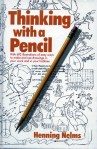
When Henning Nelms wrote Thinking with a Pencil in 1957, he wrote it for two groups of people:

  • People who wanted to use drawing “as a tool for thought and communication” but who did not know how to draw.
  • People who knew how to draw, but who wanted to apply their skills in more than one discipline.

To emphasize the fact that drawing has a place in all disciplines, Nelms includes 692 illustrations that are more about how to use drawings instead of how to make them.

Nelms advocates practical drawing across all disciplines and encourages readers to use drawing as a learning tool in all areas of their lives. Throughout his 347-page guide to drawing and thinking, he shares tips and techniques that make accuracy easy to achieve.

After establishing foundation principles inherent in all drawings, he begins an insightful overview of drawing tips and techniques, never once straying from his primary objective — how to use drawing in everyday life.

The topics discussed by Nelms include:

  • Drawing for practical use
  • Drawings requiring no skills – Charts, diagrams, webs and grids
  • Making easy drawings out of hard ones – How to lower the accuracy requirements of a drawing.
  • Tracing Techniques – How to use tracing paper and tracing techniques as a learning tool to aid in the translation of an image.
  • Creative Tracing – How to rearrange old material to create something new.
  • Proportions – How to think about proportions, take measurements, and sight with a pencil.
  • Fixed-line Construction – How to use parallel and perpendicular lines to create dimensions of space upon which freehand drawings are based. Of particular interest to botanical illustrators is Nelms’ discussion about ellipses and logarithmic spirals.
  • Constructions for Free-line Drawings – How to create constructions for even the most irregular natural forms.
  • Data Management – How to visualize numerical data.
  • More Data Management – How to turn numerical data into graphic forms.
  • Mechanical Aids – Tools to help you construct the parallel and perpendicular lines present in nearly every drawing.
  • Seeing in 3-D – How to see the third dimension and how to “draw as you go.”
  • Distortion – How to control distortion, create oblique drawings and manage ellipses.
  • 3-D Form – How to project form in three-dimensions.
  • Drawing People & Animals – How to draw figures, joints, muscles, hands, etc.
  • Rendering – How to render an object (shading, scumbling, stipple, folds).
  • Presentation – How to improve the appearance of a drawing through your choices in lettering and layout.

Included in this book is a glossary of equipment and material. When you read this section, remember that this book was written in 1957 and that some of the materials in this section may no longer be available.

The same needs to be said about the books Nelms includes in his bibliography. Nelms states he spent eleven years reviewing every book that had anything to do with drawing. In his bibliography, he only includes books he deemed of value when it comes to the practical aspects of drawing.

Thinking with a Pencil is a gem. It was reprinted in 1964 and again in 1981. Fortunately, this book is still available as a used book. Search for this book and other drawing books at independent bookstores on Biblio.com.


Literature Cited
Nelms, Henning. 1981. Thinking with a Pencil (With 692 illustrations of easy ways to make and use drawings in your work and in your hobbies). Ten Speed Press.
ISBN-10: 0-89815-052-3
ISBN-13: 978-0-89815-052-0

New classes announced at Val Webb’s Illustrated Garden!


The Illustrated Garden, A Studio Blog

http://valwebb.wordpress.com
See Val Webb’s online tutorial, Botanical Drawing with Pencil and Watercolor. Connect with The Illustrated Garden on Facebook!

  • Every Picture Tells a Story: Illustrating Children’s Books
    Wednesdays, May 18 – July 6, 2011; 6:30 – 8:30 PM (eight weeks). 
    This lively, relaxed and encouraging course will cover character design, creative page layouts, how to draw for publication and how to use pictures to move a story forward. Have questions about submissions, copyright or publishing markets? We’ll cover those topics, too. Our drawing work will focus on depicting children and animals in action settings. ALL levels of art experience are welcome.  Class size is limited. Early registration required. Cost: $125 includes art supplies. Contact Val Webb if you plan to participate. Location: Val’s studio in Fairhope, AL.
  • Botanical Drawing: Tropical Summer (daytime class in Mobile) Thursdays, May 19, 2011; 2-5 PM (six weeks). It’s the season of brilliant colors and unusual forms — we’ll use watercolor and colored pencil to create realistic renderings of summer plants including palms, succulents and tropical flowers. We’ll also paint butterflies and other insects associated with summer blooms. In addition to our regular class meetings, we’ll plan one weekend field drawing day for anyone who wishes to attend. No experience necessary, and all art supplies are provided. Cost: $140 includes all art supplies.
  • Botanical Drawing: Tropical Summer (evening class in Mobile) Thursdays, May 19, 2011; 6:30-8:30 PM (eight weeks). The same subjects as the daytime class, but scheduled for those who need a class with evening hours. Cost: $140 includes all art supplies.
  • Old and New: The Lost Art of Hand Lettering… and a New Way to Make “Vintage” Photo Transfers – Saturday, May 21, 2011;
    10 AM – 3 PM. This is not calligraphy, but the “drawn letters” used by old-fashioned sign painters and type designers. Learn to adapt this method to label your botanical artwork or write beautifully in your sketchbook or art journal. Learn how to letter on curves, how to use perspective in your lettering, and how to design your own personal lettering style. After lunch in a nearby cafe, learn how to transfer photos. Val will show you how to transfer a vintage-looking image to paper, cloth or wood using butcher’s paper and acrylic medium. The original photo is not affected in any way, and the final product has a hauntingly ephemeral look that is quite beautiful. Plus, you will learn how to tint your transfer with watercolor for a more impressionistic result. This works especially well with old family photos and garden subjects.  Embellish a journal or family album, make truly lovely greeting cards, frame them as keepsakes or gifts — the possibilities go on and on.  Class size is limited. Early registration required. Cost: $60 includes refreshments and all art supplies, plus illustrated tutorial pages to take home. Contact Val Webb if you plan to participate.
  • Botanical Drawing in Pencil and Watercolor – Saturday,
    May 28, 2011; 9 AM – 3 PM. Join Val for an intensive day of botanical drawing and watercolor at the New Orleans Botanical Garden, New Orleans, LA. With more than 2,000 varieties of plants from around the world to choose from, participants will create plant portraits using layers of graphite pencil and watercolor. This class will be held in the historic Garden Studies Center, a charming renovated 1930s potting shed that would look right at home in a Beatrix Potter story.  The day will begin with a detailed demonstration and some guided practice time before heading out into the gardens to draw and paint. This workshop is appropriate for ALL levels of art experience, and there is no supply list — all art supplies and materials (plus admission to the gardens) will be provided. Morning refreshments will be provided. Participants must bring their own lunch. Class size is limited. Early registration required. Cost: $120, includes refreshments and all art supplies. Contact Val Webb if you plan to participate. A detailed itinerary and information about a very reasonable and dog-friendly hotel in New Orleans is available upon request.
  • Old and New: The Lost Art of Hand Lettering… and a New Way to Make “Vintage” Photo Transfers. Saturday, June 4, 2011;
    10 AM – 3 PM. Val’s home/studio in Fairhope, AL. This is not calligraphy, but the “drawn letters” used by old-fashioned sign painters and type designers. Learn to adapt this method to label your botanical artwork or write beautifully in your sketchbook or art journal. We’ll cover how to letter on curves, how to use perspective in your lettering, and how to design your own personal lettering style. After lunch in a nearby cafe, we’ll turn our attention to photo transfers for the afternoon. I’ll show you how to transfer a vintage-looking image to paper, cloth or wood using butcher’s paper and acrylic medium. The original photo is not affected in any way, and the final product has a hauntingly ephemeral look that is quite beautiful. Plus, you can tint your transfer with watercolor for a more impressionistic result. This works especially well with old family photos and garden subjects. Embellish a journal or family album, make truly lovely greeting cards, frame them as keepsakes or gifts — the possibilities go on and on. This is a limited, small-group workshop and may fill quickly. Cost: $60 includes refreshments and all art supplies, plus illustrated tutorial pages to take home.
  • Drawing Birds (daytime class in Fairhope) – Tuesdays, June 7, 2011; 2-5 PM (six weeks). Use traditional illustration methods to accurately see and draw migratory birds in pencil, ink, colored pencil and watercolor. Also draw realistic nests, wild bird eggs and feathers. No experience necessary, and all supplies are provided. In addition to classroom sessions, there will be one Saturday field trip for anyone who wishes to attend. Cost: $140 includes all art supplies.
  • Drawing Small Mammals of the Gulf Coast – Saturday, June 11, 2011; 10 AM – 3 PM. Working in one of the most beautiful natural settings in our region, learn to draw fur textures, lifelike eyes and realistically rendered gray squirrels, rabbits, opossum and other small creatures that inhabit our coastal fields and forests. No experience necessary! Bring a sack lunch. All art supplies provided. Location: 5 Rivers Delta Resource Center (on the Causeway). Cost: $45 includes all art supplies.
  • Quick and Easy: Watercolor Pencil Workshop – Saturday,
    July 9, 2011; 10 AM – 4 PM. Versatile and easy to use, watercolor pencils are perfect for drawing outdoors or adding color to your sketchbook pages. Learn three techniques for getting a wide range of effects from your watercolor pencils, plus tips on using them to capturing light and texture. Bring your favorite set of watercolor pencils, and your other supplies will be provided. We’ll break for lunch at a nearby cafe. Location: Val’s studio cottage in Mobile. Cost: $50 includes some art supplies.
  • Drawing Birds (daytime class in Mobile) – Thursdays, July 14, 2011; 2-5 PM (six weeks). Use traditional illustration methods to accurately see and draw migratory birds in pencil, ink, colored pencil and watercolor. Draw realistic nests, wild bird eggs and feathers. No experience necessary, and all supplies are provided. In addition to classroom sessions, there will be one Saturday field trip for anyone who wishes to attend. Cost: $140 includes all art supplies.
  • Drawing Birds (evening class in Mobile) – Thursdays, July 14, 2011; 6:30 – 8:30 PM (eight weeks). Same as the day classes, but designed for those who need a class with evening hours. In addition to classroom sessions, there will be one daytime Saturday field trip for anyone who wishes to attend. Cost: $140 includes all art supplies.

This information has also been posted at Classes Near You > Alabama.