Feeds:
Posts
Comments

Now this is summer school!

Good company, open space, and a farm fresh lunch.


Hollengold Farm

www.hollengoldfarm.com
Wendy Hollender is an illustrator, author, and teacher. She teaches at the New York Botanical Garden, Hollengold Farm, and the National Tropical Botanical Garden. See what’s new at Wendy’s Hollengold Farm. View Wendy’s scarves, instructional books, and free art lesson at www.drawingincolor.com.

Afternoon Workshops at Hollengold Farm – Saturdays (see below). Workshops are held 1 pm – 4 pm. Cost per workshop: $35 per session ($65 for two sessions). Arrive early and enjoy a farm fresh lunch for $12.
Course details/Registration

  • May 21, 2011
  • June 18, 2011
  • July 30, 2011
  • August 20, 2011
  • September 24, 2011
  • October 22, 2011

This information can also be found at Classes Near You > New York.

Observe, observe, observe. It is not what the drawing looks like that matters. It is what has been seen and learnt that is important.

– Australian National Botanic Garden

The end of another school year is on the horizon. Summer nature camps are advertised everywhere you look. The summer season means road trips, warm evening walks and outdoor exploration.

Flowering plants get a lot of attention this time of year and now is a great time to look at them more closely. A fun way to bring attention to plants is through art. Creative activities involving leaves, paint, ink, etc. are pretty easy to find. What is more difficult to find are exercises about botanical illustration that are a nice mix of technique and history. If you are searching for lesson plans in botanical illustration to use at a summer camp or in some other informal learning situation, then consider the guides produced by the Australian National Botanic Garden (ANBG).

In Top Draw: Drawing Aussie Flora, educators will find comprehensive, concise and easy-to-teach exercises in botanical illustration. With this guide, both teachers and students will learn:

  • How to observe differences in leaves
  • How to dissect a flower
  • How to observe, record and label flower parts
  • How to shade a three-dimensional form in pen & ink through stippling
  • How to draw on-location

In Top Draw: Drawing Aussie Flora – Further Design Activities, educators will find information about printmaking and illustration techniques. The majority of this second guide, however, is dedicated to botanical painting. The easy-to-follow exercises in this guide will have students young and old mixing colors and painting leaves in no time at all.

The Top Draw teacher guide and instructional packets are available online through the Education page on the ANBG website. See the literature cited section for direct links to these resources.


Literature Cited


Also See…

  • Buy a Magnifier, Receive a Free Dissecting Kit at ArtPlantae Books
  • Members of the Society of Botanical Artists offer advice to budding botanical artists
  • Today’s Botanical Artists discuss drawing branches and veins
  • .

Enrollment is open for the Certificate in Natural Science Illustration at the University of Washington. Applications will be reviewed beginning June 1, 2011. Interested applicants must submit a letter describing their work experience and knowledge of the field. Applicants must also submit a resume and samples of their work. The Autumn 2011 program begins on October 10, 2011.

Students accepted into this program will complete the following coursework:

  • Introduction to Natural Science Illustration
  • Zoological Illustration
  • Wildlife Illustration
  • Vertebrate Illustration
  • Applied Techniques of Natural Science Illustration
  • Botanical Illustration

Detailed information about this nine-month program is available on the University of Washington’s website for Professional & Continuing Education.

This information has also been posted to Classes Near You > Washington.

Artist Andie Thrams has updated her schedule for 2011. Classes filled to capacity have been removed and new classes have been announced for Fall. Take a look!


Andie Thrams, Coloma, CA

Andie is a painter and book artist devoted to creative work in wild places.
Her work is widely exhibited and honored, and is held in many private and public collections. She is currently at work on two series, IN FORESTS and FIELD STUDIES. View Andie’s 2011 IN FORESTS calendar on her Etsy page.

  • Printers Night with Andie Thrams (Free event) – May 12, 2011; 6-8 PM. San Francisco Center for the Book, San Francisco, CA.
    Go to SFCB website
  • Transformation: The Journal into Artist’s Book. May 14-15, 2011. San Francisco Center for the Book, San Francisco, CA.
    Go to SFCB website
  • A Sense of Place: Art and Hiking Retreat – June 10-12, 2011. Awaken your senses on this weekend camping trip in Yosemite! Balanced Rock Foundation, Yosemite National Park, CA. Cost: $450. View details
  • Finding Your Colors (Color Mixing Mysteries Solved!) – June 23-24, 2011. Focus on the Book Arts Conference, Pacific University, Forest Grove, OR. Conference website
  • Book Arts for Kids – July 2-3, 2011; 10 AM – 4 PM. Use ink, watercolor, sticks, feathers, stones, reeds, pen, brush, crayon, and other objects to create book structures. Ages: 8 & up. Cost: $107. Sitka Center for Art & Ecology, Cascade Head, OR. View details
  • Watercolors in the Wild– July 7-1, 2011. Learn to paint in wild places through the creation of a series of outdoor studies. Cost: $390. Ages: 12 & up. Sitka Center for Art & Ecology, Cascade Head, OR.
    View details
  • Field Studies: Sierra Flora & The Artist’s Book – July 20-24, 2011. Focused field study of plants and habitats in the Sierra Nevada. Supply lists, camping gear requirements are available online. Cost $370. San Francisco State University Field Camp, Sattley, CA. View course details
  • International Year of the Forest Celebration! Tongass Rainforest Festival – September 7-11, 2011. Petersburg, Alaska.
    Visit Tongass National Forest
  • Watercolor in the Wild – October 7-9, 2011. Yosemite Conservancy, Yosemite National Park, CA. www.yosemiteconservancy.org
  • Sitka Center for Art & Ecology Invitational Exhibition. World Forestry Center, Portland, OR. Dates for this Fall to be announced. www.sitkacenter.org
  • Ongoing: Private Art Instruction & Creativity Coaching
    Individually tailored instruction is available to a limited number of students. Lessons are conducted via email and/or in Andie’s studio or your workspace. Contact Andie Thrams.

This information has been added to Classes Near You > California.

Alana Lea is a Brazilian-American botanical artist and avid gardener who has become a forester. She is an environmental activist and mother who trusted her gut to lead her to a place even she did not know she was going.

Just over three years ago, Alana decided to gather her skills as a botanical illustrator and horticulturist and to put them to use in some way.

In 2009, Alana started the textile company Rainforest ECO to create awareness and to use as a vehicle to raise money to buy trees to renew the Atlantic Forest in Brazil. Alana soon realized, however, it was costing her dearly to create these textiles to raise money for trees. So she decided to raise money by whatever means possible and to have the textiles follow behind these other fund-raising efforts. Now her focus is fund-raising for trees first, art and textiles, second.

When Alana decided to put her skills as a botanical artist and horticulturist to good use, she went back to Brazil to search for a way to do this. She thought about focusing her efforts in a way that would benefit the Amazon Rainforest. While she was there, she learned she was born in Brazil’s most diverse and deforested rainforest, the Atlantic Forest. The people with whom she was visiting questioned why she wanted to focus on the Amazon when the Atlantic Forest needed just as much, if not more, attention. Her focus was on the Amazon only because she didn’t know about the Atlantic Forest. After she learned about this large deforested area, she changed her focus. Alana made it her business to learn about the Atlantic Forest. She spoke with NGOs (nongovernmental organizations) to learn about the people, the area and its needs. One of the things she learned was that 93% of the Atlantic Forest is gone. Alana has made it her life’s work to revegetate this biodiversity hotspot.

Alana credits her North American drive to help her get things done. One of the daunting tasks she had to complete early on was to create a team of people who could help her accomplish her objectives. This process involved a lot of trial-and-error. Eventually, she formed strong working relationships with individuals and organizations who understand her objectives and who are comfortable thinking “outside of the box.”

In her role as CEO (Cheerleading Enthusiastic Optimist), Alana facilitates relationships between growers of organic trees and the people who want trees, but who cannot afford them. She purchases the trees from growers at fair trade prices, then gives them to individuals or to NGOs.

While in Brazil, Alana focuses on forming partnerships and connecting people who share the goal of reforestation. She also leads Awakening the Dreamer Symposiums. While in the U.S., her role is as fundraiser and public speaker.

Earlier this year, while carpooling to an environmental event in San Diego, she caught the attention of a teacher from Los Angeles. This teacher arranged for Alana to speak to the group, Kids For Environmental & Social Action (KFESA). Inspired by Alana’s story, the youth of KFESA pooled their creative talents and held a benefit concert. The young doers raised enough money to purchase, and to plant, 2,000 trees (see video). Alana is currently raising the funds needed to support their gift with field maintenance.

Because of the impact made with small resources, Rainforest ECO has been taken in by WeForest and the GlobalWorks program at Agape International Spiritual Center in Los Angeles. An international non-profit and a U.S.-based non-profit, respectively, these organizations are helping Alana raise money to meet her goal of planting 22,000 trees by the end of 2011.

Rainforest ECO’s first gift to the people of the Atlantic Forest was a donation of 1,000 trees given to residents in a rural community. Alana began her gift-giving by asking a Brazilian acquaintance to help her find people who wanted trees. Once these people were identified, a drop-off location was established, signs were put up, and through word-of-mouth, local residents learned about trees that would be made available to them for free. A truck delivered the gift of 1,000 trees and residents were allowed to take as many trees as they wanted, on the condition they took more than one species of tree. Twenty tree species were represented in this first truckload. To preserve biodiversity in the area, residents were required to select one of each species.

The second gift made by Rainforest ECO was a gift of 2,000 trees, funded by the KFESA kids. These trees were given to a NGO who divided the trees between two cattle ranchers. The NGO will oversee planting and field maintenance for one to two years, while expanding their educational outreach in the community.


The Donation Cycle

Rainforest ECO currently raises funds through three channels – their website at RainforestEco.com and donations made through the non-profits WeForest and Agape. Donations to the non-profits are tax-deductible, but you must contact Alana for directions on how to contact each organization.

The recognition provided by their acceptance into the WeForest program is of great benefit to Rainforest ECO. However, because WeForest is based in Belgium, funds that are tax-deductible in the US can take months to reach the rainforest in Brazil. This time-consuming situation is simply an artifact of how the organization processes US donations.

Funds are received more quickly when they are raised through the GlobalWorks program at Agape because it is a U.S.-based organization and its office is located in Los Angeles. Alana has more direct contact with Agape because of its convenient location. Currently, the mechanism for processing donations when Alana is in Brazil is being established.

The most direct way Rainforest ECO receives funding for reforestation is through their website. When a donation is made at RainforestECO at www.rainforesteco.com, it goes directly into an account that is used to pay Brazilian growers with whom Alana works. These growers then send trees to specific project sites. Potential donors should note that donations made through the Rainforest ECO website are not tax-deductible. Fund-raising through the Rainforest ECO site is “crowd funding”. Crowd funding is a revenue stream created by people who get behind projects they want to support. There are many crowd funding websites on the Internet and each have their own way of connecting special projects with potential donors. You will find Rainforest ECO on the website ChangeAgents at www.changeagents.com/rainforesteco.

What happens when donations are received?

When enough donations have been collected to purchase 500 – 2,000 trees, money is sent to a grower in Brazil. The grower loads a truck with trees and delivers it to a delivery site designated by the organization who will then deliver the trees to their final destinations. Rainforest ECO pays the labor costs associated with the transportation and unloading of trees incurred by the receiving organization. Sometimes Rainforest ECO will pay for fencing to keep cows out of newly revegetated areas. During her next trip to Brazil, Alana will launch an experiment using living fences, some of which are thorny, to keep the cows away from planted saplings. Her idea to get around the need to purchase fencing is experiencing some resistance from locals because some “living fence” experiments have failed in the past. If she is successful in finding plants species that create viable living fences, she sees this as bringing more business to growers, while furthering the reforestation goal.


The Growers

Who grows the over 100 species of trees used in Alana’s reforestation project?

The answer is thirteen growers who, in 2009, each had the idea that growing rainforest plants would be a good thing. It is, as Alana says, as if the growers and she each “downloaded the same file from the Universe”. For there would be no Rainforest ECObank accomplishments without the association of growers with whom she works.

Rainforest ECO was founded in 2009 to fund the project Rainforest ECObank.

Thirteen growers began their nurseries in 2009.

The growers were not aware of each others’ existence.

When they found out about each other, they formed a rural Association, thus establishing a critical factor in the success of Rainforest ECObank — stock for 250,000 trees to draw from for reforestation.

Another critical factor in Rainforest ECObank’s success is the source of plants used by the growers — a seed collector whose life is completely, of the forest. He collects seeds in a sustainable manner and sells them to the nursery Association. The Association then distributes the seeds among the 13 growers.

The amount of time it takes for a tree species to go from seed to plantable seedling varies widely. In general, though, it takes about 1 year for a seed to become a viable transplant. Trees used for reforestation are usually planted when they are small. Although right now, members of Alana’s team are planting trees that are up to 5 feet tall. These are trees that have grown while waiting for buyers to purchase them.

So far, the growers’ biggest buyer has been Alana since the competition from nurseries funded by Dow Chemical company through The Nature Conservancy, is not something these small organic growers can compete against. Also, The Nature Conservancy’s executives have a background with Goldman Sachs that Alana cannot compete with either!

At the moment, Brazilian NGOs provide on-site monitoring for one-year. Monitoring is extended to the optimal two years as funding becomes available.

Rainforest ECO’s 2011 goal is to revegetate 42.5 acres of degraded land. This land is not one parcel, but a collection of many sites totaling 42.5 acres. Alana and her team are developing their own kind of “monitoring” system and have plans to tag the areas so the plots can be viewed on Google Earth.


The Textiles

The textile line Alana created to fund her reforestation project still exists. In fact, the prints featuring her botanical designs caught the eye of a large U.S. textile company who is considering licensing her designs. A well-known fashion designer in Brazil and a large Brazilian interior design company have also taken notice. Alana’s high-end fabric, made from fine organically grown cotton, hemp and silk, is sold to the trade only. But even with the attention she has received, the current U.S. economy has been quite the challenge and Alana is investigating what it will take to move her textile production to Brazil where the economy is experiencing positive growth.


What’s Next?

Alana will return to Brazil this month. Current funds will be used to purchase trees with the greatest need for transplanting so they can be repotted and given to an organization who will plant them in the Fall. The trees that will be purchased are two-year old trees that were not planted last season. There is concern that these trees will not survive the dry season in the plastic sleeves designed primarily for one-year old trees. Larger trees mean more labor for transportation and a need to dig larger holes. This increases Rainforest ECO’s operating expenses, so these trees need to be planted quickly. The rainy season in Brazil ends in April, so Alana and her team must scramble to repot 10,000 trees before the dry season takes hold of the area. The rainy season begins again in October and, if they survive, these repotted trees will be planted at this time.

While the repotting of 10,000 trees may appear to be an impossible task, it brings the local community together. However, recruiting the help of locals hasn’t been as easy as one would think. This part of the Atlantic Forest is cattle country and the locals hesitate to try anything new. Providing a stream of income to local communities has been a critical component of Rainforest ECO’s plans. Alana says they are looking for ways to provide incentives other than money, such as creating benefits and programs for local schools. They hope to demonstrate that Rainforest ECO can contribute to local economies in more than one way.


Alana wants to know…


Art for Trees

Alana has a small collection of original watercolors and limited edition prints, some of which were exhibited at the Smithsonian, and now live in bubble wrap while she travels. She would love to convert the art to cash for trees. Alana says,

Anyone who makes a purchase that can be shipped before I leave for Brazil on May 18, will receive the gratitude of hundreds of trees for their impeccable timing!

Contact Alana for more information.

Lydia Kirchner at opening reception. (Courtesy: Randolph College. Photo by Brenda Edson)

Last year when Lydia Kirchner was taking courses in botany and museum studies, members of the Biology Department at Randolph College in Lynchburg, VA discovered botanical wall charts in the attic of the life science building. The wall charts were in very good condition, so the Biology Department contacted Randolph’s Maier Museum of Art to inform them of their discovery. One thing led to another and Kirchner was chosen to research the history of the wall charts and to curate an exhibition about the charts at the Maier Museum.

The exhibition Nature Perfected: The Art of Botanical Illustration, opened on January 23, 2011. Twelve of the wall charts are on view, along with pressed plant specimens, a 1920s microscope and microscope slides from the late 1800s emphasizing the significance of the wall charts and how they enhance our understanding of plants at a microscopic level.

Many of the charts discovered in the attic were created by Jung, Koch, Quentell in the 1950’s. Their trademark black background and colorful illustrations are still vibrant in spite of lying in an attic for many years.

Botanical wall charts have a history dating back to the 1800s. They were created during a time of educational reform in Germany. The first wall charts were created in the 1820’s, mostly for use in primary schools. In the 1840s, the student population increased 108% while the number of teachers increased only 40%. Wall charts made it possible for teachers to show supporting visuals in large classrooms filled with students.

From 1850 to 1890, botanical wall charts became very popular with the advent of color lithography. Contributing to the popularity of wall charts by Jung, Koch, Quentell specifically, is their absence of text. Because they do not contain text, the charts do not have to be translated. This makes the charts by Jung, Koch, Quentell very versatile.

Included in the exhibition are an original print by John James Audubon from the Maier Museum’s permanent collection, a 14th-century illuminated manuscript and four books from the College’s Lipscomb Library rare books collection. The books on display include:

    Beautiful Ferns
    Daniel Cady Eaton, Charles Edward Faxon, and J. H. Emerton
    S.F. Cassino, Boston (1882)
    Lipscomb Library, Randolph College

    This book features original watercolor drawings after nature accompanied with descriptive text. Although not intended for the classroom, the illustrations have captured scientific detail with artistic quality.


    The Birds of America, Vol. 1

    John James Audubon
    Roe Lockwood and Son (1859)
    Lipscomb Library, Randolph College

    The Birds of America is a collection of drawings by Audubon of birds from nature, accompanied by descriptive text. Published in seven volumes in 1840, the scientific illustrations capture idealized forms of nature with outstanding artistic expression. Audubon was recognized as both an artist and scientist for his drawings, and is still greatly celebrated and influential today.


    Conversations on Vegetable Physiology: Comprehending the Elements of Botany, with their Application to Agriculture

    Mrs. Janet Marcet, adapted for use of school by Rev. John L. Blake, 7th Edition
    E.L. Carey and A. Hart, Philadelphia (1837)
    Lipscomb Library, Randolph College

    Originally written by a woman, this classroom text was commonly called Blake’s Botany. The book features colored engravings that resemble the wall charts but include labels identifying specific structures.


    Manuscript Leaf of a Vulgate Bible

    ca. mid- to late- 14th century
    Lipscomb Library, Randolph College

    Illuminated manuscripts have a long tradition of botanical illustration used as a decorative border. The long and difficult process of hand painting each illustration limited the number of manuscripts available until early printing technology was developed in the 15th century using woodcut blocks and engravings.


    The Georgics of Virgil

    Translated by John Dryden
    Jacob Tonson, London (1697); reprint Cheshire House, New York (1931)

    A reproduction of Virgil’s poetic Georgics written in 29 B.C.E. accompanied with detailed engravings serving as a farmer’s manual teaching man about nature and the hardships of agriculture and field labor.


Nature Perfected: The Art of Botanical Illustration
will be at the Maier Museum of Art through July 31, 2011. Summer viewing hours from May through August are 1-4 PM, Wednesday through Sunday.


Exhibition Preview

Thank you to Lydia Kirchner and the Maier Museum of Art for sharing their wonderful exhibition with us. The gallery images below are provided courtesy of Lydia Kirchner.

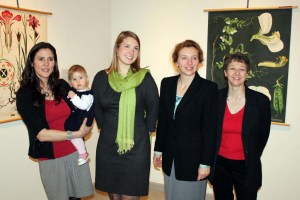
L to R: Interim Museum Director Martha Johnson, curator Lydia Kirchner, advisor Dr. Andrea Campbell, and supervisor Deborah Spanich.


Related Topics

Knowing Nature: Naturalist Illustration from Art to Science
University of Florida, Gainsville

www.harn.ufl.edu

Summer B Session
June 27 – August 5, 2011
Wednesdays, 12:30-3:15 PM

University of Florida (UF) students have the unique opportunity to study the collection of over 200 naturalist prints at the Harn Museum of Art. During this summer session, students will study prints from the 16th – 19th centuries featuring botanical, zoological, entomological and conchological subjects.

Seven faculty members will teach this course.Topics of discussion include:

  • Prints and Insects
  • Prints and Empire
  • Prints and Printmaking
  • Prints, Plants and Evolution
  • Prints, Gardens and Literature
  • Prints and Economics
  • Prints in the Museum

This summer course is for students who register through the University of Florida’s registrar’s office.

Non-UF students interested in auditing courses should read the University’s policies for auditing a class at http://www.registrar.ufl.edu/currents/audit.html.

Regular registration for this course begins June 24, 2011. The Drop/Add window for the Summer B session is June 27-28, 2011 (see academic dates)

Download flyer for Knowing Nature

This information has been posted at Classes Near You > Florida.