Feeds:
Posts
Comments

Ghost Ranch Conference Center, Abiquiu
The 21,000 acres that make up Ghost Ranch were part of a 1766 land grant to Pedro Martin Serrano from the King of Spain. Located in northwestern New Mexico, the Ranch is an education and retreat center and was the home of Georgia O’Keefe for many years.

    Field Sketching Ghost Ranch Flora and Fauna
    July 25-31, 2011
    Explore the ecosystems of Ghost Ranch, learn the art of field sketching and receive an introduction to botanical illustration. Work both in the field and in the classroom, and contribute to the creation of the Ghost Ranch nature guide. The nature guide project was started in 2009 by instructors Helen Byers (artist) and Dr. Janet Darrow (biologist). Helen has drawn and painted at Ghost Ranch since 1984 and has taught at the Ranch since 2005. Dr. Darrow is an award-winning filmmaker (Our Vanishing Desert) and has served as naturalist on trips to the Peruvian Amazon with the American Museum of Natural History. Artist of all levels are welcome. View a slide show of student work from past classes at Ghost Ranch.

    Cost: $300, plus housing and meals.
    Registration Information
    Download course flyer

This information has been posted at Classes Near You > New Mexico.

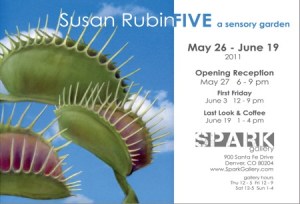
FIVE: a sensory garden
May 26 – June 19, 2011
SPARK gallery, Denver, CO

Botanical artist, Susan Rubin, will share her contemporary view of botanical art in an exhibition about plants, people, and the five senses.

As Susan explains in her statement for FIVE:

In an ongoing exploration of the relationship between people and plants, this group of drawings takes a closer look at the five senses and the way we experience our environment.

As babies, we touch and taste everything we see. As adults, we respond immediately to familiar sensations and make fast judgments based on past sensory experiences. Senses trigger one another. Just read the word “rose” and you can smell it. See a lemon and pucker up.

Smell is the sense most linked to memory. A whiff of Grandma’s perfume, the first Spring lilacs, or the charred scent of a campfire will snap you back in history faster than any photograph or story.

Beautiful, delicious, fragrant plants engage our senses, but it is not their job. It is coincidence that the sensory input of plants affects us at all. Their scents and colors and tastes are all geared toward one thing: species survival – theirs, not ours.

Textures and colors calibrate absorption of light and moisture; scent and markings attract pollinators; flavor and sound are related to ripening, decay and dehydration, which lead to dispersal of seeds and start the whole cycle again.

We are happy bystanders to botany, connected by our five senses.

View a gallery of Susan’s work online at Susan Rubin Studio.

New at Classes Near You > New York:


Cornell Plantations, Ithaca

www.cornellplantations.org
A collection of botanical resources comprised of Cornell’s arboretum, botanical garden, campus gardens, and natural areas. Cornell Plantations aims to preserve horticultural collections and natural areas for the public and for scientific research.

    The Joy of Botanical Illustration – Eight Thursdays, May 5, 12, 19, 26, June 2, 9, 16, 23, 2011; 6:00 – 9:00 PM.
    If you love botanical art but wonder if YOU could really do it yourself, this class is for you. Botanical artist Camille Doucet leads this introduction to painting the flora of the Plantations’ botanical garden. Participants will learn how to observe plants and how to draw them. They will also learn about perspective, composition and color mixing, and explore various media including pen and ink, colored pencil, and watercolor. A materials list is available upon request. Pre-registration is required. Cost: $288 nonmembers/$240 members (8 sessions). Individual sessions are $40 each for nonmembers and $35 each for members. This class will be held at the Brian C. Nevin Welcome Center.

    To register, please call (607) 254-7430 or email km274@cornell.edu.
    Additional Information

When Elaine Searle was enrolled in Anne-Marie Evans’ class by a friend, she did not know a thing about botanical art. That was in 2002.

Today in 2011, Elaine has work in the permanent collection at The Hunt Institute for Botanical Documentation and is a contributing artist to The Highgrove Florilegium, a collection of paintings documenting the plants grown in the Garden at Highgrove, the estate of HRH, The Prince of Wales.


How It All Began

Elaine received conventional art school training. After an initial year’s foundation program which included life drawing, ceramics, graphic design, etching and silkscreen printing, she chose graphics as a specialization before commencing a three-year Bachelor of Arts Degree. This decision shaped her first business career.

Graduating with an interest in Package Design, Elaine’s early career in the retail industry saw her build and manage teams of designers working on some of the most successful store concepts of the 1980-90’s. For the next 10 years, she ran a design partnership offering retail and print design to clients in the UK and Spain. This meant lots of business travel and a 24/7 schedule became the norm.

Elaine lived in an apartment in London during this time, with no garden and certainly no time to garden. Plants were not even a part of her life. Over time, Elaine became stressed with her business and a good friend told her she needed a hobby because all she did was work. The friend suggested that Elaine take a class in botanical art, something which she herself had recently done. Elaine’s reaction was, “What’s botanical art?”

Three months later, this concerned friend reserved a spot in Anne Marie Evans’ class for both of them. She told Elaine all she needed to do was show up.

Elaine showed up that first day. She returned on the second day too. However at the end of the second day, Elaine was strongly tempted not to continue.

Having used computers all of her professional life as a graphic designer, she had lost her drawing skills. She glanced rather than really looked and, in addition, didn’t even know the stamen in a flower were called stamen – referring to them as “the little bits in the middle.” She felt out of her depth. Coaxed by her very supportive husband, however, Elaine decided to return for Day Three.

That day proved to be a turning point. Anne-Marie’s teaching worked its magic and Elaine began to relax. During Days 3-5, Elaine’s experience with botanical art transformed from one of apprehension to intrigue to enthusiasm. She finished the five-day course in a much better place than when she started. After completing the course, Elaine returned to her full-time graphics business.

The experience of Anne-Marie’s class remained at the forefront of Elaine’s mind. She sought out botanical art books, traveled to exhibitions, and enrolled in more short classes. Her new obsession took on a life of its own. She contemplated joining the diploma program at the English Gardening School at Chelsea, where Anne-Marie was course director, and talked it over with her husband. Was it feasible that she could continue to run her design business, attend classes and keep up with the heavy schedule of homework? Well, her heart won over her head and she decided to enroll, financing the program with a bank loan. She structured her life so she could keep up with both her graphics business and the diploma course. Wherever possible, she made pragmatic choices – such as selecting specimens for her final project that did not move or change too much (succulents). After a hectic but very enjoyable two years, she graduated with a Distinction. Botanical art had become her passion, but financial realities meant that Elaine needed to resume her graphics business full-time.

Botanical art continued to lure Elaine. Whenever she met Anne Marie, her teacher would encourage Elaine to take her art further. Anne-Marie suggested she set her sights on the juried exhibitions hosted by the Royal Horticultural Society (RHS) in London.

Artists submitting work to the RHS exhibition are required to submit eight drawings or paintings related by a theme. Not having time to create a collection of new work, Elaine used the six succulent paintings which had formed her final project for the diploma course, painted two more, exhibited her work in January 2008, and was awarded a Silver gilt medal.

Then Anne-Marie suggested she submit work to The Hunt Institute for Botanical Documentation. Lacking the time to begin a project from scratch, Elaine sent two of those same succulents to The Hunt for their 12th Annual Exhibition, and now one of them is in the permanent collection. The exhibition gave Elaine her chance to attend her first American Society of Botanical Artists conference (which, incidentally, was also her first visit to the USA).

Elaine was surprised and honored by an invitation to paint for The Highgrove Florilegium. Elaine’s painting of Crocosmia ‘Emily McKenzie’ was accepted for inclusion in Volume I of the historic work. You can view this painting here on Elaine’s website.

While working on the Highgrove project, Elaine began to entertain the idea of teaching botanical art. She began by holding small classes locally. Wanting to see how things would go, she kept this new project low-key until she was more sure that it worked for her and her students. When she was given the opportunity to become a visiting instructor for the very diploma program she had attended in Chelsea, she gained additional and invaluable experience.

Well, word got out that Elaine was teaching, and she was invited to demonstrate at the 2008 ASBA conference and to teach at the 2009 conference. Elaine will teach again at the 2011 conference in Boston this Fall.

Elaine teaches in the UK, USA and Europe and plans and leads experiences in botanical art at vacation destinations such as Portugal and Italy. She recently launched a thoughtful and well-structured distance learning program for both beginning and experienced botanical artists.


A Conversation with Elaine Searle

ARTPLANTAE: Your paintings are not simple plant portraits. They have a presence on the paper. How do you decide on the statement your plant will make on the paper? What type of factors come into play — A plant’s physical features? Your first impression? Your past experiences with that type of plant? All of the above?

ELAINE SEARLE: Each plant has a personality. Sometimes It isn’t what you would first think of. For example, I recently painted a blue hydrangea. With its enormous “mop head” blooms and strong leaves I saw it as a “thug” in the garden. It demands your attention not because it is beautiful or brightly colored, but because of its architectural strength. I am drawn to plants that demand attention. I rarely paint herbs or wildflowers. Perhaps it’s time I did! I should find a way to give voice to their understated beauty.


AP
: What is your teaching philosophy?

ES: I believe people learn best in a safe and supportive environment. I try to take the fear out of the room. I want people to relax and to open their minds to what personally they might achieve. I like to share some of the mistakes I’ve made along the way. My teaching demonstrates that botanical art is a series of steps, which when broken down, are not difficult to learn. I don’t want to get too intense. The basic skills of watercolor painting are not complex, but to master them requires focus, determination and lots of practice. I always try to establish realistic expectations of what can be achieved within a short class. I think we often learn by making mistakes, and I think my teaching style is nurturing. I try to build confidence and discourage competitiveness.


AP
: How do you think students new to botanical art learn drawing best?

ES: I think they learn drawing with the fundamentals. By first learning to look, then to analyze, and then achieve sufficient control of the medium to be able to explain what they see. If they learn an approach based on breaking complex botanical forms down into simpler shapes and then build their drawings adding layers of refinement and detail, it reduces fear.


AP
: How do you think students new to botanical art learn painting best?

ES: By initially being introduced to a series of exercises that are not about painting botanical forms. They should be taught the correct brush hold and how to paint simple flat and graded washes. You can’t really tell someone the ratio of pigment-to-water they need. They need to practice making the paint do what they want it to do before they think about making flower or leaf shapes. Even now I still make squares of practice washes to loosen up or to try new pigments.


AP
: How do you think students with experience in botanical art learn best?

ES: They need to critique and to be critiqued without taking it personally. Learning how to critique is a valuable tool. The more experienced student needs to seek feedback from other more experienced artists whose work they admire and whose professional opinion they trust. Once they gain insight to where their strengths and weaknesses may lie, they can seek the specific tuition they need. Generally, the botanical community is a supportive one, so there are people willing to help them and share their knowledge either in the context of a masterclass or informally through discussion at an exhibition or conference. The more they are prepared to study the work of both historical and contemporary botanical masters, the more they will grow as artists.


AP
: You have developed a thoughtful and interactive distance learning program. Tell us about it.

ES: The idea for this program came out of a number of direct requests. To develop and launch such a program was not an easy decision. My own very positive experience of excellent classroom tuition made me aware that it’s very difficult for a distance learning program to match a classroom’s environment and benefits. Yet, there were clearly those who sought botanical art tuition, but were prevented from pursuing traditional routes to learning, and I wanted to develop a program that would work for those people. And, perhaps to act as an additional resource for those already taking periodic classes seeking a more structured and self-paced approach.

Researching other botanical art distance learning programs, I saw that there were basically two types. First, those which are small and very focused on a particular artist’s approach/techniques; or, second, those which were large, rather impersonal, and structured around “How to” manuals. I didn’t find that either embraced the capacity of the emerging technology of interactive learning via the Web in order to offer a more personal and nurturing environment.

Many questions arose. How could I translate the best of the classroom experience into home learning? How could I offer a structure, yet still tailor the program to some extent, to allow for differing starting levels of experience? How would I ensure that students felt motivated and supported throughout so that “distance” learning felt “up close and personal”?

The program launched in January 2011 is comprised of six modules introducing the student to the basics of observation, drawing and watercolor painting of botanical subjects. The later modules cover perceived problem colors, composition, creating textures, detail and depth.

A small group of students in the UK, USA and Japan have so far enrolled. Some are absolute beginners, others already take classes but like the idea of supplementing these with online learning. This is an evolving project and I have plans to add improved levels of interactivity, utilize video conferencing, etc. Watch my website – www.paintbotanical.com – for more news.


Office Hours with Elaine Searle

Now is your chance to ask Elaine questions about botanical art, her classes, and her new distance learning program. Elaine will hold office hours through the month of May. You are invited to submit questions to Elaine through the Comment form. Elaine will watch for your questions and will respond to all questions below.

Right now at Classes Near You > England:


Elaine Searle

www.paintbotanical.com
Elaine Searle is a botanical artist and instructor with many years of experience. She teaches at various locations in the UK, USA and Europe and each year runs a week-long botanical painting holiday open to all skill levels. For 2011 Elaine believes that she has discovered the perfect venue! A small family run hotel in a wonderful unspoilt national park setting in Umbria, Northern Italy. Non-painting partners are very welcome too.

    Coast! Get Started in Botanical/Natural History Painting
    4-6 Aug 2011; 10:00 AM – 3:30 PM. Blakeney Harbour Room, North Norfolk.
    North Norfolk is noted for its unspoilt coast. This new 3-day course will introduce the basic skills of observation, drawing and watercolour painting necessary to make studies of shoreline finds such as shells, feathers, plants and pebbles. In this studio-based class, we will work from flora and flotsam provided. Elaine Searle uses technique demonstrations and simple, practical exercises to encourage rapid progress, giving confidence to those with little or no previous experience. Small class size allows for plenty of individual attention and an atmosphere that is supportive and non-competitive with the focus on enjoyment together with personal achievement. The aim is that everyone should go home with a study sheet to be proud of, and the confidence to paint “finds” from their own beach or country rambles. Cost: Three-day nonresidential class £290 inclusive of 2 course lunches, refreshments, tuition, use of specimens, art materials, papers, and equipment. Full payment required with booking.

    Botanical Painting Holiday in Umbria
    – September, 3-10, 2011. Hotel ‘Il Collaccio, Precia, Italy. On this holiday you may paint as much, or as little as you wish. The itinerary comprises five days of tuition, with a free day to relax or explore the fascinating local area. Most mornings will be spent in the ground floor studio with Elaine offering individual guidance. A wide variety of local subject matter will be provided. In the afternoons you can choose to continue botanical painting or relax and explore. There is plenty for non-painting partners to see and do. For more information on the holiday, accommodations, excursions, and photos, click here. Registration is open booking via Il Collaccio at www.ilcollaccio.com.

    FEES
    £810 per painter (sharing)
    £535 per non-painter (sharing)
    £105 single room supplement

    WHAT’S INCLUDED
    7 nights en-suite accommodation, full board* (including half bottle of wine with evening meal). Botanical painting tuition by Elaine Searle.
    *Dinner on day of arrival, breakfast on day of departure, full board on all other days except for lunch on the free day.

    WHAT’S NOT INCLUDED
    Flights and airport transfers (collection by car can be arranged through the hotel), insurance, optional day excursions.

Download Elaine’s 2011 Course Brochure

A brain isn’t just left-sided or right-sided. It is a single working unit that makes it possible to understand the interdisciplinary nature of knowledge.

This view is expressed by Edmond Alkaslassy and Terry O’Day in Linking Art and Science with a Drawing Class, published in Bioscene: Journal of College Biology Teaching, the refereed quarterly publication of the Association of College and University Educators.

Alkaslassy and O’Day (2002) wanted to help students recognize the shared skills required in art and science, so they designed a drawing course for second-semester freshmen enrolled in an introductory biology class. This drawing course was taught in conjunction with the biology lecture/lab class. The researchers wanted to use the drawing course as a tool to reinforce the message that good observational skills are beneficial in both an artistic and scientific setting (Alkaslassy and O’Day, 2002).

Unlike other experiments in which drawing activities are incorporated into a lab class, Alkaslassy and O’Day (2002) were careful to keep the drawing class free of heavy biological content. They wanted the drawing class to be a course where students could improve their drawing ability. That’s it.

To preserve this format, they made sure drawing exercises did not resemble biology homework for fear the drawing course would become a “help session” (Alkaslassy and O’Day, 2002) for the biology class. Students were not even required to label drawings of subjects they had not yet learned about in the lecture class. Adding labels to drawings was viewed as being “tantamount to asking (students) to study and learn biology” (Alkaslassy and O’Day, 2002). The authors wanted to see if improved drawing ability had an effect on student observational skills and, therefore, an effect on academic performance in the lecture class.


The Results


Did learning how to observe in a drawing course improve academic performance in the biology class?

No. During the semester, all students enrolled in Biology 202 were required to complete five exams and twelve labs. At the end of the term, the mean scores of students enrolled in both the drawing class and the lecture/lab class were lower than the mean scores of the other students.

Why?

Alkaslassy and O’Day (2002) propose some reasons why this may have been the case:

  • The students who enrolled in the drawing course were academically weaker than students who did not enroll in the drawing course. College GPAs and SAT scores between the two groups were compared. The historical indicator of student success in the Biology 202 course (verbal SAT scores) were lower for students enrolled in the art course and the lecture/lab course.
  • The self-selected students enrolled in the drawing course because they were already concerned about their performance in Biology 202 and wanted the extra “tutorial”, which of course they did not receive because the drawing course was not designed to be a “help session”.
  • The drawing course created a false sense of understanding caused by the repeated observation of biological subjects.


Did the drawing course improve student drawing ability?

Yes. Alkaslassy and O’Day (2002) state this outcome can be observed in the pre-instructional and post-instructional drawings of trees completed by students. One example of a pre- and post- drawing is included in Alkaslassy and O’Day (2002). Students’ own comments about their improved drawing skills reinforce this finding.


Did students recognize observation as a shared skill worth developing in art and science?

Yes. Student comments about the relationship between drawing and biology suggest they were beginning to recognize the interdisciplinary nature of learning. Here is an example of one student’s comment in Alkaslassy and O’Day (2002):

I have realized, during my labs, how much more attention I pay to what I am trying to draw. Before I took this drawing class, I would’ve drawn a worm like a long skinny line and not given it its true justice of what it is really composed of.

The paper by Alkaslassy and O’Day is available online for free. See the Literature Cited section below.


Literature Cited

Alkaslassy, Edmond and Terry O’Day. 2002. Linking art and science with a drawing class. Bioscene: Journal of College Biology Teaching 28(2): 7-14. Web.
25 April 2011. <http://acube.org/bioscene/>

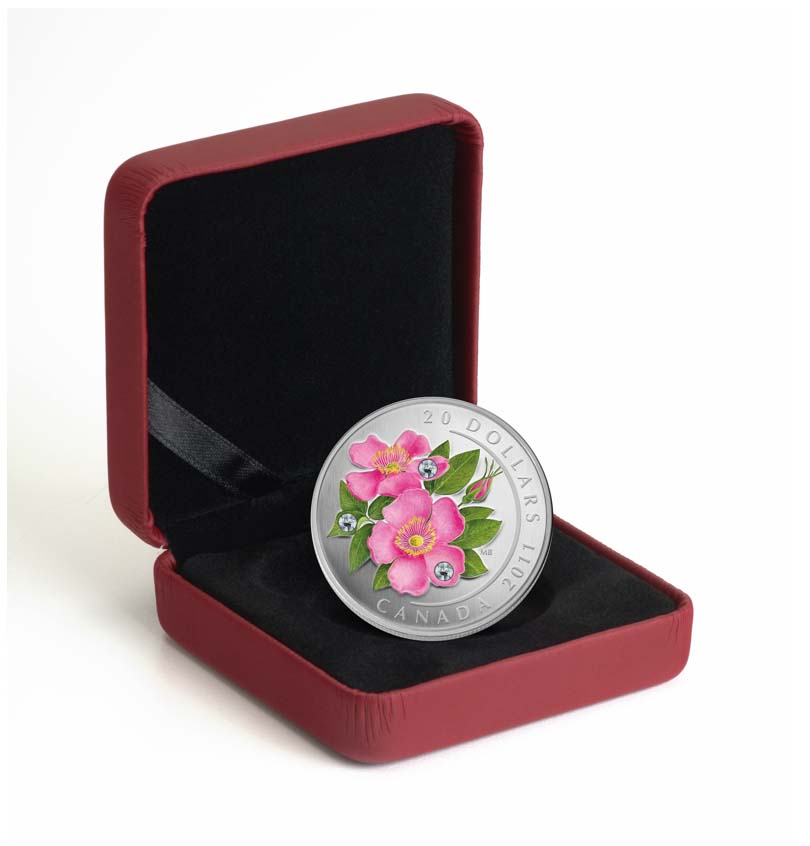
Courtesy: Royal Canadian Mint (click to enlarge)

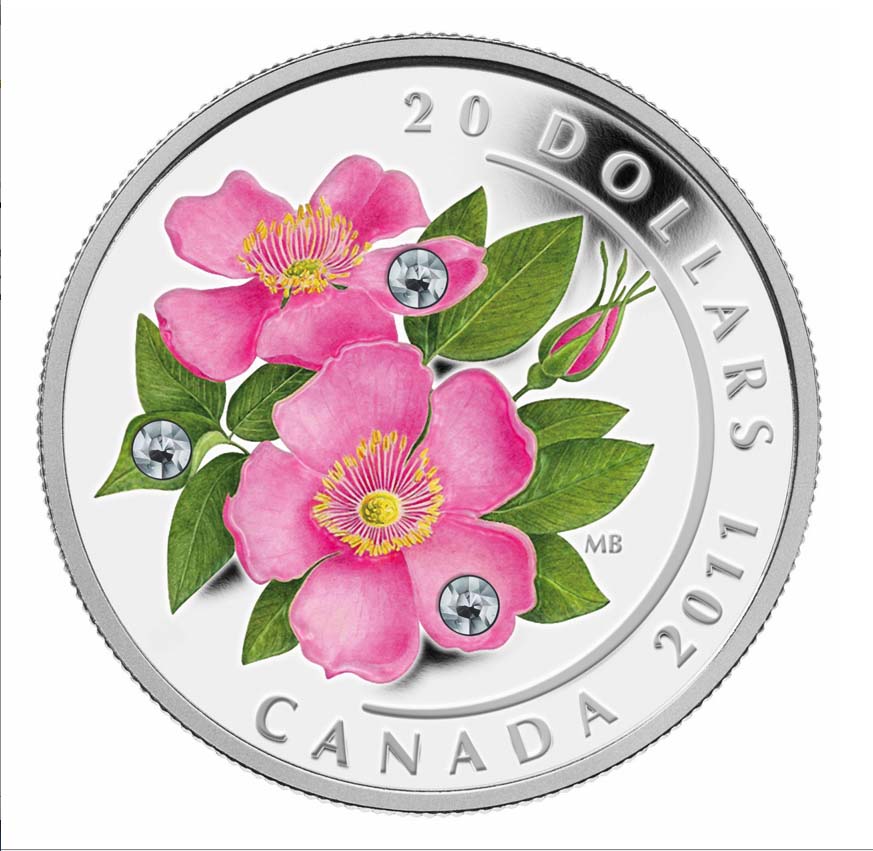
Last year, Feature Artist Margaret Best was commissioned by the Royal Canadian Mint to produce a watercolor painting of a wild rose for reproduction on a Canadian twenty dollar silver coin. Margaret’s coin was released this week and is now available online.

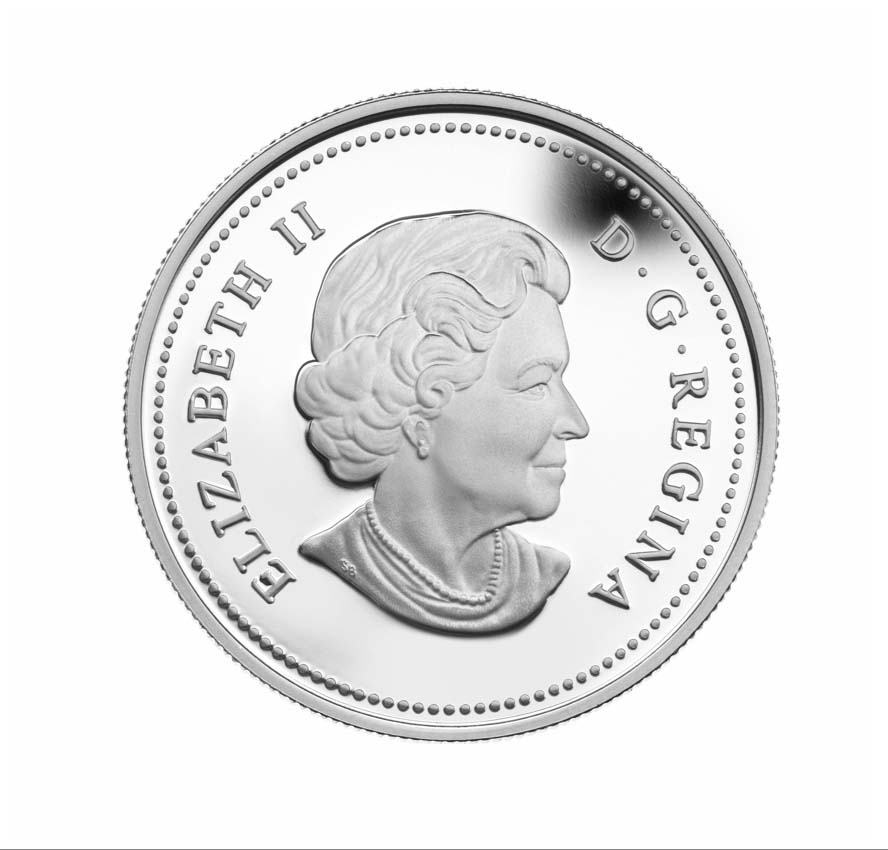
The Royal Canadian Mint is well known for issuing commemorative and collectors’ coins of unique and colorful designs to which it adds elements such as, in the case of this coin, genuine Swarovski crystals. The background of a proof finish on pure silver sets off the color of Best’s rendition of a wild rose to dramatic effect.

Margaret Best has been an artist from childhood but narrowed her focus to purely botanical art about twelve years ago. She attributes much of her success in her chosen genre to her mentor, the world-renowned English botanical artist, Pandora Sellars. Best’s botanical art is true to the tradition of rendering flora both in a scientifically accurate and artistically pleasing manner. The genre has its roots in the historical practice of documenting the flora of the world for identification, scientific, classification and recording purposes.

Best’s work has been exhibited in various galleries and group exhibitions in England, the United States and Canada. She also has a piece in the permanent collection of the Hunt Institute for Botanical Documentation of the Carnegie Mellon University, Pittsburgh. Her next solo exhibition, Bermuda Botanica, opens in Bermuda next month. Her work is also featured in Today’s Botanical Artists, a book presenting a selection of paintings by sixty-five of the top contemporary botanical artists in North America. Best is an active teacher of botanical art. She has conducted classes in Canada, the United States, the U.K. and Bermuda.

Courtesy: Royal Canadian Mint (click to enlarge)

Courtesy: Royal Canadian Mint (click to enlarge)


Also See…

Margaret Best Discuses Color in Botanical Art