Feeds:
Posts
Comments

At the age of 60, biologist Maura Flannery decided to learn more about plants. She writes about her decision in Daring Botany, an article written for her Biology Today column in The American Biology Teacher. In this article, she discusses how botanical illustration and online databases about plants have helped to resolve her self-described “plant blindness” (Flannery, 2007).

Flannery is no stranger to the use of imagery in biology. One of her research specialties is the relationship between biology and art. So it was no surprise to learn she studied botanical illustration at the New York Botanical Garden (NYBG). She has written about botanical illustration in previous articles (Flannery, 1995). What was different about this article was who she mentioned as the botanical artist whom she describes as her “role model” (Flannery, 2007).

Dr. Dick Rauh is a much-loved and respected botanist and botanical illustrator and is currently serving as President of the American Society of Botanical Artists. He teaches Plant Morphology at NYBG and at botanical gardens across the U.S. In her article, Flannery (2007) writes how Dr. Rauh taught her to see “how plants are put together”, how they work and how their morphological features vary between plant families. She writes how Dr. Rauh’s passion for plants made each of his students want to learn more about them.

Flannery describes her time at NYBG as a “humbling experience”, one marked with challenges in learning how to draw, learning how to draw plants, and “even learning (how) to hold a pencil correctly” (Flannery, 2007). Her experiences in botanical illustration made her appreciate the challenges of learning a subject with many layers of information and caused her to reflect on the challenges her own students face when learning new concepts in her classroom. Her studies at NYBG also trained her to “look more carefully at the green world” and instilled in her such a strong enthusiasm towards plants, Flannery (2007) made plants the focus of a class she taught later that year. Anyone who has learned from Dr. Rauh knows such a transformation is not an exaggeration. This story is great example of the power of effective storytelling and how botanical illustration can connect people to the seemingly invisible world of plants.

Throughout the rest of her article, Flannery (2007) talks about how she learned a great deal about plants and modern botany at the Botany and Plant Biology Joint Congress. Flannery describes the plant databases and research projects that made an impression on her. It is a selection of these databases that I will focus on next, as they are resources botanical artists may want to bookmark for future studies and travels.


    PLANTS Database

    http://www.plants.usda.gov
    View tens of thousands of plant images, use interactive keys to identify the gymnosperms, legumes, grasses and wetland monocots in your state. Are you interested in creating a body of work about local plants? The information on this website will get you started.


    National Biological Information Infrastructure (NBII)

    http://www.nbii.gov
    A resource-rich website providing information about our nation’s biological resources.


    Botanicus Digital Library

    www.botanicus.org
    A free Web-based catalog of botanical literature, with a special focus on illustrated books.


    Jepson Herbarium, UC Berkeley

    http://ucjeps.berkeley.edu/consortium/about.html
    A searchable database of 1.2 million specimens stored in herbaria throughout California. This is a resource worth exploring if your current project involves drawing a plant indigenous to California.


    The C.V. Starr Virtual Herbarium

    http://sciweb.nybg.org/science2/VirtualHerbarium.asp
    The online herbarium of the New York Botanical Garden comprised of 1.3 million herbarium specimens and 225,000 images. Specimen catalogs feature bryophytes, fungi, lichens, algae, and vascular plants. This is only one of many digitizing projects being conducted by herbaria across the U.S.


    Tropical Plant Guide from The Field Museum in Chicago

    http://fm2.fieldmuseum.org/plantguides
    Explore the tropics! The Field Museum has created downloadable field guides to plants and animals for anyone to use. This is a fantastic resource. If you need a guide to explore the ferns of Bolivia, the fruits of Mata Atlantica, or the seedlings of Costa Rica, you’ll find color guides you can download and then laminate. Also available are photos of neotropical plants, herbarium specimens, and micro-herbaria available on DVDs.

Both of Flannery’s articles can be purchased online for $14 each. Alternatively, you can search for these articles at a library near you.


Literature Cited

Flannery, Maura C. 1995. The visual in botany. The American Biology Teacher. 57(2):117-120. [accessed 16 June 2011] <http://www.jstor.org/pss/4449936>

Flannery, Maura C. 2007. Daring botany. The American Biology Teacher. 69(8):488-491. [accessed 16 June 2011] < http://www.jstor.org/pss/4452210>
Share this flyer with friends and colleagues. Post in your local library or coffee house.

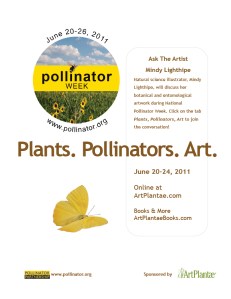
Next week is National Pollinator Week. The Ask The Artist event with Mindy Lighthipe begins on Monday and continues through Friday June 24, 2011. During this time, Mindy will respond to readers’ questions about her botanical and entomological work. Do you have questions about drawing insects, working with museums, creating a themed body of work, working with gouache, or writing a book? Ask Mindy!

Please submit your question(s) by June 20 in the comment section below and help get the conversation going. Then feel free to join in as the conversation progresses through the week.

National Pollinator Week is an annual event hosted by the Pollinator Partnership, a nonprofit organization in San Francisco, CA working to protect the health of pollinators essential to the North American landscape and agriculture. One way they do this is through supporting legislation promoting conservation practices, such as the Highways Bettering the Economy and Environment Act (Highway BEE Act) to be introduced to the U.S. House of Representatives next week on June 23. This act encourages reduced mowing and native plantings that provide habitat for pollinators, nesting birds and other wildlife on 17 million acres of highway rights-of-way. Read the complete text of this act here. The Pollinator Partnership is collecting signatures for their group letter. If you wish to add your name or your organization’s name to this letter, click here by June 20, 2011.


Related

Mindy Lighthipe Takes Plant-Insect Interactions to the Suburbs

California Native Plant Society
Conservation Conference

Conserving and restoring the roots of California’s richness
January 12-14, 2012

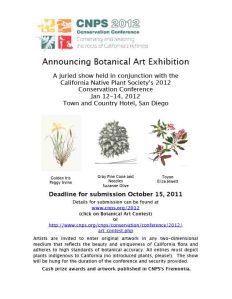
The California Native Plant Society will host an exhibition of botanical art at its January conference. All artists are invited to submit two-dimensional artwork in any medium for consideration. Artwork must be botanically accurate and must feature plants originating in and characteristic of the California landscape. Only indigenous plants will be considered. Click image to download call for entries.

Entry Deadline: October 15, 2011

Now at Classes Near You > Colorado:


Denver Botanic Gardens School of Botanical Art and Illustration

Denver Botanic Gardens
A complete program offering classes in pencil drawing, colored pencil, watercolor, sketching, botany, art history, scratch board, and classes dedicated to specific techniques and plant groups. See a complete course listing here. This program now works collaboratively with El Charco del Ingenio, a nature reserve and botanical garden in San Miguel de Allende, Guanajuato, Mexico. To learn more about the Garden’s certificate program, visit the program’s blog at http://botanicalillustration.blogspot.com. This blog is maintained by Program Coordinator, Mervi Hjelmroos-Koski.

The Summer/Fall 2011 schedule for Denver Botanical Garden includes:

GUEST WORKSHOPS

    Flower Portraits in Pastel with Susan Fisher – July 8-10, 2011

    From Outlined to Boneless: Painting Peony and Lotus the Chinese Way – October 14-16, 2011; 9:00 a.m. – 2:30 p.m. Explore the rhythms of nature and human culture through traditional Chinese ink painting. Instructor: Sally Yu Leung

    Look, Paint and Enjoy! – November 6-9, 2011; 9:00 a.m. – 2:30 p.m. Learn the meticulous drawing, painting and composition techniques of illustrator Charlotte Knox.


INTRODUCTORY COURSES
:

    Introduction to Botanical Illustration


REQUIRED COURSES
:

    Botany for the Botanical Illustrator
    Composition for Botanical Illustration
    Botanical Illustration in Pencil I
    Botanical Illustration in Pencil II
    Perfecting Perspective
    Botanical Illustration in Pen and Ink I
    Botanical Illustration in Pen and Ink II
    Color Layering for Colored Pencil
    Botanical Illustration in Colored Pencil I
    Botanical Illustration in Colored Pencil II
    Color Mixing for Artists
    Botanical Illustration in Watercolor I
    Botanical Illustration in Watercolor II


ELECTIVE COURSES
:

    Art Materials for the Botanical Illustrator
    Botany Spotlight: Lichens
    Adobe Illustrator I
    Bookbinding Workshop – Make Three Different Artistic Boxes
    Color Mixing Journal
    Botanical Artist’s Visual Journal
    The Art of the Nature Journal at Caribou Ranch and Mud Lake Open Space
    The Value of Value in Color Painting
    Focus on Style
    Expressive Ink on Mylar
    Texture on Mylar with Colored Pencil
    Ravishing Reds in Watercolor
    Features in Graphite
    Elegant Hand Lettering I
    Elegant Hand Lettering II: Beautiful Brushstrokes
    Pen and Ink III: Arizona Legumes II
    Lyrical Flowers in Colored Pencil on Mylar
    Leafy Greens in Colored Pencil
    Native Earth
    Wicked Plants
    Art Nouveau: Botanical Tile Design
    Conifers in Colored Pencil
    Brilliant Butterflies
    Indigenous Plants and American Indian Cuisine
    Drawing on Tradition: Marie Angel’s Illuminated Miniatures
    Watercolor Pencils I
    Rocky Mountain Wildflowers
    Sunflowers in Watercolor
    Colorado Native Grasses
    The Story of the Apple
    Eggs and Nests in Watercolor
    Drawing on Tradition: Album Vilmorin & the Vegetable Garden


DISTANCE LEARNING

This new program combines in-class instruction with online instruction. Students accepted into this new certificate program must live more than 150 miles from Denver Botanic Gardens. Click image to download schedule.

    Required Courses Taught at DBG
    Botanical Illustration in Pencil I
    Botany for the Botanical Illustrator
    Composition for Botanical Illustration
    Perfecting Perspective
    Color Layering for Colored Pencil

    Required Courses Taught Online with On-site Component
    (two days of in-class instruction followed by three weekly Internet sessions)
    Botanical Illustration in Pencil II
    Botanical Illustration in Colored Pencil I
    Botanical Illustration in Colored Pencil II
    Color Mixing for Artists
    Botanical Illustration in Pen and Ink I
    Botanical Illustration in Pen and Ink II
    Botanical Illustration in Watercolor I
    Botanical Illustration in Watercolor II


WORKSHOPS AT EL CHARCO 2011

    Succulents: Texture & Form in Colored Pencil (Feb. 7-11, 2011)
    Nature Illuminated: Ink and Mixed Media (July 25-29, 2011)
    Wildflowers in Watercolor (Dec. 5-9, 2011)


View and download all schedules
:

Updates at Classes Near You > Oregon:


Jeanne Debons Studio, Bend

www.jeannedebons.com
Dr. Jeanne Debons received her Ph.D. in the Department of Botany and Plant Pathology at Oregon State University. She graduated from the diploma course in Botanical Painting at the English Gardening School in 2005.

Two-Day Botanical Painting Workshop with Jeanne Debons

Learn the fundamentals of botanical painting in watercolor. Small class size ensures individualized attention. Supplies will be provided for beginners. Experienced students will work on more advanced skills. Drawing and painting techniques, color mixing, and composition will be discussed. Lunch is included for all students.

Saturdays & Sundays, choose from the following sessions:

  • June 18-19, 2011
  • July 23-24, 2011

Cost: $120 for a two-day workshop (or $65/day). Click here to download course flyer.

NEW! Botanical Painting Workshop: Potato Association of America

Saturday August 13, Sunday August 14 and Wednesday August 17; 10 AM – 4 PM each day. Association members have the opportunity to learn about the techniques of botanical illustration during the 2011 annual meeting.
Cost: $40 each session or $100 for all three sessions.

Mixed media artist, Jane LaFazio, is inspiring people across the U.S. this summer. Updates to her busy schedule have been posted in the Classes Near You section for Arizona, California, Oregon, Illinois and Utah.


Jane LaFazio, Plain Jane Studio, San Diego

www.plainjanestudio.com
Jane is a mixed media artist and a member of the San Diego Sketchcrawl group. Jane teaches at conferences across the U.S. and leads classes in Italy too. In addition to the sketching classes below, Jane teaches workshops in collage, mixed media, and quilting. A detailed class schedule can be viewed on her blog. Also see an interview with Jane and her Ask The Artist Q&A with readers.

  • Sketchbooks & Visual Journals – July 9-10, 2011. Jane will teach with Linda Blinn. Please contact San Clemente Art Supply to register.
  • Sketching & Watercolor in Utah – July 21-24, 2011. See Creative Inspiration Mountain Retreats for details.
  • Big Book – Wednesday August 3, 2011; 9:00 AM – 4:30 PM. Paint, draw, stamp, stencil, collage and weave! Surface design techniques for paper. Participants will learn how to fold paper to create a large book. Art Unraveled, Phoenix, Arizona. View details. (Art Unraveled.com)
  • Sketching & Watercolor: Journal Style Pinecones & Pods – Friday August 5, 2011; 9:00 AM – 4:30 PM. Create 5” x 7” journal pages featuring the pinecones, pods and branches of Arizona. Learn how a relaxed intuitive approach to sketching and watercolor. Art Unraveled, Phoenix, Arizona. View details. (Art Unraveled.com)
  • Sketching & Watercolor: ON LOCATION. This six-week online class begins August 11, 2011. Learn how to draw and paint on location. Specific instructions and locales will be assigned each week. Cost: $75. View details
  • Sketching & Watercolor: Journal Style – Thursday August 25, 2011. This six-hour workshop will be taught at the CREATE Mixed Media Retreat, Hickory Ridge Marriott, Lisle, IL. View event website.

  • Sketching & Watercolor: Journal Style – Art & Soul Mixed Media Art Workshop, Portland, OR. September 28, 2011. Register

Linnaeus described plants expertly. But could he draw?

Independent scholar, museum consultant and exhibition curator, Karen Reeds, takes a look at how Linnaeus described plants in When the Botanist Can’t Draw: The Case of Linnaeus.

Linnaeus studied botany during a time when botany instruction, as Reeds (2004) puts it, was very “show and tell.” A time when students had to compare a plant specimen to several illustrations to identify it because the written descriptions of plants were so unorganized (Reeds, 2010).

Linnaeus put an end to the cumbersome search for descriptive text when he created his classification system. He spent years writing descriptions of plants, documenting what he saw and then organizing this information in a systematic way. He valued descriptive text over illustrations (Reeds, 2004) and interestingly enough, this preference has put him in the hot seat, at least where his drawing abilities are concerned.

Linnaeus’ own sketches have received mixed reviews over the years. Some reviews have been more critical than others. According to Reeds (2004), Wilfrid Blunt (The Art of Botanical Illustration) has been very critical of Linnaeus’ drawings stating:

Matisse once said that his ambition was to draw like his little girl of five; Linnaeus achieved this effortlessly.

Other Linnaean scholars have been less critical.

Reeds (2004) suggests Linnaeus’ preference for words over illustrations was a combination of being on the receiving end of “show and tell” botany instruction as a student (after all, she says, he was a “pre-Linnaean” student of botany), his natural “strengths as a scientist”, and his personal struggles with drawing. Struggles that Reeds (2004) says are easy to see in his work.

Reeds (2004) says you can see “how well a drawing succeeds as description of an unfamiliar object” by copying it. When Reeds tried to copy some of Linnaeus’ drawings without referring to his written words, she found she often questioned the purpose of Linnaeus’ lines and couldn’t tell if a line was intended to show “volume, perspective, shading or texture” (Reeds, 2004).

Linneaus’ preference for descriptive text over illustrations is clear in Hortus Cliffortianus (1737), a book about the plant collection of George Clifford, a Dutch banker and director of the Dutch East India company. Clifford hired Linnaeus and artists to document his plants. Linnaeus’ descriptive text is the heart and soul of this book, while the plant portraits created by none other than botanical artist Georg Ehret and engraver Jan Vandelaar, were placed at the end of the book without an effective index linking the text to the engravings (Reeds, 2004). While Linnaeus admired the illustrations of his counterparts, he held firm in his opinion that pictures could never offer the level of information achievable with the written word stating, “I do not recommend drawings ….. for determining genera – in fact, I absolutely reject them” (Reeds, 2004). Linnaeus felt words were much more effective at describing plants and their unique qualities than illustrations.

What do you think?

For a more thorough analysis of Linnaeus’ notebooks and his thoughts about illustrations, see Reed (2004).


Literature Cited

Blunt, Wilfrid. 1993. The Art of Botanical Illustration. Antique Collectors Club. Revised and enlarged edition. (9781851491773)

Reeds, Karen. 2004. When the botanist can’t draw: the case of Linnaeus. Interdisciplinary Science Reviews. 29(3): 248-258. Web. [accessed 8 June 2011] <http://www.ingentaconnect.com/content/maney/isr/2004/00000029/00000003/art00005>