Feeds:
Posts
Comments

Don’t worry. You won’t get in trouble.

Personally, I write in the margins of many things. I write all over the research papers I read and in the books from my personal library too. Some books are so full of information (like Karin Nickelsen’s book about 18th-century botanical illustrations), notes are a necessity because they are the only way I can keep up with the author and relate new information to other things I’ve read. Writing in the margins is how I make meaning. What I do not do, is highlight and underline pages and pages of text. Highlighting and excessive underlining never worked for me. While studying teaching and learning techniques and student learning in grad school, I read a comment by someone making the point that the act of highlighting text is simply proclaiming, I’ll get to this later. Now isn’t that the truth? I apologize for not being able to give credit to this individual.

What about doodling? Do you create doodles to help you process information in the text?

Then you might be interested in an exhibition at the University of North Carolina exploring why images are paired with text and how information is conveyed through pictures. The exhibition, Meaningful Marks: Image and Text and the History of the Book, is on view at the Melba Remig Saltarelli Exhibit Room in the Wilson Special Collection Library until September 28, 2011. One of the books featured in the exhibit is Mark Catesby’s Natural History of Carolina, Florida and the Bahama Islands (1731-1743).

Getting back to scribbling in book margins…

Do you find this practice offensive or are you okay with people who do this? Here is a link to a short video featuring interviews with people on both sides of this issue. This video was created by multimedia journalist, Jonathan Michaels, and takes a look at why we write in books.


Related
:


This post marks the beginning of a new feature about books and literature pertaining to plants, nature, natural history art and related topics.


A careful photographic study of plants at Winterbourne Botanical Garden lead to the creation of unique color palettes by artist and designer, Chris Eckersley. Nature’s colors were matched using oil color after Eckersley selected six colors from each photograph to create his color charts.

See examples of Eckersley’s work in the press release on the exhibition page for The Colours of Winterbourne.

A link to this exhibition has been added to the Exhibits to Visit section.

The Colours of Winterbourne
Winterbourne House and Garden
The Coach House Gallery
Sept. 1 – Oct. 13, 2011

New ten-week programs announced at Classes Near You > Illinois:


Lillstreet Art Center

http://lillstreet.com

    Introduction to Botanical Art & Illustration I
    Mondays, September 19 – November 15, 2011; 10 AM – 1 PM. This class is designed for beginners/advanced beginners. Observation and research skills, basic drawing skills with black & white medium (graphite pencil and pen-and-ink) will be introduced along with brief botanical art history. In this ten-week class, students will also learn basic botany, which is essential for botanical artists to make their work botanically accurate. Precise reviews and critiques will follow every class and two independent projects will be completed by each student. Colored medium, watercolor and colored pencil will be introduced in Introduction to Botanical Art and Illustration II.

    For more information, contact instructor and botanical artist Heeyoung Kim at info@PrairiePlantArt.com. Learn more about Heeyoung and view her online gallery at www.PrairiePlantArt.com. To register for this class, contact the Lillstreet Art Center at (773) 769-4226 or register online. Cost: $320 members, $330 nonmembers

Here are new updates for Sibley Nature Center in Midland, Texas:


Sibley Nature Center, Midland

www.sibleynaturecenter.org
This 49-acre site is home to programs educating the public about the southern Llano Estacado and surrounding area. Museum specialist and scientific illustrator, Michael M. Nickell, teaches the Center’s courses about nature drawing and journaling. He has been a professional practicing scientific illustrator and nature artists for over 30 years. He clients include National Geographic, Texas Parks and Wildlife, The Museum of Texas Tech University, Lubbock Lake Landmark, The University of Texas at Austin, The University of Oklahoma, the Carnegie Museum of Natural History, The Square House Museum, Encyclopedia Britannica, and others.

  • Introduction to Nature Drawing – September 12 & 26,
    October 10 & 24 and November 7, 2011; 6:30 – 8:30 PM.
    Cost $50 members, $80 nonmembers.
  • How to Use Your Digital Camera – September 12 & 14, 2011; 6-8 PM. Cost: $25 members, $35 nonmembers. Instructor: Richard Galle
  • Natural Dyes – October 20, 2011; 7-8 PM. Learn how to dye cloth or yarn using plant material such as onion skin, agarita root, broomweed leaves and more. This special presentation is free for Sibley members, $10 for nonmembers. Instructor: Ethel Matthews

This information can also be viewed at Classes Near You > Texas.

New at Classes Near You > Michigan:


Shiawassee Arts Center

www.shiawasseearts.org
Located in Owosso, the Shiawassee Arts Center hosts exhibitions, classes for adults and children and art center tours. It also manages consignment galleries showcasing the artwork of artists working in a variety of media.

    Botanical Art: Drawing from the Harvest
    Thursdays, September 29 – November 3, 2011. Participants will learn how to draw the Fall harvest using colored pencils. Color layering, burnishing and other techniques will be taught. All levels of experience welcome. A supply list will be provided upon registration.
    Cost: $95 members, $105 nonmembers
    Materials Fee: $10 payable to instructor

Clip art is familiar to many people and is readily available in software programs and on the Web. Clip art images represent easy-to-interpret images and scenes on a broad range of topics. One would assume clip art images are easy to remember. However this is apparently not the case when it comes to plants, as professors Elizabeth E. Schussler and Lynn A Olzak discovered in It’s Not Easy Being Green: Student Recall of Plant and Animal Images.

Schussler & Olzak designed a study around the recall of clip art images in the Microsoft Office PowerPoint program (2003) out of concern for the public’s preference of studying animals over plants (Kinchen (1999) & Wandersee (1986), as cited in Schussler & Olzak, 2008) and the fact that teachers use animal examples in class to teach concepts more than plant examples (Uno (1994), as cited in Schussler & Olzak, 2008). In designing their research, they created two studies — a pilot study to test plant and animal images and a study in which student recall of these images was tested. They hypothesized students would recall more animal images than plant images and that botany students would recall more plant images than psychology students. One hundred thirty-three psychology students participated in the pilot study and 327 psychology and non-major botany students participated in the recall study.

What Schussler & Olzak (2008) found was that all students recalled a higher number of animal images and that botany students did not recall more plant images than psychology students. They also observed that female students recalled a statistically significant higher number of plant images than male students.

Schussler & Olzak (2008) state their results imply the following:

  • Students forget information about plants quickly.
  • Students do not give plant images the same type of attention they give animal images.
  • Student experiences in a one-semester botany class may not be enough to make students more aware of plants.
  • The socialization of women in western society may explain why female students recalled more plant images than male students.

Schussler & Olzak (2008) express concern that “student knowledge about, and attitude toward, plants compared with animals may be ingrained (either cognitively or culturally)” and that this presents a serious challenge for botany educators. They suggest teachers find out which plants their students know by name and to use these plants as examples in class. They also recommend teachers use an equal number of plant examples and animal examples in their classrooms to counter student attitudes towards plants and to prove that plants are alive and relevant to our lives. The challenge for educators, according to Schussler & Olzak (2008), is to create experiences that “increase conscious consideration of plants” at a time when the education system is accommodating the public’s preference of studying animals over plants.

Learn how Schussler & Olzak (2008) designed their pilot study and how they administered their recall study by picking up a copy of their paper at your local college library.


Literature Cited

    Kinchin, I.M. 1999. Investigating secondary-school girls’ preferences for animals or plants: a simple “head-to-head” comparison using two unfamiliar organisms. Journal of Biological Education. 33: 95-99

    Schussler, Elizabeth E. and Lynn A Olzak. 2008. It’s not easy being green: student recall of plant and animal images. Journal of Biological Education. 42(3): 112-118

    Uno, G.E. 1994. The state of precollege botanical education. The American Biology Teacher. 56: 263-267

    Wandersee, J.H. 1986. Plant or animals – which do junior high school students perfer to study? Journal of Research in Science Teaching. 23: 415-426

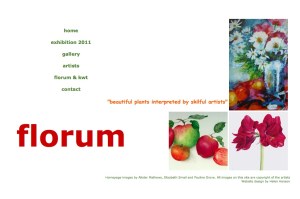
florum
Sevenoaks Wildlife Reserve
September 10-17, 2011

This weekend botanical artists will gather to celebrate plants, botanical art and the Sevenoaks Wildlife Reserve. The Florum organization and the Kent Wildlife Trust are excited to present their annual exhibition of botanical art. Proceeds benefit the Sevenoaks Wildlife Reserve, a 136-acre sanctuary composed of lakes, ponds and habitat that is home to birds, plants, fungi and wildlife. The Sevenoaks Wildlife Reserve is located near London.

Featured artists for 2011 are Kristin Rosenberg, Jan Harbon, Christina Hart-Davies, Wendy Cranston, Sue Scullard, Mayumi Hashi, Sue J. Williams, Monty Parkin, Karen Birchwood, Barbara Valentine, Elizabeth Small, and Pauline Grove. A total of 62 artists will participate in this year’s show.

This exhibition opens on Saturday and is free to the public.
Exhibition hours are 10 AM – 5 PM daily.