Feeds:
Posts
Comments

We know people are more attracted to animals than they are to plants and that the reasons why are many. People like animals because they move, can interact, are furry, etc. Do plants have any appealing qualities? Is love at first sight possible with plants? Can interest in plants be encouraged?

In Increasing the Interest of Students in Plants, Jelka Strgar of the University of Ljubljana in Slovenia brings attention to the differences in how people notice plants and animals. She points out that animals have instant appeal, while plants tend to be appreciated only after they have been explained or shared via the “enthusiasm of a third party” (Strgar, 2007). Interested in measuring the effects of classroom instruction on student interest in plants, she created the experiment that is the focus of this post.

Knowing that people are more attracted to plants if they are pretty, useful, have interesting features, or engage in some type of interesting behavior, Strgar (2007) established a collection of interesting plant specimens for students (n=184, ages 9-23) to observe. Her collection was composed of plants with immediate eye-catching qualities and plants with qualities that were less obvious. Plants were labeled “A” through “H” and students were asked to record their interest in each plant using a 5-point scale. Students rated each specimen twice. Once when they first saw the plants and again after they had received information about each plant and had the opportunity to touch the plants and reflect on what they learned. Included in the collection were a peanut plant with fruit (Arachis hypogea), a pine cone from a Himalayan blue pine (Pinus wallichiana), the fruit of an Osage orange (Maclura pomifera), a sensitive plant (Mimosa pudica), green algae, an Alice Sundew plant (Drosera aliciae), a plastic artificial squash, and a water lettuce plant (Pistia stratiotes).

Strgar (2007) observed that plants students considered to be too common generated little interest. While plants of an unusual size or shape, plants that did something (i.e., float, move), and plants with appealing colors generated immediate interest, as did plants students had never seen before. Students found the Osage orange, water lettuce and cone of the Himalayan blue pine the most interesting on first sight. Student interest in the green algae, Alice Sundew plant, sensitive plant and artificial squash was moderate. The plant generating the least amount of interest at first sight was the peanut plant.

After teachers talked about each plant and students had the opportunity to touch the plants, Strgar (2007) found there was a statistically significant increase in interest in the Alice Sundew plant, the sensitive plant and the peanut plant. Interest levels in the Osage orange, water lettuce, cone of the Himalayan blue pine and green algae remained the same. The only specimen for which there was a statistically significant decrease in interest was the plastic squash.

Upon review of data and student comments, Strgar (2007) determined that two factors contributed to the observed increase in student interest in plants:

  • Teachers showing students how to look at plants in a new way.
  • The element of surprise experienced by students with respect to some of the specimens.

Strgar (2007) concluded that it is possible to increase student interest in plants at all levels of education if teachers serve as enthusiastic guides and if living plants are used as examples.


Literature Cited

Strgar, Jelka. 2007. Increasing the interest of students in plants. Journal of Biological Education. 42(1): 19-23. Winter 2007

Search your local college library for a copy of this article

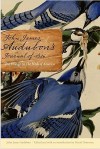
John James Audubon:
American Artist and Naturalist

Mobile Museum of Art
Mobile, AL
Oct. 14, 2011 – Jan. 8, 2012

View 80 original Audubon prints, including 64 of the original hand-colored Double Elephant Folio engravings from The Birds of America. Also see letters written by Audubon, rare books, photographs, and personal items from the John James Audubon Museum in Henderson, Kentucky.

This weekend, you will be able to learn from John James Audubon himself as author, naturalist, and storyteller Brian “Fox” Ellis portrays Audubon in several programs.

    Birding Hike and Gallery Talk
    Saturday, October 15, 2011; 9-11 AM. A unique bird-watching adventure begins in Langan Park and ends in the Museum galleries. Audubon will bring his paintings to life, giving insight into bird behavior and providing tips on becoming a better birder. Bring binoculars and dress for the weather.

    The Art of Storytelling and Interpretation
    Saturday, October 15, 2011; 1-3 PM. Learn how to create effective and memorable educational programs through storytelling and first-person monologues. Educators, docents, and naturalists will learn skills that can be used to interpret any kind of art, science or historical chapter.

    Adventures with Audubon
    Sunday, October 16, 2011; 1:30 PM. Learn about the natural history of North America as Audubon shares stories of his travels and what he saw in the early 1800s.

    Visit the museum’s website for information about workshops and lectures scheduled for November.


    Related

In Capturing the Essence: Techniques for Bird Artists, William T. Cooper shares the wisdom and insight that can only come from forty years of painting birds in the field. This book was written for bird artists, people thinking about painting birds, and those seeking insight into the artistic processes of wildlife artists.

Field sketches and finished paintings on every page complement Cooper’s written instruction. This book is divided into two parts. The first part addresses materials, field supplies and foundation principles such as tone, light, and shade, color, composition, and foreshortening. In Cooper’s section about bird anatomy, he teaches artists about the feather groups they must know to create quick sketches in the field. Cooper provides a visual for every point he makes and these invaluable visuals help artists see and think about situations they will encounter during their own studies.

Cooper designates five pages of his book to “Backgrounds and Extras” where he discusses the documentation of background scenes, plants, and prey items. This section is a look into his file cabinet. His illustrations of a plant, a lizard, a mouse, a katydid, and a dead honeyeater represent the type of reference images he creates. It is impossible to turn away from these pages without imagining what the rest of Cooper’s file cabinet might look like.

In the second part of his book, Cooper leads readers through the creation of three paintings — one in watercolor, one in acrylic and one in oil. In each instance, he lists the materials he used and describes how each painting was developed from a pencil sketch to a finished piece.

Capturing the Essence: Techniques for Bird Artists is a beautiful book. It is an inspiring how-to guide and collection of ornithological art. Cooper’s teachings about anatomy, combined with the insight he shares about sketching birds in the field and in flight, will turn anyone reading this book into a more knowledgeable observer of birds.

See inside Capturing the Essence: Techniques for Bird Artists at ArtPlantae Books.


Related

John James Audubon Exhibition Opens at Mobile Museum of Art

ArtPlantae’s Plant Notes Bookmarks have been accepted into The Gifty Awards and are in the running for Specialty Gift Product of the Year in the Paper & Stationery category. The winner in each category will receive a Gifty Award and receive recognition in Museums & More magazine and through various industry websites and networks.


Voting is now open!

Round One voting is open through Monday, October 24, 2011.
ArtPlantae respectfully asks for your consideration and vote for Plant Notes Bookmarks, the ideal tool for gardeners planning their next harvest.

View all categories and vote for products at www.thegiftys.com.


How to Vote
:

    1. Go to www.thegiftys.com.
    2. Register here.
    3. You will receive a confirmation email. Click on the link in this email.
    4. Login here.
    5. Click on the Thumbs Up and Thumbs Down buttons to vote.
    6. Logout

Thank you for your consideration.

The University of Washington Botanic Gardens will host a botanical art exhibition and contest celebrating the native plants and plant communities of northwestern North America. The exhibition and contest will be held in conjunction with the conference Conserving Plant Biodiversity in a Changing World: A View from NW North America, March 13-14, 2012. The exhibition will be on view in the Miller Library at the UW Botanic Gardens from March 1-31, 2012. Conference attendees will vote for the winner in the botanical illustration category and the photography category.

Review of Requirements:

  • Artists must send digital image of their work for consideration.
    Deadline: January 1, 2012
  • Digital image must be 300-800 dpi and must be sent to 2012plantconf.art@gmail.com. Include artist’s name, contact information, name of species, the plant’s native ecosystem and location.
  • Artists will be notified by January 15, 2012 if their work has been selected. Further instructions will be provided at this time.
  • Work must be framed and wired for hanging. No glass. Plexiglass only. Size limit: 20″ x 24″
  • Send all questions to 2012plantconf.art@gmail.com.

Additional instruction (.pdf files) about submitting botanical illustration artwork and photography is available on the exhibition website.


Conserving Plant Biodiversity in a Changing World:
A View from NW North America

University of Washington Botanic Gardens
Seattle, WA
March 13-14, 2012

Click to enlarge

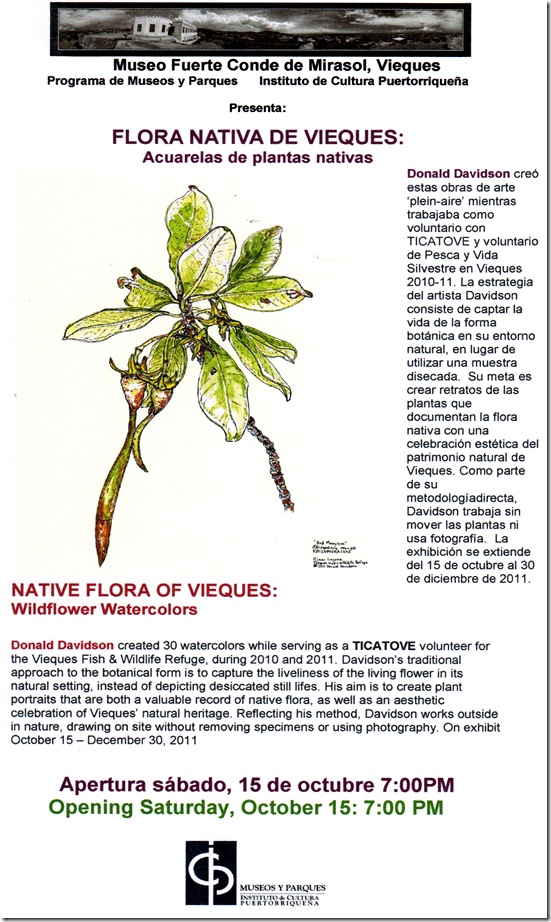
Native Flora of Vieques:
Wildflower Watercolors

Museo Fuerte Conde de Mirasol
Vieques, Puerto Rico
October 15 – December 30, 2011

Traveling artist, Donald Davidson, has documented the native flora and natural heritage of Vieques in 30 watercolor paintings. The exhibition Native Flora of Vieques will open this weekend at Museo Fuerte Conde de Mirasol. Donald created his paintings while serving as a volunteer at the Vieques Fish & Wildlife Refuge during 2010-2011.

Learn more about Donald’s current work on his website. Click on Flora Portrait, Vieques Events in the Articles section of his site.

Read about Vieques Island here.

The classes below have been added to the fall schedule at the UC Botanical Garden at Berkeley. View the Garden’s complete schedule, including details about the upcoming botanical art class with Lee McCaffree, at
Classes Near You > California.


University of California Botanical Garden at Berkeley

http://botanicalgarden.berkeley.edu
This 34-acre garden was established in 1890 and is now a non-profit research garden and museum. The botanical art classes below are taught by Lee McCaffree and Catherine Watters. View a detailed schedule and register on the Garden’s website.

  • Beeswax Soapmaking – Sunday, November 6, 2011; 11 AM – 1 PM. Errol Davis of San Francisco’s Metaphor Organic will join the Garden for a hip, hands-on beeswax soap-making class. Students will learn how to craft functional and premium quality soap from local ingredients. Students will also learn how and why base oils are blended, how to handle lye safely, how to add scents and botanicals, and much more. Materials included. Pre-registration required; $40 non-members, $35 members. Space is limited!
  • Autumn in Asia – Thursday, November 10, 2011; 1-2 PM. Join the Garden and Horticulturist Elaine Sedlack for a tour of the Garden’s Asian maple species in gorgeous autumn color. The Garden now has over 35 species of maples representative of species from Korea, China, Taiwan, Japan and the Himalayas. Members only; free; pre-registration required.
  • Succulent Wreath Making – Wednesday, November 16, 2011; 6-9 PM. Create a gorgeous succulent wreath to enjoy all year round. You’ll select among a variety of succulents and be guided on how to plant and care for your wreaths. All materials provided. Pre-registration required: $60 non-members, $50 members
  • Evergreen Wreathes and Garlands – Wednesday, December 14, 2011; 6-9 PM. Create a beautiful and festive wreath or garland to add to your holiday decorations. Greens from the Garden and other materials are included, but be sure to bring your own hand pruners. Pre-registration required; $30 non-members, $25 members.