Feeds:
Posts
Comments

There are five days left to ask our featured guest, Hazel West-Sherring, about all aspects of her work and about teaching, learning and creating botanical art.

    Do you have “how-to” questions? Ask Hazel!

    Curious as to where you should place your signature on a painting? Ask!

    Flower parts driving you crazy?

    Having a hard time with a leaf?

    Ready to throw your paint brushes out the window?

    Participate in this month’s conversation and ask our guest the questions you have on your mind this month.

Send your questions through the comment box below or send them to education@artplantae.com.

Which plants can you identify upon first glance? Are they plants from the nursery? From the florist? Are they native plants?

How did you come to know these plants?

Plants featured in an advertisement, a children’s book, or a lavish garden are more recognizable to the public than common wildflowers (Bebbington, 2005). To determine the extent to which this is the case, Anne Bebbington of the Field Studies Council created a survey to test the environmental knowledge of students taking field classes at a field center. Students’ environmental knowledge was assessed through an evaluation of their plant identification skills. Bebbington discusses her findings in The Ability of A-level Students to Name Plants.

From October 2003 through December 2004, Bebbington (2005) collected data from 925 participants. Her sample was composed of A-level biology students (i.e., college-bound high school students; n=812), graduates working on their certificate in education (n=92), and biology teachers (n=21). All participants were asked to identify ten common wildflower plants at the beginning of field courses they enrolled in at the Juniper Hall Field Centre located 25 miles outside of London. Each participant was handed a sheet featuring color illustrations of ten common plants. Participants wrote the names of plants next to the appropriate illustration. General terms like “daisy” and “violet” were accepted in lieu of exact common names or scientific names.

An evaluation of participants’ responses revealed that most A-level biology students could not identify more than three plants, that teacher education students did only slightly better than the A-level students, and that biology teachers were the most successful at identifying plants (Bebbington, 2005). Of the plants used in the exercise, the daisy plant was the most easily identified, followed by the foxglove and the primrose — a result Bebbington (2005) attributes more to participants’ personal experiences with these plants instead of anything they might have learned in school.

Bebbington’s conversations with students revealed that students did not think plant identification was a skill worth learning. Students said that naming organisms is “a job for specialists” (Bebbington, 2005). This type of thinking raises concern because students’ lack of interest in knowing the names of plants impacts their working knowledge of environmental issues.

Why does this indifference exist?

Bebbington (2005) points to the absence of botany education at all grade levels, along with less exposure to organismic biology (whole organism biology) as contributing factors. She shares the results of an interesting study revealing that eight year-old children could recognize more than half of the unnatural Pokemon types presented to them, but were less able to identify common wildlife types (Balmford et al., 2002 as cited in Bebbington (2005)). Societal issues such as safety concerns about being alone in natural areas is also cited by Bebbington (2005) as a possible contributing factor because concerns about safety may reduce one’s interest in natural history. Cultural differences, family income, family background and parents’ own outdoor experiences can also be factors (Bebbington, 2005).

Since recognizing local plants and animals is necessary to establish an environmentally literate citizenry, Bebbington (2005) proposes that primary teachers be encouraged to incorporate plant-related activities into their curriculum, that teachers be encouraged to provide more field experiences for their students, and that schools encourage students to take part in the informal science education programs provided by local organizations. The latter recommendation is inline with an observation made by Kramer and Havens (2010) in the Botanical Capacity Project about private sector programs filling-in gaps in botany education left open by academe.

To read Bebbington’s detailed assessment of her findings and to view a copy of the wildflower quiz she used, purchase The Ability of A-level Students to Name Plants online for $34 or conduct a search for this article at your local library.


Literature Cited

    Balmford, A., L. Clegg, T. Coulsen. and J. Taylor. 2002. Why conservationists should heed Pokemon. Science. 295(5564): 2367.

    Bebbington, Anne. 2005. The ability of A-level students to name plants. Journal of Biological Education. 39(2): 63-67.

    Kramer, Andrea and Kayri Havens. 2010. Assessing Botanical Capacity to Address Grand Challenges in the United States. A report by the Botanical Capacity Assessment Project. Website http://www.bgci.org/usa/bcap [accessed 4 November 2011].

Inspiration for the Holidays

It is the diaries that speak the loudest in the empty library at night.

— Susan Snyder

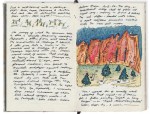
Diarist, Susan Snyder, has compiled a moving and engrossing collection of diaries in Beyond Words: 200 Years of Illustrated Diaries. The featured diarists recorded their thoughts, secret wishes, To Do lists and illustrations in diaries they referred to as their “journals”, “field notes” and “logs”. The unknown writers provide an insider’s perspective of significant world events and invaluable insight into what nature looked like during their lifetimes.

Most of the diaries in this book are from the Bancroft Library at the University of California, Berkeley where Snyder works as a librarian and researcher. The diaries in this book are not all by famous people, although you may recognize the products they created and the organizations they established. The featured diarists were (and are) travelers, mothers, inventors, explorers, naturalists, children, poets and soldiers — including a 16 year-old soldier of the Mexican-American War whose interest in botany was greater than his interest in fighting.

In Beyond Words, you will find journals written between 1776 and 1981. With each turn of the page, years pass, journal pages become less fragile, penmanship becomes more modern, and advances in technology (think typewriter) and advances in photography become evident.

Each 24″-wide, two-page spread allows the reader to view each diarists’ words and illustration up close. These visual treats and the warm colors, eye-pleasing fonts and clean layout of each page create a soothing reading experience for readers.

Heyday Books has provided us an opportunity to view pages inside this wonderful new book. Click on the image to peek into the diaries of John Muir and others.


Beyond Words: 200 Years of Illustrated Diaries

Order this book online from your local independent bookstore.

Would you like to start your own illustrated diary?

Botanical artist and teacher, Nina Antze, will teach you how to start a nature journal using colored pencils. See her updated listing in Classes Near You > California:


Northern California


Nina Antze
Drawing Nature in Colored Pencil

www.pcquilt.com/botanicals.htm
Nina received a degree in Fine Art from San Francisco State University and a Certificate in Botanical Illustration from the botanical art program at the New York Botanical Garden. For more information about the classes below, contact Nina Antze or call (707) 237-7014. Nina’s teaching schedule can also be viewed on her website.

  • Nature Drawing Classes – Four Tuesdays, ongoing. 9AM – 12 PM. Learn to capture the forms and colors of nature at Sebastopol Center for the Arts in Sebastopol, CA. Cost: $89. Contact Nina Antze or
    call (707) 237-7014.
  • Drawing Autumn Leaves – Saturday November 12, 2011; 9 AM – 4 PM. Learn how to create the rich colors of Fall using colored pencils. Point Reyes National Seashore Association. Cost: $135 non-members, $115 PRNSA members. Register online.


Southern California

    Nature Drawing Classes – Learn to capture the forms and colors of nature at El Dorado Nature Center in Long Beach, CA (2nd Saturday of the month). Contact: (562) 570-1745

The botanical garden at UC Berkeley announces classes for the new year.

To view the Garden’s current list of classes, go to
Classes Near You > Northern California:


University of California Botanical Garden at Berkeley

http://botanicalgarden.berkeley.edu
This 34-acre garden was established in 1890 and is now a non-profit research garden and museum. The botanical art classes below are taught by Lee McCaffree and Catherine Watters. View a detailed schedule and register on the Garden’s website.

  • Makin’ Mead – Saturday, January 7, 2012; 2-4 PM. Turn honey into wine! Robert MacKimmie of City Bees will teach participants how to mix a gallon of mead to ferment at home. Yes, there will be samples and everyone goes home with recipes too. Registration is required. $50 non-members, $40 members. Space is limited. Register early.
  • Plants Illustrated Exhibition – January 14 – February 3, 2012;
    10 AM – 4 PM. The Garden is pleased to announce its third annual botanical art exhibition, Plants Illustrated. The exhibition, held in conjunction with the Northern California Society of Botanical Artists, invites viewers to explore the relationship between scientific study and fine art. The exhibit presents original artworks in watercolor, graphite, colored pencil and pen and ink and explores the many styles, forms and approaches unique to botanical art and illustration. Free with Garden admission.
  • Botanical Art Through the Ages – Friday, January 20, 2012;
    2:00 – 3:30 PM. Botanical artist Catherine Watters will discuss the rich history of botanical art. View prints, slides and other media. Learn about Pierre-Joseph Redoute´, Maria Sibylla Merian and significant historical events such as Tulipmania and the Age of Exploration. $10 non-members;
    $5 members, UCB students, staff and faculty.

Hazel West-Sherring’s enthusiasm for botanical art runs deep.

Her fervor for teaching others about plants and botanical art leaps out at you through the Internet. It is no wonder she has been awarded medals by the Royal Horticultural Society (RHS), has had her work shown in the Shirley Sherwood Gallery of Botanical Art at Kew, and has work in the permanent collections of the Hunt Institute for Botanical Documentation, the RHS Lindley Library, Royal Botanical Gardens Kew and the Highgrove Florilegium. Hazel is currently working on the Flora of Sissinghurst, a special solo project documenting 50 iconic plants representing the historically important gardens at Sissinghurst Castle, the ruin of an Elizabethan house. The project satisfying and entwining her two loves of gardens and plant portraiture.

Please welcome November feature artist, Hazel West-Sherring!


ArtPlantae
: Hazel, you mentioned that you strive to provide a “real botanical experience” for your students, one that extends far beyond the studio. How do you approach teaching botanical art?

Hazel West-Sherring
: Historically the botanical artist was an illustrator following the science-based traditions of plant hunting, plant identification and plant recording. Botanical artists today enjoy a wealth of plant accessibility and choice, their interests born primarily from an innate love of their own gardens and plants, or those encountered on their travels. Crucially for me, it is native plants and their habits, through the changing seasons.

To enjoy the “real botanical experience”, my classes work around the gardening year, embracing the seasonal changes to growth and habit of a plant in bud, flower or fruit. Concentrating on classic English garden plants, fruits and vegetables, I start with encouraging familiarisation of the chosen plant family. Understanding where and how the plant grows, is to really experience its character. (It is enormous fun sourcing and growing plants, and I usually have a nursery bed of raised seed, or bulbs, planted out in preparation for future courses!) Then a good deal of inspiring reference material is made available (selected images, books and prints), to review examples of what I and others have achieved in portraying similar plant specimens.

Essential familiarity and understanding of the botany of the plant, through microscope or simple dissection, aids good observational drawing and underpins a successful painting. Sketching the parts of a plant separately on a worksheet, looking at the leaf junctions, the reverse of a leaf or the flower in bud and mature form, promotes understanding. Observance of colour should be actively and enthusiastically explored, and the student is often challenged by introduction to a palette of colour perhaps previously overlooked. The extreme pleasure of recognising colours once seen, and capturing them in pigment, is another crucial part of the real botanical experience!

My passion for 18th century English landscape gardens, and the creation of our own small formal plot, inspires and underlines my own classic approach to plant portraiture. I enthusiastically encourage and support a student’s individual approach in portraying their chosen specimen, and guide them through good observational drawing practices and watercolour techniques. Welcoming and embracing students’ individual response to colour, habit, texture, or shape, through personal expression yet sound botanical observation, is key to my ultimate reward as a teacher.

I favour small groups and happily mix student abilities in my classes. I feel strongly that the botanical experience is open to all, and that students benefit greatly from sharing their individual achievements and by learning from others.


AP
: You are a prolific painter! Your dedication to botanical art shows through your paintings, which I am sure is the result of thousands of hours of work. How do you establish balance between being a prolific painter and an attentive teacher?

HWS
: I have been painting now for several years and a body of work has inevitably built, but slowly! Yes, the paintings do require much commitment of time to reach completion. Before the painting begins, I go through the stages described above. Many hours of plant sourcing and researching, perhaps several growing seasons, hours of study, preparatory drawing and colour referencing, and then final drawing, composition and painting. It is a slow process!

There is certainly a delicate balancing act to consider when programming my teaching courses through the year, and attempting to complete a collection of paintings, or a work to commission. I enthusiastically manage and share my combined passions since each aspect happily influences the other. Often on courses run from my studio, students’ presence during the development of a painting can be beneficial to both parties. I welcome their thoughts and comments, and they scrutinise the techniques I have employed! The combined passions for plants and gardens, and for painting and teaching good botanical art, culminate in the real botanical experience that I want to share.


AP
: Do you keep a sketchbook for casual thoughts and doodles?

HWS
: With reference to my finished paintings, there has always been a certain amount of preparatory drawing and colour work done on “worksheets”. Although rather time-consuming, these sheets contain as much information as possible to allow me to complete a painting confidently when the plant has long since withered. They are the nearest equivalent to a sketchbook, since they contain many experiments and colour trials, as well as rapidly observed plant features I want to include in a final drawing.


AP
: On your website, you describe the skills botanical watercolorists must possess to be successful. Describe what “meticulous brushwork” looks like.

HWS
: Yes, I do describe skills that would be beneficial to a budding botanical watercolourist, not to put them off necessarily, but to prepare them! I talk about some botanical knowledge being helpful, and a genuine interest in the colours and forms of nature. Since good observational drawing is required to underpin a painting, patience is essential. Watercolour techniques can be learnt with practice. Meticulous brushwork is the combination of right technique in the right place, resistance to over-painting, and seamless transitions of colour interchange or light and shade. Even with much practice and some degree of satisfaction in a finished painting, there might only be one small area of a painting that truly satisfies the quest for “meticulous brushwork”…..but it is what we strive to achieve in each of our paintings.


AP
: Also, what thought processes or actions are behind “clever color mixing”?

HWS
: Colour can be such a very personal thing…I argue constantly with my husband about the sea being green not blue! But understanding how pigments work is crucial…..whether a colour is cool or warm, transparent or opaque, the properties of single pigment against a mixed colour which may granulate and misbehave. Watercolour colour mixing need not be restricted to the palette either, since the effect of layering different colour washes can be stunning, and unexpected.

For my students to really enjoy watercolour in the fullest sense, I try to break down colour prejudices or pre-conceived ideas, encouraging them to see a fuller colour palette within the specimen. A simple example would be a lemon, which on closer inspection and reference to a colour chart, may be very much warmer in hue than presupposed. It may carry green or orange bias, with the possibility of turquoise or pale violet shadows.

When painting in watercolour, I always recommend that before the onset of the actual painting, a colour palette is considered and that single pigment and mixed colour swatches are made. If possible maintain the same yellows, reds or blues from mixed colours, that may appear elsewhere as single pigment. It brings a colour unity through the painting, and allows “spot” colours to really glow!


AP
: What’s in your palette?

HWS
: I unashamedly admit to a wide palette, mostly Winsor and Newton, with some very brazen colours. For example, because I adore the “wateriness” of watercolour, and favour layering of washes, I might suggest an initial underwash of quite an unexpected colour. Opera rose is a good example of a brazen colour, fabulously luminous under subsequent deep violet washes for a velvety deep blue iris. I favour pans, and the ones most used and with the holes in, are gamboge, prussian and burnt sienna!


AP
: What’s in your pencil box?

HWS
: My pencil box is very limited! My dividers, mechanical pencil and pen, grey putty rubber and an old glass handheld magnifier. My brushes are very limited too, miniature sables and the all important prolene mixing brush and separate flat lifting and blending brush.


AP
: As you know, readers are invited to ask featured guests questions. This time, let’s have the guest lead the conversation. What would you like to discuss with readers?

HWS
: I would like to discuss the enjoyment of botanical art in the round….the “real botanical experience”. I really do believe anyone can be helped through the drawing and painting experience to a worthy outcome. Perfection of the image is not necessarily the aim, thinking more broadly, it is the knowledge and experience shared in getting to know that particular plant. Students never look at their subject in the same way again, and once the wider world of colour has been recognised, the fun really starts!


Readers, what do you enjoy about botanical art?

  • If you draw &/or paint, why do you do it?
  • How has botanical art changed how you think about plants?
  • If you are an admirer of botanical art and do not draw or paint, what about botanical art appeals to you? Why are you drawn to this art form?

You are invited to share your thoughts and to ask Hazel questions about teaching and her art. Hazel will respond to all questions at one time.

Please send your questions or comments to Hazel before Friday, November 11, 2011 by sending them to education@artplantae.com or by using the comment box below. Your anonymous questions/comments will be forwarded to Hazel. Hazel’s replies will be posted on November 21, 2011.


UPDATE: Hazel Responds to Readers’ Questions


Also See

This past summer, we learned about the discovery of botanical wall charts at Randolph College in Virginia. Uncovered in the attic of the science building, the charts became the focus of a six-month exhibition at the Maier Museum of Art.

Today we learn more about not just botanical wall charts, but educational wall charts in general. The history of educational wall charts is revealed in the beautiful new book, The Art of Instruction: Vintage Educational Charts from the 19th and 20th Centuries by Katrien Van Der Schueren, a lifelong collector of educational charts.

As we learned from curator, Lydia Kirchner, wall charts became popular teaching devices when the growth of the student population in Germany exceeded the number of available teachers. The large visual aids helped teachers communicate with their large classes. The charts were created without text intentionally so teachers could present information as needed. Since the charts were void of descriptive text, the charts had to tell their own stories and this is exactly what they did. Charts did more than present images of morphological structures. They told stories about life cycles, species-specific behaviors, and relationships between species (Van Der Schueren, 2011).

The popularity of wall charts declined as class size declined and with the publication of illustrated textbooks and the creation of presentation tools like the slide projector (Van Der Schueren, 2011). Charts were taken off classroom walls, placed in storage and sat in the dark for years, just like the charts at Randolph College.

Van Der Schueren tells the fascinating story about how the wall charts of the late 1800s were created by painter Gottlieb von Koch (Ernst Haeckel’s assistant), college director Dr. Friedrich Quentell and teacher Heinrich Jung. The charts of Koch, Quentell, and Jung are still in print today. Most of the charts have been updated and are available from Hagemann Educational Media who purchased the rights to Jung-Koch-Quentell wall charts in the 1950s when the original distributor went out of business. Most of Hagemann’s revised wall charts are featured in The Art of Instruction. Also featured are images of Danish and French educational charts in their original condition (what a treat!).

Each page in The Art of Instruction showcases either a botanical or zoological wall chart. More than pretty paintings of flowering plants, the 71 botanical wall charts touch on several topics in botany. They also tell stories about algae, fungi and gametophyte and sporophyte generations. Jung, Koch, and Quentell not only highlight the gross morphological features of plants in their charts but address plants at the cellular level too. This same approach was taken with the zoological charts they created. More than paintings of animals and skeletons, the zoological charts explain biomechanics, organ systems, embryology, comparative zoology, avian morphology, insect life cycles and even how trichina worms embed themselves in muscle fiber.

While viewing this book, it is great fun to identify as many concepts as possible when studying each chart. You can “test” yourself by comparing your observations with the keys written for each Jung-Koch-Quentell chart. Keys accompanying 78 of the botanical and zoological wall charts in the book are included in the appendix.

There is much to learn from the vintage charts in The Art of Instruction. History aside, they show how biological concepts can be described in a limited space and without the use of words. They serve as beautiful examples of how to teach less, better.


The Art of Instruction: Vintage Educational Charts from the 19th and 20 Centuries

Available at ArtPlantae Books.


Also See