Feeds:
Posts
Comments

Art for conservation is Deborah Ross’ passion.

Deborah Ross is one of America’s leading wildlife artists and working in Africa has always been one of her dreams. In 1987, she had the opportunity to live her dream working as an illustrator for a baboon project. Deborah says she loved being in Africa. So much so, that she bought a big car and stayed for nine months. Deborah has returned to Africa every year since.

Adjacent to the baboon project where she worked, was the local elementary school. Wanting to give back to the community that has supported her and her work for many years, Deborah formed a painting club at the school. The objective of this club was not simply to offer afterschool activities. The “club” Deborah launched at Il Polei Elementary school was the Olcani Project. Through this project, Deborah taught the children how to paint and document local plants and animals. The painting club began with indoor activities, but soon moved outside of the classroom. With paint, brushes and paper in hand, students began to document the world around them. At first they documented each other, their families and stories about Maasai culture as told to them by their elders. Then they turned their attention to plants.
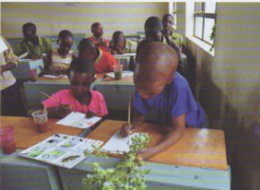
Photo courtesy of Deborah Ross.

Field trips into the bush to learn about local medicinal plants were led by herbalist, Siranga Naimando. While Siranga explained how each plant was used, students painted what they saw in the field. This collective effort is at the heart of the Olcani Project. In the Olcani booklet published about this project, Siranga explains that the Maa word for medicine is olcani, the same word used for plant.

The Olcani Project is mostly a self-financed labor of love. Funds for the project come from what Deborah has earned illustrating a series of children’s books for UNICEF in Madagascar. A full-color booklet about the project has been produced by Deborah and designer Melanie McElduff. The booklet is an illustrated guide to 12 species of medicinal plants found in the Mukogodo region of Kenya. Each species description includes a color photograph, a plant’s scientific name, a plant’s Maasai name, a description about how it is used for medicinal purposes, and an area for users to write down notes. Included in this 26-page guide are 25 plant portraits painted by students, plus photographs of 18 Il Polei students proudly displaying a sample of their work. Funding for the printing of this beautiful guide came from Ideas That Matter, the grant program established by Sappi Fine Paper North America.

When she is not in Africa, Deborah keeps in touch with the students by cell phone. She trained a young local man to continue the watercolor workshops and Deborah says he is doing a fantastic job. Deborah sends paints and brushes to the school through a scientist working in Kenya and she sends books to Kenya with scientists five times per year.

Deborah will continue her work in the region next summer, this time in Madagascar. She has received a grant to lead watercolor workshops in this island country off the coast of Africa.

Visit Deborah’s website to learn more about her and to view a gallery of her work.

The Olcani Project will soon have its own website at www.olcani.com. The website will include features about each artist that will include samples of their work and a short bio. Watch for news about its official launch.

To request a copy of Olcani: An Illustrated Guide to the Medicinal Plants of Kenya, contact Deborah Ross. ($10, plus $5 shipping)


About the Mukogodo Region of Kenya

The Mukogodo region of Kenya has undergone rapid ecological and cultural degradation. A severe drought in 2009 all but eliminated the pastoralist community’s wealth (cattle and goats). The region’s indigenous knowledge is at risk of being lost as the region’s children face a different world than their parents knew. The need for conservation, conservation education and local empowerment in Kenya is extreme. The Mukogodo region is a focus point for the conservation work done by the African Conservation Fund.


The Olcani Project’s illustrated field guide to medicinal plants blends botanical art with traditional field guide-style pages.
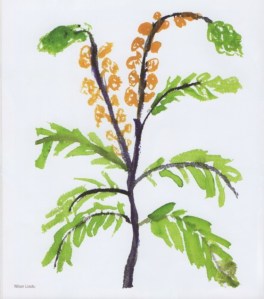
Osenetoi (Maa name), a remedy for malaria. Artist: Wilson Losotu

Field Guide Sample Page


Photos courtesy of Deborah Ross.

A steward of the environment, especially California’s Sierra Nevada, John Muir Laws, has dedicated himself to revealing the natural world through art and science.

John (Jack) Laws has been an environmental educator for 30 years. He recently collaborated with the California Native Plant Society and with English instructor, Emily Breunig, to create a wonderful curriculum integrating art, science and the language arts.

I am thrilled to introduce John Muir Laws and Opening the World Through Nature Journaling, the Feature Curriculum for December.

John has kept a sketchbook since elementary school. Challenged by dyslexia, he found that keeping a journal was the easiest way to record his experiences. Drawing and sketching helped him see things he had never noticed before. John’s mom gave John his first sketchbook. One year during a family trip, John and his family met a woman who was keeping a wildflower sketchbook. John’s mom noticed how he followed this woman and her sketchbook throughout their trip. On the next family vacation, John’s mom gave him a sketchbook and colored pencils so he could document their vacation. Little did she know that years later, John would use sketchbooks as a teaching tool.

While working as a naturalist group leader at Walker Creek Ranch in northern California, John led activities designed to connect children to nature. He decided to incorporate journaling into his activities to help students slow down and focus in the same way his own journals helped him to slow down and become a better observer. He soon began to notice differences between his journaling audience and the groups of children who ran through the ranch without stopping to see what was really there. John began to expand upon his journaling exercises. The Marin County Outdoor School at Walker Creek Ranch became a great testing ground. It took about four years for John to develop his activities. He wrote up his observations, began sharing them with other naturalists and teachers, and over a period of 10-15 years, his activities were tested hundreds of times and refined. This collection of journaling exercises eventually became Opening the World Through Nature Journaling.

The response to Opening the World Through Nature Journaling has been “amazing”, according to John. He says “(the curriculum) has been well-adopted in California and across the country. Teachers get this is authentic student-driven education.”

While John was developing and testing journaling activities, he was also launching the program Following Muir’s Footsteps and working on his book, The Laws Field Guide to the Sierra Nevada (2007).

Following Muir’s Footsteps is a conservation project for schools in the Sierra Nevada region whose aim is to encourage local youth to become citizen stewards of the Sierra. Encompassing an eighteen-county area around the Sierra Nevada, Following Muir’s Footsteps connects youth to nature through firsthand experiences and journaling. Through this program, John provides in-service training for teachers about how to use field guides and how to use science journals in their classrooms. He also sponsors one mentor teacher from each school so they can attend the Sierra Nevada Teacher Institute, a summer program where teachers learn about the biodiversity of the Sierra Nevada. School libraries also benefit from this fantastic program. The library of each participating school receives 25 copies of The Laws Field Guide to the Sierra Nevada.

The idea to create his comprehensive field guide to the Sierra Nevada was hatched when John was in high school. One day, while hiking the John Muir Trail and juggling many field guides, he thought how wonderful it would be to have all of his field guides packaged into one portable book. By the time he finished high school, John says he could visualize the pages, the layout — everything. John’s grandmother encouraged him to begin working on his dream. At about this same time, he came across a poem by Mary Oliver called The Journey. The first line of this poem read:

One day, you finally knew what you had to do, and began.

So John quit his job and says he “filled my backpack with paper and granola.” He spent the next six years documenting the flora and fauna of the Sierra Nevada. In the early stages of this full-time project, he drew whatever he encountered. At the end, he went into the field with species lists. John says the last few species on his list were a particular challenge and that locating them was a true “scavenger hunt.”

How did John take on the expansive Sierra Nevada? He started at the lower elevations in the south and, as plants bloomed in the Spring, he followed the bloom hopping back and forth between the west side and the east side. Every 1-2 weeks, John hiked out to pick up fresh supplies, get more paper, bathe and shave.

In The Laws Field Guide to the Sierra Nevada, you will find descriptions of over 1700 species and 2,700 watercolor paintings. John drew each plant from life and each illustration was started and completed in the field. Illustrations of birds, insects and mammals began as quick gesture sketches in the field. They were then finished in the studio after a careful study of museum skins, reference materials, and the collections at the California Academy of Science.

When asked how it is he can make so many big things happen, John says none of his programs were launched as big complete packages. He explains, “It was an accumulation of a lot of little pieces coming together organically. This is what makes it possible to do something big.”


Ask The Artist with John Muir Laws

John received a Bachelor of Science in Conservation and Resource Studies at UC Berkeley and a Master of Science in Wildlife Biology at the University of Montana. He is also a graduate of the scientific illustration program founded at UC Santa Cruz, that is now taught at California State University Monterey Bay. In 2011, John received the TogetherGreen fellowship from Audubon/Toyota and this enabled him to deliver the Following Muir’s Footsteps program to 10 schools in the Sierra Nevada. This month, we have the extraordinary opportunity to discuss art, science and education with John.

To take advantage of this opportunity, post your questions or comments in the comment box below. John will respond to questions throughout the month of December.

Teachers, do you know of other teachers who might like to join in the conversation? Please send them the link to this article. The conversation will happen right here on this page.


Request a copy of Opening the World Through Nature Journaling

To request your own copy of the nature journal curriculum written by John Muir Laws and Emily Breunig in collaboration with the California Native Plant Society, click here.


Drawing Plants: Tutorials by John Muir Laws

John recently posted tutorials about how to draw plants on his website. These tutorials were created specifically for teachers. The demonstrations are easy for teachers to recreate in their own classrooms. Leaf and flower templates are available for download. View John’s instructional videos in the Nature Drawing section of his website.


Get “The Laws Field Guide to the Sierra Nevada”

A new course about advanced techniques in botanical illustration has been added to the new certificate program now offered through the Cornell University Department of Horticulture. This new course has a special introductory price of $400 for the upcoming six-week term.

Read more below and at Classes Near You > New York.


Cornell University Department of Horticulture

http://hort.cals.cornell.edu/
The Department of Horticulture at Cornell University has expanded their schedule of online courses to include an advanced techniques course in botanical illustration. The Cornell University Department of Horticulture now offers a certificate in botanical illustration through the Office of Continuing Education. This certificate program is composed of the following courses: Botanical Illustration I: Basic Drawing Techniques, Botanical Illustration II: Working with Watercolor and Botanical Illustration III: Advanced Techniques.

    Botanical Illustration I: Basic Drawing Techniques
    January 23 – March 10, 2012. Students will work in pencil and pen-and-ink. Topics include: observing nature, drawing, composition, perspective, foreshortening, and how to use light to give botanical drawings three-dimensional form. Cost: $500. Limit: 15 students.
    View syllabus and register

    Botanical Illustration II: Working with Watercolor

    January 23 – March 10, 2012. In this introductory course about color, students will continue their study of plants. Emphasis will be on simpler subjects such as a single-stem flower, fruit, and vegetables. Cost: $500. Limit: 15 students. View syllabus and register

    NEW
    Botanical Illustration III: Advanced Techniques

    January 23 – March 10, 2012. In this class, students will explore various media and develop a portfolio of work. Students will develop a proficiency in botanical drawing using pastels, colored pencil, pen and ink, pencil and chalk. Cost: $400. Limit: 15 students. View syllabus and register

After you register, you will receive enrollment guidance within 2 – 3 weeks, enabling you to get access to the site. Courses do not begin formally until January 23rd.

A Botanical Illustration Certificate of Completion from the Department of Horticulture, Cornell University, will be awarded upon the successful completion of all three botanical illustration courses.

View Cornell University’s horticulture distance learning courses

New at Classes Near You > England:


Lewisham Arthouse, London

www.lewishamarthouse.co.uk
The Lewisham Arthouse once served as the central library of Deptford. Designed by architect Sir Alfred Brumwell Thomas (1868-1948) and funded by Andrew Carnegie (1835-1919), this former library is now features a public gallery and studio space for professional artists. Artist studios are open to the public once per year. Exhibitions in the gallery are open to the public year-round, free of charge.

    Drawing From Plant Life
    January 9 – March 19, 2012; 1:30 – 3:00 PM. Taught by artist and botanist, Alison Day, this ten-week workshop provides an opportunity to learn about the art and science of plant drawing at a theoretical and practical level. The course covers both graphic & paint techniques and theory. Students will learn about plants and examine the historical context of the discipline. This course is aimed at beginners and people who would like to update existing knowledge. To participate, please bring a sketch book and basic materials. Space is limited. Early registration is required. For more information and to register, contact instructor Alison Day.

Were you inspired by Kelly Houle’s Illuminated Origins project?

Below is an opportunity for botanical artists to learn about the painting and gold leaf techniques used by manuscript artists. Read about the medieval illumination class, and other exciting classes, to be offered this Spring at Corcoran College of Art & Design in Washington, DC.


Corcoran College of Art & Design

www.corcoran.edu
The only college of art and design in Washington, DC also offers a certificate program in botanical art and illustration. Classes include introductory courses in botanical drawing, botanical painting and specialty classes such as Plant Portraits in Oil and Medieval Illumination.

  • Drawing Orchids – March 17-18, 2012; 9:00 AM – 4:30 PM. Orchids will be the focus as students learn drawing and compositional skills. Light, shade, shadow, plant morphology and botanical forms will also be discussed. Students will be introduced to wet and dry media. Beginner/Immediate. Cost: $490 (0.5 Credits). View details
  • Medieval Illumination and Egg Tempera on Vellum
    February 11-19, 2012; 9:00 AM – 4:30 PM. Egg tempera, 24k gold leaf technique and natural pigments will be discussed. Students will learn how to grind natural pigments and learn the techniques used by manuscript artists during the 4th – 14th centuries. Some materials provided by instructor. Cost: $970 (1 Credit), plus $100 lab fee. View details
  • Photographing Orchids – March 3-4, 2012; 9:00 AM – 4:30 PM. Learn classic and creative photography techniques that will have you shooting compelling orchid images in no time. This workshop is designed for photo enthusiasts who want to photograph orchids at the National Orchid Show. Cost: $490 (0.5 Credits). View details
  • Introduction to Botanical Painting in Watercolor
    January 18 – May 9, 2012; 9:30 AM – 12:30 PM. For beginners wanting to learn about the painting techniques used by contemporary botanical artists. Students will learn how to apply paint to create form and detail. Some drawing experience helpful. Cost: $1440 (1.5 Credits), plus $60 lab fee. Audit Fee: $720, plus $60 lab fee. View details
  • Intermediate Botanical Painting in Watercolor
    January 18 – May 9, 2012; 9:30 AM – 12:30 PM. This course is a continuation of the introductory course above. Students will continue their study of painting techniques and plants. Cost: $1440 (1.5 Credits), plus $60 lab fee. Audit Fee: $720,plus $60 lab fee. View details

This information has been posted to Classes Near You > Washington, DC.

Learn to sketch with a paint brush. Artist and author, Brenda Swenson, has announced her teaching schedule for 2012.

This information can also be found at Classes Near You > Southern California.


Brenda Swenson, Los Angeles

www.swensonsart.net
Brenda Swenson, WW, NWWS is the author of Keeping a Watercolor Sketchbook and Steps to Success in Watercolor. She is a very popular, award-winning artist who teaches across the U.S. and abroad. See Brenda’s new section about tips, techniques, and tools for artists on her blog.

  • Watercolor Sketching Techniques – January 13-15, 2012. Schroeder Studio Gallery, 112 East Maple Avenue, Orange, CA 92866. Contact Schroeder Studio for more information. (714) 633-0653
  • Negative Painting with Watercolor – January 27-29, 2012. Associated Louisiana Artists, 106 W. Pryce, Lake Charles, LA 70601.
    Info: Sue Zimmerman
  • Negative Painting with Watercolor – February 17-19, 2012. Montrose, CA. Info: Brenda Swenson
  • Watercolor Sketching Techniques – May 18-20, 2012. Montrose, CA.
    Info: Brenda Swenson
  • Sketching in Southern France – June 23-July 7, 2012. Montfaucon Tours, Limoux, France. View details at www.montfaucontours.com.
    Info: Brenda Swenson
  • Negative Painting in Watercolor – August 10-12, 2012. Montrose, CA.
    Info: Brenda Swenson
  • Negative Painting in Watercolor – September 14-16, 2012. Schroeder Studio Gallery, 112 East Maple Avenue, Orange, CA 92866. Contact Schroeder Studio for more information. (714) 633-0653
  • Learning & Product EXPO – October 19-21, 2012. Pasadena Convention Center, Pasadena, CA.Registration begins August 1, 2012. www.learningproductexpo.com
  • Negative Painting with Watercolor – November 6-9, 2012. Plantation Art Guild, Plantation, FL Info: Karen Brauerman.
    www.plantationartguild.org

During the food-filled Thanksgiving weekend, a few changes were implemented at the store. The search function operates a bit more smoothly and a new category system was created. All of this in response to customer feedback (thank you for your comments).

Now when you go to ArtPlantae Books, you will see a new section in the right-hand column called Discover More. This section contains links to titles in the following categories:

  • Drawing
  • Pen & Ink
  • Watercolor
  • Colored Pencil
  • Plants & You
  • Botany
  • Botanical Terminology
  • Natural History Art

These categories have been created to connect you to what you’re looking for in a fraction of the time. The titles in each category are only a sample of what is available, so I encourage you to use the search field to look for related titles. I will do my best to keep fresh titles circulating through this new section.

Visit the new Discover More section and tell me what you think.


CyberMonday (& Tuesday) Specials

Save 20% off select books, gift items, DVDs and CDs storewide. Also receive free shipping on orders over $50.

Sale prices good through Tuesday, November 29, 2011.