Feeds:
Posts
Comments

Image courtesy of the Lloyd Library and Museum


Peppers in Image and Word

Lloyd Library and Museum
January 14 – April 13, 2012

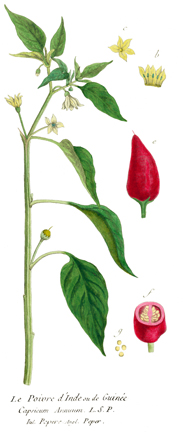
The Lloyd Library and Museum in Cinncinnati, OH celebrates Capsicum annuum (the chili pepper) in an exhibition that will feature books from the 16th through 21st centuries, the photography of Eduardo Fuss and the work of Jean Andrews, David Carangilo, Amal Naj, Jeff Schickowski and W. Hardy Eshbaugh.

An opening reception will be held this Saturday, January 14, from 4-7 PM.

Arrive early to learn from pepper expert, W. Hardy Eshbaugh, who will discuss the chili pepper in a special presentation titled,
Some Like It Hot: The Little Known World of Chili Peppers.

Eshbaugh’s lecture begins at 4:30 PM.

Map to Lloyd Library and Museum

Wild Green Things: The Art of Anne Ophelia Dowden
Andersen Horticultural Library
Minnesota Landscape Arboretum
January 18 – May 2, 2012

Anne Ophelia Todd was born in Denver and grew up in Boulder, Colorado spending her early years roaming the foothills of the Rockies. Dowden says, “I collected and drew any living thing that came my way, especially insects and flowers, and the study of nature was my absorbing hobby.”

© 2008 Hunt Institute for Botanical Documentation. All Rights Reserved.

After graduated with an art degree from Carnegie Institute of Technology, the artist moved to New York City in 1930, and taught drawing for more than 15 years. During that time, she married fellow artist Ray Dowden. Dowden began her botanical illustration work in the early 1950s, when magazines began to use her artwork on their covers and in their articles. She was in her 50s when she wrote, designed and illustrated her first book, Look at a Flower.

After 60 years in New York City, Dowden moved back to Boulder in the early 1990s to be near family and her beloved mountains. She set up her studio and published her last book, Poisons in Our Path: Plants That Harm and Heal, in 1994, when she was 87 years old. Dowden died in 2007 at the age of 99.

Anne Ophelia Todd Dowden’s artwork will be on view in the Andersen library, the Snyder Building lobby and the skyway ramp between the Visitor Center and Snyder Building. There also will be works in an Oswald Visitor Center display case.

A special insiders look at the art of Anne Ophelia Todd Dowden by exhibit curator, Lucie Taylor, will occur when Wild Green Things opens next week. Visitors will have the opportunity to view Dowden’s books, original sketches and original paintings during a one-hour presentation scheduled for Wednesday January 18 from Noon – 1 PM in the Snyder Building. Limit: 30. Cost: $7.50 members, $10 non-members. Register Online

The Minnesota Landscape Arboretum is located in Chanhassen, Minnesota on State Hwy 5, nine miles west of the intersection with I-494. The largest public garden in the Upper Midwest, the Arboretum is part of the University of Minnesota College of Food, Agricultural and Natural Resource Sciences. Open 363 days a year, admission is $9 adults; free for members and ages 15 & under.

Finding an answer to this question was the focus of a study created by
Elisabeth E. Schussler, Melanie A. Link-Perez, Kirk M. Weber and Vanessa H. Dollo. They reported their findings in Exploring Plant and Animal Content in Elementary Science Textbooks.

To determine how plants and animals were presented in nationally-distributed textbooks, they reviewed two sets of general science books — the Science series (2006) by Harcourt and the Science series (2005) by Macmillan McGraw-Hill. Schussler, et al. (2010) conducted a detailed analysis of the textbooks used in grades 1-5.

General science textbooks address concepts from many areas of science and this information is presented in many ways. Schussler, et al. (2010) studied only the life science units of each textbook and focused their analysis on the body of text within each section. They decided to leave sections of complementary information within each chapter (i.e., text boxes, special features, activities, chapter summary questions, etc.) out of their analysis. They searched specifically for plant-focused and animal-focused content to determine the following:

  • The number of sub-sections and pages of plant and animal content.
  • The number of plant and animal examples used in each text.
  • The number of plant and animal topics included in each text.

Here is a summary of what Schussler, et al. (2010) discovered:

  • In both textbook series, the number of sub-sections dedicated exclusively to non-human animals was greater than the number of sub-sections dedicated exclusively to plants. The number of content pages about animals was equal to the number of content pages about plants in the Harcourt series. In the Macmilian McGraw-Hill series, there were more animal pages than plant pages.
  • In both publisher’s textbooks, the number of animal examples used exceeded the number of plant examples used. The most repeated examples of plants in the Harcourt series were tree, grass, moss, pine and fern. In the Macmillian McGraw-Hill series, the most repeated examples of plants were tree, grass, corn, cactus and oak. The most repeated examples of animals were almost identical. They were bird, fish, insect, frog and deer. In the Harcourt series, snake tied with deer.
  • More animal-related topics were included in the textbooks than plant-related topics.

How did the research team sift though all that content and decide what was an animal-related topic and a plant-related topic?

The topic categories were identified after a careful analysis of the text. Schussler, et al. (2010) identified categories such as “seed germination”, “plant growth”, “reproduction”, and many others. After sorting through their list of categories, they came up with a list of topics that encompassed all the categories they identified. This final list addressed the following topics: Parts, Needs, Types, Growth, Reproduction, Uses, Adaptations, and Where Specimens Live (Schussler, et al., 2010). As far as plants were concerned, the topic “Plant Parts” received more attention than the topic of “Animal Parts” in both series. After this, though, content about animal needs, animal types, animal adaptations, etc. was more prevalent than the needs of plants, the types of plants growing on Earth, their adaptations and the landscapes they call home.

Schussler, et al. (2010) propose that textbooks may be contributing to the gap in knowledge observed in students when students are asked to name plants and animals. They also propose that textbooks may be contributing to students’ perception that plants are boring because plants are presented more as “parts” and not as living entities with needs, adaptations and all the rest.

Schussler, et al. (2010) recommend a thorough analysis of textbooks in all countries to find out if the differences they found in the Harcourt and Macmillian McGraw-Hill textbooks are present in other general science books. They also call upon botanists and all botany educators to use as many real world examples about plants as possible to encourage a comprehensive, big-picture view of plants.


Did You Know?


Literature Cited

Schussler, Elisabeth E. and Melanie A. Link-Perez, Kirk M. Weber, Vanessa H. Dollo. 2010. Exploring plant and animal content in elementary science textbooks. Journal of Biological Education. Vol. 44(3): 123-128.

Buy this article online from Taylor & Francis Online ($36) or visit the reference section at your local college library.
This month the National Tropical Botanical Garden offers two opportunities to learn about plant exploration.

At their garden campus in Miami, The Kampong, the National Tropical Botanical Garden is offering guided tours of the private home and garden of botanist and explorer, David Fairchild. Tours are given on Wednesdays and Saturdays through January. Tours begin at 10:30 AM. Reservations are required.
View Details/Register

Meanwhile, at their main garden in Kaua’i, the National Tropical Botanical Garden will host a viewing of Pearl of the Pacfic: Exploratory Botanist Steve Perlman on January 19 (5:30 – 7:00 PM). View Details/Register

To get a sense of what plant explorers do in the field to gain a better understanding of the plant world, watch this video of botanist Steve Perlman at work on the Hawaiian island of Moloka’i.

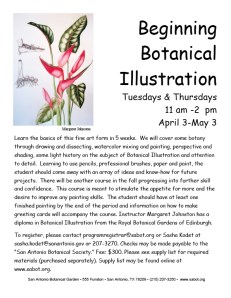
Interested in learning about botanical art, but don’t know where to begin? Botanical artist Margaret Johnson will teach a ten-session course for beginners at the San Antonio Botanical Garden this Spring. Margaret received a diploma in botanical illustration from the Royal Botanic Garden Edinburgh.

San Antonio Botanical Garden
www.sabot.org
Created to help people connect with, and understand, the plant world, the Garden offers educational programs for school groups, families and adults. View photos and the Garden’s Master Plan for the future at www.sabot.org.

    Beginning Botanical Illustration with Margaret Johnston
    Tuesdays & Thursdays, April 3 – May 3, 2012; 11 AM – 2 PM. Students will be introduced to botany and botanical illustration and learn about the techniques and equipment used by botanical artists. Students will complete one painting during this course and will leave class prepared for their next botanical art class. A second class covering intermediate topics will be taught in the Fall. Margaret is a graduate of the diploma course in botanical illustration at the Royal Botanic Garden Edinburgh. Cost: $300. View Details/Register

This update has also been posted at Classes Near You > Texas:

Botanical illustration classes with illustrator, Christine Grey-Wilson, have been added to Classes Near You > England.

West Suffolk College
www.westsuffolk.ac.uk
West Suffolk College serves the rural communities of Haverhill, Ipswich, Mildenhall, Stowmarket and Sudbury.

  • Botanical Illustration with Christine Grey-Wilson
    January 13 – March 23, 2012; 10 AM – 12 PM. Learn traditional botanical illustration techniques using pencil, pen and ink and watercolor from Christine Grey-Wilson, freelance illustrator and former illustrator at the Royal Botanic Gardens, Kew. Cost: £90. View Details/Register
  • Botanical Illustration with Christine Grey-Wilson
    January 19 – March 29, 2012; 6-8 PM. Learn traditional botanical illustration techniques using pencil, pen and ink and watercolor.
    Cost: £90. View Details/Register
  • Botanical Illustration with Christine Grey-Wilson
    March 3, 2012; 10:00 AM – 4:30 PM. Sharpen your observation skills in this one-day class. Learn how to draw and paint plant subjects using pencil, pen and ink &/or watercolor. Cost: £30. View Details/Register

  • Botanical Illustration with Christine Grey-Wilson
    April 19 – June 28, 2012; 6-8 PM. Learn traditional botanical illustration techniques using pencil, pen and ink and watercolor. Cost: £90.
    View Details/Register
  • Botanical Illustration with Christine Grey-Wilson
    April 20- June 29, 2012; 10 AM – 12 PM. Learn traditional botanical illustration techniques using pencil, pen and ink and watercolor.
    Cost: £90. View Details/Register
Registration Opens Tomorrow
January 3, 2012


Minneapolis College of Art & Design Continuing Eduction

www.mcad.edu
The Minneapolis College of Art and Design offers continuing education classes for adults, children and teens. Adults can learn about new media and techniques. Children 5-18 have the opportunity to participate in fun and creative studio experiences at a top art and design school.

    Living Wonders: Botanical Illustration
    Saturdays, February 11-25, 2012; 10 AM – 4 PM. Instructor Carey Dean will introduce you to the history and splendor of botanical illustration. Learn how to illustrate plants using graphite, ink, colored pencils and watercolor. Learn about plants and draw on-location at the Como Conservatory in Saint Paul. Basic drawing skills recommended, but not required. Non-Credit Tuition: $179. View Details/Register

This information has been added to Classes Near You > Minnesota.