Feeds:
Posts
Comments

Now there are even more opportunities to learn how to use colored pencils in botanical art. The new schedule at the L.A. County Arboretum & Botanic Gardens includes both weekday and weekend classes. Here is what’s new in Southern California:


Los Angeles County Arboretum & Botanic Gardens, Arcadia

www.arboretum.org
Courses in introductory botanical drawing, beginning and intermediate watercolor, colored pencil, sketching and Chinese brush painting are taught throughout the year. Go to the Events & Classes for more information. The Arboretum is located in Arcadia, CA. To register, contact Jill Berry or call (626) 821-4624.

    Using Colored Pencil in Botanical Art
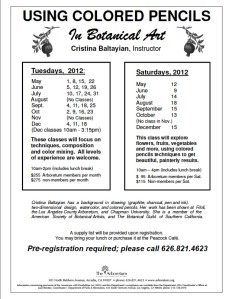
    Learn the colored pencil techniques used by botanical artists! All levels of experience are welcome. Students will receive a supply list. Pre-registration required. Registrants may bring a lunch or buy lunch at the Peacock Cafe. Both Tuesday and Saturday classes will be offered beginning in May. The Summer/Fall 2012 schedule is as follows:

    Tuesdays, 2012
    May 1, 8, 15, 22
    June 5, 12, 19, 26
    July 10, 17, 24, 31
    August (No Classes)
    Sept. 4, 11, 18, 25
    Oct 2, 9, 16, 23
    Nov (No Classes)
    Dec 4, 11, 18 (Dec classes 10:00 AM – 3:15 PM)

    These classes will focus on techniques, composition and color mixing. All levels of experience are welcome.

    10 AM – 2 PM (includes lunch break)
    $255/mo. Arboretum members per month
    $275/mo. Non-members per month
    Pre-registration required; please call (626) 821-4623

    Saturdays, 2012
    May 12
    June 9
    July 14
    August 18
    September 15
    October 13
    (No class in Nov.)
    December 15

    Each individual class will explore flowers, fruits, vegetables and related subjects. Participants will learn how to use colored pencils techniques to achieve beautiful, painterly results. You may register for one class at a time. A supply list will be provided upon registration; you can also bring your lunch or buy it at the Peacock Café.

    10 AM – 4 PM, includes a one-hour lunch break (5 hours of class)
    $95 Arboretum members per Saturday
    $115 Non-members per Saturday
    Pre-registration required; please call (626) 821-4623

Cristina Baltayian is a botanical artist with a background in drawing (graphite, charcoal, pen & ink), two-dimensional design, watercolor and colored pencil. Her work has been shown at Filoli, the Los Angeles County Arboretum and Chapman University. She is a member of the Botanical Artists Guild of Southern California and the American Society of Botanical Artists.


You May Also Enjoy
:

    Art Workshop – Mondays. This self-directed workshop (no instructor) provides a supportive, encouraging environment for those who wish to pursue their artistic endeavors in watercolor, graphite, pastels, etc. Both beginning and experienced artists are welcome. It is a wonderful opportunity to develop at your own speed in your own media while being in the company of those with like interests. Each session of eight meetings costs $35 for Arboretum members ($42 non-members). Upcoming sessions: December 5, 2011 – February 6, 2012; February 13—April 2, 2012; April 9—May 28, 2012; June 4—July 23, 2012. Artists meet in the Oak Room from 9:30 – 11:30 AM. To register, contact Jill Berry or
    call (626) 821-4624.

And don’t forget about the plants, the garden chats, the inspiring ideas and the marketplace at GROW! A Garden Festival (May 4-6).

Pierre Joseph Redouté (French, 1759-1840 ), A Bouquet of Flowers with Insects, watercolor with gold on vellum; laid down, Ailsa Mellon Bruce Fund. Courtesy National Gallery of Art, Washington.

The National Gallery of Art on the National Mall in Washington, DC announced a new online resource for teachers last week. This resource makes available more than 20,000 images teachers can search, share and download for the classroom. Available through the Gallery are open access images the Gallery believes to be in the public domain. Teachers, scholars and the public may download these images free of charge.

Instructors of botanical art will find drawings and paintings of flowers and trees they may want to share with students in their presentations about botanical art history, drawing or painting. Paintings that may be of particular interest to botanical artists are the paintings by Pierre Joseph Redouté and the two paintings and one drawing by Jan van Huysum. Images are available in high-resolution format and in a “Quick Download” format for presentations and screen use. Each image can be viewed in a “lightbox” format. In this format, details about each image are provided and this information can be printed on a single sheet of paper.

Users of this national online resource should read the Open Access Policy before downloading images.

Go to NGA Images

Here is what’s new at Classes Near You > England!


Farncombe Estate, Cotswolds

www.farncombeestate.co.uk
A 300-acre privately-owned parkland in the Cotswolds. Host to weekend classes in a variety of subjects. There is even a bed-and-breakfast option! Follow their blog or become a fan of their Facebook page to learn more about this unique learning opportunity. Farncombe Estates’ current course schedule can be viewed online. The current schedule includes:

  • Botanical Illustration for Improvers with Valerie Oxley
    Friday, June 8, 2012
  • Outdoor Sketching in Line & Wash with Paul Weaver
    Friday, July 8, 2012
  • Botanical Basics Painting with Simon Williams
    Friday, July 13, 2012
  • Drawing for the Terrified with Richard Box
    Friday, July 14, 2012
  • Sketching with Pen & Wash with Paul Weaver
    Monday, August 27, 2012
  • Drawing and Painting from Nature with Simon Williams
    Friday, October 12, 2012
  • Botanical Illustration: Drawing and Painting Autumn Fruits & Fungi with Valerie Oxley
    Friday, October 19, 2012
  • View all painting and drawing classes at Farncombe Estate here.

Discover books under $10 at ArtPlantae Books!

The “Under $10” category currently addresses resources related to art instruction, flowers, leaves, photosynthesis, seeds, and trees. This curated collection brings attention to art books, field guides, reference books, children’s books and activity books for artists and botanists of all ages and at all levels of experience. Some of these resources will be familiar to you, while others will be delightful new discoveries.

View this new collection in the Irresistible! section at ArtPlantae Books. Some titles are available for immediate download as Google eBooks.

When Rumphius arrived in Ambon in 1654, he walked into a world very different from his home in Hesse, Germany.

It is safe to say many things piqued his curiosity. Today we take a look at Rumphius, the naturalist.

Before we get too far ahead in this story, we need to remember that Rumphius did not travel to Indonesia to write about its natural history. He went to the East Indies in 1652 on a five-year contract to work as a soldier for the Dutch East Indies Company to protect their interests in the spice trade. He had his hands full and could not dedicate himself to documenting the many interesting things he observed.

It is estimated that Rumphius began to collect botanical and zoological specimens in 1657 (Beekman, 2011). No longer a soldier and now working in the civil service branch of the Dutch East Indies Company, Rumphius worked on personal projects in his spare time (Beekman, 2011). His focused work on the herbal is thought to have begun three years later in 1660 (Beekman, 2011).

The curious naturalist that he was, Rumphius observed and described insects, mammals, birds, marine life, and plants. At one time he was in possession of a large cabinet of curiosities containing specimens collected over many years. Unfortunately, he had to sell his collection to the Grand Duke of Tuscany in 1682 (Beekman, 2011). He did not sell his collection to make money, but to make his employer look good. The Dutch East Indies Company used Rumphius’ collection to cater to the Grand Duke whom the Company saw as a potential business opportunity.

Rumphius lived the latter years of his life as a “naturalist for the people.” In an open letter he writes to readers in the preface of The Ambonese Herbal, Rumphius refers to himself as a “lover of natural science” who offers his talents “to the common good” (Beekman, 2011). Rumphius was determined to introduce Europe to the plants and animals of the East Indies. He tells readers that if his work brings them pleasure, then it would be worth all the trouble and expense he endured to bring it to them.

Rumphius is considered to be one of the greatest naturalists of the 17th century. This is because of his observation skills, his first-hand accounts and his detailed written descriptions about what he saw while living in the “Water Indies” (Beekman, 2011). It is also because his significant works were created by one man.

During his lifetime, Rumphius wrote a small collection of scholarly articles. He also wrote a book about the history and politics of Ambon and his observations from the field (the Dutch East Indies Company did not make this book public). Rumphius’ most significant works were The Ambonese Curiosity Cabinet (D’Amboinsche Rariteitkamer) and The Ambonese Herbal (Het Amboinsche Kruidboek).

The Ambonese Curiosity Cabinet describes the marine life of the East​ Indies. It contains​ Rumphius’ descriptions of arthropods, shells and much more. A general description of its contents is included in the book’s very long original title. Here is the English translation taken from Beekman (1999):

The Ambonese Curiosity Cabinet, Containing a Description of all sorts of both soft as well as hard Shellfish, to wit rare Crabs, Crayfish, and suchlike Sea Creatures, as well as all sorts of Cockles and Shells, which one will find in the Ambonese Sea: Together with some Minerals, Stones, and kinds of Soil, that are found on the Ambonese and on some of the adjacent Islands. Divided into three Books, And supplied with the requisite Prints, drawn from life. Described by GEORGIUS EVERHARDUS RUMPHIUS, from Hanau, Merchant and Counselor on Amboina, also member of the Academiae Curiosorum Naturae, founded in the Holy Roman Empire, under the name PLINIUS INDICUS.”

This collection of three books was first published in 1705 (three years after Rumphius’ death) and includes the only known portrait of Rumphius drawn from life. It was drawn by his son sometime between October 1695 – July 1696 (Beekman, 1999). Translated, edited and annotated by Dutch scholar, E.M. Beekman (1939-2008), the English translation includes the original sixty plates paired with the modern scientific names of the species illustrated on each plate. Beekman (2003) describes this book as Rumphius’ most popular work because of the shell illustrations it contains. As for Rumphius’ greatest achievement? Beekman (2003) says it is The Ambonese Herbal.

Contained in the original twelve books of the herbal are descriptions of the trees, shrubs, herbs, wild plants and sea trees (coral) of eastern Indonesia.

We’ll take a closer look at the herbal next week.


Adopt a first-edition copy of The Ambonese Curiosity Cabinet

Vassar College has a first-edition copy of The Ambonese Curiosity Cabinet in their collection. This book is featured in Vassar’s Adopt-a-Book program. Through this program, the conservators in Vassar’s Archives and Special Collections Department seek donor support for the conservation of fragile and damaged items. To see images from this historic work and to learn more about the conservation effort surrounding Rumphius’ book, see the webpage for The Ambonese Curiosity Cabinet on the Adopt-a-Book website.

Wondering if there are botanical works in this program? Yes, there are. See here.

NOTE:
I contacted the Special Collections department and asked about the donation amount. I learned that they are seeking a donation that covers the entire conservation amount. So if you were thinking of making a smaller donation (like I was), this is not possible because they are not set up to receive small amounts that do not add up to the amount required for conservation.


Literature Cited

    Rumphius, Georgius Everhardus. 1999. The Ambonese Curiosity Cabinet. Translated, annotated, and with an introduction by E.M. Beekman. New Haven, CT: Yale University Press.

    Rumphius, Georgius Everhardus. 2003. Rumphius’ Orchids. Translated, annotated, and with an introduction by E.M. Beekman. New Haven, CT: Yale University Press.

    Rumphius, Georgius Everhardus. 2011. The Ambonese Herbal. Translated, annotated, and with an introduction by E.M. Beekman. New Haven, CT: Yale University Press.

All six volumes of The Ambonese Herbal are available at ArtPlantae Books.
Find out how you can view all six volumes this month.


Continue Rumphius’ story with…

Inside “The Ambonese Herbal”
Take an art break this summer at Field Breaks. Rest and relaxation are their specialty! The Field Breaks program has grown to include classes in botanical illustration, realistic painting and landscape painting taught at relaxing country homes, bed and breakfasts and hotels across the UK.

See what’s new at Classes Near You > England.


Field Breaks – Special Interest Art Breaks Derbyshire, England

www.fieldbreaks.co.uk
Enjoy like-minded company in a relaxing and friendly environment with experienced and approachable tutors. Details and pricing for all 2012 courses can be viewed here.

  • The Freshness of Spring Flowers in Coloured Pencil, Watercolour or Graphite with Gaynor Dickeson – April 23-24, 2012. Two non-residential days at Goodnestone Gardens, SE Kent, (£175 including lunches & refreshments)
  • Hedgerows in Spring in Watercolour with Deborah Devauden
    April 23-25, 2012. Create studies of spring flowers! Cwrt Bleddyn, Monmouthshire (£366 residential £229 non-residential).
  • Painting Fritillaria Flowers in Watercolour with Sharon Bradley
    May 9-11, 2012. New Lanark Mill Hotel, Lanark (£398 residential £249 non-residential).
  • Perfect Pencil Drawings in Graphite with Jane Nicholas Barne
    May 16-18, 2012. The Bear Hotel, Hungerford (£459 residential £249 non-residential).
  • Bloom on Fruit in Coloured Pencil with Sue Vize – May 14-16, 2012. Learn how to layer colors to portray the bloom seen on plums, blueberries and grapes. Losehill House Hotel, Derbyshire (£398 residential £249 non-residential).
  • Seasonal Vegetables in Graphite Pencil with Julie Small
    May 21-23, 2012. Losehill House Hotel, Derbyshire (£398 residential £249 non-residential).
  • Grasses and Meadow Flowers in Coloured Pencil, Watercolour or Graphite with Sue Vize May 23-25, 2012. The Nightingale Centre, Derbyshire (£298 residential £198 non-residential includes eve meals & wine).
  • Delights for the June Garden in Coloured Pencil with Susan Christopher-Coulson – June 11-13, 2012. Ripon Spa, Ripon (£398 residential £249 non-residential).
  • Summer Flowers and Foliage in Watercolour with Sandra Wall Armitage – June 11-13, 2012. Knuston Hall, Northampton (£385 residential £275 non-residential includes evening meals).
  • Herbaceous Summer Flowers in any media with Jennie Hinton
    June 11-13, 2012. Lady Ann Middleton, York (£425 residential £245 non-residential).
  • Smell English Roses! In Watercolour, Coloured Pencil or Graphite with Gaynor Dickeson – June 25-26, 2012. Two non-residential days at Goodnestone Gardens, SE Kent (£175 including lunches & refreshments).

Readers of this website have always provided helpful feedback, both within and outside of the surveys created to make this website and ArtPlantae’s educational activities as worthwhile as possible.

There are many ways to follow ArtPlantae and the number of people following through social media channels, RSS feeds, the Follow link below and through the email list have grown. So much so, that I feel it time to poll readers for feedback and comments.

Your feedback is invaluable and is always appreciated. Please consider taking a few moments to complete a quick Reader Survey. Thank you for your time.