Feeds:
Posts
Comments

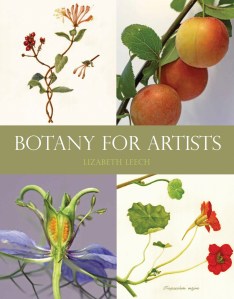
Botanist and botanical artist, Lizabeth Leech, has written a comprehensive introduction to botany for both artists and non-artists alike. In Botany for Artists, Liz does more than simply rattle off facts about plants. She teaches readers how to observe and record information about the plant specimens before them, as well as any fungi or lichen that may have taken their breath away.

Liz teaches readers how to see with “helpsheets” — worksheets designed to help artists see carefully, the morphological features of different plant groups. Blank helpsheets for flowers, winter twigs, gymnosperms, ferns, moss, and fungi are provided in the appendix and are easy to copy for personal use.

Each chapter of Liz’s book has information that will help artists navigate the plant world from an artist’s perspective. Sections of special note are:

    Liz’s Explanation of the Floral Formula. Helpsheet #2 (Recording Flower Details While Sketching and Annotating) found in Chapter 2, provides a helpful breakdown of the floral formula. This sheet will make recording data in the field easier and, most importantly, reliable! With this helpsheet completed, artists shouldn’t have too much of a problem keying out a plant back in the studio or keying out a plant at some later date.

    Labeled Line Drawings. Informative line drawings can be viewed throughout the book. Good examples are grass (Chapter 3), an orchid flower (Chapter 4), a winter twig (Chapter 8), and moss (Chapter 11).

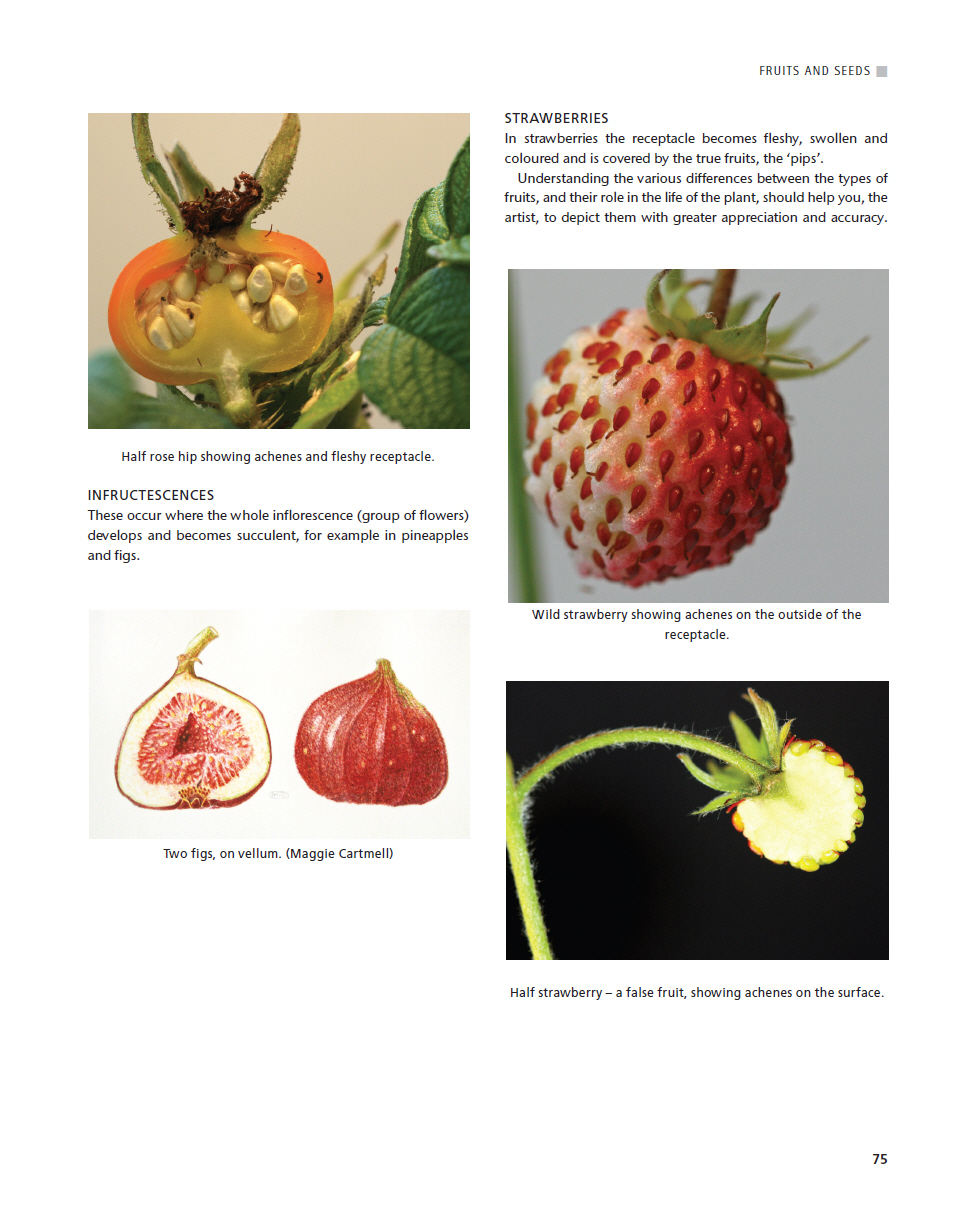
    Liz’s Thoughtful Explanations. Take, for example, Liz’s patient explanation of fruits and seeds. Liz takes her time explaining each fruit structure

    Courtesy Crowood Press. All rights reserved

    and seed dispersal mechanism. Her review is better than the usual charts and graphics encountered in a traditional botany class.

    Liz’s Review of Phyllodes, Climbing Adaptations and Roots. In Chapter 6, Liz stresses the need to observe leaves, fruit and stems carefully and for artists “to keep their wits about them to understand, and then depict and show, the links between structures and their functions.”

    Liz’s Review of Gymnosperms. In Chapter 9, artists will find descriptive photographs of different gymnosperms, a helpful table summarizing the phyla of gymnosperms and an example of how to complete Helpsheet #4 when observing gymnosperm specimens.

    Liz’s Review of Ferns, Club Mosses and Horsetails in Chapter 10, along with her illustrations and Helpsheet #5 (Ferns), ensure artists will develop a fluent understanding of these groups.

    Helpsheet #6 (Moss), in conjunction with Liz’s illustrations and photographs about the branching habits of moss and the leaf shapes of bryophytes, is sure to strengthen artists’ understanding of mosses and how they work.

    Liz’s Introduction to Fungi & Lichens will enhance artists’ understanding of where and how fungi and lichen grow. Helpsheet #7 (Fungi) is a helpful guide to collecting and observing capped fungi.

    How to Indicate Scale on a Drawing or Painting. Instructions on how to indicate scale can be found in the last chapter of Botany for Artists, along with a review of binomial names and plant-collecting equipment.

Lathyrus japonicus by Sara Bedford. Courtesy Crowood Press. All rights reserved

An explanation of the classification of plants, an introduction to the Hampton Court Palace Florilegium Society, a 297-word glossary, and a bibliography are also included in Liz’s new book.

Botany for Artists is a wonderful resource for botanical artists, as well as anyone incorporating botanical themes into creative projects who would like to learn more about plants.


Published in the UK in 2011, Botany for Artists is now available in the US and can be purchased at ArtPlantae Books. Use the coupon code presented at checkout to deduct 15% off your purchase.

View details for each course and read about the program’s successful outcomes below and at Classes Near You > New York.


Cornell University Department of Horticulture

http://hort.cals.cornell.edu/
The Department of Horticulture at Cornell University has expanded their schedule of online courses to include an advanced techniques course in botanical illustration. The Cornell University Department of Horticulture now offers a certificate in botanical illustration through the Office of Continuing Education. This certificate program is composed of the following courses: Botanical Illustration I: Basic Drawing Techniques, Botanical Illustration II: Working with Watercolor and Botanical Illustration III: Advanced Techniques.

    Botanical Illustration I: Basic Drawing Techniques
    June 4 – July 21, 2012
    Students will work in pencil and pen-and-ink. Topics include: observing nature, drawing, composition, perspective, foreshortening, and how to use light to give botanical drawings three-dimensional form. Cost: $500. Limit: 15 students.
    View syllabus and register

    Botanical Illustration II: Working with Watercolor

    June 4 – July 21, 2012
    In this introductory course about color, students will continue their study of plants. Emphasis will be on simpler subjects such as a single-stem flower, fruit, and vegetables. Cost: $500. Limit: 15 students.
    View syllabus and register

    Botanical Illustration III: Advanced Techniques

    June 4 – July 21, 2012
    In this class, students will explore various media and develop a portfolio of work. Students will develop a proficiency in botanical drawing using pastels, colored pencil, pen and ink, pencil and chalk. Cost: $400. Limit: 15 students. View syllabus and register

A Botanical Illustration Certificate of Completion from the Department of Horticulture, Cornell University, will be awarded upon the successful completion of all three botanical illustration courses.

View Cornell University’s horticulture distance learning courses


Program News

Cornell’s Winter 2012 classes in botanical illustration produce successful student outcomes. Read More

Originally trained in botany, Alison Day transitioned into a more creative lifestyle by training at Goldsmiths College and The London Metropolitan University. A former photographer, Alison returned to drawing after an accident left her studio bound for a considerable time.

An artist for over 20 years, Alison’s drawings and paintings reflect a love for, and understanding of, the natural environment. Her work speaks to her process of looking, reflecting and communicating the essence of plants. Alison explains:

This work takes time and a meditative patience. Some have commented that the process must be therapeutic, which it is. But then doesn’t artistic practice by its very nature perform this function? The work attempts to imbue the viewer with the same feeling of meditative peace. As an artist, I invite the viewer to take time to look, not something we often give ourselves the pleasure of doing.

Interested in learning more about botanical illustration?

A “taster session” for those interested in botanical art will be held on Saturday, May 27, 2012 from 1:00 – 2:30 PM. All are welcome. Please bring your own drawing or painting materials.


About The Gallery London

The Gallery London promotes the creative expressions of local artists. They provide both established and emerging artists the opportunity to work in a creative environment and the opportunity to promote and exhibit their work. The Gallery hosts art classes for children and adults, as well as a cafe and a vintage boutique. The Gallery is located at 132 Hither Green Lane, SE13 6QA. For more information, contact Larissa at The Gallery London.

Many new exhibitions have been added to the Exhibits to Visit section. So many in fact, it is necessary to create an announcement to bring attention to all of them.

Some exhibitions are already open and others will open this week, such as the exhibition at the Northbrook Public Library in Northbrook, IL featuring the award-winning botanical art of Heeyoung Kim. On view will be the collection of paintings for which Heeyoung was awarded a gold medal by the Royal Horticultural Society earlier this year.

Here is what’s new:

Lizabeth Leech is a botanist, botanical artist, teacher and author. Liz has worked as a botanist at the Field Studies Council, taught biology in Australia, studied the flora and fauna of Australia as a postgraduate student, taught high school for 20 years and worked as a research assistant in soft fruit breeding and in a tissue culture lab growing eucalyptus and acacia trees. In the years leading to retirement, Liz began to study botanical illustration.

Since graduating from the diploma course in botanical painting at the English Gardening School in 2002, Liz has become a founding member of the Hampton Court Palace Florilegium Society, developed short courses in botany for artists and written the new book, Botany for Artists, released in the US just this morning!

Please welcome Liz Leech, the Featured Botanist for May!


A Conversation with Liz

Instead of publishing a complete interview like I normally do on the first day of the month, Liz and I will work together to lead this month’s conversation. We are slowing down our dialogue so that you can comment and ask questions as the conversation develops.

The conversation with Liz will advance every 2-3 days when I will ask our guest a new question. To comment or to ask a question at any time, click in the Comment box below and enter your comment or question. Before you click the Post Comment button, be sure to check the box next to “Notify me of follow-up comments via email”. By checking this box, you will be able to follow the conversation from your inbox.

Let’s begin!

Georgius Everhardus Rumphius (1627-1702), soldier and naturalist, has many “firsts” to his name. His “firsts” are outlined in the introduction to The Ambonese Herbal. They include being the first to write about epiphytes, the first to describe how orchids reproduce from seed, and the first to write detailed descriptions of coral (Beekman, 2011). And, of course, he was the first to describe the plants of eastern Indonesia.

Rumphius’ Ambonese Herbal is a significant botanical work for more than the fact it contains the medicinal uses of 1,300 plants. His herbal is an important piece of botanical literature because it is a documented history of eastern Indonesia, its dialects, its culture, and its beliefs (Beekman, 2011). It is a snapshot of what life was like in a part of the world not easily accessible by the average person.

What also makes The Ambonese Herbal an impressive resource is the fact it was published in spite of several unfortunate events. Events such as Rumphius losing his eyesight. Up until he lost his eyesight to glaucoma in 1670, Rumphius was writing the herbal in Latin. After he lost his sight, he had to start over. He started over not because there was anything wrong with his work. He had to start over so he could continue his work. This meant dictating the herbal’s contents in the only language his assistants understood — Dutch. Switching to Dutch also meant his herbal could be read by a larger European audience (Beekman, 2011).

A draft of the herbal’s 12 books was completed by 1687 (Beekman, 2011). This draft included half of the herbal’s illustrations which Rumphius drew himself. An accomplishment to say the least!

Continued forward movement would not come easily for Rumphius, however. In 1674, his wife and daughter were killed in a major earthquake that struck the island of Ambon. A neighborhood fire in 1687 destroyed all of his original illustrations (his manuscript was saved). In 1692, the first six books of the herbal, including the redrawn illustrations, were lost at sea. Fortunately, the then governor-general of Batavia was a naturalist and one of Rumphius’ biggest supporters. Before the original manuscript was shipped to Amsterdam, he had Rumphius’ manuscript copied. Now that the governor-general’s copy was the only one in existence, he ordered that a second copy be made, as well as two sets of illustrations (Beekman, 2011).

Adding to Rumphius’ misfortunes was the theft of completed drawings stolen from his office in 1695 (Beekman, 2011).

In spite of these setbacks, the completed herbal and the appendix were safely in the hands of the Dutch East Indies Company by 1701. There was only one problem, though. The Dutch East Indies Company did not want to publish the herbal because they felt it contained proprietary information; they were especially concerned about Rumphius’ notes about cloves and nutmeg (Beekman, 2011). The Company eventually changed its mind about publishing the herbal, but with the condition that they be allowed to review passages that “could be judged detrimental to the Company” (Beekman, 2011). This change-of-heart came too late for Rumphius, however. He died three months earlier.

You would think the Dutch East Indies Company’s change-of-heart would clear the way for the herbal to be published for public consumption as Rumphius had planned. But this did not happen. It would be another 34 years before the Dutch East Indies Company would release the manuscript. The manuscript was eventually received by Johannes Burman, a Dutch botanist and expert in tropical biology. The year was 1736. A mere seventy-nine years after Rumphius began the field work for his herbal upon transferring to the civil service branch of the Dutch East Indies Company.

The herbal was printed twice before the current English translation. The first edition was printed in 1741 (view it here) and the second edition was printed in 1750.

For convenience sake, Rumphius’ original twelve books are grouped into six volumes in the English translation. These volumes are arranged as follows:

  • Volume 1 (Book 1): Trees Bearing Fruit That Are Husbanded by People
  • Volume 2 (Books 2-4): Aromatic Trees; Trees Producing Resin, Notable Flowers or Hurtful Milk; Trees That Provide Timber
  • Volume 3 (Books 4-7): Wild Trees in No Particular Order; Shrubs – Domesticated & Wild; Forest Ropes & Creeping Shrubs
  • Volume 4 (Books 8-9): Potherbs Used for Food, Medicine and Sport; Bindweeds, Twining Plants and Creeping Plants
  • Volume 5 (Books 10-12): Random Wild Plants; Remaining Wild Plants; Sea Trees and Stony Sea Growths Which Resemble Plants
  • Volume 6: Index of Common and Scientific Names

The Ambonese Herbal is an amazing reference. Get two sentences into any page and Rumphius’ life opens up before your eyes.

Beekman’s English translation of the herbal matches the original Dutch version as closely as possible. He does not use modern-day terminology to replace or change descriptions written in Rumphius’ 17th-century Dutch. On occasion he explains why he chose to use some of the English words that he uses. Sometimes his choice of words are based on the fact that the modern word we would use and recognize today did not exist during Rumphius’ time. A thorough explanation about the translation of The Ambonese Herbal is included in Beekman’s introduction.

In this new edition, Beekman speaks to readers through incredibly detailed annotations located in the margins of the text. Their placement in the margin (both on the sides and on the bottom of the page) are a huge help to readers. There are many footnotes in the English edition and flipping back and forth to the back of the book would have been troublesome.

Reading the herbal is truly an engaging experience and for this we need to thank E.M. Beekman. Unfortunately Dr. Beekman, like Rumphius, did not see his masterpiece as a finished product. Dr. Beekman passed away in 2008.

Dr. Beekman spent many years of his life bringing Rumphius and his achievements to a larger audience. He wanted to bring attention to the plant world, especially the plants in The Ambonese Herbal that have gone extinct or are about to go extinct (Beekman, 2011). In a world where the current focus on the molecular study of plants separates plants from their native habitat, Dr. Beekman felt it important to emphasize the value of the descriptive texts written by early naturalists. He says texts written by Rumphius and others make “readers see, sense, and taste the reality they were trying to communicate” (Beekman, 2011).

As he brings his introduction to The Ambonese Herbal to a close, Dr. Beekman leaves readers with the following quote by 19th-century physician, William Osler:

We miss more by not seeing, than by not knowing.

What do you think?


Literature Cited

    Rumphius, Georgius Everhardus. 1999. The Ambonese Curiosity Cabinet. Translated, annotated, and with an introduction by E.M. Beekman. New Haven, CT: Yale University Press.

    Rumphius, Georgius Everhardus. 2011. The Ambonese Herbal. Translated, annotated, and with an introduction by E.M. Beekman. New Haven, CT: Yale University Press.

These books and Rumphius’ Orchids, also translated by E.M. Beekman, are available at ArtPlantae Books by special order.


Related Topic

Botany Superstars Become Rare Specimens
The American Society of Botanical Artists unveiled their new website on Monday. Be sure you take a look! Upon arriving at the new site, you will be greeted by a beautiful rotating display of member artwork and the latest event and exhibition news. You will also find information about past, current and upcoming exhibitions.

Make sure you drop-in on the online galleries showcasing new work by ASBA members and historical works of botanical art. The Virtual Gallery currently features an exhibition entitled “Grey Matters”, showing that botanical art doesn’t always come in color.

The Education section includes a list of classes taught by ASBA members, a list of instructors organized by state, books about botanical art, how-to tutorials from past issues of The Botanical Artist (the ASBA’s journal), articles about the science of botanical art, and advice for aspiring collectors. There is also a section about technology.

Articles and images from past conferences can also be viewed on the new site. Read about the fun and the field trips at the 2008 conference in Pasadena, how ASBA members enjoyed the Valley of Sun (Phoenix) in 2009, and get a glimpse of what members saw at the Glass Flowers Collection at Harvard Museum of Natural History during last year’s conference in Boston. Every three years the ASBA conference is held in Pittsburgh, in conjunction with the international exhibition of botanical art hosted by the Hunt Institute for Botanical Documentation. Read about the 2010 event and look ahead to 2013!

Have you ever read the ASBA’s journal, The Botanical Artist? Don’t miss out on the opportunity to read a sample issue you can download for free. It is filled with interesting articles and ASBA-related news.

With the new site, comes a new Web address.

Add www.asba-art.org to your bookmarks!