Feeds:
Posts
Comments

Looking for adventure?

See what’s new at Classes Near You > Mexico!


Amelia Hoopes

Amelia is the Director of Cylburn Nature Science Camp in Baltimore and teaches botanical art at Cylburn Arboretum. Learn more about Amelia and view examples of her work in the ASBA Member Gallery.

    Botanical Art in Zirahuen
    June 20 – July 4, 2012

    Come to the shore of one of the cleanest lakes in Mexico to learn how to paint realistic watercolor illustrations of native wildflowers. Brush up on drawing skills and practice traditional watercolor techniques of graded wash, wet-in-wet and drybrush as you enjoy beautiful weather and the unique flora of Mexico’s central highlands. Swim in Lake Zirahuen, go zip-lining far above the lake, hike in the pine forests, bird-watch, sing around the campfire and partake in wholesome meals created from the organic produce of Michoacan, the “breadbasket of Mexico.” This one-of-a-kind adventure will be led by experienced botanical art instructor, master naturalist and science teacher Amalia Hoopes.

    Cost: $546, includes 2 meals/day; does not include lodging or transportation. For an additional fee, transportation can be arranged to and from the Ixtapa/Zihuatenejo airport on Tuesday or Wednesday, June 19th or 20th and on Wednesday or Thursday, July 4th or 5th. Transportation can also be arranged to and from the Morelia airport. Please contact Amalia Hoopes for lodging information. Options range from free camping to a resort hotel.

Liz Leech’s new book, Botany for Artists, has been adopted by the English Gardening School as a recommended text. It joins other helpful references written for students of botany and botanical art. Which references do you like to use?

Teachers, which resources have you found most helpful while teaching?

Students, which resources do you like to use in your studies?

Find out why Botany for Artists has been called an “essential reference book” by teachers and students in the UK.

Join this conversation already in progress..

After Liz identified a need for botany instruction, she was encouraged to write her book. She explains:

I finally decided to write my book in October 2009, having toyed with the idea for the previous 4 years or so. The final impetus came when I met Valerie Oxley who had just published her wonderful book “Botanical Illustration” with the Crowood Press. I mentioned that I intended to write a book on botany for botanical artists and wondered if she too thought there was a need. She was suitably enthusiastic and pointed me in the direction of her publisher with the words “Get on with it”.

Join this conversation already in progress…

Scholar Alain Touwaide, co-founder of the Institute for the Preservation of Medical Traditions and expert about medicinal plants found in Renaissance herbals, will present Ancient Roman Gardens as Urban Pharmacopeia on July 18. This presentation is one of many special learning opportunities provided by The Smithsonian Associates. In his presentation, Alain will discuss how the population boom in ancient Rome created a shortage of medicinal plants.

For a complete description of Alain’s presentation, and to purchase tickets, click here.

Today, guest Liz Leech shares with us the moment she realized botany classes for artists were necessary. She says she knew botany classes would be helpful when…

A couple of fellow students on the diploma course produced wonderful paintings marred by obvious botanical errors (e.g. one had put in a leaf to make the composition better but had upset the natural leaf pattern on the branch, and could not “see” anything wrong with her painting). Others had on-going problems understanding the structure of some flowers and how the parts related to each other. Various fellow students then started to ask me questions and to ask for help with their botanical concerns. Once we founded the Florilegium, over time, I was asked to do a range of sessions on botanical topics for my fellow members. I also started to teach botany-based courses for artists at West Dean College, a new idea at the time. This in turn lead to my “distilling” information in the form of a series of notes to be handed out after I had delivered workshops, using lots of plant material, on different topics – starting with floral structure, fruits, ferns, fungi etc. Anything of interest or considered difficult.

Join this conversation already in progress…

Click to download flyer

The Wellesley College Friends of Horticulture has changed its name to Friends of Wellesley College Botanic Garden. The Friends’ listing in the Classes Near You section has been updated.

Here is what you’ll find at Classes Near You > Massachusetts:


Friends of Wellesley College Botanic Gardens
Certificate Program in Botanical Art and Illustration

www.wellesley.edu/wcbgfriends
This program offers several weekly and two- or three-day classes on botanical art and scientific illustration with Sarah Roche and Jeanne Kunze and seminars with visiting instructors including Susan Fisher, D. L. Friedman, Kathie Miranda, Carol Ann Morley, Kate Nessler, Elaine Searle, Catherine Watters and more. The courses offered through this program cover all aspects of botanical art. The following is only a glimpse of what this program offers:

  • Foundations of Botanical Drawing and Painting
  • Techniques of Botanical Drawing and Painting
  • Plant Drawing for the Petrified
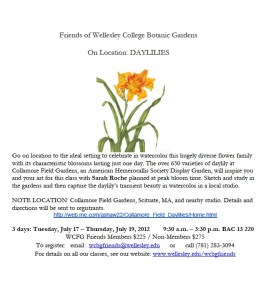
  • On Location: Daylilies with Sarah Roche
  • Fruit from the Orchard
  • Botanical Painting on Vellum
  • Flowers as They Grow
  • Playing with Transparency: Colored Pencil on Mylar
  • View current schedule & instructor bios


Additional Learning Opportunities

Daylilies at Collamore Field Gardens – July 17-19, 2012; 9:30 AM – 3:30 PM. Learn about daylilies at Collamore Field Gardens, an American Hemerocallis Society Display Garden featuring over 650 varieties of daylilies. Sketch lilies in the garden during peak bloom and learn how to transform your sketch into a watercolor painting in the studio. Botanical artist and instructor, Sarah Roche, will show you how! Cost: WCFG Friends Members $225, Non-members, $275. To register, contact wcbgfriends@wellesley.edu or call (781) 283-3094.

I asked this month’s featured guest, Liz Leech, to identify the aspect of plant biology she finds to be most unfamiliar to the public. She replied…

The most unfamiliar aspect of plant biology, and the greatest barrier, seems to me to be the ability to distinguish plant characteristics and therefore to differentiate between plants within generally recognizable broad groupings such as trees, grass, ferns, moss, flowers, seaweed etc. Most people can put typical examples into these rather loose “groupings” of plants but are lost as soon as they have to be more specific and have to look more closely at less obvious examples. For instance, I have found that most high school students, when faced with assessing how many different species there are in a patch of lawn, only recognized the existence of lawn daisies if the flowers were still left on! After mowing they gave 100% grass! Smaller plants and different grasses were certainly not “seen”.

Join this conversation already in progress…