Feeds:
Posts
Comments

Are you a botanical illustrator living near London? You may want to investigate the details about this job announcement posted by City Lit, a provider of part-time courses for adults in Covent Garden, London. Here is a quick summary:

Department:
Visual Arts, Photography and Digital Arts

Location:
City Lit, 1-10 Keeley Street, Covent Garden, London, WC2B 4 BA

Hourly Rate:
£33.91 per hour inclusive of pro rata holiday entitlement and preparation time.

Course Dates & Times:
Sundays; February 24, 2013 – March 17, 2013; 10:30 AM – 5:30 PM


Essential Criteria

  • At least 3 years’ professional working experience in botanical illustration using a variety of media.
  • A qualification relevant to the subject being taught.
  • Teaching Certificate (if teaching more than 50 hours per year at City Lit)
  • Evidence of continuing development


Desirable Criteria

  • Experience teaching botanical illustration to adults of mixed ability in group settings.
  • Current knowledge and evidence of at least 3 years’ professional experience using the latest versions of Photoshop and Illustrator software for illustration.
  • Good working knowledge of Apple Mac computer and the latest operating systems.

Many more criteria are listed in the job announcement. View the
job announcement online to download a detailed job description.

This is the first time City Lit has offered this kind of teaching position. City Lit does not currently offer ongoing courses in botanical illustration. However, they hope to offer more courses if the botanical illustration/digital arts course is successful.

Read the job announcement for Botanical Illustration Teacher


Application Deadline
:
June 18, 2012 at Noon (UK time)

Interviews:
July 2-6, 2012

To bring attention to the shapes of leaves, flowers, and the types of fruit a plant produces is a fairly straightforward process. The usual approach is to point, name and label.

But how do you teach people to see color?

This week we look at an activity that goes beyond asking, “What color is it?”

The key question today is, “Can you find this color?”

In Nature’s Palette, authors and educators, Brooke B. McBride and Carol A. Brewer describe how they turn students into explorers in search of color.

Using the color cards readily available in the paint aisle at home improvement stores, McBride and Brewer (2010) create field cards for students to use in outdoor investigations. With these cards in hand, students are assigned the task of looking for natural objects matching the colors on their respective cards.

What makes this activity more than one requiring students look for green, red and yellow, is that McBride and Brewer (2010) do not create cards with predictable color schemes. Instead, they collect a broad range of colors from the paint aisle. To make sure they collect a broad selection, they pull “every fifth or tenth paint chip” as they work their way down the aisle. When they pull a chip containing many shades of color, McBride and Brewer (2010) simply cut the cards to separate the shades.

To make the reference cards their students use in the field, McBride and Brewer (2010) cut the poster board down to a size that is easily transported. They then paste 5-10 colors on each sheet of poster board. One board is then given to each group of 2-4 students. To get students excited about their investigation, McBride & Brewer (2010) engage students in conversations about where they may find the range of colors before them and encourage students to match the colors as best they can. They also remind students to collect only natural items, not manmade items, and remind students that what they collect has to fit on their piece of poster board. The reason for this is that when their investigation ends, students must present their posters and their observations to their classmates.

McBride and Brewer (2010) have found that students need only 25 minutes to conduct successful color searches and to collect specimens matching the colors on their assigned color card. They go on to say the number of natural objects students find in 25 minutes has been “mind-boggling and far surpassed” their expectations.

During the poster presentations, McBride & Brewer (2010) ask the following types of questions to help guide student discussions:

  • Which color did you observe the most? Which color did you observe the least often? What was the most unusual color you found?
  • Which of your senses did you have to rely on during your search? How did you find the objects you collected?
  • What is the most interesting object your group found? What makes it so interesting? What do you think it is?

The authors have found these questions, and this activity, helps students “focus and observe with a purpose” (McBride & Brewer, 2010).

Readers, how do you help others see nature’s colors?
Share your stories in the Comment box below.


Literature Cited

McBride, Brooke B. and Carol A. Brewer. 2010. Nature’s palette. Science and Children. 48(2): 40-43.

Visit your local college library to get a copy of this article or purchase a copy online (99¢).

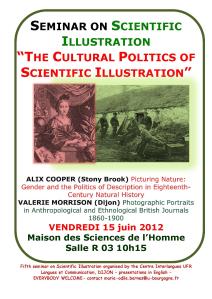
The fifth seminar on scientific illustration led by Marie-Odile Bernez at the University of Burgundy in France, will be held on Friday June 15, 2012 in the Maison des Sciences de l’Homme. Beginning at 10:15 AM, professor Alix Cooper from Stony Brook University will focus on gender and the depiction of nature in the eighteenth century. Then Valérie Morisson will present a number of ethnographic and anthropological photographs from the end of the nineteenth century, questioning the issue of ethnic groups in science. Both speakers will address the question of scientific illustrations in the context of political/cultural prejudices.


Seminar on Scientific Illustration, June 15

    Picturing Nature: Gender and the Politics of Description in Eighteenth-Century Natural History (Alix Cooper, Stony Brook, USA)

    Photographic Portraits in Anthropological and Ethnological British Journals 1860-1900 (Valerie Morrison, Dijon, France)

Paper engineer and book artist, Shawn Sheehy, will teach you how to create a field guide of wildflowers and a journal for your garden.

See what’s new in the Classes Near You sections for Minnesota, Ohio and Illinois.


Shawn Sheehy

www.shawnsheehy.com
A book artist and paper engineer whose work incorporates ecological principles observed in nature. Sheehy’s art reflects his interests in ecosystems, natural resources, population biology and evolution.

    Pop-Up Field Guide to Wildflowers – June 29 – July 1, 2012;
    9 AM – 4 PM. Create a pop-up book featuring North American wildflowers! In this three-day workshop you will learn the fundamental structures, techniques and materials of pop-up engineering while building 10-12 exquisite flower forms. You can bind the structures together to create a book or keep them separate for gifting to family and friends. Either way, you will have the knowledge and skills to begin creating your own cards at home. Cost: $300. Materials Fee: $17. Location: Grand Marais Art Colony Grand Marais, MN. View Details/Register


    Pop-Up Field Guide to Wildflowers
    – July 14-15, 2012; 10 AM – 4 PM. In this two-day workshop, you will create 8-10 pop-up cards featuring native flowers of the Midwest. Fundamental techniques of pop-up engineering will be demonstrated and practiced while building these flowers, using little more than a knife, glue and card stock. Aside from a collection of cards that you might either bind together and keep for further study or [as] gift[s] to family and friends, you will also receive the knowledge and tools to continue creating your own cards at home. No experience is necessary, but binding and/or sewing skills will speed your progress. This is a great workshop to take if you want to explore making your own greeting cards or would like to advance your skills in using paper as a medium for sculpture. Cost: $165. Location: Morgan Art of Papermaking Conservatory Cleveland, OH. View Details/Register


    The Pop-Up Vegetable Garden
    – October 25 – November 2, 2012. Fundamental techniques of pop-up engineering will be demonstrated and practiced while building these vegetable plants, using little more than a knife, glue and card stock. At the end of the day you will have a collection of 4-5 cards that you might either keep for further study or gift to family and friends. No experience is necessary, but binding and/or sewing skills will speed your progress. Location: Chicago Botanic Garden Chicago, IL. Details and registration information will be posted here.

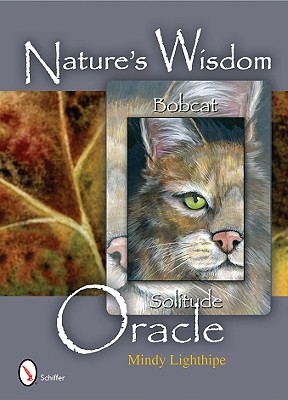
Natural science illustrator, Mindy Lighthipe, will be interviewed on Blog Talk Radio this afternoon from 4-5 PM (Eastern). Mindy will discuss her Nature’s Wisdom Oracle cards from Schiffer Publishing.

Mindy’s collection is composed of 48 colorful art nature cards. These oracle cards display the power of Nature’s Wisdom that comes through her beautiful art. The messages are deeply rooted in the essence of humanity, with each card representing a facet of nature that is the spirit of living with nature. These messages are interwoven with animals and plants as part of its symbology, as well as a special message that helps the reader gain positive insight into the past, present, and future.

Mindy Lighthipe is a natural science illustrator, author and teacher. She teaches in the US and leads art expeditions to Costa Rica. In 2009, Mindy was awarded a Silver Medal from the Royal Horticultural Society for her painting series Symbiosis.

Learn more about Mindy, her art tours, and view her online gallery at www.botanicalartpainting.com.

Be sure to read about her 52-week challenge (52 Weeks/52 Paintings) and to see how she’s doing!


Related

Nature’s Wisdom Oracle Cards

Yesterday the Transit of Venus across the sun received a lot of attention. Many of us were able to view it on the Internet through the many gadgets we have at our disposal. In 1769, however, James Cook, Joseph Banks and surviving members of the Endeavour crew had to endure many months at sea to watch this event unfold in Tahiti. Observing and documenting the Transit of Venus was one of the expedition’s assignments. They did see it and they did take notes.

This wasn’t their only mission, however. The Endeavour crew was sent out to confirm the presence or absence of a certain land mass in the southern hemisphere (i.e., Australia).

With the current attention focused on the Transit of Venus, I thought it would be a good time to give a little attention to the work of botanist Joseph Banks.

During the Endeavour expedition’s travels to South America, Tahiti, New Zealand, and Australia, Joseph Banks and his crew collected and described thousands of plants. Specimens were drawn by artist Sydney Parkinson who also applied watercolor to his sketches as a way of recording the colors of each plant.

The hard work of Banks’ team was to be recognized in a florilegium Banks wanted to create. He hired artists and master engravers, but in the end, never published his book. The 743 plates created by his team of artists and engravers were transferred to the British Museum and were not printed until 200 years later.

Today we are able to gain insight into the printing of Banks’ florilegium thanks to The National Museum of Australia. They created Banks’ Florilegium: From Plant to Print, an online gallery featuring nine plates from this historic work. This online gallery is more than a collection of nine colorful thumbnail-sized images. The gallery provides information about the materials behind each plate. Viewers are able to compare each plate to its herbarium specimen, the original sketch by Sydney Parkinson, and the final watercolor painting that was based on Parkinson’s sketch. The information in the interactive gallery is presented thoughtfully and provides an engaging learning experience.

Tour this fascinating exhibit for yourself. Go to Banks’ Florilegium: From Plant to Print.


Related

What type of light box do you use?

A reader is looking for a light box and is asking for input from fellow artists and illustrators. This reader writes:

I am in looking into buying a light box to be used for tracing. I would like it as bright as I can get it to allow me to see thru some of the thicker art papers. Just wondering if you had suggestions for a
12″ x 18″ thin unit?

Do you have any suggestions or comments to share? Please post them in the Comment section below.

Thank you!