Feeds:
Posts
Comments

Cornish College of the Arts
www.cornish.edu
Established in 1914 in Seattle, Cornish College of the Arts offers classes in art, dance, design, music, performance production, and theater. Its mission is to “provide students aspiring to become practicing artists with an educational program of the highest quality.”

    Natural Science Illustration – August 6-10, 2012; 9 AM – 4 PM. Instructor Rossi Donesky has created a series of classes introducing children (ages 15-18) to scientific illustration. In her courses, students will take an in-depth look at the field and learn how to draw and paint their own illustrations. They will also investigate the work of Leonardo da Vinci, Canaletto, Albrecht Durer, George Stubbs, John James Audubon and others. This course is part of Intensives Session II. Register for both Intensive Sessions I and II and receive $100 off your total tuition.
    Cost: $695, includes materials.

    This course is offered through the Art + Design program, a program offering studio experiences for students ages 15 to 18.

    View course details, including information about scholarships and housing, here.

This information can also be found at Classes Near You > Washington.

The company, Everything Botanical, manages two institutes of botanical art in Australia. Learn more about them below and at Classes Near You > Australia.


Everything Botanical Pty Ltd

www.biba.com.au
Private company managing the Beechworth Institute of Botanical Art and the Canberra Institute of Botanical Art in Australia.

Beechworth Institute of Botanical Art
The Beechworth Institute of Botanical Art was established in 2007 and is located in the Beechworth region of northeast Victoria. Upcoming courses include:

  • Camellias – July 21-22, 2012
  • Layering with Drafting Film – October 20-21, 2012
  • Eucalypts – November 24-25, 2012
  • Course details can be viewed on the BIBA Workshops page.

Canberra Institute of Botanical Art
The Canberra Institute of Botanical Art was established in 2005. Upcoming courses include:

  • Amazing Scraperboard – July 7-8, 2012
  • Creating a Collection Sampler – October 13-14, 2012
  • Onions and Garlic – November 10-11, 2012
  • Course details can be viewed on the CIBA Worshops page.

Join me in welcoming Valerie Littlewood, our featured guest for June!

Valerie has been a commercial illustrator, designer for industry, artist and art lecturer for many years. Most recently, she has been drawing plants and insects, becoming more and more interested in their relationships and their conservation. Currently she is drawing bees and other pollinators and has a traveling show, BUZZ: A Celebration of British Bees and Their Flowers, showcasing 24 of Britain’s bees. Valerie was awarded a bursary from The Society for All Artists in 2012 to help encourage creative people of all abilities to take inspiration from the natural world, from insects, bees and flowers and to understand more about their important relationship to us.

A hands-on artist, Valerie says she loves “everything about making art with brushes, pencils and paint.” Valerie made her living as a general illustrator creating illustrations for anything from packaging and advertising to book illustration. She also created illustrations as a giftware designer. Valerie does less commercial work these days because so much of the work she used to do is now done on the computer. Being a hands-on artist, Valerie says she is “very reluctant to sit at a computer all day.” So she has turned more of her attention to teaching.

Throughout her career, Valerie has always taught art — from degree students to “purely-for-pleasure art holidays.” She feels teaching is a wonderful way to open up possibilities for all kinds of people. Valerie has taught many subjects and has many interests herself. She is a printmaker, a painter, loves ceramics and bookmaking. She used to teach an interior design course teaching creative thinking and fine faux finishes. Her experiences as an artist and teacher have enabled her to be happy painting with a 6″ house brush or a 00 sable brush.

An admirer and advocate of craft skills, Valerie believes artists should hone their skills to be able to say what they want to say in their work.

Reflecting on an almost 40-year career as an artist, designer and educator, Valerie says the natural world has been a recurring theme in her work. While she may teach people how to draw and paint, she says her main preoccupation is to teach them to “see”.

(I teach students) to observe and to consider what is around them through the eyes of an artist. 
The observation and interpretation of the natural world can be the inspiration for so many of the artistic disciplines, from pattern and form to structure and colour informing sculpture, textiles, architecture and more.

Then there is the emotional connection we have with nature, things that we as humans relate to. A fascination with how things live, thrive, survive and reproduce and an affinity with their daily struggle. For example, how could you not admire the ingenuity of a little bee who makes her nest in a snail shell, who diligently collects twigs many times her own size to cover the shell and who chews little pieces of leaves to use as a green camouflage?


To practice art in any of its forms you first have to learn to look. Artists have to be observant. But it is so worth the effort because the added joy of that looking, seeing, and learning, especially in the field of natural sciences, is the understanding it brings. Then what hopefully follows is a greater connection with a world which can sometimes seem increasingly distant as we rely on machines more and more.

Certainly since painting the bees, I have become more aware of the astonishing variety and interdependence of living things, especially some of those small often overlooked creatures. I have become increasingly appreciative of how important they are in our lives.

Bombus hortorum on honeysuckle. © Val Littlewood. All rights reserved

Save the Date!
Pollinator Week
(June 18-24, 2012)

Valerie will discuss her work with Britain’s bees and the plants they pollinate during Pollinator Week. You will have the opportunity to ask Valerie questions during this annual event that brings attention to declining pollinator populations.

One of the topics Valerie will discuss is her book, BUZZ, dedicated to British bees and the plants they visit and pollinate. BUZZ is a self-published title. You can preview Valerie’s book here. Above is an example of the type of pollinator illustrations Valerie creates. Featured is an illustration of Bombus hortorum (Garden Bumble Bee). This species of Bombus has a long tongue it uses to access nectar from the long tubular flowers of the honeysuckle plant. While drinking nectar, pollen is deposited on the bee’s body. When the bee travels to another flower, it brings the pollen with it and deposits the pollen on the stigma of the new flower, thereby completing the transfer of pollen (i.e, pollination).

Unlike their longer-tongued counterparts, short-tongued bees are unable to access the nectar of honeysuckle flowers in the same way. This does not stop them from getting what they want, however. To get their share of the nectar, they bite holes into the base of the tubular flowers and steal the nectar. While this may be a win-win for the nectar robbers, this form of nectar harvesting negatively impacts pollination success because pollen is not transferred in the process.

Even the simple act of pollen transfer is not as simple as one might think!


Ask the Artist with Valerie Littlewood

Watch for more information about our conversation with Valerie during Pollinator Week. Share this information with colleagues, friends, fellow gardeners and the pollination ecology students in your life. Look for events in your state, download planting guides and learn about resources for the home gardener and professional landscaper here.


Gardens for Pollinators with the BeeSmart Pollinator Gardening App

Created by the Pollinator Partnership and Catch.com, this app is a database of almost 1,000 native plants found across the United States. To find pollinator-friendly plants for your garden, simply enter your zip code to view a list of plants for your area. Then sort through your list by selecting specific pollinators, flower colors, soil types, plant types or the type of sunlight your garden receives. To learn more about the BeeSmart Pollinator Gardening app click on the image above.



UPDATE
: Pollinator Week Q&A with Valerie Littlewood
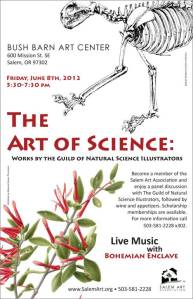
The Art of Science
Bush Barn Gallery
Salem, OR
June 1 – July 28, 2012

On Friday, members of the newly formed Oregon group of the Guild of Natural Science Illustrators (GNSI) will launch The Art of Science at the Bush Barn Gallery in Salem, Oregon. This exhibition is the group’s first juried exhibition.

A panel discussion with group members and biologist, David Craig, will be held on Friday, June 8, 2012 at 5:30 PM. The panel will discuss the field of scientific illustration and how illustrators work. Artists participating in the panel discussion are: Rebecca Brown-Thompson, Kristie Potwora, Jeanne Debons, Barbara Gleason, Kris Kirkeby and Cynthis Kranch. This discussion is open to members of the Salem Art Association and their guests. Wine, appetizers and entertainment will follow. To become a member of the Salem Art Association, complete a membership application online.

Gallery Hours:
Tuesday – Friday, 10 AM – 5 PM
Saturday and Sunday, Noon – 5 PM
Closed Monday


Also See…

Guild of Natural Science Illustrators

Botanist and botanical artist, Linda Ann Vorobik, will teach workshops in four states this summer and fall. Here is what’s new in the Classes Near You section for California, Oregon, Washington, and Hawaii.


Vorobik Botanical Art

www.vorobikbotanicalart.com
Linda Ann Vorobik, Ph.D. is a botanical illustrator and botanist who teaches at the Jepson Herbarium at UC Berkeley, conducts field research in the Siskiyou Mountains in Oregon and teaches botanical illustration in California, Oregon, Washington and Hawaii. Visit Linda’s website to view her current teaching schedule, online gallery, blog, and to sign-up for her newsletter. Upcoming classes include:

  • Introduction to Botanical Illustration – May 31 – June 3, 2012;
    9 AM – 5 PM. Siskiyou Field Institute, Selma, Oregon.
  • Botanical Art: Field Sketching to Studio Watercolors
    June 22-24, 2012. Point Reyes, CA.
  • Crash Course in Flowering Plant Families – July 7-10, 2012.
    Siskiyou Field Institute, Selma, Oregon.
  • Painting Orchids on the Big Island of Hawaii – October 14-20, 2012. Captain Cook, Hawaii.

An exhibition of Linda’s botanical art and hand-painted silk scarves will open on June 9 at the Chimera Gallery on Lopez Island in Washington.

Linda will also participate in the Lopez Island Studio Tour scheduled for Labor Day weekend (September 1-2, 2012).

It was only in January when sixteen scientists met with sixteen artists in northern California. Brought together by Santa Cruz-based artist, Lisa Hochstein, scientists from the U.S. Geological Survey’s Pacific Coastal and Marine Science Center partnered with sixteen artists from California’s Central Coast and the greater San Francisco Bay area. The purpose of the meeting was to create collaborative partnerships in which scientists shared their research with artists and in which artists would then create new work based on the research of their scientist-partner.

The research topics presented to the artists include the study of migratory bird patterns, the movement of sediment through wind, waves, and currents, deep-water reserves of precious metals, the potential effects of natural and anthropogenic hazards, and mapping climate change as it impacts both human communities and natural environments. The scientists’ areas of specialization include geology, biology, geography, geochemistry, and oceanography.

Stepping outside of their usual line of work, artists have worked closely with scientists to explore the interdisciplinary nature of art and science. Artists discuss their respective projects on the Earth • Science • Art website. The way artists have chosen to interpret their partner’s data is fascinating. If you only have time to quickly skim over the Earth • Science • Art website, try to spend most of your time reading the Artist’s Update page. Your day will be sprinkled with inspiration and is sure to be much brighter.

About this collaboration of artists and scientists, aritst/curator, Lisa Hochstein, says:

This project is an opportunity to showcase the talents of our area’s artists, as well as the exciting scientific work being done in Santa Cruz by the USGS. Through these collaborations we hope to invite people to reflect on the vastness of geological time, the impact of humans on the planet, and the creative ways that, as scientists and artists, we study and represent the world around us.

The exhibition Earth • Science • Art will open with a First Friday opening reception on Friday, June 1 from 5-9 PM at the R. Blitzer Gallery in Santa Cruz. The public is invited to attend. This exhibition is free and will be open to the public, Wednesday – Sunday from 11 AM to 5 PM, June 2–30, 2012. During the month of June, two evening panel discussions with project participants will be hosted by the R. Blitzer Gallery.

Visit the Earth • Science • Art website at www.earthscienceartSC.com.

Visit the R. Blitzer Gallery in Santa Cruz.

Painter, sculptor and printmaker, Ellsworth Kelly, is best known for his abstract paintings. Next week, an exhibition of his work will open at the Metropolitan Museum of Art in New York. This exhibition will bring special attention to Kelly’s plant drawings. This will be the first major museum exhibition dedicated exclusively to Kelly’s drawings of plants, flowers, and leaves.

Approximately 75 drawings will be on view. They date back to 1948 and include his most recent work made in upstate New York.

Ellsworth Kelly has been featured in major solo exhibitions at The Museum of Modern Art (1973), The Whitney Museum of American Art (1982), and the Solomon R. Gugenheim Museum, New York (1996), and his work is included in many prestigious American and international public collections.

Gallery talks, studio workshops for adults, and an evening lecture will be offered in conjunction with the exhibition. Visit the exhibition website for details.

The book Plant Drawings by Ellsworth Kelly is available at ArtPlantae Books.


Ellsworth Kelly Plant Drawings

Metropolitan Museum of Art
New York, NY
June 5 – Sept. 3, 2012