Feeds:
Posts
Comments

In the introduction to her research paper, Botanical Knowledge of a Group of South Carolina Elementary School Students, Chandra L. Cooper shares a quote by anthropologist Eugene S. Hunn in which he pronounces the extent of Americans ignorance of the natural environment.

His comment begs the questions: How ignorant are they? Can this be reversed?

Cooper addressed these questions, in part, by studying the botanical knowledge of a small group of elementary school children. To determine how much the students knew about plants and to determine if this knowledge could be improved through informal learning experiences, Cooper created a way to quantify the students’ prior botanical knowledge and created a three-month program in informal botany education whose aim was to improve students’ knowledge of plants.

Cooper’s research focused on how well a group of elementary school students could identify trees, flowers, weeds/wild plants, garden crops, vines, shrubs/bushes, water plants, house plants, grasses and “other plants” (Cooper, 2008), plants not included in the previous categories.

From December 2006 through May 2007, Cooper (2008) worked with children enrolled in a small elementary school located in rural South Carolina. The sample population (n=11) consisted of eight males and three females, age 9-12 years. Of the eleven students, data for ten were analyzed.

Cooper (2008) administered a three-part pre-assessment survey to determine students’ prior experiences with nature, their ability to name plants and to sort them into categories, and their ability to identify 60 species of plants shown in a slide show. For the post-assessment survey, students repeated the same tasks. They also responded to questions in a verbal interview conducted by Cooper.

The pre-assessment inquiries revealed that nine of the students had a vegetable or flower garden at home and that eight of them had experience performing yard work (Cooper, 2008). Pre-assessment surveys also revealed the children preferred outdoor activities over indoor activities, most had participated in recycling practices in their home, and that the students were able to identify at least two uses of plants (Cooper, 2008). When asked to list plants in the 10 categories outlined above, students listed an average of 10 trees, 6 flowers, 9 garden crops, and 3 weeds; their lists for plants in the remaining categories were very short, containing 1-2 items each (Cooper, 2008). When asked to identify plants in a slide show containing 60 species of plants (students were allowed to view the slide show at their own pace), students could on average identify 33% of the plants in the slide show, with all of them correctly identifying cotton, potato, rose, strawberry and bamboo (Cooper, 2008). Students could identify garden crop plants 70% of the time, multiple-use plants 60% of the time and wild plants 18% of the time (Cooper, 2008).

Following the pre-assessment surveys, students attended a three-month after-school program in which they participated in hands-on activities about plants and studies about plants in their local area (Cooper, 2008). Upon completing the program, students could list significantly more garden crop plants than they did in the pre-assessment survey (Cooper, 2008). They also listed significantly fewer shrubs/bushes, a development Cooper (2008) says can be explained by the students’ ability to better categorize plants as a result of their participation in the after-school program (see Cooper’s paper for a detailed review of student responses).

Post-assessment surveys also indicate this small group of elementary school students could identify correctly 55% of the plants in the slide show — up from 33% (Cooper, 2008). When analyzing the average number of correct responses made by students, Cooper (2008) found that students could identify correctly 91% of garden crop plants (up from 70%), 33% of ornamental plants (up from 15%), 42% of wild plants (up from 18%), and 80% of multiple-use plants (up from 60%).

The three-month program implemented by Cooper lead to an increased interest in plants and increased student ability to identify correctly various categories of plants. Student interest in plants was assessed during the post-assessment interviews. Enhanced student interest in plants was confirmed by the types of comments students made during the interview. Comments such as, “There are a lot more plants in the environment than I think, and I’ve just got to look closer” (Cooper, 2008).

Cooper’s results indicate that a program in informal botany education can lead to increased knowledge about plants and to an enhanced interest in the plant world.

Read more student comments about plants.

Download a copy of Cooper’s article by clicking on the link below. The article is free to download. The journal Ethnobotany Research and Applications is published online. Its contents are licensed under a Creative Commons Attribution 3.0 License.


Literature Cited

Cooper, Chanda L. 2008. Botanical knowledge of a group of South Carolina elementary school students. Ethnobotany Research and Applications. 6: 121-127. Web. <http://lib-ojs3.lib.sfu.ca:8114/index.php/era/article/view/166>
[accessed 28 September 2012]


Studies of Botanical Knowledge

In her introduction, Cooper (2008) discusses how the botanical knowledge of children in indigenous societies is greater than that of children in the US, in the United Kingdom, and in Switzerland. She cites studies reviewed previously in this column. Click on the links to these studies to learn more.
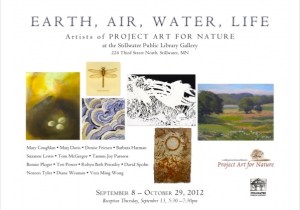
Earth, Air, Water, Life
Sept. 8 – Oct. 29, 2012
Stillwater, MN

Fourteen artists from
Project Art for Nature are participating in Earth, Air, Water, Life an exhibition now on view at the Stillwater Public Library Gallery in Stillwater, MN. The artists of Project Art for Nature work independently and with each other to create art promoting awareness of threatened natural areas in Minnesota and Wisconsin. They host educational art exhibitions every year at art galleries, nature centers, libraries and other venues in both states.

Visit the Stillwater Public Library

Artist Lala Ragimov has announced her new scientific illustration class for children and adults. This weekend class will be taught at Madrona Marsh, the last vernal marsh in Los Angeles County. See below for details.


Lala Ragimov

www.LalaRagimov.com
A Southern California artist who studies the techniques of Renaissance painters and uses these techniques in her work. Her work is currently on view in the solo exhibition, Envisioning the Natural World, at the Madrona Marsh Nature Center. Lala’s classes appeal to a general audience and can accommodate participants working on independent projects. Botanical artists are welcome! The classes below are taught at the Torrance Cultural Arts Center in Torrance, CA.

Adult Classes:

    Exploring Watercolor Techniques
    Thursdays, September 20 – November 29, 2012; 6:30 – 9:00 PM
    (no class Nov 22)
    Learn new techniques at each meeting. Students have the option of participating in the class project or working on their own. Cost: $135 Torrance residents ($150 non-residents). View Details/Register


    Fundamentals of Oil Painting

    Learn oil painting techniques and apply your new knowledge using still life sets or in your own independent project. Topics addressed include: color theory, composition, positive space and negative space. Two sections of this course are available. Cost per section: $135 Torrance residents, ($150 non-residents)

    Mondays, September 17 – November 26, 2012; 6:30 – 9:00 PM
    (no class Nov 12)
    View Details/Register for Monday option

    Tuesdays, September 18 – November 20; 9:30 AM – 12:00 PM
    View Details/Register for Tuesday option


    Learn to Draw and Sketch

    Tuesdays, September 18 – November 6, 2012; 12:30 – 2:30 PM.
    In this introductory course, participants will learn how to observe subjects. They will also learn about shading, composition, expression and style. Cost: $100 Torrance residents, ($110 non-residents)
    View Details/Register


Children’s Classes
:

    Drawing and Watercolour Painting (Ages 10-16)
    Young artists will work in pencil, pen, ink and watercolor while learning about perspective, shading and color. They will also draw and paint from life and imagination and learn the techniques of the Old Masters. Two sections of this course are available. Cost per section: $79 Torrance residents, ($89 non-residents)

    Fridays, September 21 – November 9, 2012; 4:00-5:30 PM
    View Details/Register for Friday option

    Saturdays, September 22 – November 10, 2012; 3:15-4:45 PM
    View Details/Register for Saturday option


    NEW!
    Botanical and Zoological Illustration
    Learn how to draw and paint the plants and animals at Madrona Marsh, the last surviving vernal marsh in Los Angeles County. In this Saturday morning program, participants will learn how to create botanical, ornithological and other scientific illustrations with the help of the artist Lala Ragimov. Basic drawing and watercolor supplies provided. Adults and children (9 years old and older) are welcome. Cost: $10 per class. Class dates are listed below. Each class meets from 10 AM – 12 PM.

    To register, contact Friends of Madrona Marsh at (310) 782-3989.
    Explore the Madrona Marsh online at www.friendsofmadronamarsh.com.

    Class Dates:
    Satuday, November 17, 2012
    Saturday, December 8, 2012
    Saturday, January 26, 2012
    Saturday, February 16, 2013
    Saturday, March 30, 2013
    Saturday, April 20, 2013

This information can also be found at Classes Near You > Southern California.

Learn how to capture Nature’s forms in black and white in this five-week class with Rose Pellicano.

Get the latest at Classes Near You > New York!


Rose Pellicano

Rose Pellicano’s career as a botanical artist spans 20 years. Her work has been exhibited widely and is in the permanent collection of the Hunt Institute for Botanical Documentation. Learn more about Rose by visiting her profile in the ASBA Members Gallery. Rose is represented by Susan Frei Nathan Fine Works on Paper, LLC in New Jersey.

    Drawing Flowers and Plants in Graphite
    Fridays, October 26 and November 2,9,16,30, 2012
    10 AM – 1 PM
    Learn the basics of drawing flowers and plants in graphite. Create the illusion of depth and three dimensionality to your drawing by learning to apply even gradations of values. This course is for beginning and intermediate students. Flowers will be provided. Cost: $205, plus $10 materials fee. Location: Southampton Cultural Center, www.scc-arts.org.

    To register, contact Kirsten Lonnie or call (631) 287-4377.

Seattle-area residents have many opportunities to learn botanical art!

Here is Kathleen McKeehan’s new teaching schedule:


Kathleen McKeehen, Scientific Illustrator

Kathleen is a teacher and freelance illustrator. Her work has appeared in Organic Gardening Magazine and The Herb Companion. View Kathleen’s artwork in the ASBA Members’ Gallery or at the Guild of Natural Science Illustrators’
Science-Art.com. Kathleen welcomes both beginners and advanced students to her classes.

    Studio Classes with Kathleen McKeehen
    Morning to early afternoon studio sessions are available on Wednesdays and possibly Tuesdays. For more information, please contact Kathleen.

    Botanical Watercolor – Mondays, October 1 – November 19, 2012; 7:00 – 9:30 PM. Poulsbo Parks & Recreation, www.cityofpoulsbo.com
    or 360-779-9898

    Botanical Drawing – Mondays, January 28 – March 18, 2013;
    7:00 – 9:30 PM (no class Feb 18). Poulsbo Parks & Recreation, www.cityofpoulsbo.com or 360-779-9898

    Botanical Watercolor – Thursdays, October 11 – November 15, 2012; 10 AM – 1 PM. Bloedel Reserve, Bainbridge Island, View Details/Register

    Botanical Drawing
    Fridays, January 18 – March 22, 2013; 9:30 AM – 12:30 PM
    Learn to draw botanical subjects with basic techniques of measurement, gesture sketching, and shading; class is good preparation for continuing with botanical painting or for drawing other non-botanical subjects. Repeat students can take on more complex subjects with supervision. Gage Academy, Seattle, www.gageacademy.org

    Botanical Watercolor
    Fridays, January 18 – March 22, 2013; 1:30-4:30 PM
    Winter subjects such as conifers & cones will be rendered using classic dry-brush and wash techniques; beginners will learn measurement, flat & graded washes, dry-brush–methods that produce a realistic and accurate rendering. Returning students will get additional practice in these techniques and can select subjects of their choice. (Those interested in expanding subjects to include natural history options such as feathers, skulls, shells, etc. will be able to do so.). Gage Academy, Seattle, www.gageacademy.org

    Botanical Watercolor
    Winslow Art Center, Bainbridge Island
    Check the schedule at Winslow Art Center for announcement about the dates and time for this class.


    Weekend Workshops
    :

    Botanical Watercolor Painting Conifer Cones
    February 9-10, 2013 (All Day)
    New students will learn basic dry brush watercolor techniques and work on a simple fir cone; students with some experience in the technique can tackle more complex cones. Gage Academy, Seattle, www.gageacademy.org

    Botanical Watercolor Edible Botanicals!
    March 2-3, 2013 (All Day)
    Students will learn basic techniques of dry brush and controlled washes to portray simple fruits or vegetables; students with some experience may select subjects of their choice and work under supervision to review and learn new skills. Gage Academy, Seattle, www.gageacademy.org

This information has also been posted to Classes Near You > Washington.

Here is what’s new at Classes Near You > Northern California:


Gardens at Heather Farm, Walnut Creek

www.gardenshf.org
The Gardens at Heather Farm are comprised of twenty demonstration gardens. This six-acre garden is also an outdoor classroom. The garden offers many classes about plants, botany, botanical art and the environment. It also has its own florilegium. The florilegium project is managed by botanical artist, Catherine Watters. Visit the website to view the complete schedule of classes.

  • Successful Citrus for the Diablo Valley – October 13, 9:30 – 11:30 AM. Four Winds Growers, developers of dwarf citrus will share everything you ever wanted to know about successfully growing a large variety of citrus throughout the Diablo Valley. Plants will be available for sale.
    Cost: $20.
  • Patio Gardens: California Native Plants for Containers – October 20, 2012; 9:30 – 11:30 AM. Join Pete Veilleux, East Bay Wilds Nursery for a course in growing California natives in containers. Learn about the most suitable containers to use, soil and soil mixes, and the plants that work best. Pete will also be offering containers and his fabulous native plants for sale. Cost: $25
  • Improving Your Garden Photography – November 3, 2012; 9:30 AM – 12:00 PM. Bring your camera (DSLR or point & shoot) and a tripod if you have it. Learn about camera settings such as ISO, shutter speed, aperture, file size and macro settings; plus compositional skills and direction of light. Then practice your new skills in the garden while receiving guidance from instructor Jen Kennedy. Cost: $25
  • The Gardens in Autumn – November 10, 2012; 9:00 AM – 12:00 PM. Patrice Hanlon & Susan Handjian will show you the beauty of an autumn garden. Many plants have more subtle but equally lovely bark color as well as fruits, berries, and seedpods. Learn about proper plant selection for your site; why it’s best to plant in the fall; and tips for maintaining your garden using principles of sustainability.  Receive a plant list that will help you create a fall palette for your garden. Cost: $25

The annual fall plant sale at the University of California Botanical Garden at Berkeley will be held this weekend.

The garden’s native plant sale is also coming up soon. Read more about this annual celebration, the upcoming iPhoneography class, and the last Butterfly Walk of the year below.


University of California Botanical Garden at Berkeley

http://botanicalgarden.berkeley.edu
This 34-acre garden was established in 1890 and is now a non-profit research garden and museum. The botanical art classes at UCBG are taught by Lee McCaffree and Catherine Watters. View a detailed schedule and register on the Garden’s website.

  • Sick Plant Clinic – First Saturday of Each Month, 9 AM – 12 PM. Free.
    No reservations required.
  • Monthly Butterfly Walks – Fourth Tuesday of each month (March – October); 3 – 4 PM. Garden volunteer, docent, and caterpillar lady, Sally Levinson, will lead walks through the garden in search of butterflies. Space is limited. Children welcome. Free with admission.
  • Garden Strollers – Second Wednesday of Each Month,
    11 AM – 11:45 PM. A 45-minute tour of the garden for adults with young children (3 and under). Tour will end on the lawn for play and snacks (bring your own). Children must be in a stroller or carrier during the tour. FREE with garden admission. Meet in front of the Garden Ship. For more information, call (510) 642-7082 or email garden@berkeley.edu.
  • Fall Plant Sale – Sunday, September 30, 2012; 10:30 AM – 2:00 PM. Get a head start at our eagerly anticipated fall sale. We specialize in regionally appropriate, Mediterranean-climate plants including California natives, and plants from South Africa, Australia, the Mediterranean region, and South America. We also have the exotic and unusual. Our wide variety of plant offerings will appeal to everyone. See the UCBG Fall Plant Sale page for more information.
  • iPhoneography: Create Great Garden Photos Using an iPhone October 6, 2012; 9:30 – 12:30. Get the photos you want with iPhone photographer, Yoni Mayeri. View Details/Register
  • Native Plant Extravaganza – October 7, 2012; 10 AM – 4 PM. Lectures and plant sale. View Details

This information can also be found at Classes Near You > Northern California.