Feeds:
Posts
Comments

The annual fall plant sale at the University of California Botanical Garden at Berkeley will be held this weekend.

The garden’s native plant sale is also coming up soon. Read more about this annual celebration, the upcoming iPhoneography class, and the last Butterfly Walk of the year below.


University of California Botanical Garden at Berkeley

http://botanicalgarden.berkeley.edu
This 34-acre garden was established in 1890 and is now a non-profit research garden and museum. The botanical art classes at UCBG are taught by Lee McCaffree and Catherine Watters. View a detailed schedule and register on the Garden’s website.

  • Sick Plant Clinic – First Saturday of Each Month, 9 AM – 12 PM. Free.
    No reservations required.
  • Monthly Butterfly Walks – Fourth Tuesday of each month (March – October); 3 – 4 PM. Garden volunteer, docent, and caterpillar lady, Sally Levinson, will lead walks through the garden in search of butterflies. Space is limited. Children welcome. Free with admission.
  • Garden Strollers – Second Wednesday of Each Month,
    11 AM – 11:45 PM. A 45-minute tour of the garden for adults with young children (3 and under). Tour will end on the lawn for play and snacks (bring your own). Children must be in a stroller or carrier during the tour. FREE with garden admission. Meet in front of the Garden Ship. For more information, call (510) 642-7082 or email garden@berkeley.edu.
  • Fall Plant Sale – Sunday, September 30, 2012; 10:30 AM – 2:00 PM. Get a head start at our eagerly anticipated fall sale. We specialize in regionally appropriate, Mediterranean-climate plants including California natives, and plants from South Africa, Australia, the Mediterranean region, and South America. We also have the exotic and unusual. Our wide variety of plant offerings will appeal to everyone. See the UCBG Fall Plant Sale page for more information.
  • iPhoneography: Create Great Garden Photos Using an iPhone October 6, 2012; 9:30 – 12:30. Get the photos you want with iPhone photographer, Yoni Mayeri. View Details/Register
  • Native Plant Extravaganza – October 7, 2012; 10 AM – 4 PM. Lectures and plant sale. View Details

This information can also be found at Classes Near You > Northern California.

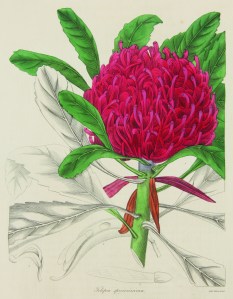
Telopea speciosissima, Waratah, 1837-1842; Miss Maund; Benjamin Maund, publisher; Maund’s The Botanist; handcoloured engraving on paper; Collection: Art Gallery of Ballarat; Purchased with funds from the Joe White Bequest, 2010

Capturing Flora: 300 Years of Australian Botanical Art
September 25 – December 2, 2012
Art Gallery of Ballarat

The much-anticipated exhibition featuring three hundred fifty drawings and prints celebrating Australia’s wildflowers opens tomorrow at the Art Gallery of Ballarat.

Visitors to the Art Gallery of Ballarat can attend free talks, attend workshops and take home one of many themed keepsakes created around this exhibition. Visitors will have their choice of a 280-page hardcover catalog, a 2013 calendar, a perpetual diary, note cards, coasters, magnets, mirrors and more!

Entertaining the idea of traveling to Australia to see this exhibition in person? If you are, you don’t have to spend too much time planning because the planning has been done for you. Take a look at these Ballarat in Bloom travel packages.

Special events are planned throughout the exhibition. A summary is provided below. Visit the exhibition’s Programs and Events page to learn more.

Free Talks

  • Art Insight, September 26
    Engraving, lithography, scientists and intellectuals
  • Let’s Talk Poetry, October 9
    Poetry, Australian landscapes and bush poetry
  • Art Insight, October 10
    The life and work of botanical illustrator, Margaret Flockton.
  • Art Insight, October 24
    The work of John Pastoriza-Piñol.


Concerts and Recitals

  • Musica Botanica, October 3
  • Artists Inspire Artistry, November 9 and November 13
  • VOX: Flower Songs, November 10


Workshops

  • The Microscopic realm with Lauren Black, September 28

The Art Gallery of Ballarat is open daily from 9 AM – 5 PM.
Admission $12, Concession $8, Child and Gallery Members Free
www.artgalleryofballarat.com.au


A Look at ‘Capturing Flora’, courtesy The Art Gallery of Ballarat

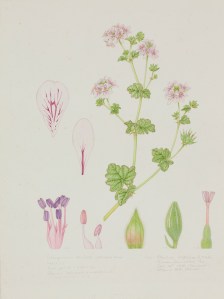
Pelargonium australe, East Coast form by Margaret Stones; watercolour & pencil on paper; Collection: Art Gallery of Ballarat; Purchased with funds from the Hilton White Bequest, 2011

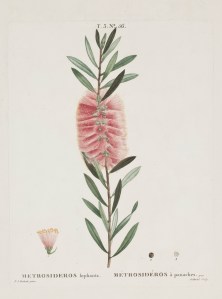
Metrosideros lophanta, date?; Pierre Joseph Redouté; Gabriel, engraver; plate 56 from Henri Duhamel du Monceau’s Traite des arbres et arbustes que l’on cultivee en France en pleine terre [Trees and Shrubs that are grown in the ground in France]; handcoloured engraving on paper; Collection: Art Gallery of Ballarat; Purchased with funds from the Joe White Bequest, 2012

Seed Packet Artist Book © Laura Stickney. All rights reserved

Artist’s Book Workshop with Laura Stickney
Saturday, Sept. 29, 2012
10 AM – Noon

Make your own accordion-folded book with decorative covers and create carved stamps in this book arts class for adults. This is an easy and fun project — no art experience necessary. Laura is a visual artist, poet and the Theodore Payne Foundation’s 2012 Artist in Residence. For 25 years, she taught and coordinated art classes at the Junior Arts Center in Barnsdall Art Park and continues to teach etching and parent/child art workshops in her community. Limit: 12 participants. Cost: $20 members, $25 nonmembers.

Register Today!


About the Theodore Payne Foundation

The Theodore Payne Foundation for Wild Flowers and Native Plants, Inc., is a non-profit organization dedicated to helping others discover the beauty of California native plants. It is located north of Los Angeles in Sun Valley, CA.
www.theodorepayne.org

Instead of exploring drawing and learning as it applies to young learners, today we’re looking at drawing, learning and teachers.

How teachers view the environment influences how they make meaning about it. To investigate how teachers view the world around them, Christine Moseley, Blanche Desjean-Perrotta and Julianna Utley field-tested a scoring rubric assessing teachers’ perceptions of the environment as revealed through their drawings. Their findings are discussed in The Draw-An-Environment Test Rubric (DAET-R), Exploring Pre-Service Teachers’ Mental Models of the Environment.

Drawings have been used as a research tool for many years because they provide insight into an individual’s beliefs and how they make meaning about the world around them (Moseley et al., 2010). Because there has been little research into teachers’ mental images of the environment and how these images influence how teachers think about the environment, Moseley et al. (2010) made this the focus of their research.

To make it easier to quantitatively assess teachers’ mental images as revealed through their drawings, Moseley et al. (2010) created a rubric that enabled them to assign a score to specific elements (or “factors”) in a drawing. The rubric they designed was used to evaluate pre-service teachers’ replies to two prompts in the Draw-An-Environment Test (DAET). Teachers were instructed to draw a picture of what they thought the environment was and then were asked to provide a written definition for the environment. The two prompts pre-service teachers responded to were “My drawing of the environment is ___” and “My definition of the environment is ___”.

Moseley et al. (2010) designed this study to address two research questions:

  1. Is the Draw-An-Environment Test Rubric a valid assessment tool?
  2. What mental models (i.e., images) do early childhood pre-service teachers have of the environment?

The quick answer to their first research question is, “yes”. The rubric they created is a valid and reliable assessment tool. A thorough statistical analysis of the DAET-R can be found in their paper.

As for their findings regarding their second research question…

One hundred eighteen pre-K to fourth grade pre-service teachers (average age 26.9 years) participated in this study. The participants were enrolled in senior level science and math courses.

The drawing portion of the DAET was evaluated using the DAET-R. The evaluation focused on “the degree of evidence in the drawings of interactions” (Moseley et al., 2010). Scores were assigned if a factor was present, if a factor was not present, if a factor interacted with other factors and if two or more factors interacted with each other (Moseley et al., 2010). The research team assigned “degrees of evidence” using a scoring system of 0-3 points, with the highest point score assigned to drawings in which “the participant was trying to indicate an interaction among factors with an emphasis on a systems approach to the definition of environment” (Moseley et al., 2010).

The drawings they received revealed that the pre-service teachers do not consider humans to be an integral part of the environment. Sixty percent of the participants completing the DAET did not draw humans in their pictures and only 31% drew humans interacting with the environment in some way (Moseley et al., 2010). The drawings also revealed the pre-service teachers’ lack of understanding about interactions occurring between factors in the environment (Moseley et al., 2010). Participants included many factors in their drawings and while they labeled them with identification labels such as “cat” or “tree”, they did not assign conceptual labels like “pollination” or “growth” (Moseley et al., 2010). Only two of the 118 drawings scored represented an understanding of how systems are dependent upon each other in the natural environment (Moseley et al., 2010).

The research team observed several drawings of homes, bedrooms, schools, classrooms and urban neighborhoods — scenes suggesting to Moseley et al., 2010 that the word environment did not bring forth images of nature in the minds of their participants. Citing the work of several other studies, Moseley et al. (2010) concluded that their sample population of pre-service teachers had an “object view” of the environment instead of a view in which humans interacted with the environment.

Before I continue, I need to point out that, prior to participants completing the DAET, Moseley et al. (2010) asked participants about their “residential experiences” (i.e., where they have lived for most of their lives). They found out that 21% of their sample population had lived in a rural environment, 32% in an urban environment, and 46% in a suburban environment. It should also be pointed out that prior to their participation in this study, the pre-service teachers had not received any training in environmental education (Moseley et al., 2010).

The results of the drawing section of the DAET are consistent with the results observed in the written section of the test, an evaluation that Moseley et al. (2010) described in a separate paper. The research team evaluated the drawing and written portions of the DAET separately so that the DAET-R could be evaluated for its validity as an assessment tool.

The results of their study prompted Moseley et al. (2010) to call for teacher education programs “that support pre-service teachers’ development of a conceptual model of the environment that integrates humans and the abiotic and biotic factors within the environment” as this would better prepare teachers to teach children about organisms, the environment, and biodiversity.

Read more about the research team’s recommendations and see how they used the DAET-R to evaluate drawings. Purchase a copy of this paper online or
search for this article at your local college library. A copy of the DAET and the DAET-R are included in this paper.


Literature Cited

Moseley, Christine, Blanche Desjean-Perrotta and Julianna Utley. 2010. The Draw-An-Environment Test Rubric (DAET-R): exploring pre-service teachers’ mental models of the environment. Environmental Education Research.
16(2): 189-208.


Also See
The Biodiversity Heritage Library (BHL) has millions of them and they want your help sorting them out. Earlier this year, the Missouri Botanical Garden received funding to identify and describe the natural history illustrations that can be found in the digitized books and journals in the library’s collection.

A system of cataloging and describing the images has been devised. Now the new system (i.e., schema) needs to be reviewed. The Art of Life project team who is sorting through BHLs images is seeking feedback from artists, biologists, humanities scholars, librarians and educators to help them determine if their cataloging system will satisfy the research needs of these groups.

How do you search for images? What type of information do you want to find when you search for images?

Go to the BHL website to read the schema and to send them your thoughts.

Farncombe Estate in the Cotswolds announces their 2013 schedule.

See the latest at Classes Near You > England:


Farncombe Estate, Cotswolds

www.farncombeestate.co.uk
A privately-owned parkland in the Cotswolds. Covering more than 300 acres, this private estate/conference center/hotel welcomes guests from all over the world. Follow Farncombe’s blog or become a fan of their Facebook page to learn more about this unique learning opportunity. Farncombe Estates’ new schedule for 2013 can be viewed online. The current schedule includes:

  • Drawing and Painting from Nature, October 12, 2012
  • Botanical Illustration: Drawing and Painting Autumn Fruits & Fungi, October 19, 2012
  • Sketching Farncombe, February 1, 2013
  • Botanical Drawing in Colored or Graphite Pencil: Spring Buds & Cottage Garden Flowers, April 5, 2013
  • Sketching with Pen and Wash, April 26, 2013
  • Botanical Painting in Watercolor or Gouache (All Levels), May 31, 2013
  • Drawing and Sketching: A Course for Beginners, July 12, 2013
  • Drawing Allsorts – Pencil Sketching for All, August 2, 2013
  • Sketching with Watercolor Pencils, August 31, 2013
  • Botanical/Natural History Painting in Gouache or Watercolor, Sept 13
  • Botanical Drawing in Colored or Graphite Pencil: Pine Cones & Seed Pods, October 25, 2013

Begin your studies in botanical art! Here is an opportunity to study drawing and painting well into Spring 2013 at the University of Bristol Botanical Garden.


University of Bristol Botanic Garden

http://www.bristol.ac.uk/botanic-garden
A four-acre garden founded in 1882 by Adolf Leipner, professor of botany at Bristol University College. Plant collections address the following subject areas: plant evolution, Mediterranean plants, local plants, rare native plants, and useful plants. This garden was founded on an initial budge of £104!

    Traditional Botanical Painting and Drawing
    October 8, 2012 – May 6, 2013
    1:00 – 4:30 PM
    Establish a foundation in botanical drawing and painting in this 21-week course taught by artist Jenny Brooks. Students will learn how to use line, how to create form and textures, how to mix colors, and how to create botanical paintings in watercolor. Cost: £360. View Details

Information about this course has been posted to Classes Near You > England.

Visit this page to also view information about many other classes that will be taught in England through the end of the year.