Feeds:
Posts
Comments

Archive for the ‘Special Events’ Category


Jennifer, twice in your dissertation you bring attention to students’ indifference towards plants. In one instance you observe that one of the two exercises in which student performance was the lowest, was an exercise about drawing plants. You share a student’s comment about plants being “kind of dull to draw” (Landin, 2011). You also share that during the plant lab, students did not work in their Lab Workbooks and paid little attention to the teaching assistant. You also mention that some students viewed the plant lab as not being very important. Do you have any thoughts or hunches about what might be contributing to student indifference towards plants?

Jennifer:

That is an excellent question.

I have three ideas (just opinions really): 1) a majority of students in the biology program are planning on health careers so they tend to be very focused on humans; 2) a general human-centric focus of society; 3) a lack of knowledge about plants.

I think all three conditions could be addressed by a better understanding of plant biology. It’s interesting that biology classes about a hundred years ago were more equally focused on plants and animals. Now though, even with the increase in understanding of cell biology (which is so similar between plants and animals), we teach mostly about animals. If you consider the decrease in agricultural pursuits, society has really lost a ton of awareness about plants.

It’s too bad because plants are incredibly fascinating in defense mechanisms, competitive behaviors and symbiotic relationships. There’s so much ACTION in plants, but it’s mostly chemical rather than physical.

I would strongly encourage teachers to use more plants in their lessons – they’re easy to grow in a classroom, students can have a sense of “ownership” when they care for a plant, and there are so many great topics to cover using plants (history of agriculture & society, medicine, biological competition, experimental design, where food comes from, etc.).


Readers, have you encountered student indifference towards plants in your own classroom?

Share your stories

Read Full Post »

Designing a research project requires an incredible amount of thoughtful and methodical planning. Nothing could possibly go wrong.

Did all go smoothly for Jennifer Landin during her investigation of the use of perceptual drawing in the classroom? Did she encounter any problems?

I asked her. She replied:

Did I ever! I come from a science background – research on plants, animals or cells is SO much easier than research on people! It was a real learning experience for me.

The biggest issue involved conducting research in an actual class. Many educational researchers do this – it’s the most convenient approach. But I think I’d conduct individual testing in the future. By simplifying the activity, I could control more variables, monitor individual behaviors better, and end up with much better data.

The most unexpected event was…

Read More

Read Full Post »

Click for speaker information

Click for speaker information

Bridging the Gap Between Alternative and Conventional Medicine
Lloyd Library and Museum
Cincinnati, OH
October 12, 2013

The Lloyd Library and Museum invites you to attend Bridging the Gap between Alternative and Conventional Medicine, its first major scientific symposium. Speakers and participants will explore the complicated issue of using herbal and other natural remedies in a society that has long relied on conventional medical practices.

Alternative, sometimes referred to as Traditional, medicine tends to approach health from an entirely different perspective, looking to prevent rather than having to cure. However, the two medical practices can and do work together, and there is a way to integrate the two methods to obtain optimum health.

The Lloyd is bringing to Cincinnati some of the biggest advocates for herbal and natural medicine, including:

  • Mark Blumenthal, Founder and Executive Director of the American Botanical Council
  • Roy Upton, Executive Director of the American Herbal Pharmacopoeia ®
  • Sheila Kingsbury, professor of Medical Botany at Bastyr University
  • Lisa Gallagher, local naturopathic physician from the Alliance Institue for Integrative Medicine (Cincinnati)

Jan Scaglione, Clinical Toxicologist at Cincinnati Children’s Hospital Medical Center and Cincinnati Drug and Poison Control Center, will serve as moderator in an open afternoon session, facilitating interaction between the speakers and audience. Attendees can expect to come away with a better understanding of the alternative therapies available and how to integrate natural medicines with their routine medical care to achieve a healthier lifestyle.

The symposium begins at 8:00 AM and ends at 3:00 PM. Registration for the event is $50 and includes light continental breakfast and afternoon snacks. Registration deadline is October 1, 2013.

On October 13, 2013, a Lloyd representative along with local herbalist/botanist, Abby Artemisia, will lead a medicinal botany hike at the Curtis Gates Lloyd Wildlife Management Area (CGLWMA) in Crittenden, Kentucky. The walk begins at 10:30 AM at the CGLWMA and ends at 12:30 PM. The cost for this educational and fun event is $25.00. Registration deadline is October 1, 2013.

Space is limited for both dates so please register soon if you would like to attend. Combined registration for both events is $65.00. Details and a registration form can be found on the Lloyd Library and Museum website.


About the Lloyd Library and Museum

The Lloyd Library and Museum, a 501(c)3 not-for-profit organization, is a local and regional cultural treasure, which began in the 19th century as a research library for Lloyd Brothers Pharmacists, Inc., one of the leading pharmaceutical companies of the period. Our mission is to collect and maintain a library of botanical, medical, pharmaceutical, and scientific books and periodicals, and works of allied sciences that serve the scientific research community, as well as constituents of the general public, through library services and programming that bring science, art, and history to life. It is open Monday-Friday, 8:30 AM – 4:00 PM, and on the 1st and 3rd Saturdays of the month from 9:00 AM – 4:00 PM.

Read Full Post »

On Monday Jennifer Landin told us how she collected data for her research. Did the data collected through testing tools, her Observational Skills Assessment, interviews and weekly observations support her hypothesis?

Well, yes and no. In the case of content knowledge, the students who drew did perform slightly better on the assessment. But there was only a tiny difference in their class grades. Considering that students were only drawing for ~5-10 minutes per week, though, the differences I saw between the groups were incredibly interesting.

For Attitude-Toward-Biology, I ran into an unexpected problem…

Find Out More

Read Full Post »

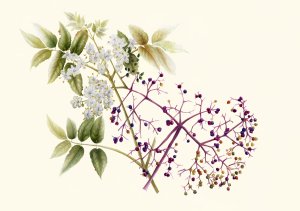
Berries for Nana's Jam, watercolor. © 2013 by Linda C. Miller. All rights reserved.

Berries for Nana’s Jam, watercolor. © 2013 by Linda C. Miller. All rights reserved.

Every year the Herb Society of America selects a plant of the year. This year the chosen plant is the elderberry bush. Williamsburg botanical artist, Linda Miller, painted this heirloom plant for the 2013 Mid-Atlantic Gathering program.

The elderberry plant is a native of North America. Its flowers and fruits may be used to create jams, syrups, pie and wine. Linda worked from a specimen at The Williamsburg Botanical Garden in Freedom Park.

This month Linda has two print-signing events. The first event will occur this weekend at The Gallery at York Hall on September 14 and 15 from 10 AM – 2 PM. The second signing will occur at The Williamsburg Botanical Garden during their Art in the Garden event and plant sale on Saturday, September 28 (8 AM – 2 PM).

You are invited to celebrate the 2013 Herb of the Year, to see Linda’s original painting and to learn more about botanical art.

Read Full Post »

What kind of data did Jennifer Landin collect in her studies about the use of perceptual drawing in the classroom?

I measured knowledge of biology with a pre- and post-test (kind of like a short final exam). I also asked students to take an Attitude-Toward-Biology test and my Observational Skills Assessment. I supplemented these tests with interviews, questionnaires and weekly observations of student behaviors.

All of the students had the same lecture class and same lab activities. So, as much as possible, all the experiences the students had in class were the same. The only difference was a “Journal” randomly assigned to each student. Some students had drawing activities to complete, others had writing tasks.

More About Our Conversation with Jennifer Landin

Read Full Post »

Jennifer Landin is a biology professor at North Carolina State University. She is also a scientific illustrator and a member of the Guild of Natural Science Illustrators (GNSI). She attended the University of Georgia and University of Montana for her undergraduate degree in Forestry & Wildlife Management. She received her Master’s degree in biology from Marshall University in West Virginia.

I first met Jennifer last year at the GNSI conference in Savannah, Georgia. It wasn’t until after the conference, when we were working on an article for the Guild’s journal, did I learn of Jennifer’s dissertation research about the use of perceptual drawing in the classroom. I have since read her dissertation and am excited that we have the opportunity to learn more about Jennifer’s research this month.

In her research, Jennifer addresses the use of drawing to improve observational skills and increase understanding in the biology classroom. To help you understand her project, here are her research questions as they appear in Landin (2011):

    1. Do students who participate in weekly drawing activities demonstrate a higher level of biology content knowledge when compared to students who participate in weekly writing activities?

    2. Do students who participate in weekly drawing activities show a more positive attitude toward biology when compared to students who participate in weekly writing activities?

    3. Do students who participate in weekly drawing activities display improved observational skills when compared to students who participate in weekly writing activities?

    4. What are student perceptions of drawing activities in relation to biological understanding?

    5. Are there correlations between the gains in content knowledge related to drawing activities and student cognitive processes?

Jennifer hypothesized that students who participated in weekly drawing activities would:

  • Demonstrate a higher level of biology content knowledge.
  • Demonstrate a more positive attitude toward biology.
  • Demonstrate a higher level of observational skills when compared to students who participated in weekly writing activities only.

Did the data support these hypotheses?

We’ll find out as this month progresses.

Please welcome Dr. Jennifer Landin as our special guest for September!


Literature Cited

Landin, Jennifer. 2011. Perceptual Drawing as a Learning Tool in a College Biology Laboratory. Dissertation. North Carolina University, Raleigh, North Carolina. 


Update October 2016

See Jennifer and her students at work in a video produced by North Carolina State University at https://youtu.be/MFuDDLqajVA.

Read Full Post »

« Newer Posts - Older Posts »