Feeds:
Posts
Comments

Archive for the ‘Special Articles & Interviews’ Category

Art for conservation is Deborah Ross’ passion.
Deborah Ross is one of America’s leading wildlife artists and working in Africa has always been one of her dreams. In 1987, she had the opportunity to live her dream working as an illustrator for a baboon project. Deborah says she loved being in Africa. So much so, that she bought a big car and stayed for nine months. Deborah has returned to Africa every year since.

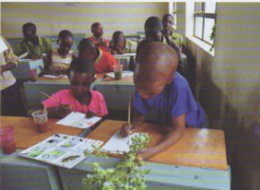
Adjacent to the baboon project where she worked, was the local elementary school. Wanting to give back to the community that has supported her and her work for many years, Deborah formed a painting club at the school. The objective of this club was not simply to offer afterschool activities. The “club” Deborah launched at Il Polei Elementary school was the Olcani Project. Through this project, Deborah taught the children how to paint and document local plants and animals. The painting club began with indoor activities, but soon moved outside of the classroom. With paint, brushes and paper in hand, students began to document the world around them. At first they documented each other, their families and stories about Maasai culture as told to them by their elders. Then they turned their attention to plants.

Photo courtesy of Deborah Ross.

Field trips into the bush to learn about local medicinal plants were led by herbalist, Siranga Naimando. While Siranga explained how each plant was used, students painted what they saw in the field. This collective effort is at the heart of the Olcani Project. In the Olcani booklet published about this project, Siranga explains that the Maa word for medicine is olcani, the same word used for plant.

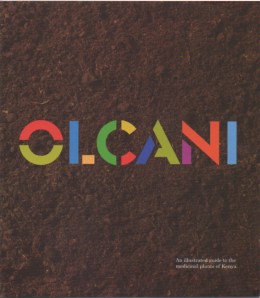
The Olcani Project is mostly a self-financed labor of love. Funds for the project come from what Deborah has earned illustrating a series of children’s books for UNICEF in Madagascar. A full-color booklet about the project has been produced by Deborah and designer Melanie McElduff. The booklet is an illustrated guide to 12 species of medicinal plants found in the Mukogodo region of Kenya. Each species description includes a color photograph, a plant’s scientific name, a plant’s Maasai name, a description about how it is used for medicinal purposes, and an area for users to write down notes. Included in this 26-page guide are 25 plant portraits painted by students, plus photographs of 18 Il Polei students proudly displaying a sample of their work. Funding for the printing of this beautiful guide came from Ideas That Matter, the grant program established by Sappi Fine Paper North America.

When she is not in Africa, Deborah keeps in touch with the students by cell phone. She trained a young local man to continue the watercolor workshops and Deborah says he is doing a fantastic job. Deborah sends paints and brushes to the school through a scientist working in Kenya and she sends books to Kenya with scientists five times per year.

Deborah will continue her work in the region next summer, this time in Madagascar. She has received a grant to lead watercolor workshops in this island country off the coast of Africa.

Visit Deborah’s website to learn more about her and to view a gallery of her work.

The Olcani Project will soon have its own website at www.olcani.com. The website will include features about each artist that will include samples of their work and a short bio. Watch for news about its official launch.

To request a copy of Olcani: An Illustrated Guide to the Medicinal Plants of Kenya, contact Deborah Ross. ($10, plus $5 shipping)


About the Mukogodo Region of Kenya

The Mukogodo region of Kenya has undergone rapid ecological and cultural degradation. A severe drought in 2009 all but eliminated the pastoralist community’s wealth (cattle and goats). The region’s indigenous knowledge is at risk of being lost as the region’s children face a different world than their parents knew. The need for conservation, conservation education and local empowerment in Kenya is extreme. The Mukogodo region is a focus point for the conservation work done by the African Conservation Fund.


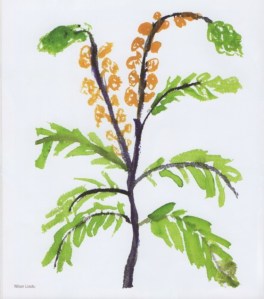
The Olcani Project’s illustrated field guide to medicinal plants blends botanical art with traditional field guide-style pages.

Osenetoi (Maa name), a remedy for malaria. Artist: Wilson Losotu

Field Guide Sample Page


Photos courtesy of Deborah Ross.

Read Full Post »

Hazel West-Sherring appreciates your questions and has replied to your questions and comments.

Thank you to readers who participate in the learning opportunities presented each month with featured guests. These opportunities exist so that you can ask our guests questions directly and so you can connect with each other. Remember that your participation is always welcome. Simply join in the conversation by using the comment box below.

I would like to thank Hazel for her thoughtful replies and wonderful instruction. Hazel has spoiled us with step-by-step instructions for painting stems.

Let’s get right to it!


Reader 1
: Hello Hazel. I have been unable to find courses in botanical art without having to travel thousands of miles and having to spend thousands of dollars. I am unclear where you live, but feel sure that the ASBA (American Society of Botanical Artists), would be able to locate classes locally, since their membership is widespread as well as international. Meeting like-minded people to paint with will save lots of money and is really enjoyable. I have all of the “how to” books on learning botanical art, but seem to have lost the passion or zest or desire to do anymore painting. And doing it on my own just isn’t any fun, at all. It has now been over a year since I have done any painting of any subject (in watercolours or graphite). I think that because there is no support, no teachers, no interest from anyone, that I have lost my interest also.

Hazel: You haven’t lost your interest fully or you wouldn’t be writing! I do agree that botanical art can become a rather lonely occupation. It is hugely helpful therefore to meet others, to view their work, and receive feedback on your own work too. Initially when I first became professional in botanical art, I met with a small group of other amateur and professional painters once a month, over a period of 2 years. We didn’t do much painting, but we inspired and encouraged each other, and discussed exhibitions.


Reader 1
: I hate to give this up because I have invested a small fortune in books, painting supplies, time and talent. I feel absolutely lost. How do I find some interest in this again, or some fellow botanical artists for mutual support? Is there anyone else who has given up?

Hazel: For me, when feeling uninspired to paint, gardening or a visit to a good plant nursery often helps. Visiting galleries and exhibitions is sometimes a welcome relief when feeling confused about direction. Looking through bulb or seed catalogues is inspiring, and (perhaps) allows planning for a series of paintings?!

Start simple with a subject whose colour, texture or shape you absolutely love, and want to ‘capture’…..an apple or pear, a pretty leaf, or perhaps a single flower stem. To bring some fun into your projects, challenge composition and the way that you crop the image, or concentrate on red flowers or just yellow.


Reader 1
: Any suggestions, please?

Hazel: Get those paints out and ‘play’ with colour! Form a wish list of favourite plants, fruits or vegetables, and have a go at drawing and painting what you are inspired to portray.


Reader 2
:
You mentioned opera rose as an unexpected underwash. What are some of your other favorite colors to use as an underwash. I need to get out of my blue or yellow underwash state of mind.

Hazel: Yellows and blues are always useful as single pigment underwashes! A wash of cerulean or cobalt blue is fantastic on deep green shiny leaves, and raw sienna or gamboges works well for more olive tones. If looking for a startling bright red, an underwash of transparent orange or winsor yellow works well, identifying the underlying tones of the final red.


Reader 3
: The Auricula Collection in your gallery has a peaceful antique look to it. Did you paint your specimens on colored paper or did you paint the background? Did you use gouache or transparent watercolor to paint the deep colors in this collection?

Hazel: The Auricula Collection was painted in watercolour on Arches hot-pressed paper. Depth of colour is built up with subsequent layers of colour wash (i.e not watery but full of pigment), or by using very dry brush and small ‘feathered’ strokes. This collection has no painted background, but occasionally I am asked to paint a weak tea-coloured background in order to promote an antique feel, as in the gooseberries and currants. This was achieved by mixing up a quantity of much diluted burnt umber, applied liberally with a very large sable brush. Once dry, it can be modified if there are areas that are too dark and need lifting.


Reader 4
: What are common mistakes students make when learning how to draw, shade, color, or paint stems? I am hoping you say something that will make me realize what I am doing to make not-so-graceful, not-quite-realistic stems.

Hazel: What a good question! I think that there is much fear in painting stems, with many people fearful of wiggly edges and a thickening of the stem in the wrong places. The plant’s posture and character rely on the stem structure. It will often determine your composition, so the drawing (with good observation of how the stem behaves), must capture this character. Where does it thicken, bend or curve? How do leaf junctions work? What is the cross section? Is there colour interchange or transition of green to magenta for example, as it nears a leaf junction, flower, or roots? What is the texture, and are there additional features such as hairs, prickles or thorns?

Shading is about applying necessary light and shade, to promote 3-dimensional qualities. In general terms, if you think of the stem as a geometric tube or cylinder, and applying the light source from top left for example, break the length of the cylinder into thirds. Tonally, the left light, the center medium and the right dark.

To paint:

  • Taking care to create clean edges, underwash with a light lime green or yellow wash, allow to dry. (This first wash determines the boundaries for the subsequent paint layers to flow within…..try not to paint outside these clean edges.)
  • Paint two-thirds (the centre and right-hand side) in a darker medium tone, allow to dry.
  • With a darker tone still, then paint down the right hand side giving the stem three tones. It will look striped, so carefully blend the edges working the paint from the darker tone into the lighter tone with a damp rounded or flat brush. Where you see possibility of a highlight, use a flat brush to take away a thin area of the first light wash.
  • Use a very dark shadowy tone on the extreme right-hand edge of the stem and up and under the leaf or flower.
  • Most stems will carry colour that will be found in the flower or fruit, often magenta. Carefully observe the texture, spots or flecks, and apply.
  • Finally, use a final dilute green wash to blend it all together!


Reader 5
: When you paint on colored ground, do you paint your subject in white to establish a footprint for your painting or do you paint directly over the colored paper?

Hazel: I don’t work with coloured grounds, although I adore the work done by Mrs. Delaney on her deep black painted ground. The idea of establishing a white footprint is ideal when working with gouache, and results are delightful. A weak watercolour tea wash is about my limit!


Readers, do you have any questions or comments?

Read Full Post »

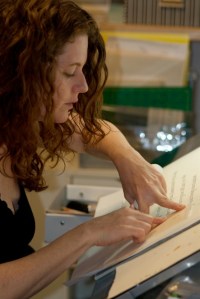
Kelly Houle at work in her studio.

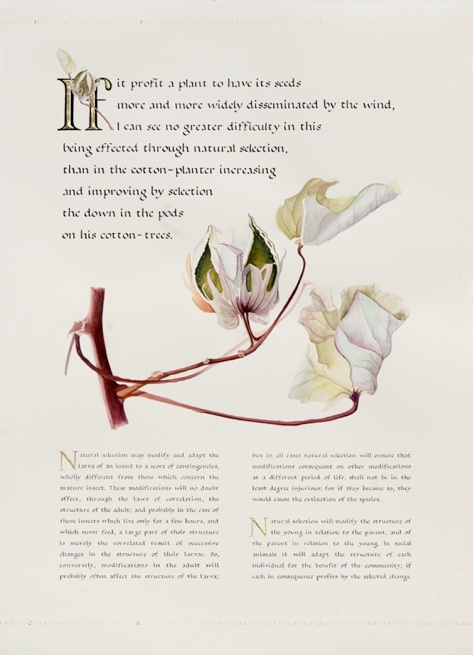
Natural history artist, calligrapher and science educator, Kelly Houle, is creating a large-scale illuminated manuscript based on Charles Darwin’s The Origin of Species. Each page will be designed as a work of art. All text will be written by hand and natural history illustrations will be illuminated with iridescent watercolors and 23-karat gold. The completed manuscript will be 22 x 30 inches and is expected to have 300 pages and over 500 illuminations.

Kelly has established working relationships with biologists and evolution experts from all over the world who will advise her during this project (see timeline). Kelly’s goal is to enhance public understanding of Darwin’s text. She explains:

I believe that the main barrier to understanding The Origin of Species is the perceived difficulty of the writing. The concepts themselves are simple, yet profound. I hope to improve understanding of The Origin by integrating poetic arrangements of Darwin’s words with visually striking presentations of the evidence. I will use elements of poetry, traditional realism, lettering art, graphic design, and fine art illustration in the service of communicating one of the most important ideas in science. 

Kelly has been raising funds on the funding website Kickstarter. Donors donating $10 or more will receive gifts of art related to The Illuminated Origin of Species. All donors will have their names written in a special section of the illuminated manuscript. In addition to individual donations, Kelly is looking for an institutional donor to fund the entire Illuminated Origin of Species project in exchange for the completed manuscript.

To read more about this project, watch a short video and to make a donation, visit the The Illuminated Origin of Species.


Related


Read Full Post »

Judging by the questions received from readers, there is a lot of interest in creating botanical note cards. This month’s group Q&A with the Birmingham Society of Botanical Artists (BSBA) focuses primarily on this topic. Today we’ll learn how BSBA members select an image for their cards, how they create a digital image of their artwork, how they create a layout for note cards and how they print their cards.

The conversation presented today is open to everyone, so please feel free to send in your comments or additional questions. Let’s keep the conversation going!

Thank you to readers who submitted questions. And many thanks to BSBA members who responded and to all BSBA members who are following this conversation ready to join in as the conversation develops.


Your Questions for the Birmingham Society of Botanical Artists
:

Read Full Post »

Don’t worry. You won’t get in trouble.

Personally, I write in the margins of many things. I write all over the research papers I read and in the books from my personal library too. Some books are so full of information (like Karin Nickelsen’s book about 18th-century botanical illustrations), notes are a necessity because they are the only way I can keep up with the author and relate new information to other things I’ve read. Writing in the margins is how I make meaning. What I do not do, is highlight and underline pages and pages of text. Highlighting and excessive underlining never worked for me. While studying teaching and learning techniques and student learning in grad school, I read a comment by someone making the point that the act of highlighting text is simply proclaiming, I’ll get to this later. Now isn’t that the truth? I apologize for not being able to give credit to this individual.

What about doodling? Do you create doodles to help you process information in the text?

Then you might be interested in an exhibition at the University of North Carolina exploring why images are paired with text and how information is conveyed through pictures. The exhibition, Meaningful Marks: Image and Text and the History of the Book, is on view at the Melba Remig Saltarelli Exhibit Room in the Wilson Special Collection Library until September 28, 2011. One of the books featured in the exhibit is Mark Catesby’s Natural History of Carolina, Florida and the Bahama Islands (1731-1743).

Getting back to scribbling in book margins…

Do you find this practice offensive or are you okay with people who do this? Here is a link to a short video featuring interviews with people on both sides of this issue. This video was created by multimedia journalist, Jonathan Michaels, and takes a look at why we write in books.


Related
:


This post marks the beginning of a new feature about books and literature pertaining to plants, nature, natural history art and related topics.


Read Full Post »

After raising her children, textile designer, teacher and caterer, Helen Allen, enrolled in the diploma course taught by Anne-Marie Evans in 1996. In 2003, she began to assist Anne-Marie Evans on the diploma course and in 2005, succeeded Anne-Marie as Course Director. Today this 17-year old program is taught by Helen and four other teachers — a botanist from Kew, a botanical illustrator from Kew, and two painting tutors who are also botanical painters. Former students and graduates have earned medals from the Royal Horticultural Society, have artwork included in the Highgrove Florilegium, in Curtis’s Botanical Magazine, and are represented in many public and private collections.

While Helen was studying at the English Gardening School, she also worked as a medical researcher. It was during this time she learned that research has to be meticulous and rigorous and this has benefited her approach to botanical painting. During her teaching career, Helen was a an Advisory Teacher in London and was responsible for the teaching of textiles and related crafts in London’s primary schools.

Helen has always loved painting, plants and teaching and at the English Gardening School with Anne-Marie, these three things have come together in a neat package. Helen believes she has been incredibly privileged to have learned from the best and to have taught students who are amazingly talented.

Helen’s own work has been featured in the Highgrove Florilegium twice. Her paintings can also be found at The Hunt Institute for Botanical Documentation, the Chelsea Physic Garden Archive, the Hampton Court Palace Florilegium Archive and the Royal Botanic Gardens, Kew Archive and Collection, as well as many private collections.

Please welcome our Feature Artist for September, Helen Allen!


ArtPlantae
: Helen, thank you so much for introducing me to your work. Teaching at the English Gardening School and at your own studio keeps keeps you very, very busy! I wanted to begin by asking about the successful program created by Anne-Marie. The program is comprised of three ten-week terms and several projects along the way. Many of us reading this interview have experienced the 5-day version of this 30-week program, having had the opportunity to learn from Anne-Marie herself. Did this program begin as a three-term program? How has it evolved over the years?

Helen Allen: Anne-Marie’s short courses are legendary and beautifully constructed and tailored to get the best results from participants. The short courses are not taught in the same way as our one-year diploma course nor should they be viewed as a shortened version. However, the short course format follows the same 5-step program following the drawing and painting of a chosen flower to it’s final conclusion. It is marvelous to see just how well students, with little or no experience, do in such a short space of time.The diploma program came after the initial short courses and grew out of those. The course began as a certificated program and then became a diploma program in 1996 or thereabouts. The course was designed along traditional methods of art teaching that require much practice. Techniques are learned through exercises that are then applied to plant material. The exercises are building blocks, if you like, and form the secure foundation on which to build towards adding the fine detail.

Over the years I have re-ordered these building blocks in a more logical way and updated materials and tasks. With my teachers, I review and amend program content every year and sometimes during the year if necessary. Student’s work and projects are also monitored on a regular basis; some is self- and group-critiqued and some reviewed by teachers.

Currently class notes and supporting material and images are available to our diploma students by email. We hope to use technology more in the classroom in the future.


AP
: What is your teaching philosophy?

HA: I love what I do and want to share this with others. I want my students to learn the excitement of LOOKING at plants and really SEEING, in detail, important diagnostic features. It is only then that the student KNOWS what to investigate, highlight and show in the finished piece of work. It is imperative to OBSERVE and RECORD meaningfully and accurately through careful DRAWING. A good drawing stands a good chance of becoming a good painting. A bad drawing has NO chance at all.

COMPOSITION is the setting for the PAINTING and where BOTANY and DRAWING meet on the page. PAINTING requires hours of PRACTICE and is the ultimate PRIZE.

These are the ingredients which, blended together with care, build CONFIDENCE and INDEPENDENCE.

Learning botanical painting is rather like learning how to make a souffle. There will be mistakes and loss of confidence along the way but if the souffle collapses we have to rescue it and in doing so we learn not to make the same mistake again. This is how we learn to be CONFIDENT.


AP
: A number of the program’s students have gone on to make significant contributions to botanical art by way of their participation in florilegia and the inclusion of their work in public collections. Why do you think this is so?

HA: It has become very fashionable for great gardens and collections of plants to be painted for posterity. It is another method of conservation, of preserving plants that may in time become extinct. Artists paint together, and with botanists, make the collections not just scientifically correct but aesthetically pleasing. What a wonderful way to paint. We have always taught in an historical context. This is important, not just to KNOW why we do it but to appreciate the discoveries and developments in science, art and materials over the centuries. It is useful also to know how travel, wars and social history influenced art and the teaching of art. We aim to make students aware of what has gone before and the debt we owe the great artists and botanical artists and illustrators, both historic and contemporary. If we can even begin to scratch the surface of what they did with anything like their dedication and finesse, then we leave a legacy too. I believe our graduates are inspired, have a sense of purpose and are ambitious, not necessarily for themselves, but to leave their legacy for others to see in the future.


AP
: The diploma course will begin its 18th year in January. Have you or the English Gardening School considered adding botanical art classes to the school’s schedule of distance learning courses?

HA: We already have a hugely successful and internationally renown Garden Design distance learning course, however I approach learning botanical painting, at a distance, with some skepticism. Technology is a wonderful aid but by the time the painted image has been photographed, saved to CD or hard drive and viewed by several people on as many monitors, the truth is lost. If printed, then we are seriously compromised. Learning in isolation is not helpful. In the classroom original work is seen by tutors and simply watching the way in which a student applies paint can prompt constructive criticism and help. Knowing the students, their approach to their work, their fears and woes, is helpful to their technical and self-development. There is always more than one way to teach and learn a single skill. We need to find the right way for each student and help them individually to attain goals. So many invaluable tips and asides are absorbed in the classroom as well as intelligent critique. I believe that many of these experiences are not available at a distance.


AP
: Many people people learn botanical art by picking up a one-day class here and a three-day class there. Often these learning opportunities are separated by several months. Embarking on a serious, structured, long-term study of botanical art is a dream for many and has its obvious benefits. However, even students in established programs can fall behind with their homework. Drawing upon your observations of how students learn botanical art, what is the most effective way students of botanical art can stay on track with their studies?

HA: Firstly, they must be serious in their endeavours and understand that perfection only comes through hard labour. Every stage of the course takes many hours of work. For example, drawing parallel lines would seem a childish pursuit to the uninitiated. However this is how stems are constructed and we all need to be able to observe the nature of the stem and to describe it in pencil, paint or ink with confidence. Whatever the technique, there is no quick-fix solution and they must KEEP UP with and finish the homework set each week.

When homework (assignments) are set, students are advised that they can go home and do the set work OR they can practice it over and over again and then do their homework. They also understand that some tasks take longer than others to perform to an acceptable standard, and individuals learn these techniques at different rates. They learn to critique constructively, ask relevant questions and have their own work critiqued by looking at each others work each week. It is surprising how much one learns this way. If work is not shown, it is impossible for student and teacher to have a meaningful dialogue.

Reading around the botany, visiting art galleries and museums and being aware of our surroundings all influence the way we work and are helpful in the development of our work and skills.


AP
: How should students new to botanical art think about paint? (Six colors or as many as your heart desires? Tubes or pans? Palette arrangement, etc.)

HA: AAH! Now here is a most controversial subject. There are as many colour theories as there are hues and all have their good points. It is always interesting to hear the views of other painters. As far as I am concerned, there is no right or wrong paintbox and I will never say NEVER to a student ALTHOUGH I may advise caution. I like both tubes and pans, tubes go further and are easier to mix with water and each other, they are also kinder to paint brushes. But I prefer pans when working on vellum and particularly my old W&N (Winsor & Newton) paints.

I advise a limited palette containing 2 yellows, blues and reds, a magenta, violet, indigo, pthalo green and burnt umber. Other hues are added later on where necessary. Students make paint charts for their boxes, do many paint mixing exercises and quickly become familiar with paints and their properties. These repetitive exercises help students practice and improve their painting skills, whilst providing them with a superb dictionary of colours.

I like the colour bias wheel and descriptions of hues as green blues, orange yellows, violet reds, etc. It is then easy to understand and actually see the relative proportions of primary colours in the botanical subject, to analyse the hues in the paint box and mix accordingly. This is a very simplistic explanation but works well for me.

We advise our students to start with a limited palette to which they add over the year and prefer students to use single pigment paints as when learning and mixing there is less chance of making mud every single time. They will then have a clearer idea of how these colours mix. With just six colours it is possible to make almost any but the very cleanest and brightest of colours. More importantly it is very much easier to mix each colour with the other 5 in turn to see the vast range of colours that are possible. All students begin with the same make and range of colours, rich pigments with sufficient filler to make them easy to mix and to use in washes, and the same white paper so that there is some standardization.

As with all things, the more one works with paints and practices the various techniques required, the more one is able to make choices based on experience. Arranging the paintbox is a personal choice. I arrange mine in RAINBOW order but starting with a green yellow, through reds to violets and onto blues. All other colours come after (this). I now have a red through violets and purples box, a green box, a larger box for yellows and blues, and a box of earths, greys, white and any other stray colours. I also have paint boxes that are restricted to paints made by single manufacturers.

One could pontificate forever. As with technique, one manufacturer of paint or theory does not suit everybody.


AP
: Are there noticeable stylistic differences between the botanical art produced in Europe, Asia, Australia and the US? If so, how does the botanical art differ by region?

HA: I think there are. Styles are influenced by culture, education and training. Very often it is the botanical material and placement on the page that gives the game away. I envy the technical ability of many of the Japanese artists, the drawing skills of the Australians and the colour work of the South Africans. American botanical painting is a fusion of many styles in a variety of media and therefore more enigmatic. With huge climatic variation and geographical differences, plant life is also hugely varied. European style is very traditional in it’s approach, but overall remains more true to the traditions and rules of yesteryear whilst continually pushing the boundaries.

I think we are all in danger of missing the point of botanical art, whether it be illustration or painting and maybe even confusing the boundaries between botanical art and the more decorative art of flower painting. It doesn’t matter how good we are in manipulating the tools of our trade or how deep our knowledge of colour theory if we lose sight of why we do it. As botanical painters, what we all need to work towards is the faithful rendition of plants in a three dimensional way whilst capturing the beauty and drama of the subject with subtlety and finesse.

To be more specific will take too long.


AP
: Does technology have a place in the creation of botanical art or should this classic art form remain untouched by technology?

HA: I have touched on my concerns about technology in an earlier section. I greatly admire Niki Simpson’s work and am very interested in where it will lead. I believe we need to be receptive to change in materials and technology and see where it leads us, but without losing sight of why we paint botanical. But I think also that a sound classical art training develops hand-eye coordination, develops the mind and the achievement of particular manipulative skills in a way that simply using technology to achieve something similar cannot. However, I do not wish to undermine or denigrate the work of those with technological skills which I neither have nor understand!

I shall be in Boston and look forward to seeing old friends and making new.


Ask The Artist with Helen Allen

Helen welcomes your questions about her work and botanical art. Please post your question(s) below in the comment box. Helen will respond when she is able. Thank you.


You May Also Enjoy
:

Welcome to Ask The Artist with Anna Knights. Unlike past sessions in which readers submitted questions to visiting artists, this time readers mostly shared their experiences and thoughts about distance learning programs in botanical art.

One reader asked Anna about how she enlarges her painting subjects. We will begin with this question and then jump into the topic of distance learning.

Sincere thanks to the readers who so openly shared their thoughts about learning botanical art outside of the classroom. This conversation would not be possible without your thoughtful comments.

Thank you to Anna Knights for sharing her work with us this month and for participating in the dialogue below.

Learn more about Anna in this interview from earlier this month. Also, be sure to visit Anna’s Facebook page to see Anna at work at a recent event.


A reader asks Anna…

    Most botanical artists’ work is true to actual size. Is yours done larger to achieve such magnificent detail? And if so, how do you so accurately enlarge it?

    AK: I like to enlarge to capture that magnificent detail but also to give the work much more impact than traditional life-sized work. I scale up using just a ruler and calculator. I work out the scale I’m enlarging to and then take a few measurements of key reference points in the composition and then freehand draw from there. This is made a lot easier when scaling up from photographs – which I make extensive use of.


Readers’ thoughts about distance learning options in botanical art…

    Reader #1

    I have had mixed results from distance learning courses. (In) my first attempt, I found the feedback to be inadequate and I kept getting graded down for stupid things like size of paper and other things that normally would have been inconsequential. It really shook my confidence and I can’t say that I learned any more than I might have just using the course book, which is not very detailed and sometimes confusing. There is no flexibility for lesson deadlines, which sometimes makes it difficult for those of us with other responsibilities. It (was) also a VERY expensive course. You pay the full amount (over $3000) in advance, and you don’t get any of your money back if you drop out.

    My second and ongoing experience has been completely different and truly wonderful. It is with the Academy of Botanical Art in Sarasota, FL. The instructors there understand that we are at all different levels and that we each have strong and weak areas. They are nurturing and confidence building and meet each student where they are rather than trying to force us all into one mold. The lesson materials for each class are very detailed and complete. Everything is spelled out and there is no need to try and guess what the instructor wants. It is also on a pay-as-you-go basis rather than having to pay the full amount up front. It is a much more personalized and less regimented program. It keeps me motivated to paint and learn rather than dreading the next assignment.

    I think that people should be able to research different possibilities before they sign up and commit big bucks toward an experience that may not meet their needs.


    Reader #2

    In answer to your questions about the distance-ed courses :

    I have taken one dist. ed. course and found that I was encouraged to keep working on the art while I learned. One my own, I have the tendency to drift to other things and don’t keep to a schedule.

    I would like to have a dist. ed. course so that I have a mentor who gives critiques, a schedule, a group of fellow students that I might be able to confer with, so basically I guess I need someone to give me a push and keep me interested.

    As to what type of format I would find ideal, I have to admit that I don’t know what this means. Presumably it means that I would like to have my work followed on-line. I have all of the botanical art books but need more confidence and someone to give me guidance. I would appreciate other students being able to contact me and vice versa for more support.


    Reader #3

    Sounds like a great idea, it will be an alternative to students, who for any number of reasons, cannot use the classroom style of learning. I live in Australia, and I have been using the distance learning system in the past, and also now, I am doing an art subject in Fine Arts, at the Open Universities Australia. I am enjoying the study but it is also very challenging. I am an emerging artist and I may be interested in the botanical course. How much does it cost?


    Reader #4

    I would be very interested in taking the Distance Learning Course in Botanical Illustration, with these provisos:

    Payment for the course should be in installments clearly pre-defined. Total payment up front does not generate confidence in prospective students for distance learning, sorry. The instructor should list his/her curriculum so distance students would know what to expect.

    A basic list of art materials should be given before enrollment, so that prospective students know what art materials are needed and can estimate cost. Good materials are expensive. Paper, paints and brushes represent an investment that all watercolor artists should have.

    Under these conditions I would be very interested in taking the course. I also think that the instructor(s) should tell us how they will conduct the course, that is how they will grade the lessons after they are mailed in. Will they make corrections or make suggestions on tracing paper over the sent-in lessons?

    I am a retired businessman from California, now living in Arizona. I am a self-taught amateur artist who loves botanical illustration, though I have never taken any live lessons, only from books.

    The instructor(s) have to make a commitment to the course, so I understand that they will require a certain number of students; I hope you get them. Also, after some time, will you stimulate students to exchange ideas and make this exchange possible?


    Reader #5

    I assume these are like the classroom classes with the regular demonstrations and how to do things plus an equipment list? I think it would be interesting to do this as I have never done it via computer.


    Reader #6

    I’d be very interested in a formal distance-learning program for botanical art/natural history illustration. Workshops and short courses offered by individual artists are also a good training option.

    The type of formal program I would be most interested in would be a certificate program and be offered by an accredited institution of some kind, whether a botanical garden, an extension division of a university, etc. It would be most practical to have the majority of the coursework handled online, with concentrated residency periods punctuating the course, say 1-2 weeks at the start, middle and end of the program. Certainly a 1-2 week workshop in residence midway would be needed.

    I was rather disappointed to read the details of the Denver Botanical Gardens’ distance program. That course would have required distance students to go to Denver nearly every weekend over the learning period–simply not practical for most people living outside of Colorado.

    For distance training offered by individual artists, I’d prefer a workshop of 1-2 weeks. This would allow a concentrated period to really make some progress. Weekend workshops would be excellent for a student who lives nearby. Certificates aren’t necessary for this type of course option.


    Reader #7

    Yes, I would take a distance learning class. I have taken many. Some use Nicenet, some used Dashboard, others used email. If you teach one online, I would attend.


    Reader #8

    I would like to know how distance educators feel about the progress of technology and the ability to enhance an art-based course by using either a Group Facebook page where photos of subjects can be discussed, video demonstrations can be posted, ideas exchanged or via email where attachments can show problem areas and be addressed more accurately. Botanical art has a chance to really shine in this format but it seems many distance educators are not as comfortable with email and Internet as their students are.


    Reader #9

    I would love to take a distance learning course but for real beginners…Even more with Anna.

    I don’t know if we can really learn by distance without, once in a while, (being) in real contact with the teacher. I am wondering if it could be a good idea to meet students first for at least ”2 weeks in a row” (why not during the summer? a great way to learn in a nice country and visit in the same time).

    I strongly believe that we should first get some basic knowledge with teacher and then start the distance program. The problems are: the distance and the cost. I guess we all want to get in a program like this because we would not have to travel. It saves time and money.

    All students don’t have the same goals. Some would like to paint for pleasure and some may think about a career. Some have already knowledge in painting, some don’t. So how (to) create a program for everyone? Maybe separated modules, or sessions. Like: drawing no1- watercolors 1- 2 etc. So everyone would be able to get into a course at their levels..Probably more work for the teacher.

    For myself, I am really interested to get in a program, well-structured with an ”available” teacher. The program, I would love, would be one where I can learn (from) the beginning. Learn how to sketch, learn about pigments in watercolors to be able to mix colors properly, etc. Project painting can be done after.

    Contact with students may be done by emails. Pictures of the works sent also by email and, further in the program, works may be sent by post. Internet is a great way to communicate, it is fast and ”free”.

    Voilà! I hope my English writing is OK. I am a French Canadian. Could add more but writing in English for me is work!

    Looking to hear from you. I am in love with your work and would be honored to be one of (your) distance students.


    Reader #10

    I most definitely would take an online botanical art class!


Anna’s reply to comments about distance learning
:

Thanks to everyone for your comments about the online course. They were really sensible and in line with my own thoughts about it. Having thought about it a bit more, what I am really proposing is to create a private online social network – along Facebook lines for those enrolled on the course. It would mean that students could also share work with each other as well as with me and interact as a group. Crucially my teaching style is all about instilling confidence and to that end is supportive and relaxed – so no harsh grading or anything like that – just constructive feedback to help students develop their own style and way of painting.

I would probably run it as a series of structured step-by-step exercises which people could pay per exercise or series of exercises – therefore allowing each student to tailor their learning and address the issues of different students having very different objectives. Then in terms of the content – I’d use video clips mainly to demo what I’m doing – along with stage-by-stage photographs – very much along the lines of the description by Reader 8. The whole course would be delivered online, so I would ask students to scan or photograph their work and email it. There may be some limitations to this but actually with the macro function on everyone’s digital camera it is perfectly possible for me to see close up the brush work, etc. I think there are huge possibilities for this and I plan to start work on the content to make sure I have a really comprehensive offering.

Thanks again for sharing your thoughts about it. If you’d like to sign up for my newsletter and be the first to know when I launch the online course you can do so via my Facebook page at http://www.facebook.com/AnnaKnightsArtist or the contact page of my website at www.annaknights.co.uk.

Read Full Post »

« Newer Posts - Older Posts »