Feeds:
Posts
Comments

Archive for the ‘nature’ Category

Now at Classes Near You > Massachusetts!


Massachusetts College of Art and Design

massart.edu
Professor Saúl Nava teaches the life sciences and biology at the Massachusetts College of Art and Design (MassArt). He also teaches summer programs about art and biology. One program is called Field BIO+ART: Collaborative R.N.A. (Research in Nature and Art). The other program is about natural history and biological art and is an introduction to visualizing plants, animals and natural forms. This second class begins soon. Sign-up today!

    Natural History and Biological Art
    Monday-Wednesday, July 8 – July 31
    9:30- 1:00 PM

    This course provides an introduction to visualizing and exploring the diversity of wildlife, habitats, and biological forms of plants and animals through art and direct observation in the field. Through careful examination, illustration, microscopy, and photography, participants will study and visualize anatomical, behavioral, and ecological similarities and differences between species. Participants will use various media but will focus on classical observation and drawing/painting techniques in the field. This course involves travel to various locales, field sites and The Harvard Museum of Natural History. View the blog from the 2012 course at http://naturalhistorybiologicalillustration.blogspot.com.
    View Details/Register

Read Full Post »

Years ago when I was teaching in grad school, the SimLife game was used as an activity in the Bio 101 labs to teach non-majors about population biology. Students had control of an assortment of variables and could watch generations of their sample population change over time. Students enjoyed the exercise and it helped them understand how the traits they assigned to their sample population resulted in either their population’s survival or eventual demise.

One of the objectives of incorporating botanical drawing into studies about the environment is to use it as a way to tell Nature’s story. Botany’s story is more than complicated terminology, labels with arrows and expensive textbooks.
In today’s column, we move beyond look-see-draw and engage in a bit of storytelling.


Botanical Illustration in the Lab

How does botanical illustration fit into a lab about population biology?

How about as a game?

Educators Erik Lehnhoff, Walt Woolbaugh and Lisa Rew explain how to do this in Designing the Perfect Plant: Activities to Investigate Plant Ecology.

What Lehnhoff et al. (2008) do first is lead students in a conversation about plant ecology. They show students photographs of whole plants, leaves, seeds, growing situations and other imagery related to plant ecology (Lehnhoff et al., 2008). They then ask students to consider the advantages and disadvantages of the growth forms, growing conditions and plant traits observed in the photographs.

Student observations become the foundation of a class conversation about plant ecology. With this conversation fresh on students’ minds, Lehnhoff et al. (2008) call upon students to design a plant with traits they think will ensure their plant’s long-term survival. Instead of creating a plant using a computer program, students are asked to draw their plant and to include in their drawing every trait they assigned to their plant. The authors ask students for a detailed drawing because they have observed that the “act of drawing the plant characteristics allowed students to better comprehend each of them, and to recognize how the plant may fit into its environment.” (Lehnhoff et al., 2008).

With their plants drawn, students then engage in a competitive game of cards. The game they play enables them to live with their plants through 10 generations. The custom deck of cards they play with contains four categories of cards. These categories are Weather, Dispersal Mechanisms, Disturbance Factors and Predation/Disease. Each card drawn exposes the carefully designed plants to conditions that could impact their survival. The cards in this custom deck each have a point value. Plants with the highest points per generation survive. Plants receiving negative points in repeated generations spiral towards extinction. After living through ten generations with their plants, students are asked to write about their plant’s fate.

This clever activity provides a way to introduce botanical illustration as a tool to learn about broad ecological concepts and to move it beyond its use as a tool to learn plant morphology. Included in this paper by Lehnhoff et al. (2008) are examples of the playing cards they use in their game.

Designing the Perfect Plant is available for purchase from the National Science Teachers Association (NSTA) at the NSTA Science Store (99¢). You can also search for this article at your local college library.


Literature Cited

Lehnhoff, Erik and Walt Woolbaugh, Lisa Rew. 2008. Designing the perfect plant: Activities to investigate plant ecology. Science Scope. 32(3): 29-35.


Related

Read Full Post »
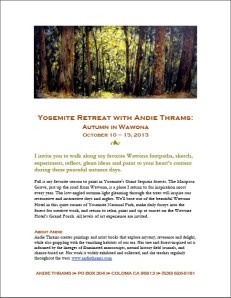
Click to download itinerary.

Click to download itinerary.

Plan now for a peaceful, creative and rejuvenating Autumn!

You are invited to join Andie Thrams in Yosemite National Park to learn how to capture the sounds, scents and landscape of this special place in your sketchbook.

Here is the latest at
Classes Near You > No. California:


Andie Thrams

www.andiethrams.com
Andie is a painter and book artist devoted to creative work in wild places. She teaches in California, Oregon, Alaska and Hawaii. Her work is widely exhibited and honored, and is held in many private and public collections. Get the latest news about Andie’s popular classes on her website.

    Autumn in Wawona with Andie Thrams
    Yosemite National Park
    October 10 – 13, 2013
    Upon arriving at Yosemite, meet with Andie and fellow classmates on the Grand Porch at the Wawona Hotel to enjoy an evening of sunset painting. Then get ready for daily walks through meadows and forests to learn how to make marks, create images and capture colors using watercolor, gouache, ink and pencil. Cost: $440 for the retreat, includes boxed lunches. Not included in the course fee are: lodging, transportation, food & drink (except lunch). Download itinerary


    Private Creativity Coaching & Artist Mentoring

    In addition to the workshops listed here, Andie also works privately with a limited number of students. Contact Andie Thrams

Read Full Post »

In desperate need for some time away from the daily grind?

Check out this weekend retreat now at Classes Near You > Texas:


Cynthia Padilla, Dallas

http://fruitflowerinsect.blogspot.com
Cynthia Padilla teaches painting and drawing classes at prestigious universities, major museums, arboreta, art societies across the US, Canada, Central America and internationally. She curates exhibitions, serves as a juror of exhibitions, lectures and conducts demonstrations, and leads painting retreats worldwide. Cynthia is also the founder of the Botanical Art & Naturalist Illustration group on Yahoo!

    Art and Nature Retreat at the Black Land Prairie in Ana, Texas
    This two-day weekend retreat will be held June 7-9, 2013. The course fee includes instruction, two nights lodging, two continental breakfasts, two dinners and other activities. Sketchbooks will be shared at the end of each day over cookies and cocoa. What more could you ask for!

    If you are in need of rest and relaxation or have been curious about artist retreats, sign-up for this rejuvenating weekend getaway.

    For more information, visit Art & Nature Retreat: The Black Land Prairie on Facebook.

Read Full Post »

Regardless of where you live, you can learn how to create an expressive journal for summer with mixed-media artist, Jane LaFazio.

See what’s new at Classes Near You > Southern California:


Jane LaFazio

janeville.blogspot.com
Jane is a mixed media artist and a member of the San Diego Sketchcrawl group. Jane teaches at conferences across the U.S. and leads classes in Italy and Greece too. In addition to sketching classes, Jane teaches workshops in collage, mixed media, and quilting. There are always many, many opportunities to learn from Jane in-person. Below is a short list of classes that may be of interest to you. To view all of Jane’s upcoming classes, see her teaching schedule online.

Also see this interview with Jane and her Ask The Artist Q&A with readers.


Sketching & Watercolor: Journal Style

Six-week online class.
Learn how to record your life, your summer vacation and other adventures using a loose and quick style of journaling. Participants in this online class will learn a new technique or subject each week and will receive links to supporting material. Communicate with fellow participants and see each others’ projects progress. Designed for beginners. Cost: $85. Online classroom open June 16.
View Details/Register.


Sketching and Watercolor in a Mixed Media Journal

Six-week online class.
Learn to draw from life using Jane’s quick approach to drawing. Take your art journaling to a whole new level! Cost: $90. Online classroom open June 16.
View Details/Register


Learn from Jane In-person
:

  • Lavender Sage Art Retreat with Pamela Underwood – June 10-14, 2013. Mixed media retreat in Taos, New Mexico. View Details/Register
  • Walking and Watercolor in Italy – October 7-13, 2013
  • ArtWalk: San Diego – January 13-19, 2014
  • ArtWalk: Italy – May 24-30, 2014
  • ArtWalk: The French Riviera – June 1-7, 2014

Read Full Post »

Click to view poster.

Click to view poster.

Annual Wildflower & Art Festival
Idyllwild Nature Center
Idyllwild, CA
May 25-27, 2013
9 AM – 4 PM

Visit the Idyllwild Nature Center in the mountain community of Idyllwild this Memorial Day weekend to learn about local wildflowers and native plants. This fun-filled weekend also includes guided nature walks, an art exhibition, and activities for the entire family.

Weekend visitors to Idyllwild also have the opportunity to start a personalized guide to plants at ArtPlantae.

Learn more below!


Free Workshops with Purchase of Sketchbook at ArtPlantae

Create your own personalized guide to plants! Purchase a sketchbook at ArtPlantae during the Annual Wildflower Show and Art Festival at the Idyllwild Nature Center (May 25-27, 2013) and attend any of the sessions below for free during the Memorial Day weekend. Limit 10 people per session.
Cost: $9.95 per person

Participants may repeat a session if space is available. Priority goes to first-time attendees. Waiting lists will be established if necessary. Please register early. Sessions will begin promptly at their scheduled start times.


Let’s Explore Plants
Memorial Day Schedule

    Saturday, May 25
    9:30 – 10:30 – What makes a stem a stem?
    11:00 – 12:00 – What makes leaves, leaves?
    12:00 – 1:00 – Lunch Break
    1:00 – 2:00 – What makes flowers, flowers?
    2:30 – 3:30 – What makes fruit, fruit?


    Sunday, May 26

    9:30 – 10:30 – What makes fruit, fruit?
    11:00 – 12:00 – What makes a stem a stem?
    12:00 – 1:00 – Lunch Break
    1:00 – 2:00 – What makes leaves, leaves?
    2:30 – 3:30 – What makes flowers, flowers?


    Monday, May 27

    9:30 – 10:30 – What makes flowers, flowers?
    11:00 – 12:00 – What makes fruit, fruit?
    12:00 – 1:00 – Lunch Break
    1:00 – 2:00 – What makes a stem a stem?
    2:30 – 3:30 – What makes leaves, leaves?

cre8time_ProudToSupport_image

Read Full Post »

In 1871 Marianne North, a forty-year old woman from a wealthy Victorian family, embarked on an adventure to paint the plants of the world. Even by today’s standards, North’s travels are an amazing accomplishment. You might think Marianne North is a one-of-a-kind wonder, however she shares the title of brave pioneering female naturalist with women such as Maria Sibylla Merian (1647-1717) who was one of the first to describe metamorphosis, and Jeanne Baret (1740-1807) who was the first woman to circumnavigate the globe and the herb woman whose expertise as a field botanist made her an invaluable asset to botanist Philibert Commerson during the Bougainville expedition (1765-1768).

Through her paintings, Marianne North made several contributions to the field of botany. This month we have the unique opportunity to learn more about Marianne North from Katie Zimmerman, a PhD candidate at the University of Cambridge whose research is dedicated to the work of this fearless naturalist and artist.

Please welcome Katie Zimmerman, the Featured Scholar for May!


About Katie Zimmerman

Katie is a PhD candidate at the University of Cambridge and an instructor at the University of Washington where she teaches courses in the history of science. She is broadly interested in the relationship between art and science, the geography of knowledge, and Victorian natural history. Before taking up her dissertation on Marianne North, Katie taught high school and university courses in Warsaw, Poland, worked at the National Museum of American History in Washington, DC, and earned her MA in the history of science at Oregon State. Katie lives in Seattle, WA with her husband, two children, and a dog named Huxley – all of whom greatly admire and appreciate the botanical wonderland produced by that rainy state.

Read Full Post »

« Newer Posts - Older Posts »