Feeds:
Posts
Comments

Archive for the ‘Education’ Category

After raising her children, textile designer, teacher and caterer, Helen Allen, enrolled in the diploma course taught by Anne-Marie Evans in 1996. In 2003, she began to assist Anne-Marie Evans on the diploma course and in 2005, succeeded Anne-Marie as Course Director. Today this 17-year old program is taught by Helen and four other teachers — a botanist from Kew, a botanical illustrator from Kew, and two painting tutors who are also botanical painters. Former students and graduates have earned medals from the Royal Horticultural Society, have artwork included in the Highgrove Florilegium, in Curtis’s Botanical Magazine, and are represented in many public and private collections.

While Helen was studying at the English Gardening School, she also worked as a medical researcher. It was during this time she learned that research has to be meticulous and rigorous and this has benefited her approach to botanical painting. During her teaching career, Helen was a an Advisory Teacher in London and was responsible for the teaching of textiles and related crafts in London’s primary schools.

Helen has always loved painting, plants and teaching and at the English Gardening School with Anne-Marie, these three things have come together in a neat package. Helen believes she has been incredibly privileged to have learned from the best and to have taught students who are amazingly talented.

Helen’s own work has been featured in the Highgrove Florilegium twice. Her paintings can also be found at The Hunt Institute for Botanical Documentation, the Chelsea Physic Garden Archive, the Hampton Court Palace Florilegium Archive and the Royal Botanic Gardens, Kew Archive and Collection, as well as many private collections.

Please welcome our Feature Artist for September, Helen Allen!


ArtPlantae
: Helen, thank you so much for introducing me to your work. Teaching at the English Gardening School and at your own studio keeps keeps you very, very busy! I wanted to begin by asking about the successful program created by Anne-Marie. The program is comprised of three ten-week terms and several projects along the way. Many of us reading this interview have experienced the 5-day version of this 30-week program, having had the opportunity to learn from Anne-Marie herself. Did this program begin as a three-term program? How has it evolved over the years?

Helen Allen: Anne-Marie’s short courses are legendary and beautifully constructed and tailored to get the best results from participants. The short courses are not taught in the same way as our one-year diploma course nor should they be viewed as a shortened version. However, the short course format follows the same 5-step program following the drawing and painting of a chosen flower to it’s final conclusion. It is marvelous to see just how well students, with little or no experience, do in such a short space of time.The diploma program came after the initial short courses and grew out of those. The course began as a certificated program and then became a diploma program in 1996 or thereabouts. The course was designed along traditional methods of art teaching that require much practice. Techniques are learned through exercises that are then applied to plant material. The exercises are building blocks, if you like, and form the secure foundation on which to build towards adding the fine detail.

Over the years I have re-ordered these building blocks in a more logical way and updated materials and tasks. With my teachers, I review and amend program content every year and sometimes during the year if necessary. Student’s work and projects are also monitored on a regular basis; some is self- and group-critiqued and some reviewed by teachers.

Currently class notes and supporting material and images are available to our diploma students by email. We hope to use technology more in the classroom in the future.


AP
: What is your teaching philosophy?

HA: I love what I do and want to share this with others. I want my students to learn the excitement of LOOKING at plants and really SEEING, in detail, important diagnostic features. It is only then that the student KNOWS what to investigate, highlight and show in the finished piece of work. It is imperative to OBSERVE and RECORD meaningfully and accurately through careful DRAWING. A good drawing stands a good chance of becoming a good painting. A bad drawing has NO chance at all.

COMPOSITION is the setting for the PAINTING and where BOTANY and DRAWING meet on the page. PAINTING requires hours of PRACTICE and is the ultimate PRIZE.

These are the ingredients which, blended together with care, build CONFIDENCE and INDEPENDENCE.

Learning botanical painting is rather like learning how to make a souffle. There will be mistakes and loss of confidence along the way but if the souffle collapses we have to rescue it and in doing so we learn not to make the same mistake again. This is how we learn to be CONFIDENT.


AP
: A number of the program’s students have gone on to make significant contributions to botanical art by way of their participation in florilegia and the inclusion of their work in public collections. Why do you think this is so?

HA: It has become very fashionable for great gardens and collections of plants to be painted for posterity. It is another method of conservation, of preserving plants that may in time become extinct. Artists paint together, and with botanists, make the collections not just scientifically correct but aesthetically pleasing. What a wonderful way to paint. We have always taught in an historical context. This is important, not just to KNOW why we do it but to appreciate the discoveries and developments in science, art and materials over the centuries. It is useful also to know how travel, wars and social history influenced art and the teaching of art. We aim to make students aware of what has gone before and the debt we owe the great artists and botanical artists and illustrators, both historic and contemporary. If we can even begin to scratch the surface of what they did with anything like their dedication and finesse, then we leave a legacy too. I believe our graduates are inspired, have a sense of purpose and are ambitious, not necessarily for themselves, but to leave their legacy for others to see in the future.


AP
: The diploma course will begin its 18th year in January. Have you or the English Gardening School considered adding botanical art classes to the school’s schedule of distance learning courses?

HA: We already have a hugely successful and internationally renown Garden Design distance learning course, however I approach learning botanical painting, at a distance, with some skepticism. Technology is a wonderful aid but by the time the painted image has been photographed, saved to CD or hard drive and viewed by several people on as many monitors, the truth is lost. If printed, then we are seriously compromised. Learning in isolation is not helpful. In the classroom original work is seen by tutors and simply watching the way in which a student applies paint can prompt constructive criticism and help. Knowing the students, their approach to their work, their fears and woes, is helpful to their technical and self-development. There is always more than one way to teach and learn a single skill. We need to find the right way for each student and help them individually to attain goals. So many invaluable tips and asides are absorbed in the classroom as well as intelligent critique. I believe that many of these experiences are not available at a distance.


AP
: Many people people learn botanical art by picking up a one-day class here and a three-day class there. Often these learning opportunities are separated by several months. Embarking on a serious, structured, long-term study of botanical art is a dream for many and has its obvious benefits. However, even students in established programs can fall behind with their homework. Drawing upon your observations of how students learn botanical art, what is the most effective way students of botanical art can stay on track with their studies?

HA: Firstly, they must be serious in their endeavours and understand that perfection only comes through hard labour. Every stage of the course takes many hours of work. For example, drawing parallel lines would seem a childish pursuit to the uninitiated. However this is how stems are constructed and we all need to be able to observe the nature of the stem and to describe it in pencil, paint or ink with confidence. Whatever the technique, there is no quick-fix solution and they must KEEP UP with and finish the homework set each week.

When homework (assignments) are set, students are advised that they can go home and do the set work OR they can practice it over and over again and then do their homework. They also understand that some tasks take longer than others to perform to an acceptable standard, and individuals learn these techniques at different rates. They learn to critique constructively, ask relevant questions and have their own work critiqued by looking at each others work each week. It is surprising how much one learns this way. If work is not shown, it is impossible for student and teacher to have a meaningful dialogue.

Reading around the botany, visiting art galleries and museums and being aware of our surroundings all influence the way we work and are helpful in the development of our work and skills.


AP
: How should students new to botanical art think about paint? (Six colors or as many as your heart desires? Tubes or pans? Palette arrangement, etc.)

HA: AAH! Now here is a most controversial subject. There are as many colour theories as there are hues and all have their good points. It is always interesting to hear the views of other painters. As far as I am concerned, there is no right or wrong paintbox and I will never say NEVER to a student ALTHOUGH I may advise caution. I like both tubes and pans, tubes go further and are easier to mix with water and each other, they are also kinder to paint brushes. But I prefer pans when working on vellum and particularly my old W&N (Winsor & Newton) paints.

I advise a limited palette containing 2 yellows, blues and reds, a magenta, violet, indigo, pthalo green and burnt umber. Other hues are added later on where necessary. Students make paint charts for their boxes, do many paint mixing exercises and quickly become familiar with paints and their properties. These repetitive exercises help students practice and improve their painting skills, whilst providing them with a superb dictionary of colours.

I like the colour bias wheel and descriptions of hues as green blues, orange yellows, violet reds, etc. It is then easy to understand and actually see the relative proportions of primary colours in the botanical subject, to analyse the hues in the paint box and mix accordingly. This is a very simplistic explanation but works well for me.

We advise our students to start with a limited palette to which they add over the year and prefer students to use single pigment paints as when learning and mixing there is less chance of making mud every single time. They will then have a clearer idea of how these colours mix. With just six colours it is possible to make almost any but the very cleanest and brightest of colours. More importantly it is very much easier to mix each colour with the other 5 in turn to see the vast range of colours that are possible. All students begin with the same make and range of colours, rich pigments with sufficient filler to make them easy to mix and to use in washes, and the same white paper so that there is some standardization.

As with all things, the more one works with paints and practices the various techniques required, the more one is able to make choices based on experience. Arranging the paintbox is a personal choice. I arrange mine in RAINBOW order but starting with a green yellow, through reds to violets and onto blues. All other colours come after (this). I now have a red through violets and purples box, a green box, a larger box for yellows and blues, and a box of earths, greys, white and any other stray colours. I also have paint boxes that are restricted to paints made by single manufacturers.

One could pontificate forever. As with technique, one manufacturer of paint or theory does not suit everybody.


AP
: Are there noticeable stylistic differences between the botanical art produced in Europe, Asia, Australia and the US? If so, how does the botanical art differ by region?

HA: I think there are. Styles are influenced by culture, education and training. Very often it is the botanical material and placement on the page that gives the game away. I envy the technical ability of many of the Japanese artists, the drawing skills of the Australians and the colour work of the South Africans. American botanical painting is a fusion of many styles in a variety of media and therefore more enigmatic. With huge climatic variation and geographical differences, plant life is also hugely varied. European style is very traditional in it’s approach, but overall remains more true to the traditions and rules of yesteryear whilst continually pushing the boundaries.

I think we are all in danger of missing the point of botanical art, whether it be illustration or painting and maybe even confusing the boundaries between botanical art and the more decorative art of flower painting. It doesn’t matter how good we are in manipulating the tools of our trade or how deep our knowledge of colour theory if we lose sight of why we do it. As botanical painters, what we all need to work towards is the faithful rendition of plants in a three dimensional way whilst capturing the beauty and drama of the subject with subtlety and finesse.

To be more specific will take too long.


AP
: Does technology have a place in the creation of botanical art or should this classic art form remain untouched by technology?

HA: I have touched on my concerns about technology in an earlier section. I greatly admire Niki Simpson’s work and am very interested in where it will lead. I believe we need to be receptive to change in materials and technology and see where it leads us, but without losing sight of why we paint botanical. But I think also that a sound classical art training develops hand-eye coordination, develops the mind and the achievement of particular manipulative skills in a way that simply using technology to achieve something similar cannot. However, I do not wish to undermine or denigrate the work of those with technological skills which I neither have nor understand!

I shall be in Boston and look forward to seeing old friends and making new.


Ask The Artist with Helen Allen

Helen welcomes your questions about her work and botanical art. Please post your question(s) below in the comment box. Helen will respond when she is able. Thank you.


You May Also Enjoy
:

This Fall, learn how to draw animals and plants at the Harvard Museum of
Natural History in Massachusetts.


Harvard Museum of Natural History

www.hmnh.harvard.edu
Serves as the public face of the Museum of Comparative Zoology, the Harvard University Herbaria and the Mineralogical and Geological Museum. Founded in 1998, this museum receives over 190,000 visitors each year.

  • Drawing Animals – Saturdays, September 24 – October 15, 2011; 9:30-11:30 AM. Learn how to draw what you see and capture movement while examining the museum’s zoological collection. Class size is limited. Cost: $140 nonmember, $126 members. View registration details here.
  • The Art of Botanical Drawing – Saturdays, November 5 – Dec 3, 2011; 9:30-11:30 AM. Learn botanical art techniques and explore plant forms using pencil, watercolor and colored pencil. All levels of experience welcome. Class size is limited. Cost: $140 nonmember, $126 members. No class on November 26. View registration details here.

This information has been posted to Classes Near You > Massachusetts.

Read Full Post »

Many updates now at Classes Near You > Washington!


Kathleen McKeehen, Scientific Illustrator

Kathleen is a teacher and freelance illustrator. Her work has appeared in Organic Gardening Magazine and The Herb Companion. View Kathleen’s artwork in the ASBA Members’ Gallery or at the Guild of Natural Science Illustrators’
Science-Art.com.

Gage Academy, Seattle

www.gageacademy.org

  • Botanical Watercolor: Autumn Cornucopia – Fridays,
    September 16 – November 18, 2011; 1:30 PM – 4:30 PM. Capture the elements of Fall using the dry-brush and wash techniques of traditional botanical watercolor to portray leaves, gourds, squash and corn. Cost: $420. Register online


Oil & Water Art Supply, Bainbridge Island

www.oilandwaterarts.com

  • Botanical Drawing/Painting – Ongoing on Tuesdays beginning September 21, 2011. Learn how botanical artists portray botanical subjects using pencils and watercolor. Oil & Water Art Supplies, Winslow, Bainbridge Island. Students pay per session. For additional details, contact 206-842-0477.


Center for Urban Horticulture, University of Washington

http://depts.washington.edu/uwbg

  • Beginning Botanical Watercolor – Wednesdays,
    September 28 – October 26, 2011; 7:00 – 9:30 PM. Learn the basic techniques of botanical watercolor painting. Students will learn dry-brush and wash techniques. Contact 206-685-8033 or register online.


Poulsbo Parks & Recreation

Fall 2011 / Winter 2012 Activity Schedule

  • Botanical Drawing – Mondays, October 17 – November 28, 2011;
    7:00 – 9:30 PM. In this seven-week course, learn how to draw botanical subjects in graphite using line and shading. Methods learned can be applied to a variety of subjects. Cost: $129. Supplies list provided at registration. Registration form
  • Botanical Watercolor – Mondays, January 23 – March 12, 2012;
    7:00 – 9:30 PM. Learn the dry-brush and wash techniques used in traditional botanical art in this seven-week course. Cost: $129. Supplies: $15 – $50, depending on student choice. Supplies available from instructor. Registration form


Bloedel Reserve, Bainbridge Island

www.bloedelreserve.org

  • Botanical Watercolor – Thursdays, October 6 – November 3, 2011. Learn the basic techniques of botanical watercolor painting. Students will learn dry-brush and wash techniques. Contact 206-842-7631 for more information.


Studio Classes

Botanical drawing and watercolor classes in Kathleen’s Indianola studio. Contact Kathleen for more information.

Read Full Post »

A new ten-week class about botanical illustration will be taught at Lewisham Arthouse in London. Here is what’s new at Classes Near You > England:


Lewisham Arthouse, London

www.lewishamarthouse.co.uk
The Lewisham Arthouse once served as the central library of Deptford. Designed by architect Sir Alfred Brumwell Thomas (1868-1948) and funded by Andrew Carnegie (1835-1919), this former library is now features a public gallery and studio space for professional artists. Artist studios are open to the public once per year. Exhibitions in the gallery are open to the public year-round, free of charge.

  • Botanical Illustration for All – Mondays, September 19 – November 28, 2011; 1:30 – 3:00 PM. This ten-week course is an introduction to the art and science of botanical illustration. Topics include botanical art history, contemporary botanical art, places of interest and botanical art collections. Participants will explore botanical art techniques and draw wild and cultivated plants. This class is open to adults of all abilities and levels of experience. Students must bring their own drawing supplies, painting supplies and sketchbook. Additional equipment will be provided. For more information and to register, contact instructor Alison Day at Lewisham Arthouse. Cost: £90 (£85 concessions) or £10 per session.
    Disabled access.

Read Full Post »

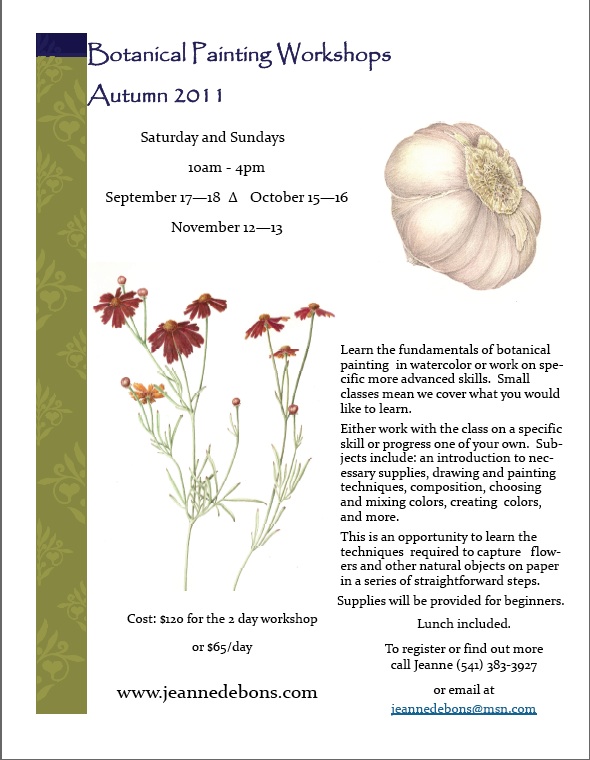
Click to enlarge image

Jeanne Debons Studio, Bend
www.jeannedebons.com
Dr. Jeanne Debons received her Ph.D. in the Department of Botany and Plant Pathology at Oregon State University. She graduated from the diploma course in Botanical Painting at the English Gardening School in 2005.

Two-Day Botanical Painting Workshop with Jeanne Debons

Learn the fundamentals of botanical painting in watercolor. Small class size ensures individualized attention. Supplies will be provided for beginners. Experienced students will work on more advanced skills. Drawing and painting techniques, color mixing, and composition will be discussed. Lunch is included for all students.

Saturdays & Sundays, choose from the sessions below.
All sessions held from 10 AM – 4 PM.

  • September 17-18, 2011
  • October 15-16, 2011
  • November 12-13, 2011

Cost: $120 for a two-day workshop (or $65/day).
Download course flyer

This information has been posted to Classes Near You > Oregon.

Read Full Post »

Brand new at Classes Near You > Ohio!


Cleveland Botanical Garden

www.cbgarden.org
A ten-acre garden in University Center, near the Cleveland Museum of Art. Stroll through ten different garden settings in Cleveland’s cultural district, visit The Garden Store and dine at The Garden Cafe. Free to the public.

  • Botanical Arts:  Autumn Splendor – Tuesdays, September 13, 20, 27 and October 4, 11, 18 & 25, 2011; 10:00 am – 12:30 pm. Instructor Susan Gray Bé instructs participants to improve their compositions while learning to balance mass, tone, line, color, texture and form. All mediums welcome, oil preferred. Independent drawing time in the garden. All levels of experience welcome. Discounted parking included.
    Cost: $130/members; $145/nonmembers.
    Register online or call (216) 721-1600, x100.
  • Botanical Arts: Watercolor Pencil Workshop – Saturday,
    September 17, 2011; 1:00 – 4:00 pm. Learn how to use watercolor pencils and colored pencils in botanical drawings from instructor Susan Morse. Previous drawing experience recommended as this class includes independent drawing time. Materials provided. Discounted parking included. Register online or call (216) 721-1600, x100. Cost: $20/member; $28/nonmember for this session OR join the additional workshop to continue your skills on Saturday, November 19. Special Two-Session Fee: $36/member; $50/nonmember. Please call 216.721.1600 x100 to register for this special two-session fee.
    Register online for the single September session.
  • Botanical Arts: Basic Botanical Drawing and Watercolor Pencil – Wednesdays, October 12, 19, 26 and November 2, 2011; 1:00 – 4:00 pm
Instructor Susan Morse will teach beginning artists line, shape, texture, and form so they can draw botanical images. Participants will also learn how to use watercolor pencils in botanical drawings. Cost: $72/member; $90/nonmember (entire series) OR attend only one session on October 12. Cost for the single October 12 session is $20 members/$28 nonmembers. To register for one session only, please call (216) 721-1600, x100. To register for the series, register online or call the number above.
  • Botanical Arts: Digital Photography Weekend Workshop – Saturday, October 22, 2011 from 8:00 am – 4:00 pm and Sunday, October 23, 2011 from 8:00 am – 12:00 pm. Learn how to capture autumn color from award-winning nature photographer, John Radigan. Demonstrations and group critique. Digital SLR cameras with manual exposure and focus preferred. Coffee and lunch on Saturday and all parking included with registration fee. Cost: $145/member; $160/nonmember; $135/Cleveland Botanical Garden Photography Club member (Photography Club members call (216) 721-1600, x100 to register and receive special discounted fee). All others, register online or call number above.
  • Botanical Arts: Watercolor Pencil Workshop – Saturday, November 19, 2011; 1:00 – 4:00 pm. Instructor Susan Morse introduces new techniques using watercolor pencils and colored pencils for botanical drawings. Previous drawing experience recommended as this class includes independent drawing time. Materials provided. Discounted parking included. Cost: $20/member; $28/nonmember. Register online or call (216) 721-1600, x100.

Read Full Post »

Welcome to Ask The Artist with Anna Knights. Unlike past sessions in which readers submitted questions to visiting artists, this time readers mostly shared their experiences and thoughts about distance learning programs in botanical art.

One reader asked Anna about how she enlarges her painting subjects. We will begin with this question and then jump into the topic of distance learning.

Sincere thanks to the readers who so openly shared their thoughts about learning botanical art outside of the classroom. This conversation would not be possible without your thoughtful comments.

Thank you to Anna Knights for sharing her work with us this month and for participating in the dialogue below.

Learn more about Anna in this interview from earlier this month. Also, be sure to visit Anna’s Facebook page to see Anna at work at a recent event.


A reader asks Anna…

    Most botanical artists’ work is true to actual size. Is yours done larger to achieve such magnificent detail? And if so, how do you so accurately enlarge it?

    AK: I like to enlarge to capture that magnificent detail but also to give the work much more impact than traditional life-sized work. I scale up using just a ruler and calculator. I work out the scale I’m enlarging to and then take a few measurements of key reference points in the composition and then freehand draw from there. This is made a lot easier when scaling up from photographs – which I make extensive use of.


Readers’ thoughts about distance learning options in botanical art…

    Reader #1

    I have had mixed results from distance learning courses. (In) my first attempt, I found the feedback to be inadequate and I kept getting graded down for stupid things like size of paper and other things that normally would have been inconsequential. It really shook my confidence and I can’t say that I learned any more than I might have just using the course book, which is not very detailed and sometimes confusing. There is no flexibility for lesson deadlines, which sometimes makes it difficult for those of us with other responsibilities. It (was) also a VERY expensive course. You pay the full amount (over $3000) in advance, and you don’t get any of your money back if you drop out.

    My second and ongoing experience has been completely different and truly wonderful. It is with the Academy of Botanical Art in Sarasota, FL. The instructors there understand that we are at all different levels and that we each have strong and weak areas. They are nurturing and confidence building and meet each student where they are rather than trying to force us all into one mold. The lesson materials for each class are very detailed and complete. Everything is spelled out and there is no need to try and guess what the instructor wants. It is also on a pay-as-you-go basis rather than having to pay the full amount up front. It is a much more personalized and less regimented program. It keeps me motivated to paint and learn rather than dreading the next assignment.

    I think that people should be able to research different possibilities before they sign up and commit big bucks toward an experience that may not meet their needs.


    Reader #2

    In answer to your questions about the distance-ed courses :

    I have taken one dist. ed. course and found that I was encouraged to keep working on the art while I learned. One my own, I have the tendency to drift to other things and don’t keep to a schedule.

    I would like to have a dist. ed. course so that I have a mentor who gives critiques, a schedule, a group of fellow students that I might be able to confer with, so basically I guess I need someone to give me a push and keep me interested.

    As to what type of format I would find ideal, I have to admit that I don’t know what this means. Presumably it means that I would like to have my work followed on-line. I have all of the botanical art books but need more confidence and someone to give me guidance. I would appreciate other students being able to contact me and vice versa for more support.


    Reader #3

    Sounds like a great idea, it will be an alternative to students, who for any number of reasons, cannot use the classroom style of learning. I live in Australia, and I have been using the distance learning system in the past, and also now, I am doing an art subject in Fine Arts, at the Open Universities Australia. I am enjoying the study but it is also very challenging. I am an emerging artist and I may be interested in the botanical course. How much does it cost?


    Reader #4

    I would be very interested in taking the Distance Learning Course in Botanical Illustration, with these provisos:

    Payment for the course should be in installments clearly pre-defined. Total payment up front does not generate confidence in prospective students for distance learning, sorry. The instructor should list his/her curriculum so distance students would know what to expect.

    A basic list of art materials should be given before enrollment, so that prospective students know what art materials are needed and can estimate cost. Good materials are expensive. Paper, paints and brushes represent an investment that all watercolor artists should have.

    Under these conditions I would be very interested in taking the course. I also think that the instructor(s) should tell us how they will conduct the course, that is how they will grade the lessons after they are mailed in. Will they make corrections or make suggestions on tracing paper over the sent-in lessons?

    I am a retired businessman from California, now living in Arizona. I am a self-taught amateur artist who loves botanical illustration, though I have never taken any live lessons, only from books.

    The instructor(s) have to make a commitment to the course, so I understand that they will require a certain number of students; I hope you get them. Also, after some time, will you stimulate students to exchange ideas and make this exchange possible?


    Reader #5

    I assume these are like the classroom classes with the regular demonstrations and how to do things plus an equipment list? I think it would be interesting to do this as I have never done it via computer.


    Reader #6

    I’d be very interested in a formal distance-learning program for botanical art/natural history illustration. Workshops and short courses offered by individual artists are also a good training option.

    The type of formal program I would be most interested in would be a certificate program and be offered by an accredited institution of some kind, whether a botanical garden, an extension division of a university, etc. It would be most practical to have the majority of the coursework handled online, with concentrated residency periods punctuating the course, say 1-2 weeks at the start, middle and end of the program. Certainly a 1-2 week workshop in residence midway would be needed.

    I was rather disappointed to read the details of the Denver Botanical Gardens’ distance program. That course would have required distance students to go to Denver nearly every weekend over the learning period–simply not practical for most people living outside of Colorado.

    For distance training offered by individual artists, I’d prefer a workshop of 1-2 weeks. This would allow a concentrated period to really make some progress. Weekend workshops would be excellent for a student who lives nearby. Certificates aren’t necessary for this type of course option.


    Reader #7

    Yes, I would take a distance learning class. I have taken many. Some use Nicenet, some used Dashboard, others used email. If you teach one online, I would attend.


    Reader #8

    I would like to know how distance educators feel about the progress of technology and the ability to enhance an art-based course by using either a Group Facebook page where photos of subjects can be discussed, video demonstrations can be posted, ideas exchanged or via email where attachments can show problem areas and be addressed more accurately. Botanical art has a chance to really shine in this format but it seems many distance educators are not as comfortable with email and Internet as their students are.


    Reader #9

    I would love to take a distance learning course but for real beginners…Even more with Anna.

    I don’t know if we can really learn by distance without, once in a while, (being) in real contact with the teacher. I am wondering if it could be a good idea to meet students first for at least ”2 weeks in a row” (why not during the summer? a great way to learn in a nice country and visit in the same time).

    I strongly believe that we should first get some basic knowledge with teacher and then start the distance program. The problems are: the distance and the cost. I guess we all want to get in a program like this because we would not have to travel. It saves time and money.

    All students don’t have the same goals. Some would like to paint for pleasure and some may think about a career. Some have already knowledge in painting, some don’t. So how (to) create a program for everyone? Maybe separated modules, or sessions. Like: drawing no1- watercolors 1- 2 etc. So everyone would be able to get into a course at their levels..Probably more work for the teacher.

    For myself, I am really interested to get in a program, well-structured with an ”available” teacher. The program, I would love, would be one where I can learn (from) the beginning. Learn how to sketch, learn about pigments in watercolors to be able to mix colors properly, etc. Project painting can be done after.

    Contact with students may be done by emails. Pictures of the works sent also by email and, further in the program, works may be sent by post. Internet is a great way to communicate, it is fast and ”free”.

    Voilà! I hope my English writing is OK. I am a French Canadian. Could add more but writing in English for me is work!

    Looking to hear from you. I am in love with your work and would be honored to be one of (your) distance students.


    Reader #10

    I most definitely would take an online botanical art class!


Anna’s reply to comments about distance learning
:

Thanks to everyone for your comments about the online course. They were really sensible and in line with my own thoughts about it. Having thought about it a bit more, what I am really proposing is to create a private online social network – along Facebook lines for those enrolled on the course. It would mean that students could also share work with each other as well as with me and interact as a group. Crucially my teaching style is all about instilling confidence and to that end is supportive and relaxed – so no harsh grading or anything like that – just constructive feedback to help students develop their own style and way of painting.

I would probably run it as a series of structured step-by-step exercises which people could pay per exercise or series of exercises – therefore allowing each student to tailor their learning and address the issues of different students having very different objectives. Then in terms of the content – I’d use video clips mainly to demo what I’m doing – along with stage-by-stage photographs – very much along the lines of the description by Reader 8. The whole course would be delivered online, so I would ask students to scan or photograph their work and email it. There may be some limitations to this but actually with the macro function on everyone’s digital camera it is perfectly possible for me to see close up the brush work, etc. I think there are huge possibilities for this and I plan to start work on the content to make sure I have a really comprehensive offering.

Thanks again for sharing your thoughts about it. If you’d like to sign up for my newsletter and be the first to know when I launch the online course you can do so via my Facebook page at http://www.facebook.com/AnnaKnightsArtist or the contact page of my website at www.annaknights.co.uk.

Read Full Post »

« Newer Posts - Older Posts »