Feeds:
Posts
Comments

Archive for the ‘Learning Opportunities’ Category

Theodore Payne Foundation, watercolor. © Ron Maben. All Rights Reserved


Inspired: Interpretations of California Native Flora, Fauna and the Natural Landscape of Theodore Payne Foundation

Feb. 1 – Mar. 24, 2012
theodorepayne.org

Paintings, poems and photographs. Baskets, gourds, ceramics and drawings. Watercolors.  
These are a few of the many works in a large group exhibition of artists who are inspired by the native flora, fauna and the natural landscape found at Theodore Payne Foundation for Wild Flowers and Native Plants. Over 25 artists responded to the call for entries, submitting their personal interpretations of California’s native landscape. 

Hung salon-style, this exhibition is one of extraordinary creativity and a survey of the varied styles and mediums in which artists are working today. 

This exhibition is sponsored by the Theodore Payne Arts Council.  The Theodore Payne Foundation for Wild Flowers and Native Plants, Inc., is a non-profit organization dedicated to helping others discover the beauty of California native plants.

The Theodore Payne Foundation is located north of Los Angeles in Sun Valley, CA. Map

Read Full Post »


The Illustrated Garden, A Studio Blog

www.valwebb.com
Val Webb is Derwent Pencils’ Feature Artist for 2012!
She will post drawing tutorials each month at Derwent’s blog, Love Pencils. See Val Webb’s online tutorial, Botanical Drawing with Pencil and Watercolor. Connect with The Illustrated Garden on Facebook. For more information about the classes below, or to register, email Val Webb.

  • Nature Drawing Workshop: Winter’s Tale
    Saturday, February 25, 2012; 10 AM – 3 PM. Spend a day in one of Alabama’s most beautiful waterfront settings, using traditional drawing techniques to create elegant and accurate drawings of winter nature subjects in pen-and-ink. No experience necessary! All art supplies provided. Location: 5 Rivers Delta Resource Center (on the Causeway). Proceeds support wildlife education programs at 5 Rivers. Cost: $60
  • Draw and Paint Six Culinary Herbs
    Saturday, March 17, 2012; 10 AM – 3 PM. Learn the basic structure of a leaf, then put that knowledge to work as you create a color rendering of six culinary herbs in layered pen-and-ink with watercolor. No previous experience necessary, and all supplies are provided. Take home your completed botanical art and six potted herb plants at the end of the day. Lunch at the Ever’man Organic Cafe. Note: This workshop fills quickly. Location: Ever’man Natural Foods Co-op (Community Room), 315 West Garden St., Pensacola, FL. Cost: $60
  • Gift from the Gulf: Shells and More in Watercolor
    Saturday, April 14, 2012; 10 AM – 3 PM. Paint treasures from the Gult using watercolor on beautiful handmade Arches paper. Learn about color families, creating textures with salt and sponges, making spatter “sand” and how to use different brushes for different effects. No previous experience necessary! This is a relaxed and playful workshop, hosted in a private home on the riverfront in Moss Point, Mississippi. Bring a sack lunch and enjoy the view during our midday break. All art supplies provided. (Note: If you plan to attend, please email Val Webb; space is limited.). Location: Moss Point, Mississippi. Details will be provided upon registration. Cost: $60
  • Draw and Paint Wildflowers and Native Plants of the Gulf Coast
    Thursdays, March 1, 8, 15, 22, 29, and April 12, 2012.
    No classes on April 5.
    Sessions 2-5 PM or 6:30-8:30 PM
    Studio cottage in Mobile, AL
    Plus one optional Saturday field trip.

    Develop your powers of scientific observation and create realistic renderings of pitcher plants, wood fern, early-blooming wildflowers and more. Students will work from plant specimens in the classroom, and will draw wild orchids and bog plants during an optional field trip. No previous experience necessary! All supplies are provided. Classes will use pen-and-ink with watercolor. Returning students who prefer colored pencil are welcome to bring their own. Class size limited. Cost: $140

Val’s classes have also been posted to the Classes Near You sections for Alabama, Mississippi and Florida.

Read Full Post »

Artist Andie Thrams has announced her teaching schedule for the new year. The new schedule includes classes about botanical field studies, forest art and a special Hawaiian retreat designed to reconnect you with nature through art and yoga!


Andie Thrams, Coloma, CA

Andie is a painter and book artist devoted to creative work in wild places. She teaches in California, Oregon and Hawaii. Her work is widely exhibited and honored, and is held in many private and public collections. View Andie’s 2012 IN FORESTS calendar at her Etsy store.

  • Spring Retreat: Wildflowers, Watercolors & Field Journals
    April 13-15, 2012
    With field journal and lightweight tools in hand participants will gather on the South Fork of the American River poised to make marks, capture colors, record visions, explore habitats. Participants’ work will dance between care and abandon, using watercolor, ink and gouache to invite the magic of spring into our art practice. The pace will allow time for quiet meandering, optional Sunday morning yoga, and sunset painting by the river. Andie will share her ever-evolving field techniques for capturing light, color, gesture and detail, using the journal as a way to experiment and develop ongoing creative themes. Location: Camp Lotus, Coloma, California. Details & Registration: Contact Andie Thrams
  • Field Trip: A Day at the Museum
    April 17, 2012
    Spend a day at the San Franscisco Museum of Modern Art to view art, discuss trends in modern and contemporary art and learn about the Museum’s fantastic resources. Fill your field journal pages with sketches and observations about your day at the museum and compare notes with other artists. Limited to six students. Food and coffee at museum restaurant. Details & Registration: Contact Andie Thrams
  • Accordion Color Book
    April 28-29, 2012
    Learn how to create an accordion-folding book. Explore watercolor techniques through step-by-step exercises that will demystify color theory as you build a reference book of paint mixing strategies. Using watercolors, both systematically and intuitively, you’ll create spring-inspired color studies applying techniques that transfer to work in ink, gouache, acrylic and oil. You’ll complete a beautiful book, an inspiration source for future projects. Location: San Francisco Center for the Book. Cost: $260. View Details/Register
  • Native Botanicals: Field Studies in Drawing & Design
    June 2, 2012
    Create studies of native plants in black and white using pencil, ink and gouache. Discover field-friendly ways to render positive/negative space; reveal gesture and detail; create strong compositions; and explore your own creativity. Participants will leave class with an understanding of the principles of design and a collection of beautiful studies for future reference. Location: Regional Parks Botanic Garden in Tilden, Berkeley, California. Cost: $120 members, $130 non-members. Details/Register
  • Native Botanicals: Field Studies in Watercolor 
    June 3, 2012
    Create summertime watercolor studies in the garden. Working with watercolor and gouache, participants will learn how to mix color accurately, create beautiful shimmering surfaces, and build layers using wet into wet, dry brush and glazing techniques. Participants will go home with a series of studies that conjure up the complexity of wild flora and inspire future painting in the field. Location: Regional Parks Botanic Garden in Tilden, Berkeley, California. Cost: $120 members, $130 non-members. Details/Register
  • Watercolors in the Wild: Sierra Flora
    July 29 – August 3, 2012
    Create lively field studies of California’s Sierra Nevada mountains. Discover field-friendly ways to use watercolor and gouache to mix accurate color; create shimmering surfaces; explore light and shadow; build layers using wet into wet, dry brush and glazing techniques; render gesture and detail; and reveal your own mark with ease. We’ll consider botanical imagery in past and contemporary art and take gentle daily forays into the wild to work with new techniques. Participants will go home with a collection of Sierra flora watercolors to use for future reference. Location: San Francisco State University Sierra Nevada Field Campus, Sattley, California. View Details/Register
  • The Artful Cookbook: Celebrating Food, Community & Story
    Co-taught with Rebecca Welti
    August 18-19, 2012
    Bring cookbooks, treasured recipes, photographs, poems and other food-related memorabilia to use as inspiration. Participants will collage, paint, write and draw to create layers of embellished imagery within a series of projects on paper. Share meals and stories with fellow participants, sprinkle herbs and spices into your paintings and onto your food, savor flavors and ideas, while creating recipe-inspired art. Location: Sitka Center for Art and Ecology, Otis, Oregon. Cost: $215. Member registration begins February 27. Public registration begins March 12.
    View 2012 Schedule/Register
  • Book Arts for Kids & Adults: Creative Fun & Exploration
    Co-taught with Inga Dubay
    August 20-21, 2012
    Kids, teens, friends, siblings, parents, grandparents, aunties and uncles are all invited to celebrate the creative spirit through exploring the book arts. Families will discover easy and fun-to-make book structures. Participants will use ink, watercolor, sticks, feathers, reeds, pens, brushes and crayons to explore lighthearted and beautiful ways to make drawings, paintings and calligraphic writing. For all levels, ages 8 and up. Location: Sitka Center for Art and Ecology, Otis, Oregon. Cost: $120. Member registration begins February 27. Public registration begins March 12.
    View 2012 Schedule/Register
  • Wild Forest Wild Art: Tree-Inspired Painting
    August 23-26, 2012
    Andie will demonstrate her ever-evolving field techniques for working in layers to capture light, color, gesture and detail, evoking what is seen and felt under the trees. Working indoors and out, through sequenced studies, participants will create images revealing their own responses to the unique complexity of wild forests. Participants will complete a series of forest-inspired mixed media drawings and paintings. Location: Sitka Center for Art and Ecology, Otis, Oregon. Cost: $415. Member registration begins February 27. Public registration begins March 12.
    View 2012 Schedule/Register
  • Big Island Retreat: Wild Art & Wild Yoga in Hawaii!
    Co-taught with Dennis Eagan
    October 7-13, 2012
    Island of Hawaii
    Join Andie and her husband, Dennis, on the Big Island of Hawaii, and sink into that blissful place of wonder through the practices of art and yoga. Artists will explore art and yoga as pathways to deepening their connection to the energies of our planet: its plants, waters and creatures. Each day will offer art classes with Andie, yoga classes with Dennis, and open time for your own exploration; classes will be optional and open to all levels of experience. Art students will use field journals to record daily observations and experiences through drawing, writing and painting with watercolor. Subjects will include island color palette; sunrise, sunset and cloud painting; and tropical plant studies. Yoga classes will emphasize asana and pranayama for opening creative energies and for studying the five elements of yoga: earth, air, water, fire and space.
    Location: Kalani Honua Resort
    Details & Registration: Contact Andie Thrams
  • Field Studies: Autumn Leaves
    November 7-8, 2012
    During forays into Hoyt Arboretum, participants will collect leaves and inspiration for studio work. Learn how to paint the thousand ambers, crimsons and rusts of Fall while building layers of watercolor, gouache and colored pencil to capture glow and detail. Participants will create beautiful studies for future reference and inspiration. Host: Sitka Center for Art and Ecology, Otis, Oregon. Location: World Forestry Center, Portland, Oregon. Cost: $212. Member registration begins February 27. Public registration begins March 12. View 2012 Schedule/Register
  • Private Creativity Coaching & Artist Mentoring
    In addition to the workshops listed here, Andie also works privately with a limited number of students. This year individual instruction is offered in two eight-week sessions only.
    Session 1: March 15 – May 15
    Session 2: September 15 – November 15
    Details & Registration: Contact Andie Thrams

Andie’s classes have also been added to the Classes Near You sections for Northern California, Oregon and Hawaii.

Read Full Post »

Botanical Art in Hawaii

I have received inquiries about botanical art classes in Hawaii (specifically on the island of Oahu). Do you know of classes on this island? If you do, please let me know or forward this post to instructors teaching on the island.

Thank you!

Read Full Post »

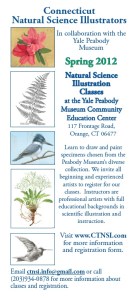
The Connecticut Natural Science Illustrators group has announced their Spring schedule. Here is what’s new at Classes Near You > Connecticut:

Download schedule


Connecticut Natural Science Illustrators

In collaboration with the Yale Peabody Museum
www.ctnsi.com

Connecticut Natural Science Illustrators LLC is composed of professional artists and scientists who have developed educational programs in natural science illustration. The members of CTNSI also provide illustrations, printed material, murals and exhibits addressing environmental and biological topics. The team at CTNSI works with environmental groups, nature centers, schools, and event managers. All classes are taught at the Yale Peabody Museum Education Center/West Campus, 117 Frontage Road, Orange, CT 06477. Register online at www.ctnsi.com or contact ctnsiprogramcoordinator@comcast.net.

Download Spring 2012 Schedule

  • One Day Sketching Workshop: Indoors or Outdoors
    March 17, 2012 or March 24, 2012; 10 AM – 1 PM. Practice the art of drawing quickly using graphite and conte crayon. Beginners and experienced artists welcome. Cost: $90 each one-day workshop.
  • Drawing and Painting Birds – Wednesdays, April 4 – May 9, 2012;
    1-4 PM. During this six-week class, you will learn avian anatomy while sketching birds in the field and sketching mounted specimens and museum skins. Participants will visit the Yale Peabody Museum ornithology collection. Prerequisite: Fundamentals of Natural Science Illustration or permission from the instructor. Cost: $275
  • Pen & Ink: Basic Techniques – Wednesdays, April 4-25, 2012; 1-4 PM. Applying skills learned in Fundamentals of Natural Science Illustration, students will learn traditional techniques used by scientific illustrators. Cost: $175.
  • Pen & Ink: Natural Science Specimens – Wednesdays,
    May 2-23, 2012; 1-4 PM. Applying techniques learned in Pen and Ink I, students will illustrate specimens from the Peabody Museum collection and learn how to prepare illustrations for reproduction. Prerequisite: Pen and Ink I or permission from the instructor. Cost: $175
  • Drawing from the Peabody Museum’s Dioramas – Saturdays,
    April 7-28, 2012; 10 AM – 1 PM. Draw from the dioramas and bird collection of the Yale Peabody Museum. Graphite, colored pencil and watercolor will be used. Open to beginners and to experienced artists. Cost: $175
  • Field Sketching – Saturdays, May 5-26, 2012. Sketch outdoor habitats at Yale’s West Campus using graphite, colored pencil and watercolor. Open to beginners and to experienced artists. Cost: $175

Read Full Post »

Adult education classes for the Winter term are now open for enrollment at the Gardens at Heather Farm. Included in the schedule are classes about plants and the environment. The following classes have been posted to Classes Near You > Northern California:


Gardens at Heather Farm, Walnut Creek

www.gardenshf.org
The Gardens at Heather Farm are comprised of twenty demonstration gardens. This six-acre garden is also an outdoor classroom. The garden offers many classes about plants, botany, botanical art and the environment. It also has its own florilegium. The florilegium project is managed by botanical artist, Catherine Watters. Visit the website to view the complete schedule of classes.

  • Discovering a Sense of Place – Saturday, March 17 – 9:00 AM – 2:00 PM. Learn about the Diablo Valley’s unique bioregion. Develop crucial knowledge about climate-appropriate plants for your home and garden as well as key facts about the soil, climate, watersheds, history and wildlife biodiversity of the region that help you create and maintain a beautiful landscape. Instructors: Patrice Hanlon, GHF Garden Manager and Susan Handjian, Garden Consultant/ Coach.
    Cost: FREE ($20 registration fee refunded at class).
    Early registration for Walnut Creek Residents ends 2/17
/12.
  • The Life of Roots and a Short Tour of the Soil Food Web – Saturday,
    March 31, 2012; 10:00 AM – 2:00 PM. Learn how roots provide for and partner with the Soil Food Web to create healthy soil and a thriving garden. Find out what you can do to support and promote the Soil Food Web to build a deep harmony into your landscape. Compost and compost tea, mulching and top dressing techniques will be explained. Transform your clay soil into rich beautiful topsoil! Instructor: Christine Finch, Bay-Friendly Landscape Professional & co-author of the East Bay Municipal Utility District’s Plants and Landscapes for Summer-Dry Climates.
    Cost: $25

Read Full Post »

Many years ago, I came across a reference to a book by botanist and illustrator, Michael Hickey, about how to draw plants in pen and ink. I began a diligent search for this book and couldn’t find it anywhere. I decided to take a chance and write to Mr. Hickey to ask about his book. To my surprise, he wrote back. He told me that while his book Drawing Plants in Pen and Ink was no longer in print, he had an extra copy lying around the house. He told me he would send it to me. Not long afterward, the book arrived. What was before a unique hard-to-find book became a one-of-a-kind treasure because of Mr. Hickey’s generosity and thoughtfulness.

Many of you are familiar with Mr. Hickey’s botany books. I have written before about the book he wrote with Clive King (The Cambridge Illustrated Glossary of Botanical Terms), and several of you are familiar with Mr. Hickey’s Botany for Beginners and Botany for Beginners II. Each of these publications are invaluable references for anyone interested in drawing plants.

This month, I have the honor of introducing you to the Institute for Analytical Plant Illustration, an institute founded by Mr. Hickey specifically to “encourage collaboration between botanists and illustrators” and to “encourage members to develop their skills in scientific illustration and to increase their botanical knowledge.”

Please welcome IAPI Chairperson, Sue Nicholls, and all members of the Institute for Analytical Plant Illustration, the Feature Group for February!


ARTPLANTAE
: Sue, thank you for introducing the group this month. Please tell us more about IAPI’s history.

SUE NICHOLLS: IAPI was founded in 2004, by Michael Hickey, to encourage the scientific illustration of flowering and non-flowering plants. He was also concerned that though there is a great interest in botanical art and illustration, the interest tends to be towards botanical art rather than scientific illustration and I think Michael wanted to raise the profile of botanical knowledge within the botanical art and illustration world.

Michael circulated an invitation to as many people as he could identify who might be interested, to attend a meeting in Cranborne Village Hall one Saturday in December 2004. Cranborne is a village in the Cotswolds, near Michael’s home. This meeting became the inaugural meeting of IAPI.

Unfortunately, Michael was taken ill very soon after that meeting, and was unable to take any further active part in its development. He died in summer 2005. Fortunately, there were enough interested people who shared Michael’s aims and ideals to take them forward.

IAPI prospered and in November 2009, which was five years since the foundation of the Institute, we held our first Michael Hickey Memorial Lecture, in Cambridge Botanical Garden, with which Michael had had a long relationship. IAPI continues to grow and develop in relation to current circumstances but also with Michael’s aims very much in mind and we maintain our connection with his family.

It is my regret that I was unable to attend the founding meeting, and so I cannot count myself a Founder Member, and in fact, I never met Michael.


AP
: How many members does IAPI have? Are all members from the UK? Will you accept members from other countries?

SN: IAPI is a comparatively small society at the moment. We currently have 45 members, all of whom are based in the UK. One of the strengths of IAPI is that membership is open to artists of all levels who are interested in scientific illustration and to botanists who are interested in illustration. Many members are also members of, and represent other botanical art or illustration societies.

Our membership is currently drawn mainly from those who can attend at least some meetings, though those who cannot attend meetings are also welcome. Meetings are held every two months, most often in Birmingham because of its central location, but we try to use other venues around the UK to accommodate as many people as possible. It will probably sound surprising to those who are not based in the UK that our geography can be limiting! The meetings programme usually includes lectures on topics of current interest, workshops on technical issues, field trips and visits to institutions of botanical or historical interest.

We have a bi-monthly newsletter, produced in months between meetings, to include members who cannot for whatever reason get to meetings. Nowadays it is easy to distribute this by email so any members overseas would not be at a disadvantage. Not only does the newsletter remind members of forthcoming meetings and other events of interest to IAPI, but it also serves as a record of past meetings, of equal value to those who attended and to those who were not able to attend.

We are currently looking at an affiliation scheme to enable us to formalise relationships with other societies.

IAPI would be delighted to accept members from other countries. It would be really interesting to collaborate with people from overseas.


AP
: In November, Anne Bebbington and Mary Brewin contributed to an article about their new curriculum, Botany for Botanical Artists. Now that the first 10-week course has been taught and feedback has been received, what is next for this exciting new program?

SN: I am interested that you find the Botany for Botanical Artists course exciting.

Since the inception of IAPI, the University Certificate Courses at Birmingham and Sheffield in Botanical Illustration which included botany, have been discontinued and there are now very few formal botany courses that can be accessed by illustrators.

Following Anne and Mary’s course, the IAPI Education Subcommittee is attempting to provide help to encourage tutors of equivalent expertise to run similar courses, and is seeking the recognition by a respected academic agency of the achievements made by the students on such courses. This is so that students will be able to convey their acquired expertise to others.


AP
: I have read all available issues of Eryngium, the journal of the Institute for Analytical Plant Illustration, and thoroughly enjoyed immersing myself into each issue. This is my kind of journal! The plant profiles are very informative and the how-to articles about illustration techniques contain the type of information any botanical illustrator would want to keep at their fingertips. Has the IAPI ever considered publishing a book that expands upon the journal’s format?

SN: It’s an interesting thought, but no I don’t think we have thought of that, though we are quite proud of our Journal. Eryngium itself is available to members as part of their membership, though we do have some back issues available and we are thinking of making back issues available via our website.

You mention keeping information at your fingertips, and this is something we have taken on by producing TipCards, laminated cards, A5 size, on topics that illustrators often want to keep to hand, with the drawing materials. Our bestseller is on how to make scale bars, something that illustrators often find difficult at first; and we have others on topics such as illustrating leaves, habit drawings, and some individual plant families. These are available for purchase by members and non-members and there is a list available on the IAPI website.


AP
: You and other IAPI members work a lot with botanists. Does the group work with members of the public as well? If so, how does IAPI work with the public?

SN: It’s not that IAPI members work with botanists, the IAPI membership includes botanists as well as artists and illustrators, though of course, we do also work with other botanists.

We have not yet looked at working directly with the public, though you could say that the Botany for Botanical Artists course represents an initiative to work with members of the public. We have regular exhibitions and demonstrations at BSBI (Botanical Society of the British Isles) exhibition meetings. We are also intending to publish a couple of small publications, based on previous illustration projects that will have a general appeal. Two members have recently published books, Lizabeth Leech’s Botany for Artists and Val Oxley’s Botanical Illustration.


AP
: The IAPI is dedicated to enhancing individuals’ knowledge about plants. I often ask people how they think people learn about plants best. I would like to turn this question around a bit and ask, drawing upon your experiences as a teacher and illustrator, what aspect of plant life do people seem to know the least about?

SN: This seems to be the knowledge of plant construction. It is of course dependent upon understanding the botanical (evolutionary) relationships which botanists of the past have spent so long establishing. The only way into this understanding is through the terminology and techniques of botany.

What about lower plants? I reckon the general public knows little about moss and fern life cycles, why they don’t have flowers, how they reproduce instead, or indeed how to identify them.

I think it is also important not to take plant life for granted; to keep a sense of wonder and a spirit of enquiry. It is tempting to assume we know enough about something and not be prepared to find out more. We so often seem to grow out of this spirit of enquiry, to look without actually seeing, and to not question what it is that we are looking at. I’d like to encourage everyone to look more closely, and to go on learning…


AP
: I enjoyed reading about the group’s project illustrating all methods of attachment used by British climbing plants. Has the group selected a project for the new year?

SN: Since completing work on the climbing plants project we’ve been engaged on a project to illustrate ‘nuts’, from Brazil nuts to walnuts and everything in between. The term ‘nut’ has a precise meaning botanically, and not everything that we are familiar with in the kitchen is a nut in that proper sense. Many of them are completely unrelated. It’s quite interesting exploring the relationships between all the different things we call nuts, and or course its quite important when we consider the development of various allergies to nuts.


Ask The Artist

IAPI Members Ask YOU Questions!

The IAPI wanted to begin their Ask the Artist session with readers by beginning the conversation a bit differently this month. This time, our guests are asking readers questions, first.

Consider these questions…

    1. How much do you need to understand a plant in order to illustrate it accurately?

    2. Some botanical art has departed from the process of being a totally scientifically reliable depiction, obeying rules and restrictions imposed by the botanical requirements, should it be judged now solely as an art-form?

    3. Traditionally, watercolour has been the medium considered most appropriate for accurate illustration of plant material. In the modern age, is watercolour still the best choice?

You are invited to participate in a casual month-long conversation with members of the Institute for Analytical Plant Illustration. Members are ready to discuss their new botany curriculum for artists and all aspects of botanical art and illustration. Visit the IAPI website to view members’ work and to learn more about IAPI members and their professional projects.

Tell your friends and colleagues about this learning opportunity by using the “Share This” buttons below.

Read Full Post »
« Newer Posts - Older Posts »