Image courtesy of Kathleen Garness. All rights reserved
This week we have the good fortune to learn from
Kathleen Garness, a scientific illustrator in Illinois whose botanical illustrations are being used to encourage an interest in native plants in the Chicago area. Kathleen has graciously stopped by to discuss her current projects.
ArtPlantae: How did you become involved in the Chicago plant families project?
Kathleen: I have become passionate about the need for natural areas restoration since joining the Chicago Botanic Garden’s Plants of Concern rare plant monitoring program in 2001. Plants of Concern (POC) uses a nationally-acclaimed systematic scientific protocol that records data about the species, its associates, threats to the population and land management history. Right now I am responsible for monitoring about 40 populations of 26 rare species at ten different sites in four counties in our region, reporting our findings to the Chicago Botanic Garden and the landowners.
Why? Our rare, and even common, native species are being crowded out by non-native shrubs such as European buckthorn and herbaceous plants such as garlic mustard and teasel. Because of this, we are losing our valuable pollinators, and if we allow this trend to continue it will have disastrous economic and nutritional impacts on our well being, not to mention the tragic loss of so much of our botanical natural heritage.
Several years ago I had been asked to consider “adopting” one of my monitoring sites, Grainger Woods, since it did not have a steward, and they hoped that restoration efforts would be able to keep it nearly pristine. Two years ago we achieved the highest level of natural areas protection afforded by the state. Now, over half of the site is an Illinois dedicated nature preserve. Grainger Woods has over 300 species of plants and is an important bird study area for Lake County IL, because the rare red-headed woodpecker has been known to nest there. One Saturday morning every month, in addition to our POC work (which may involve one or more extensive surveys per season per species and site) we clear the area of invasive non-native trees, shrubs or herbaceous plants.
While the Chicago region is arguably the nation’s leader in natural areas restoration, our biennial Wild Things conference draws well over a thousand attendees from the region. Many volunteers lack a depth of botanical knowledge that, a hundred years ago, used to be an essential part of every high school curriculum. But now, this knowledge is in danger of being lost entirely. And many site managers and stewards don’t have the time to train their volunteers about the finer points of plant taxonomy, even if they felt it would be valuable. So one of the region’s leaders, Barbara Birmingham, a retired science teacher, has been trying to address that deficit by offering monthly field botany classes at her site every year for the past three years. She asked me to assist her in developing new materials, and since each month she focused on a different common plant family, and would be using these materials in coming years, I felt this was a worthwhile use of my skills and time.
As the project evolved, we realized this could be useful region-wide, so I enlisted the help of many local scientists and stewards, emailing them the pages for their comments, according to their area of specialty. Chicago Botanic Garden’s Plant Conservation Manager of Regional Floristics, Susanne Masi, who co-authored The Sunflower Family in the Upper Midwest, edited the Asteraceae pages; Stephen Packard, director of Audubon Chicago Region and Kenneth Robertson from the Illinois Natural History Survey, contributed to the Rosaceae; and many others contributed to the rest of the series. John Balaban, one of the original Cook County North Branch stewards, and Rebecca Collings provided dedicated support from the Field Museum of Natural History here in Chicago. We are more than halfway through the project, having completed fourteen of the twenty-six most common plant families here. (Rebecca and I first become acquainted when I was asked by their botanist Bil Alverson to assist with Keys to Nature Orchids.
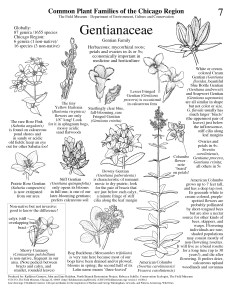
The Field Museum provided the template, which was consistent with the other Rapid Color Guides they had already developed. We worked together as a team to come up with the design and content for each page, which I wrote and illustrated. We chose species that restoration volunteers might easily come across, as well as a few that are invasive or of special concern, to watch out for and report. Since we have so much biodiversity in our region, it was hard to choose, and for that I was very grateful for the team approach. Some of the families, such as the gentians and arums, were able to be completed in one page — the others were just an overview. We also wanted to suggest some of the important ecological relationships plants have to animals and used Milkweed Metropolis as that one example.
ArtPlantae: What are the goals of this project? How do the project sponsors – The Field Museum – plan to use this information?
Kathleen: We will be promoting the pages next February during the
Wild Things Conference at the University of Illinois at Chicago. The Field Museum will be giving their ecology students the pages as handouts this next field season, and providing the link to the pages so that folks can also access them via mobile technology such as smartphones or digital tablets. Stewards will be able to use them as handouts in their field botany walks and restoration instructions, too.
And I feel a clarification is in order here – by no means are they intended to replace field guides or taxonomic keys. Rather, they are a quick visual way for folks new to natural areas exploration or restoration to begin to familiarize themselves with botany basics, not feel so intimidated by the diversity our area offers, and maybe eventually purchase a field guide such as Peterson’s or Newcomb’s. So they are intended to complement the use of field guides, providing a quick visual identification to family; from there an unknown plant can hopefully be keyed to species using a field guide or an online resource such as the USDA PLANTS Database or Flora of North America. The page set also includes a short glossary.
ArtPlantae: Do you envision other uses for this guide?
Kathleen: We have shown them to regional scouting program leaders and
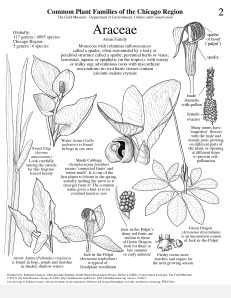
Image courtesy of Kathleen Garness. All rights reserved
ArtPlantae: You have mentioned in the past that there needs to be a grassroots effort to help people “make the connection between plants and well-being.” From what you’ve observed through your work with the public, where would be a good place to start?
Kathleen: Well, we’re hoping these materials will begin to assist with this! For the last twenty years or so, there has been a groundswell of interest in natural areas restoration, organic gardening, urban horticulture, even beekeeping, not just regionally or nationally, but worldwide. Well before this, the Midwest was blessed with being the epicenter of the ecology movement, through the pioneering work of famous naturalist Robert Kennicott, who worked for the Smithsonian Institution and was a founder of the Chicago Academy of Sciences; Stephen Forbes, who was the first head of the Illinois Natural History Survey; Henry Chandler Cowles, University of Chicago, today considered the father of ‘dynamic ecology’; Aldo Leopold; and the tireless May Theilgaard Watts, who was one of Morton Arboretum’s most famous naturalists. These intrepid naturalists got out into the field every day, marveled at the wonders of nature, made careful observations, and inspired several generations that followed. So this generation, I feel, is standing on the shoulders of giants, and we need to keep the momentum going – we need to get folks outside, to have them experience the beauty of nature firsthand on a regular basis, but also provide them the tools to really SEE and appreciate what they are looking at. That is the goal of my current botanical illustration work and I see no proper end to it. I hope artists and naturalists in other regions see the value in this and do it for their communities too.
ArtPlantae: You are working on another project in which economic botany and ornamental horticulture are the focus. What are the educational objectives of this project?
Kathleen: The Oak Park Conservatory, where I am Artist-in-Residence until November 2013, has also engaged me to make similar materials about the plants in their tropical greenhouses. So far I have completed two sets – cacao and poinsettias – of the eight sets commissioned, and am now starting on the cacti and succulents. These are not family pages per se because each set’s scope is broader than just one family. I also interact with the Conservatory visitors, show them how a botanical artist works, chat about the various collections if they’re interested, and will hopefully complete my tenure there with an exhibit of new watercolors!
ArtPlantae: You are doing wonderful work, Kathleen. Thank you for spending time with us this week.
More About the Field Guide
The pages of Common Plant Families of the Chicago Region are standard 8.5″ x 11″ pages and fit easily into a 3-ring binder. Since they are a standard size, the pages are also easy to laminate. Users of this guide may be interested in creating their own color-coding system while learning the features of each plant family (similar to what is used in Botany Illustrated).
Featured in this guide are the following plant families:
- Apiaceae (Parsley Family)
- Araceae (Arum Family)
- Asclepiadaceae (Milkweed Family)
- Asteraceae (Sunflower Family)
- Brassicaceae (Mustard Family)
- Fabaceae (Legume Family)
- Gentianaceae (Gentian Family)
- Lamiaceae (Mint Family)
- Liliaceae (Lily Family)
- Onagraceae (Evening Primrose Family)
- Orchidaceae (Orchid Family)
- Ranunculaceae (Buttercup Family)
- Rosaceae (Rose Family)
- Scrophulariaceae (Snapdragon Family)
A glossary of botanical terms is also included with the guide.
The guide Common Plant Families of the Chicago Region is available online for free.
About Kathleen Garness
The botanical/scientific illustration certificate program at Morton Arboretum was the turning point for me. While I had painted watercolors of tropical orchids for many years previous, the classes at Morton refined my pen and ink skills and fueled an interest in learning about and documenting local native species.
I really enjoy my work as a volunteer natural areas steward for Grainger Woods. My two passions – preserving habitat and documenting native species – seem to feed off each other. In 2008 my colleague Pat Hayes and I were surprised with a Chicago Wilderness Grassroots Conservation Leadership Award for our work in developing educational materials for youth as part of the national Leave No Child Inside initiative.
What feels like an eon ago, I served as board member and president of the historic Palette and Chisel Academy of Fine Arts in Chicago, and am still currently active in several local and national arts organizations. One of my most exciting opportunities, though, was the acceptance of one of my paintings into the Shirley Sherwood Gallery, Kew Gardens, London, as part of Losing Paradise? Endangered Plants Here and Around the World and in the 2011 edition of Smithsonian in Your Classroom.
I am the mother of one son, Ian Halliday, who encouraged me in this work by buying me a Wacom tablet one year for Christmas when he saw me laboring over my other avocation, the illustrations for the Little Gospels, published by Liturgy Training Publications for the Catechesis of the Good Shepherd curriculum. I still have to figure out how the Master’s in Religious Education and 20+ years teaching Sunday school figures into the artist side of me, but it all seems to fit somehow!
Additional Information About Plants of the Chicago Region
Read Full Post »


 ArtPlantae Today