Feeds:
Posts
Comments

Archive for the ‘drawing’ Category

Professional graphite artist, Mike Sibley, has announced the start date of his next online drawing course at DrawSpace.com. This eight-week course is based on his excellent book Drawing From Line to Life (2006). Sample pages and reviews of this book can be viewed here.

Here is the latest at Classes Near You > England:


Mike Sibley Fine Art

www.sibleyfineart.com
Mike Sibley is the author of Drawing from Line to Life, an inspiring instructional book about creating realistic drawings in graphite. Mike teaches classes in England, the US and Canada. He is currently looking into teaching a class in Australia in 2013. He also teaches an online course and is currently creating instructional DVDs. Mike’s website is a rich resource for the graphite artist. If graphite is your preferred medium, be sure to visit!

    Drawing from Line to Life – Begins April 11, 2012. An eight-week online course based on Mike Sibley’s book of the same name. Beginners will learn fundamental drawing techniques, shading techniques and how to break a drawing down into manageable parts. Weekly homework will be assigned. Students may work towards certification or take this class as an auditing student. For additional information, including a class outline, go to the Drawing from Line to Life course page. Cost: $228 (certification), $114 (audit)

Read Full Post »

Add a bit of spring to your schedule next week with botanical artist, Nina Antze!


Nina Antze
Drawing Nature in Colored Pencil

www.pcquilt.com/botanicals.htm
Nina received a degree in Fine Art from San Francisco State University and a Certificate in Botanical Illustration from the botanical art program at the New York Botanical Garden. For more information about the classes below, contact Nina Antze or call (707) 237-7014. Nina’s teaching schedule can also be viewed on her website.

  • Nature Drawing Classes – Four Tuesdays, ongoing. 9AM – 12 PM. Learn to capture the forms and colors of nature at Sebastopol Center for the Arts in Sebastopol, CA. Cost: $89. Contact: (707) 237-7014
  • Drawing Spring Flowers in Colored Pencil – Thursday, March 15, 2012; 10 AM – 3 PM. Draw the first flowers of spring with botanical artist, Nina Antze. Learn color theory, value and color application. Apply the techniques of blending, burnishing and impressed line to your work. Location: San Francisco Botanical Gardens at Strybing Arboretum.
    Cost: $80 members, $90 nonmembers. Register: (415) 661-1316, x400 or download registration form.

This information can also be found at Classes Near You > California.

Read Full Post »

Kathleen McKeehen announces her new schedule of classes for spring and summer. Kathleen’s workshops for artists at all levels of experience (and studio classes too!) have been posted to Classes Near You > Washington.


Kathleen McKeehen, Scientific Illustrator

Kathleen is a teacher and freelance illustrator. Her work has appeared in Organic Gardening Magazine and The Herb Companion. View Kathleen’s artwork in the ASBA Members’ Gallery or at the Guild of Natural Science Illustrators’
Science-Art.com.

  • Botanical Drawing/Painting at Oil & Water Art Supply, Bainbridge Island – Ongoing on Tuesdays. Learn how botanical artists portray botanical subjects using pencils and watercolor. Oil & Water Art Supplies, Winslow, Bainbridge Island. Students pay per session. For additional details, contact 206-842-0477.
  • Botanical Watercolor – Thursdays, March 15 – April 12, 2012;
    10 AM – 1 PM. Beginners and those who have already taken the watercolor class are welcome; continuing students will get supervision on projects of their choosing. Location: Bloedel Reserve.  Details/Registration
  • Introduction to Botanical Watercolor – Sunday, April 1, 2012.
    Learn how botanical artists capture the beauty of plants in this one-day workshop. Location: Winslow Art Center on Bainbridge Island, WA. Register: Contact Martha
  • Botanical Drawing – Fridays, April 13 – June 15, 2012 (9 classes; no class May 25); 9:30 AM – 12:30 PM. Learn to draw botanical subjects with accuracy and beauty. Students will learn to use pencil as a “stand alone” medium or as preparation for botanical watercolor. Location: Gage Academy of Art. Register: (206) 323-GAGE or visit website for details.
  • Botanical Watercolor – Fridays, April 13 – June 15 2012 (9 classes; no class May 25); 1:30 – 4:30 PM. This botanical painting workshop is open to beginners. Students with previous experience can work independently on projects with guidance from the instructor. Location: Gage Academy of Art. Register: (206) 323-GAGE or visit website for details.
  • Botanical Drawing – Mondays, April 16 – June 4, 2012; 7:00 – 9:30 PM. Learn how to portray botanical subjects in pencil. This class will help prepare students interested in taking a botanical painting workshop. Location: Poulsbo Parks & Recreation. Register: (360) 779-9898 or visit website for details.
  • Botanical Drawing – Wednesdays, April 18 – June 6, 2012 (7 classes; no class May 25); 7:00 – 9:30 PM. Graphite is an excellent medium for depicting botanical subjects; the class is also good preparation for further study of botanical watercolor.  Beginners and those with previous experience are welcome.  Location: University of Washing Botanic Gardens. View Details/Register.
  • Botanical Watercolor: Painting the Pansy – Saturday & Sunday,
    April 21-22, 2012; 9:30 AM – 4:30 PM. Learn the basics of botanical drawing and how to to apply traditional watercolor techniques while studying the familiar pansy. Open to all levels of experience. Experienced students can choose to use this two-day workshop to complete an independent project. Location: Gage Academy of Art. Register: (206) 323-GAGE or visit website for details.

  • Introduction to Botanical Painting (3-day classes) – Mondays,
    July 2, 9, 16, 2012; 7:00 – 9:30 PM. This class will also offered on the following Monday evenings: August 6, 13, 20, 2012 from 7 to 9:30 PM. Watercolor is an excellent medium for botanical subjects. Learn the basics of the classical dry-brush method to portray the plants you love. Location: Poulsbo Parks & Recreation. Register: (360) 779-9898 or
    visit website for details.

  • Studio Classes with Kathleen McKeehen
    Morning to early afternoon studio sessions are available on Wednesdays and possibly Tuesdays. For more information, please contact Kathleen.

Read Full Post »


The Illustrated Garden, A Studio Blog

www.valwebb.com
Val Webb is Derwent Pencils’ Feature Artist for 2012!
She will post drawing tutorials each month at Derwent’s blog, Love Pencils. See Val Webb’s online tutorial, Botanical Drawing with Pencil and Watercolor. Connect with The Illustrated Garden on Facebook. For more information about the classes below, or to register, email Val Webb.

  • Nature Drawing Workshop: Winter’s Tale
    Saturday, February 25, 2012; 10 AM – 3 PM. Spend a day in one of Alabama’s most beautiful waterfront settings, using traditional drawing techniques to create elegant and accurate drawings of winter nature subjects in pen-and-ink. No experience necessary! All art supplies provided. Location: 5 Rivers Delta Resource Center (on the Causeway). Proceeds support wildlife education programs at 5 Rivers. Cost: $60
  • Draw and Paint Six Culinary Herbs
    Saturday, March 17, 2012; 10 AM – 3 PM. Learn the basic structure of a leaf, then put that knowledge to work as you create a color rendering of six culinary herbs in layered pen-and-ink with watercolor. No previous experience necessary, and all supplies are provided. Take home your completed botanical art and six potted herb plants at the end of the day. Lunch at the Ever’man Organic Cafe. Note: This workshop fills quickly. Location: Ever’man Natural Foods Co-op (Community Room), 315 West Garden St., Pensacola, FL. Cost: $60
  • Gift from the Gulf: Shells and More in Watercolor
    Saturday, April 14, 2012; 10 AM – 3 PM. Paint treasures from the Gult using watercolor on beautiful handmade Arches paper. Learn about color families, creating textures with salt and sponges, making spatter “sand” and how to use different brushes for different effects. No previous experience necessary! This is a relaxed and playful workshop, hosted in a private home on the riverfront in Moss Point, Mississippi. Bring a sack lunch and enjoy the view during our midday break. All art supplies provided. (Note: If you plan to attend, please email Val Webb; space is limited.). Location: Moss Point, Mississippi. Details will be provided upon registration. Cost: $60
  • Draw and Paint Wildflowers and Native Plants of the Gulf Coast
    Thursdays, March 1, 8, 15, 22, 29, and April 12, 2012.
    No classes on April 5.
    Sessions 2-5 PM or 6:30-8:30 PM
    Studio cottage in Mobile, AL
    Plus one optional Saturday field trip.

    Develop your powers of scientific observation and create realistic renderings of pitcher plants, wood fern, early-blooming wildflowers and more. Students will work from plant specimens in the classroom, and will draw wild orchids and bog plants during an optional field trip. No previous experience necessary! All supplies are provided. Classes will use pen-and-ink with watercolor. Returning students who prefer colored pencil are welcome to bring their own. Class size limited. Cost: $140

Val’s classes have also been posted to the Classes Near You sections for Alabama, Mississippi and Florida.

Read Full Post »

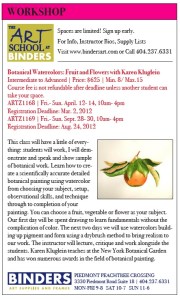
Learn traditional botanical painting techniques at Binders Art Supplies and Frames in Atlanta.


The Art School at Binders

www.bindersart.com
Award-winning botanical artist, Karen Kluglein will teach botanical painting classes at Binders Art Supplies and Frames, a fine art store in Atlanta, GA. Ms. Kluglein has designed packaging for companies such as Dannon, Hersheys, General Food, Tetley and Ragu. Her work has been exhibited across the US and is included in public and private collections. Ms. Kluglein is represented by Susan Frei Nathan Fine Works on Paper, LLC in Millburn, New Jersey.


Botanical Watercolors: Fruit and Flowers with Karen Kluglein

Choosing either a fruit, vegetable or flower as their subject, students will learn how to create a detailed botanical painting. Students will learn fundamental drawing techniques on the first day and learn dry brush techniques on the remaining two days. Instructor will demonstrate various techniques. Cost: $625. Minimum: 8 students. Limit: 15 students. Click on image to download details and to register.

Intermediate to advanced artists have two opportunities to learn dry brush techniques used by botanical artists. Please note registration deadlines. Course fee is not refundable after deadline unless another student can take your place.

ARTZ1168:
April 12-14, 2012 (10 AM – 4 PM)
Registration deadline is March 2, 2012.

ARTZ1169:
September 28-30, 2012 (10 AM – 4 PM)
Registration deadline is August 24, 2012.

This information can also be found at Classes Near You > Georgia.


Related

Susan Frei Nathan on Creating and Collecting Botanical Art

Read Full Post »

When learning about the life cycle of any living thing, it helps to have real-life examples, or at least images, to guide you through each phase. Observing the entire life cycle of a plant can be a bit of a problem if you and your audience are bound to a classroom or a location void of plant life. How can you have engaging conversation about plant life cycles in these type of settings?

Elisabeth E. Schussler and Jeff Winslow have created a solution and have tested it in fourth-grade classrooms. Their solution is a drawing exercise that is both a hands-on activity and an assessment tool.

In Drawing on Students’ Knowledge, Schussler and Winslow explain how they created an activity for fourth-grade students that provides students with the opportunity to observe and document the life cycle of a plant.

Before Schussler and Winslow (2007) could engage students in learning about the stages of a plant’s life, they had to find out what students already knew about life cycles. They tapped into students’ prior knowledge of life cycles by reviewing the life cycle of frogs and butterflies. They then turned students’ attention to the plant they would study in class and asked them to draw a picture of what they thought the life cycle of their plant would look like. In their paper, Schussler and Winslow (2007) describe what they learned from the students. Through their botanical drawings, students demonstrated they understood that seeds became seedlings, that seedlings produced flowers, that plants produced seeds, that seeds were dispersed and that plants die. They also demonstrated a gap in their knowledge — specifically that they did not recognize that seeds came from fruit and that fruit came from flowers.

To conduct their 40-day study, Schussler and Winslow (2007) worked with students in nine 4th grade classrooms at two local elementary schools and collected pre- and post-assessment data from 81 of these students. Even though they designed the 40-day activity, Schussler and Winslow (2007) made only four visits to each classroom. Their involvement was limited to pre- and post-assessments of students’ knowledge about life cycles, instruction in how to plant and maintain Wisconsin Fast Plants (Brassica rapa), instruction in how to pollinate the plant specimens, and the collection of student data (Schussler and Winslow, 2007). The classroom teachers with whom they worked oversaw their students’ daily collection of data. Students collected data such as date of germination, plant height, leaf number, flower number, pollination, fertilization, number of seed pods and the number of seeds per pod.

Since student knowledge about plant life cycles was to be determined by the presence or absence of information in student drawings, Schussler and Winslow (2007) created a checklist to help them code information in each drawing. This checklist was used on pre-assessment drawings and on the post-assessment drawings students created on the last day of the project. The instructions for the post-assessment drawing were identical to the instructions given for the pre-assessment drawing (Schussler & Winslow, 2007).

Here is what Schussler and Winslow (2007) observed in students’ drawings after they had observed and documented the life cycle of Brassica rapa:

  • 65% of students drew fruit and seed pods in their second drawing. Only 4% of students included fruit or seed pods in their first drawing.
  • 33% of students drew cotyledons (seed leaves) in their second drawing. None of the students included seed leaves in their first drawing.
  • 40% of students correctly placed fruit in locations where a flower was once located. In the pre-assessment drawing, only 4% of students drew fruit where a flower had been. This change suggests that students learned the relationship between flowers and fruit.

Schussler and Winslow (2007) found the drawing activity to be a fun learning tool and an effective assessment tool. The most revealing discovery to come out of their research was that much of what the students learned about plants was learned without receiving any planned instruction. Teachers from participating classrooms were not required to present specific information about plant growth. What students learned about plant life cycles was learned through direct observation and data collection (Schussler & Winslow, 2007). The knowledge and insight gained by students through direct observation was consistent from class to class, suggesting to Schussler and Winslow (2007) that their hands-on growing activity and drawing assessment tool was effective in all settings, whether or not teachers presented additional information about plant growth to their students.

View the materials and methods used by Schussler and Winslow (2007), a copy of the checklist they used to evaluate drawings, and sample pre- and post-assessment drawings in Drawing on Students’ Knowledge, available online for free, available at the store of the National Science Teachers Association for 99¢, or in the January 2007 issue of Science and Children. Look for this issue in the reference section of your local college library.


Literature Cited

Schussler, Elisabeth and Jeff Winslow. 2007. Drawing on students’ knowledge. Science and Children. 44(5): 40-44.


Related

View the life cycle of Brassica rapa, the Wisconsin Fast Plant

Read Full Post »
Start a garden journal, begin your exploration of botanical art or engage in studies about color. These experiences and more can be found in the Spring 2012 schedule of botanical art classes at Lewis Ginter Botanical Garden!


Lewis Ginter Botanical Garden

www.lewisginter.org
In 1884, Lewis Ginter purchased some property and built a gathering place for Richmond bicyclists. One hundred years later, the Lewis Ginter Botanical Garden was established on this same piece of property and soon became one of the top five destinations in Virginia. The Garden is home to Artbase a searchable database containing 2,500 botanical watercolor paintings by Alexandre Descubes. The Adult Education program at the garden includes workshops in botanical drawing and painting.

View Spring 2012 Schedule & Register

  • Color Theory for Botanical Artists – Wednesdays,
    February 1, 8, 15, 22, 2012; 9:30 AM – 2:00 PM. Learn the principles of color harmony and discord, as well as basic watercolor techniques and special effects. Materials list sent upon registration. Lunch on your own. Instructor: Celeste Johnston. Cost: $194 non-members, $150 members.
  • Beginning Botanical Illustration in Pen and Ink – Saturdays,
    March 3, 10, 17, 24, 31, 2012; 9:30 AM – 2:00 PM. Develop your drawing and observation skills while learning botany and the traditions of botanical art. Some drawing experience helpful. All materials provided. Lunch on your own. Instructor: Celeste Johnston. Cost: $250 non-member, $195 member
  • Colored Pencil Over Watercolor for Botanical Artists – Wednesdays, March 7, 14, 21, 28, 2012; 9:30 AM – 2:00 PM. Students will learn how to layer colored pencil over transparent watercolor glazes on paper. Some knowledge of watercolor techniques and botanical drawing is needed. Materials are provided. Lunch on your own. Instructor: Celeste Johnston. Cost: $250 non-member, $195 member
  • Advanced Botanical Illustration Workshop (Orchids) – Tues/Thurs, March 27, 29 and April 3, 5, 2012; 10 AM – 4 PM. Taught in conjunction with the Orchids Galore! exhibition. Students will complete an orchid study applying what they learn about orchids and about composition. Materials list will be sent upon registration. Lunch on your own. Instructor: Juliet Kirby. Cost: $239 non-member, $195 member (includes a blooming orchid plant to take home)
  • Anatomy of Flowers for Botanical Artists – Wednesdays,
    April 11, 18, 25, 2012; 9:30 AM – 2:00 PM. Students will observe, dissect and draw flower parts to understand their structure and function. Students will make a small drawing or painting of a flower to present in botanical terms. A basic knowledge of drawing required. Materials list will be sent upon registration. Cost: $158 non-member, $125 member
  • How to Draw Stuff (in the Garden) – Saturdays,
    April 14, 21, 28, 2012; 9:30 AM – 12:00 PM. Spend a leisurely morning drawing in the garden! Learn the drawing and sketching techniques necessary to record your observations in your journal. Recommended text is Drawing and Sketching by Jackie Simmonds (buy on your own). Instructor: Susie Kowalik. Cost: $138 non-members, $105 members. $15 materials fee for new students.

This information has been added to Classes Near You > Virginia.

Read Full Post »

« Newer Posts - Older Posts »