Feeds:
Posts
Comments

Archive for the ‘drawing’ Category

Summer school for kids and adults!

See what’s new at Classes Near You > Oregon:


Leach Botanical Garden

http://leachgarden.org
A 16-acre garden in southeast Portland. Formerly the private garden of botanist Lilia Leach and her husband pharmacist John Leach, the garden features over 2,000 species of plants and hosts special events and workshops year-round.

    Botanical Illustration – This one-day class for adults is taught every Tuesday from May 1 – October 30, 1-3 PM. Class will be taught under the Meadow Tent. Instructor Jane Nash will teach participants how to turn a pencil sketch into a finished colored pencil painting. Supplies are provided. Pre-registration is required. Cost: $25 per class non-members, $20 per class members. View Details/Register

    Kids Nature Illustration
    – This one-day class for children ages 9-14 is taught every Tuesday from June 19 – August 28, 2012, 8:30 – 11:30 AM. Children will learn how to observe plants and how to draw them using pencil, drawing pens and other media. Pre-registration is required. Cost: $15 per class non-members, $13 per class members.
    View Details/Register

Read Full Post »

Know your veggies.
Eat your veggies.
Draw your veggies.

Making vegetables and plants irresistibly interesting to the next generation is the goal of Botany on Your Plate: Investigating the Plants We Eat, a ready-to-use curriculum written by Katharine D. Barrett, Jennifer M. White and Christine Manoux.

The eight interdisciplinary lessons in this book written for K-4 students are based on the Grocery Store Botany program taught at the UC Botanical Garden Berkeley. Each lesson includes a materials list and instruction on how to lead students to an understanding of plants through inquiry. Drawing is an essential part of each lesson and clearly enhances student observation skills and student understanding of plants and how they grow. Here is a summary of each lesson:

  • Lesson 1: Let’s Become Botanists! – During this lesson, teachers will determine students’ prior knowledge about plants and learn about the plants their students eat. Students create the botany journal they will use throughout the unit and learn about the “plant snack process”. A recurring feature, the “plant snack” activity encourages students to “taste and describe” the fruit and vegetables they are learning about.
  • Lesson 2: Roots – Students learn about roots and their function through observation, dissection and drawing. Suggestions about how to relate this lesson to math, nutrition, cooking, social science, language arts and plant propagation are provided.
  • Lesson 3: Stems – Students learn about stems and how water and nutrients travel through plants while dissecting and drawing stems. Students learn about the scientific process while conducting an experiment and learn about products made from stems. Suggestions about how to relate this lesson to math, nutrition, cooking, social science and language arts are provided.
  • Lesson 4: Leaves – Leaf structure and photosynthesis are the focus of this lesson. Dissection and drawing again play an integral role. Suggestions about how to relate this lesson to math, nutrition, social studies and language arts are provided.
  • Lesson 5: Flowers – Students study flowers and learn about pollinators while dissecting flowers and drawing floral structures in their botany journals. Suggestions about how to relate this lesson to math, nutrition, pollination ecology, cooking, social science and language arts are provided.
  • Lesson 6: Fruit – A study of two types of fruit leads to discussion about seeds and seed dispersal. Suggestions about how to relate this lesson to math, nutrition, ethnobotany, social science, cooking and language arts are provided.
  • Lesson 7: Seeds – In this lesson, students explore seeds in more detail. They learn about a seed’s function through dissection and drawing. Suggestions about how to relate this lesson to math, nutrition, cooking, gardening, social science, and language arts are provided.
  • Lesson 8: Plants – Top to Bottom – A recap of the many elements in this unit, students end the eight-lesson series drawing and writing about plants in their journals.

Background information about plant biology is provided for teachers, as are copies of the handouts required for each lesson. A helpful glossary is also included.

Botany on Your Plate: Investigating the Plants We Eat is an invaluable resource that should be in every classroom or at least in every school library.


Literature Cited

Barrett, Katharine D. and Jennifer M. White and Christine Manoux. 2008. Botany on Your Plate: Investigating the Plants We Eat. Burlington, VT: National Gardening Association.


Related Topics

Read Full Post »

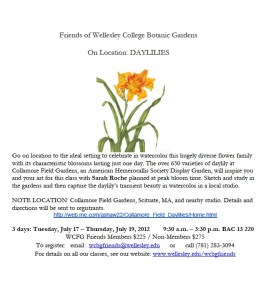
Click to download flyer

The Wellesley College Friends of Horticulture has changed its name to Friends of Wellesley College Botanic Garden. The Friends’ listing in the Classes Near You section has been updated.

Here is what you’ll find at Classes Near You > Massachusetts:


Friends of Wellesley College Botanic Gardens
Certificate Program in Botanical Art and Illustration

www.wellesley.edu/wcbgfriends
This program offers several weekly and two- or three-day classes on botanical art and scientific illustration with Sarah Roche and Jeanne Kunze and seminars with visiting instructors including Susan Fisher, D. L. Friedman, Kathie Miranda, Carol Ann Morley, Kate Nessler, Elaine Searle, Catherine Watters and more. The courses offered through this program cover all aspects of botanical art. The following is only a glimpse of what this program offers:

  • Foundations of Botanical Drawing and Painting
  • Techniques of Botanical Drawing and Painting
  • Plant Drawing for the Petrified
  • On Location: Daylilies with Sarah Roche
  • Fruit from the Orchard
  • Botanical Painting on Vellum
  • Flowers as They Grow
  • Playing with Transparency: Colored Pencil on Mylar
  • View current schedule & instructor bios


Additional Learning Opportunities

Daylilies at Collamore Field Gardens – July 17-19, 2012; 9:30 AM – 3:30 PM. Learn about daylilies at Collamore Field Gardens, an American Hemerocallis Society Display Garden featuring over 650 varieties of daylilies. Sketch lilies in the garden during peak bloom and learn how to transform your sketch into a watercolor painting in the studio. Botanical artist and instructor, Sarah Roche, will show you how! Cost: WCFG Friends Members $225, Non-members, $275. To register, contact wcbgfriends@wellesley.edu or call (781) 283-3094.

Read Full Post »

Many new exhibitions have been added to the Exhibits to Visit section. So many in fact, it is necessary to create an announcement to bring attention to all of them.

Some exhibitions are already open and others will open this week, such as the exhibition at the Northbrook Public Library in Northbrook, IL featuring the award-winning botanical art of Heeyoung Kim. On view will be the collection of paintings for which Heeyoung was awarded a gold medal by the Royal Horticultural Society earlier this year.

Here is what’s new:

Read Full Post »

Here is what’s new at Classes Near You > England!


Farncombe Estate, Cotswolds

www.farncombeestate.co.uk
A 300-acre privately-owned parkland in the Cotswolds. Host to weekend classes in a variety of subjects. There is even a bed-and-breakfast option! Follow their blog or become a fan of their Facebook page to learn more about this unique learning opportunity. Farncombe Estates’ current course schedule can be viewed online. The current schedule includes:

  • Botanical Illustration for Improvers with Valerie Oxley
    Friday, June 8, 2012
  • Outdoor Sketching in Line & Wash with Paul Weaver
    Friday, July 8, 2012
  • Botanical Basics Painting with Simon Williams
    Friday, July 13, 2012
  • Drawing for the Terrified with Richard Box
    Friday, July 14, 2012
  • Sketching with Pen & Wash with Paul Weaver
    Monday, August 27, 2012
  • Drawing and Painting from Nature with Simon Williams
    Friday, October 12, 2012
  • Botanical Illustration: Drawing and Painting Autumn Fruits & Fungi with Valerie Oxley
    Friday, October 19, 2012
  • View all painting and drawing classes at Farncombe Estate here.

Read Full Post »

You don’t have to be a professional artist to enjoy drawing plants, any more than you have to be a professional writer to compose an e-mail or write a letter.

— Gail Selfridge

Scientific illustrator, Gail Selfridge, shares how she was inspired to start collecting and documenting Stapelia after reading a book about these interesting South African succulents. While she had prepared countless illustrations for books, journals, and museums as a professional illustrator, she had never prepared extensive illustrations for herself. Drawing her personal collection of Stapelia was a rewarding experience taking more than two years to complete.

In her article, Selfridge (2008) explains how she created her colored pencil illustrations and shares images of work-in-progress. Using little more than graphite pencils, colored pencils, a portable sketchbook, paper from a desktop printer, and discarded cardboard boxes from the grocery store, Selfridge (2008) built a collection of work about her favorite plant. With these mundane materials, she created a studio-worthy collection of portable drawing supplies, inexpensive sketching paper, and a homemade flat file. The “formal” art supplies in her studio included Prismacolor colored pencils, tracing paper, a kneaded eraser, drawing paper, illustration board, and a 10x linen tester with which to study a plant’s details (instead of an expensive dissecting microscope).

In Selfridge’s collection is an educational piece about Stapelieae designed specifically to introduce people to this group of plants and to “spark an interest in (viewers) to observe and learn more about their own plants through drawing” (Selfridge, 2008). This piece has traveled to museums and has been included in exhibitions such as Focus on Nature VII and a show at the Bruce Museum of Art and Science in Connecticut about flowers and their pollinators.

To learn more about Selfridge’s practical approach to creating a personal florilegium, contact the author to request a copy of her article.


Literature Cited

Selfridge, Gail. 2008. Drawing from your collection. Cactus and Succulent Journal. 80(1): 7-11.


QUESTION FOR READERS:

What everyday items do you like to use to document your observations about plants and nature? Tell us about your favorite simple art supply.


Updated June 20, 2016

Read Full Post »

Observe and draw local flora while learning plant classification and identification. See what’s new in the Classes Near You sections for Washington, Oregon and Colorado.


Quinn Fitzpatrick

www.quinnfitzpatrick.com
Quinn is an artist, a musician, and a graduate of the Natural Science Illustration Program at the University of Washington. His specialties include wild cats, raptors, wild edible plants, and medicinal plants. His chosen media are graphite, watercolor, gouache, colored pencil, and photography. He teaches workshops in botanical illustration in Washington, Oregon and Colorado.

  • Introduction to Botanical Illustration
    Tuesdays, April 10 – June 5, 2012; 5:30 – 7:30 PM. This workshop introduces students to the practices of botanical illustration from a natural science perspective. We will be primarily working with black & white mediums using graphite and pen & ink. Some color theory and mediums (i.e., colored pencil) will be introduced. Draw northwest flora while learning classification and identification. Some drawing experience is helpful and this course is open to all skill levels. Location: North Seattle Community College, Seattle, WA. Details/Register
  • Introduction to Botanical Illustration – April 30, 2012; 6-9 PM. This workshop introduces students to the practices of botanical illustration from a natural science perspective. We will be primarily working with black & white mediums using graphite and pen & ink. Some color theory and mediums (i.e., colored pencil) will be introduced. Draw northwest flora while learning classification and identification. Some drawing experience is helpful and this course is open to all skill levels. Location: Rossehill Community Center, Mukilteo, WA. Details/Register
  • Introduction to Botanical Illustration – May 3, 2012; 6-9 PM. This workshop introduces students to the practices of botanical illustration from a natural science perspective. We will be primarily working with black & white mediums using graphite and pen & ink. Some color theory and mediums (i.e., colored pencil) will be introduced. Draw southwest flora while learning classification and identification. Some drawing experience is helpful and this course is open to all skill levels. Location: Frontrange Community College, Boulder, CO. Cost: $59. Details/Register
  • Introduction to Botanical Illustration
    May 5, 2012; 9:30 AM – 12:30 PM. This workshop introduces students to the practices of botanical illustration from a natural science perspective. We will be primarily working with black & white mediums using graphite and pen & ink. Some color theory and mediums (i.e., colored pencil) will be introduced. Draw southwest flora while learning classification and identification. Some drawing experience is helpful and this course is open to all skill levels. Location: Frontrange Community College, Westminster, CO. Cost: $59. Details/Register
  • Introduction to Botanical Illustration
    May 7, 2012; 4:30 – 7:30 PM. This workshop introduces students to the practices of botanical illustration from a natural science perspective. We will be primarily working with black & white mediums using graphite and pen & ink. Some color theory and mediums (i.e., colored pencil) will be introduced. Draw southwest flora while learning classification and identification. Some drawing experience is helpful and this course is open to all skill levels. Location: Frontrange Community College, Fort Collins, CO. Cost: $59. Details/Register
  • Introduction to Botanical Illustration
    May 20, 2012; 4:30 – 7:30 PM. This workshop introduces students to the practices of botanical illustration from a natural science perspective. We will be primarily working with black & white mediums using graphite and pen & ink. Some color theory and mediums (i.e., colored pencil) will be introduced. Draw southwest flora while learning classification and identification. Some drawing experience is helpful and this course is open to all skill levels. Location: South Whidbey Parks & Recreation, Whidbey Island, WA. Details/Register
  • Botanical Illustration Weekend Workshop
    June 15-17, 2012. Review plant anatomy, ecological adaptations and develop drawing skills while exploring the flora on the east side of the Cascades with Quinn Fitzpatrick. Cost: $280 for shared room includes 2 nights, 5 meals, instruction and field trips; $295 private room; $175 no lodging. Details/Register
  • Introduction to Botanical Illustration – July 11, 2012. This workshop introduces students to the practices of botanical illustration from a natural science perspective. We will be primarily working with black & white mediums using graphite and pen & ink. Some color theory and mediums (i.e., colored pencil) will be introduced. Draw northwest flora while learning classification and identification. Some drawing experience is helpful and this course is open to all skill levels.
    Location: Portland Community College, Portland, OR. Details/Register

Read Full Post »

« Newer Posts - Older Posts »