Feeds:
Posts
Comments

Archive for the ‘botany’ Category

Attention teachers, naturalists and artists near Dallas Center, Iowa!

The Leaf Lab at the Brenton Arboretum will open on August 20, 2013 and will be open every Wednesday from 1-4 PM through November 13, 2013. Visitors to the lab will learn about leaf morphology and plant identification. They will also be able to compare leaves in their personal collections to leaves in the lab and to leaves on the trees in the Arboretum’s living collection.

Cost: $5 lab contribution per visit

Learn more about the Brenton Arboretum, their classes and other services at www.thebrentonarboretum.org. Follow them on Twitter (@brentontrees) and Facebook.

Read Full Post »

New updates for the Classes Near You pages for California, Hawaii and Washington.


Vorobik Botanical Art

www.vorobikbotanicalart.com
Linda Ann Vorobik, Ph.D. is a botanical illustrator and botanist who teaches at the Jepson Herbarium at UC Berkeley, conducts field research in the Siskiyou Mountains in Oregon and teaches botanical illustration in California, Oregon, Washington and Hawaii. Visit Linda’s website to view her current teaching schedule, online gallery, blog, and to sign-up for her newsletter.

    An Introduction to Botanical Art
    Burke Museum
    University of Washington Herbarium
    September 20, 2013
    Pre-registration required by September 13, 2013


    Painting Orchids on the Big Island of Hawaii
    – October 20-26, 2013


    Plan Ahead for 2014!

    An Introduction to Botanical Art
    Santa Barbara Botanical Garden
    Santa Barbara, CA
    March 22-23, 2014


    An Introduction to Botanical Art

    Center for Urban Horticulture
    University of Washington Botanic Gardens
    Seattle, WA
    October 4-5, 2014


    Painting Orchids on the Big Island of Hawaii

    October 19-25, 2014


Also See

An interview with Linda Ann Vorobik

Read Full Post »

Today is the first Thursday of the month and this means that this evening the streets of downtown Riverside will be filled with people enjoying a warm summer night at ArtsWalk.

Tonight ArtsWalk will be especially memorable for Habitat for Humanity Riverside which has been celebrating its 25th anniversary and the 15th anniversary of the Riverside ReStore this year. Their celebration takes a very public turn as Habitat’s “Homes” tour kicks off in front of the Main Public Library on Mission Inn Blvd, across the street from the Riverside Metropolitan Museum and the historic Mission Inn.

This tour will showcase the work of 46 local artists and their interpretation of what home means to them. This exhibition will be on view inside the library
August 4-22, 2013. Beginning August 27, the twenty-five dollhouses and fifteen plaques will be auctioned off to raise money for housing projects in Riverside, Jurupa Valley, Moreno Valley, Corona and Norco — areas served by Habitat for Humanity Riverside. This auction will be held at the Riverside ReStore. Bidding will also occur online, allowing individuals in neighboring communities the opportunity to participate. The auction ends on September 27, 2013. Winning bidders will be announced on September 28, 2013.

Participating artists will be in attendance during ArtsWalk tonight to answer questions about their work. I will be there with my educational/interactive piece titled, Garden Journal: Sunflower. It is a “home herbarium” piece designed to ignite a curiosity about plants and offers gardeners a way to begin recording what grows in the home garden.

Showcase artists will serve as docents while the exhibition is on view inside the library from August 4-22, 2013. If you can’t make it out tonight, we hope to see you while the exhibition is at the library or when the exhibition returns to the Riverside ReStore for the auction.

I invite you to attend the ArtsWalk launch of this special “Homes” tour tonight from 6:00 – 8:30 PM to admire the thoughtful creativity of local artists and their presentation of the showcase message, Home is where our story begins…


Vote for Your Favorite

After viewing the 25 amazing dollhouses and 15 creative plaques, go online to vote for your Fan Favorite at the Riverside ReStore. A Fan Favorite Award will be presented at Habitat’s 25th Anniversary Gala in September.

Read Full Post »

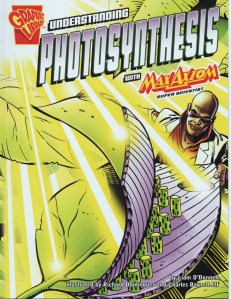
UnderstandingPhotosynthesisMaxAxiom A graphic novel about photosynthesis?

You bet.

And a good one too, thanks to the thorough explanation by super-intelligent Max Axiom Super Scientist and the illustrations by Richard Dominguez and Charles Barnett III.

In Understanding Photosynthesis with Max Axiom, Super Scientist by Liam O’Donnell, Max Axiom introduces young botanists to the word photosynthesis, explains how molecules are mixed and formed in the chloroplasts​ of plant cells, explains the role photosynthesis plays in the water cycle, and explains why plants cannot keep the air clean and the Earth healthy all by themselves. Max Axiom accomplishes all this in a conversational tone and without smothering readers with technical terms.

Includes a glossary, a list of recommended books and information about related Internet sites.

Target Age Group: 8-14
Reading Level: 3-4


Related

Plants & Comic Books

Read Full Post »

If you are looking for ways to engage with your audience about plants instead of talking at them about plants, make note of the 5E Learning Model. Whether you teach children or adults, the 5E Learning Model provides a framework with which you can create experiences to introduce plants to new audiences.

The 5E Learning Model, created by the Biological Sciences Curriculum Study (BSCS 1989), helps teachers plan learning opportunities for their students so they can Engage, Explore, Explain, Elaborate and Evaluate a topic. An example of how to apply this learning model to teach students about plants is presented in Discovering Flowers in a New Light by professors Rebecca L. McNall and Randy L. Bell.

In the unit created by McNall and Bell (2004), students learn how to explore flowers, learn how to use a digital microscope, learn how to draw and record their observations, and gain experience presenting their findings to classmates.

McNall and Bell (2004) created a methodical and thoughtful series of investigations into flower anatomy, flower form and flower function. Students are engaged from beginning to end, illustrating observations, writing hypotheses, and contemplating the function of flowers and their parts. Students also become immersed in technology through their use of a digital microscope. Students use the digital microscope to look at flowers and to photograph what they see through the scope. Students then insert their images into an electronic worksheet where they label flower parts and describe the function of each structure.

To help teachers prepare for this multifaceted activity, McNall and Bell (2004) share sources for digital microscopes and resources about microscopy and hands-on activities for children.

A copy of McNall and Bell (2004) can be purchased online from the National Science Teachers Association for 99¢.


Literature Cited

    Biological Sciences Curriculum Study (BSCS). 1989. New designs for elementary school science and health: A cooperative project of Biological Sciences Curriculum Study (BSCS) and International Business Machines (IBM). Dubuque, Iowa: Kendall/Hunt. Search your local college library

    McNall, Rebecca L. and Randy L. Bell. 2004. Discovering flowers in a new light. Science and Children. 41(4): 36-39


Also See

Read Full Post »

When students arrive in your classroom, what is their attitude towards plants?
How did these attitudes form?

If you teach a traditional botanical art class, you most likely have enthusiastic students with vast amounts of plant-based experiences and knowledge. If you lead nature walks and work with the public, you may find that your audience does not have a particular interest in plants.

Do you ever wonder what people’s experiences with plants have been prior to meeting them?

I do. While I don’t have an answer to the question above, I can share a study that might serve as a first step to answering this question.

In the late 1980s, then-graduate student Margarete R. Harvey, conducted a study of how children experience plants and how their experiences contribute to their interest in the environment. She describes her research project and findings in Children’s Experiences with Vegetation.

Harvey (1989) conducted a study in which she evaluated children’s experiences with vegetation as play objects, as food, as tasks, as obstacles, as ornament and as adventure. She created subcategories for each experience. Because knowing these subcategories is important to understanding even this very brief look at Harvey’s research, I need to create a quick list of each experience and their respective subcategories. Here they are as presented in Harvey (1989):

    Vegetation as Play Object
    (tree climbing; playing in tall grass; playing hide-and-seek in bushes)

    Vegetation as Food
    (picking fruit and vegetables; tasting leaves, flowers or berries;
    planting seeds)

    Vegetation as a Task
    (mowing the lawn; watering plants; pulling weeds)

    Vegetation as an Obstacle
    (being stung by nettles; allergic reactions; plants interfering with
    an activity)

    Vegetation as Ornament
    (growing houseplants; putting flowers in a vase; pressing leaves
    or flowers)

    Vegetation as Adventure
    (playing in a park; walking in a forest; camping)

Harvey (1989) created a questionnaire that was distributed to 995 children, ages 8-11, at 21 schools in England. Her analysis is based on the 845 completed questionnaires she received. Harvey analyzed how often students engaged in the 18 activities described above, their level of enjoyment with these experiences, children’s attitudes towards vegetation and their attitudes towards trees, bushes and flowers on school grounds.

Large amounts of data were analyzed. Here are some interesting points from Harvey (1989):

  • Boys enjoy contact with vegetation as play objects and as adventure.
  • Girls enjoy contact with vegetation more as food and ornament.
  • Girls’ attitudes towards vegetation is more positive overall.
  • Both boys and girls liked bushes the least. Boys liked trees best, girls liked flowers the most.
  • Older children had fewer positive reactions to plants, than younger children.
  • Children of higher socio-economic status had more experiences with vegetation, more contact with vegetation and expressed more appreciation towards plants.
  • Experiences with vegetation had a positive influence on children’s attitudes towards plants.

These points only hint at what is contained in Harvey’s interesting paper. Pick up a copy of her paper to learn about the tools she used to measure degrees of enjoyment, student interest in vegetation, and how children’s past experiences with vegetation influenced their attitudes towards plants.

Get a copy of Children’s Experiences with Vegetation at your local college library.


Literature Cited

Harvey, Margarete R. 1989. Children’s experiences with vegetation. Children’s Environments Quarterly. 6(1): 36-43.


Related

Read Full Post »
Years ago when I was teaching in grad school, the SimLife game was used as an activity in the Bio 101 labs to teach non-majors about population biology. Students had control of an assortment of variables and could watch generations of their sample population change over time. Students enjoyed the exercise and it helped them understand how the traits they assigned to their sample population resulted in either their population’s survival or eventual demise.

One of the objectives of incorporating botanical drawing into studies about the environment is to use it as a way to tell Nature’s story. Botany’s story is more than complicated terminology, labels with arrows and expensive textbooks.
In today’s column, we move beyond look-see-draw and engage in a bit of storytelling.


Botanical Illustration in the Lab

How does botanical illustration fit into a lab about population biology?

How about as a game?

Educators Erik Lehnhoff, Walt Woolbaugh and Lisa Rew explain how to do this in Designing the Perfect Plant: Activities to Investigate Plant Ecology.

What Lehnhoff et al. (2008) do first is lead students in a conversation about plant ecology. They show students photographs of whole plants, leaves, seeds, growing situations and other imagery related to plant ecology (Lehnhoff et al., 2008). They then ask students to consider the advantages and disadvantages of the growth forms, growing conditions and plant traits observed in the photographs.

Student observations become the foundation of a class conversation about plant ecology. With this conversation fresh on students’ minds, Lehnhoff et al. (2008) call upon students to design a plant with traits they think will ensure their plant’s long-term survival. Instead of creating a plant using a computer program, students are asked to draw their plant and to include in their drawing every trait they assigned to their plant. The authors ask students for a detailed drawing because they have observed that the “act of drawing the plant characteristics allowed students to better comprehend each of them, and to recognize how the plant may fit into its environment.” (Lehnhoff et al., 2008).

With their plants drawn, students then engage in a competitive game of cards. The game they play enables them to live with their plants through 10 generations. The custom deck of cards they play with contains four categories of cards. These categories are Weather, Dispersal Mechanisms, Disturbance Factors and Predation/Disease. Each card drawn exposes the carefully designed plants to conditions that could impact their survival. The cards in this custom deck each have a point value. Plants with the highest points per generation survive. Plants receiving negative points in repeated generations spiral towards extinction. After living through ten generations with their plants, students are asked to write about their plant’s fate.

This clever activity provides a way to introduce botanical illustration as a tool to learn about broad ecological concepts and to move it beyond its use as a tool to learn plant morphology. Included in this paper by Lehnhoff et al. (2008) are examples of the playing cards they use in their game.

Designing the Perfect Plant is available for purchase from the National Science Teachers Association (NSTA) at the NSTA Science Store (99¢). You can also search for this article at your local college library.


Literature Cited

Lehnhoff, Erik and Walt Woolbaugh, Lisa Rew. 2008. Designing the perfect plant: Activities to investigate plant ecology. Science Scope. 32(3): 29-35.


Related

Read Full Post »

« Newer Posts - Older Posts »