Feeds:
Posts
Comments

Archive for the ‘botanical art’ Category

This Fall, learn how to draw animals and plants at the Harvard Museum of
Natural History in Massachusetts.


Harvard Museum of Natural History

www.hmnh.harvard.edu
Serves as the public face of the Museum of Comparative Zoology, the Harvard University Herbaria and the Mineralogical and Geological Museum. Founded in 1998, this museum receives over 190,000 visitors each year.

  • Drawing Animals – Saturdays, September 24 – October 15, 2011; 9:30-11:30 AM. Learn how to draw what you see and capture movement while examining the museum’s zoological collection. Class size is limited. Cost: $140 nonmember, $126 members. View registration details here.
  • The Art of Botanical Drawing – Saturdays, November 5 – Dec 3, 2011; 9:30-11:30 AM. Learn botanical art techniques and explore plant forms using pencil, watercolor and colored pencil. All levels of experience welcome. Class size is limited. Cost: $140 nonmember, $126 members. No class on November 26. View registration details here.

This information has been posted to Classes Near You > Massachusetts.

Read Full Post »

Many updates now at Classes Near You > Washington!


Kathleen McKeehen, Scientific Illustrator

Kathleen is a teacher and freelance illustrator. Her work has appeared in Organic Gardening Magazine and The Herb Companion. View Kathleen’s artwork in the ASBA Members’ Gallery or at the Guild of Natural Science Illustrators’
Science-Art.com.

Gage Academy, Seattle

www.gageacademy.org

  • Botanical Watercolor: Autumn Cornucopia – Fridays,
    September 16 – November 18, 2011; 1:30 PM – 4:30 PM. Capture the elements of Fall using the dry-brush and wash techniques of traditional botanical watercolor to portray leaves, gourds, squash and corn. Cost: $420. Register online


Oil & Water Art Supply, Bainbridge Island

www.oilandwaterarts.com

  • Botanical Drawing/Painting – Ongoing on Tuesdays beginning September 21, 2011. Learn how botanical artists portray botanical subjects using pencils and watercolor. Oil & Water Art Supplies, Winslow, Bainbridge Island. Students pay per session. For additional details, contact 206-842-0477.


Center for Urban Horticulture, University of Washington

http://depts.washington.edu/uwbg

  • Beginning Botanical Watercolor – Wednesdays,
    September 28 – October 26, 2011; 7:00 – 9:30 PM. Learn the basic techniques of botanical watercolor painting. Students will learn dry-brush and wash techniques. Contact 206-685-8033 or register online.


Poulsbo Parks & Recreation

Fall 2011 / Winter 2012 Activity Schedule

  • Botanical Drawing – Mondays, October 17 – November 28, 2011;
    7:00 – 9:30 PM. In this seven-week course, learn how to draw botanical subjects in graphite using line and shading. Methods learned can be applied to a variety of subjects. Cost: $129. Supplies list provided at registration. Registration form
  • Botanical Watercolor – Mondays, January 23 – March 12, 2012;
    7:00 – 9:30 PM. Learn the dry-brush and wash techniques used in traditional botanical art in this seven-week course. Cost: $129. Supplies: $15 – $50, depending on student choice. Supplies available from instructor. Registration form


Bloedel Reserve, Bainbridge Island

www.bloedelreserve.org

  • Botanical Watercolor – Thursdays, October 6 – November 3, 2011. Learn the basic techniques of botanical watercolor painting. Students will learn dry-brush and wash techniques. Contact 206-842-7631 for more information.


Studio Classes

Botanical drawing and watercolor classes in Kathleen’s Indianola studio. Contact Kathleen for more information.

Read Full Post »

A new ten-week class about botanical illustration will be taught at Lewisham Arthouse in London. Here is what’s new at Classes Near You > England:


Lewisham Arthouse, London

www.lewishamarthouse.co.uk
The Lewisham Arthouse once served as the central library of Deptford. Designed by architect Sir Alfred Brumwell Thomas (1868-1948) and funded by Andrew Carnegie (1835-1919), this former library is now features a public gallery and studio space for professional artists. Artist studios are open to the public once per year. Exhibitions in the gallery are open to the public year-round, free of charge.

  • Botanical Illustration for All – Mondays, September 19 – November 28, 2011; 1:30 – 3:00 PM. This ten-week course is an introduction to the art and science of botanical illustration. Topics include botanical art history, contemporary botanical art, places of interest and botanical art collections. Participants will explore botanical art techniques and draw wild and cultivated plants. This class is open to adults of all abilities and levels of experience. Students must bring their own drawing supplies, painting supplies and sketchbook. Additional equipment will be provided. For more information and to register, contact instructor Alison Day at Lewisham Arthouse. Cost: £90 (£85 concessions) or £10 per session.
    Disabled access.

Read Full Post »

Click to enlarge image

Jeanne Debons Studio, Bend
www.jeannedebons.com
Dr. Jeanne Debons received her Ph.D. in the Department of Botany and Plant Pathology at Oregon State University. She graduated from the diploma course in Botanical Painting at the English Gardening School in 2005.

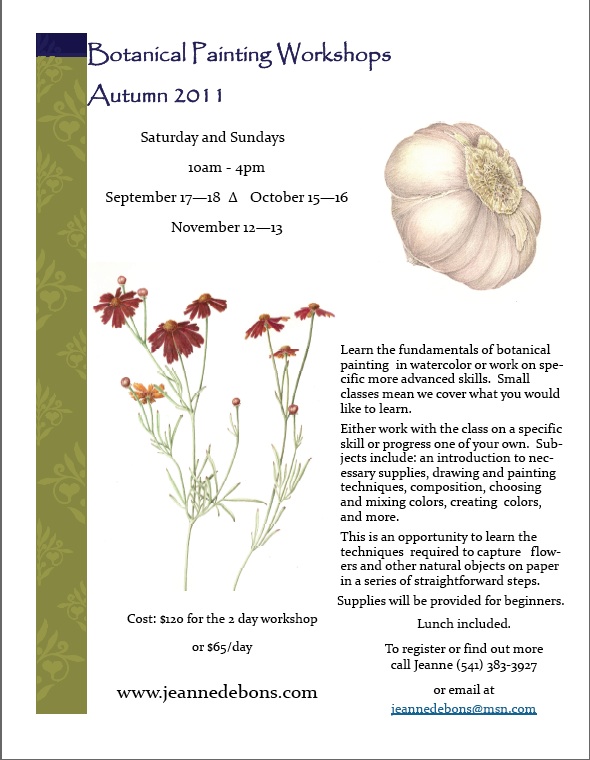
Two-Day Botanical Painting Workshop with Jeanne Debons

Learn the fundamentals of botanical painting in watercolor. Small class size ensures individualized attention. Supplies will be provided for beginners. Experienced students will work on more advanced skills. Drawing and painting techniques, color mixing, and composition will be discussed. Lunch is included for all students.

Saturdays & Sundays, choose from the sessions below.
All sessions held from 10 AM – 4 PM.

  • September 17-18, 2011
  • October 15-16, 2011
  • November 12-13, 2011

Cost: $120 for a two-day workshop (or $65/day).
Download course flyer

This information has been posted to Classes Near You > Oregon.

Read Full Post »

Brand new at Classes Near You > Ohio!


Cleveland Botanical Garden

www.cbgarden.org
A ten-acre garden in University Center, near the Cleveland Museum of Art. Stroll through ten different garden settings in Cleveland’s cultural district, visit The Garden Store and dine at The Garden Cafe. Free to the public.

  • Botanical Arts:  Autumn Splendor – Tuesdays, September 13, 20, 27 and October 4, 11, 18 & 25, 2011; 10:00 am – 12:30 pm. Instructor Susan Gray Bé instructs participants to improve their compositions while learning to balance mass, tone, line, color, texture and form. All mediums welcome, oil preferred. Independent drawing time in the garden. All levels of experience welcome. Discounted parking included.
    Cost: $130/members; $145/nonmembers.
    Register online or call (216) 721-1600, x100.
  • Botanical Arts: Watercolor Pencil Workshop – Saturday,
    September 17, 2011; 1:00 – 4:00 pm. Learn how to use watercolor pencils and colored pencils in botanical drawings from instructor Susan Morse. Previous drawing experience recommended as this class includes independent drawing time. Materials provided. Discounted parking included. Register online or call (216) 721-1600, x100. Cost: $20/member; $28/nonmember for this session OR join the additional workshop to continue your skills on Saturday, November 19. Special Two-Session Fee: $36/member; $50/nonmember. Please call 216.721.1600 x100 to register for this special two-session fee.
    Register online for the single September session.
  • Botanical Arts: Basic Botanical Drawing and Watercolor Pencil – Wednesdays, October 12, 19, 26 and November 2, 2011; 1:00 – 4:00 pm
Instructor Susan Morse will teach beginning artists line, shape, texture, and form so they can draw botanical images. Participants will also learn how to use watercolor pencils in botanical drawings. Cost: $72/member; $90/nonmember (entire series) OR attend only one session on October 12. Cost for the single October 12 session is $20 members/$28 nonmembers. To register for one session only, please call (216) 721-1600, x100. To register for the series, register online or call the number above.
  • Botanical Arts: Digital Photography Weekend Workshop – Saturday, October 22, 2011 from 8:00 am – 4:00 pm and Sunday, October 23, 2011 from 8:00 am – 12:00 pm. Learn how to capture autumn color from award-winning nature photographer, John Radigan. Demonstrations and group critique. Digital SLR cameras with manual exposure and focus preferred. Coffee and lunch on Saturday and all parking included with registration fee. Cost: $145/member; $160/nonmember; $135/Cleveland Botanical Garden Photography Club member (Photography Club members call (216) 721-1600, x100 to register and receive special discounted fee). All others, register online or call number above.
  • Botanical Arts: Watercolor Pencil Workshop – Saturday, November 19, 2011; 1:00 – 4:00 pm. Instructor Susan Morse introduces new techniques using watercolor pencils and colored pencils for botanical drawings. Previous drawing experience recommended as this class includes independent drawing time. Materials provided. Discounted parking included. Cost: $20/member; $28/nonmember. Register online or call (216) 721-1600, x100.

Read Full Post »

Welcome to Ask The Artist with Anna Knights. Unlike past sessions in which readers submitted questions to visiting artists, this time readers mostly shared their experiences and thoughts about distance learning programs in botanical art.

One reader asked Anna about how she enlarges her painting subjects. We will begin with this question and then jump into the topic of distance learning.

Sincere thanks to the readers who so openly shared their thoughts about learning botanical art outside of the classroom. This conversation would not be possible without your thoughtful comments.

Thank you to Anna Knights for sharing her work with us this month and for participating in the dialogue below.

Learn more about Anna in this interview from earlier this month. Also, be sure to visit Anna’s Facebook page to see Anna at work at a recent event.


A reader asks Anna…

    Most botanical artists’ work is true to actual size. Is yours done larger to achieve such magnificent detail? And if so, how do you so accurately enlarge it?

    AK: I like to enlarge to capture that magnificent detail but also to give the work much more impact than traditional life-sized work. I scale up using just a ruler and calculator. I work out the scale I’m enlarging to and then take a few measurements of key reference points in the composition and then freehand draw from there. This is made a lot easier when scaling up from photographs – which I make extensive use of.


Readers’ thoughts about distance learning options in botanical art…

    Reader #1

    I have had mixed results from distance learning courses. (In) my first attempt, I found the feedback to be inadequate and I kept getting graded down for stupid things like size of paper and other things that normally would have been inconsequential. It really shook my confidence and I can’t say that I learned any more than I might have just using the course book, which is not very detailed and sometimes confusing. There is no flexibility for lesson deadlines, which sometimes makes it difficult for those of us with other responsibilities. It (was) also a VERY expensive course. You pay the full amount (over $3000) in advance, and you don’t get any of your money back if you drop out.

    My second and ongoing experience has been completely different and truly wonderful. It is with the Academy of Botanical Art in Sarasota, FL. The instructors there understand that we are at all different levels and that we each have strong and weak areas. They are nurturing and confidence building and meet each student where they are rather than trying to force us all into one mold. The lesson materials for each class are very detailed and complete. Everything is spelled out and there is no need to try and guess what the instructor wants. It is also on a pay-as-you-go basis rather than having to pay the full amount up front. It is a much more personalized and less regimented program. It keeps me motivated to paint and learn rather than dreading the next assignment.

    I think that people should be able to research different possibilities before they sign up and commit big bucks toward an experience that may not meet their needs.


    Reader #2

    In answer to your questions about the distance-ed courses :

    I have taken one dist. ed. course and found that I was encouraged to keep working on the art while I learned. One my own, I have the tendency to drift to other things and don’t keep to a schedule.

    I would like to have a dist. ed. course so that I have a mentor who gives critiques, a schedule, a group of fellow students that I might be able to confer with, so basically I guess I need someone to give me a push and keep me interested.

    As to what type of format I would find ideal, I have to admit that I don’t know what this means. Presumably it means that I would like to have my work followed on-line. I have all of the botanical art books but need more confidence and someone to give me guidance. I would appreciate other students being able to contact me and vice versa for more support.


    Reader #3

    Sounds like a great idea, it will be an alternative to students, who for any number of reasons, cannot use the classroom style of learning. I live in Australia, and I have been using the distance learning system in the past, and also now, I am doing an art subject in Fine Arts, at the Open Universities Australia. I am enjoying the study but it is also very challenging. I am an emerging artist and I may be interested in the botanical course. How much does it cost?


    Reader #4

    I would be very interested in taking the Distance Learning Course in Botanical Illustration, with these provisos:

    Payment for the course should be in installments clearly pre-defined. Total payment up front does not generate confidence in prospective students for distance learning, sorry. The instructor should list his/her curriculum so distance students would know what to expect.

    A basic list of art materials should be given before enrollment, so that prospective students know what art materials are needed and can estimate cost. Good materials are expensive. Paper, paints and brushes represent an investment that all watercolor artists should have.

    Under these conditions I would be very interested in taking the course. I also think that the instructor(s) should tell us how they will conduct the course, that is how they will grade the lessons after they are mailed in. Will they make corrections or make suggestions on tracing paper over the sent-in lessons?

    I am a retired businessman from California, now living in Arizona. I am a self-taught amateur artist who loves botanical illustration, though I have never taken any live lessons, only from books.

    The instructor(s) have to make a commitment to the course, so I understand that they will require a certain number of students; I hope you get them. Also, after some time, will you stimulate students to exchange ideas and make this exchange possible?


    Reader #5

    I assume these are like the classroom classes with the regular demonstrations and how to do things plus an equipment list? I think it would be interesting to do this as I have never done it via computer.


    Reader #6

    I’d be very interested in a formal distance-learning program for botanical art/natural history illustration. Workshops and short courses offered by individual artists are also a good training option.

    The type of formal program I would be most interested in would be a certificate program and be offered by an accredited institution of some kind, whether a botanical garden, an extension division of a university, etc. It would be most practical to have the majority of the coursework handled online, with concentrated residency periods punctuating the course, say 1-2 weeks at the start, middle and end of the program. Certainly a 1-2 week workshop in residence midway would be needed.

    I was rather disappointed to read the details of the Denver Botanical Gardens’ distance program. That course would have required distance students to go to Denver nearly every weekend over the learning period–simply not practical for most people living outside of Colorado.

    For distance training offered by individual artists, I’d prefer a workshop of 1-2 weeks. This would allow a concentrated period to really make some progress. Weekend workshops would be excellent for a student who lives nearby. Certificates aren’t necessary for this type of course option.


    Reader #7

    Yes, I would take a distance learning class. I have taken many. Some use Nicenet, some used Dashboard, others used email. If you teach one online, I would attend.


    Reader #8

    I would like to know how distance educators feel about the progress of technology and the ability to enhance an art-based course by using either a Group Facebook page where photos of subjects can be discussed, video demonstrations can be posted, ideas exchanged or via email where attachments can show problem areas and be addressed more accurately. Botanical art has a chance to really shine in this format but it seems many distance educators are not as comfortable with email and Internet as their students are.


    Reader #9

    I would love to take a distance learning course but for real beginners…Even more with Anna.

    I don’t know if we can really learn by distance without, once in a while, (being) in real contact with the teacher. I am wondering if it could be a good idea to meet students first for at least ”2 weeks in a row” (why not during the summer? a great way to learn in a nice country and visit in the same time).

    I strongly believe that we should first get some basic knowledge with teacher and then start the distance program. The problems are: the distance and the cost. I guess we all want to get in a program like this because we would not have to travel. It saves time and money.

    All students don’t have the same goals. Some would like to paint for pleasure and some may think about a career. Some have already knowledge in painting, some don’t. So how (to) create a program for everyone? Maybe separated modules, or sessions. Like: drawing no1- watercolors 1- 2 etc. So everyone would be able to get into a course at their levels..Probably more work for the teacher.

    For myself, I am really interested to get in a program, well-structured with an ”available” teacher. The program, I would love, would be one where I can learn (from) the beginning. Learn how to sketch, learn about pigments in watercolors to be able to mix colors properly, etc. Project painting can be done after.

    Contact with students may be done by emails. Pictures of the works sent also by email and, further in the program, works may be sent by post. Internet is a great way to communicate, it is fast and ”free”.

    Voilà! I hope my English writing is OK. I am a French Canadian. Could add more but writing in English for me is work!

    Looking to hear from you. I am in love with your work and would be honored to be one of (your) distance students.


    Reader #10

    I most definitely would take an online botanical art class!


Anna’s reply to comments about distance learning
:

Thanks to everyone for your comments about the online course. They were really sensible and in line with my own thoughts about it. Having thought about it a bit more, what I am really proposing is to create a private online social network – along Facebook lines for those enrolled on the course. It would mean that students could also share work with each other as well as with me and interact as a group. Crucially my teaching style is all about instilling confidence and to that end is supportive and relaxed – so no harsh grading or anything like that – just constructive feedback to help students develop their own style and way of painting.

I would probably run it as a series of structured step-by-step exercises which people could pay per exercise or series of exercises – therefore allowing each student to tailor their learning and address the issues of different students having very different objectives. Then in terms of the content – I’d use video clips mainly to demo what I’m doing – along with stage-by-stage photographs – very much along the lines of the description by Reader 8. The whole course would be delivered online, so I would ask students to scan or photograph their work and email it. There may be some limitations to this but actually with the macro function on everyone’s digital camera it is perfectly possible for me to see close up the brush work, etc. I think there are huge possibilities for this and I plan to start work on the content to make sure I have a really comprehensive offering.

Thanks again for sharing your thoughts about it. If you’d like to sign up for my newsletter and be the first to know when I launch the online course you can do so via my Facebook page at http://www.facebook.com/AnnaKnightsArtist or the contact page of my website at www.annaknights.co.uk.
Read Full Post »

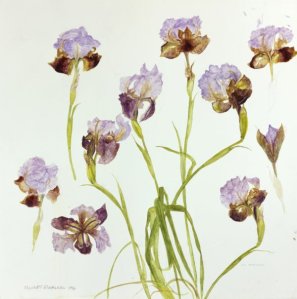
Elizabeth Blackadder, Iris oncocyclus (Courtesy National Galleries of Scotland)

ELIZABETH BLACKADDER

Scottish National Gallery
The Mound, Edinburgh

www.nationalgalleries.org
July 2, 2011 – Jan 2, 2012

Sponsored by Baillie Gifford

The artwork of one of Scotland’s most accomplished living artists, Dame Elizabeth Blackadder, is on view at the National Galleries of Scotland in Edinburgh. The exhibition celebrates Blackadder’s 60-year career and her 80th birthday.

Since launching her career in 1959, Elizabeth Blackadder has become known for her paintings, prints and drawings. She was the first woman artist to be elected to both the Royal Academy and Royal Scottish Academy and in 2001 she was honored with the title Her Majesty the Queen’s Painter and Limner in Scotland, a role that began with Sir Henry Raeburn almost 200 years ago. Blackadder studied at Edinburgh University and Edinburgh College of Art.

Included in the exhibition are Blackadder’s early drawings of the Italian landscape and its architecture. Her Pop Art-inspired work fills the central room of the exhibition, while her well-known drawings, paintings and prints about nature are celebrated in an adjacent room. Blackadder’s studies of nature illustrate her desire to capture the world around her, with no subject being too small or insignificant.

Blackadder traveled extensively throughout her career. In the 1980s, her visits to Japan made an impression on her and resulted in her embracing new techniques and imagery. A room dedicated to her exploration of the country’s unique customs, objects and design is included in this exhibit. On view are Japanese-inspired prints created by combining materials such as gold leaf with more conventional printing methods.

The exhibition concludes with recent and new paintings, drawings and prints.

John Leighton, Director-General of the National Galleries of Scotland said: 

Elizabeth Blackadder is, quite simply, one of Scotland’s greatest painters. She has revitalized long-established traditions of landscape, still life and flower painting in this country; she could be described as one of our finest painters in watercolor or equally lauded for her work as a printmaker. At once profoundly Scottish and enticingly exotic, her art is both familiar and mysterious. This major exhibition is both a celebration of her work and an invitation to look again at the achievement of an artist who could be described as a “national treasure”.


A Look at the Artwork of Elizabeth Blackadder

Courtesy of the National Galleries of Scotland

This slideshow requires JavaScript.


Also See
:

Read Full Post »

« Newer Posts - Older Posts »