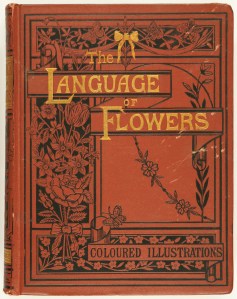
Cover of Robert Tyas’ The Language of Flowers, or Floral Emblems or Thoughts, Feelings and Sentiments (London, George Routledge and Sons, 1869), HI Library call no. DG21 T977L.
FLORA’S LEXICON
25 March–30 June 2011
Flora’s Lexicon explores the 19th-century European and American phenomenon of The Language of Flowers, the common understanding that plants and blooms were charged with sentiment and meaning and held the potential to express emotion or to communicate privileged messages within the strict confines of social etiquette. Flower associations made their way into Victorian language from various sources, including Japanese, Middle Eastern, Turkish, Greek and Roman cultures, religions and mythology, as well as the literature of Shakespeare and the still-life painting of 17th-century Dutch artists. The result was a fashionable system of floral connotations that blossomed during a time of burgeoning public interest in botany and its scientific importance.
So pervasive and popular was The Language of Flowers trend that it launched the introduction of the floral dictionary or Language of Flowers book, a small, beautifully bound and illustrated volume devoted to the decoding of each flower’s secret meaning. This sentimental craze and the books associated with it originated in France, the most notable being Le Langage des Fleures of 1819 by Charlotte de Latour. This volume was reprinted in multiple editions, translated into English and imitated by other French, British and American authors until the trend waned in the mid-1880s, shortly after English author and illustrator Kate Greenaway (1846–1901) published her charmingly illustrated floral dictionary, The Language of Flowers (1884).
The Language of Flowers book phenomenon also attracted the skills of numerous
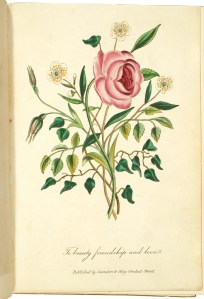
To beauty, friendship and love (rose, ivy and myrtle), hand-colored engraving published by Saunders and Otley, Conduit Street, from Anna Christian Burke’s The Illustrated Language of Flowers (London, G. Routledge and Co., 1856), HI Library call no. DG21 B959I.
respected botanical artists of the era, including Pierre-Joseph Redouté (1759–1840), Pancrace Bessa (1772–1846), Pierre-Jean-François Turpin (1775–1840) and Pierre-Antoine Poiteau (1766–1854). Although their illustrations for this genre differed slightly in scale and scientific detail from their major works, they were prized for their beauty and added to the appeal of these intricately bound and decorated volumes while serving to familiarize a large segment of the population with the artists’ talent.
Flora’s Lexicon presents books from the Hunt Institute’s Library and botanical portraits from the Art Department in an examination of the scope of The Language of Flowers phenomenon, from the influences on its beginning to its continued presence in 21st-century publishing. Differing approaches to the floral dictionary are displayed, while intricate systems of meaning are explored through artworks of many key 18th- and 19th-century botanical artists and illustrators.
Location & Hours
The exhibition will be on display on the 5th floor of the Hunt Library building at Carnegie Mellon University and will be open to the public free of charge. Hours: Monday–Friday, 9 a.m.–noon and 1–5 p.m.; Sunday, 1–4 p.m. (except 22–24 April; 15 and 29–30 May). Hours subject to change, please call or email before your visit to confirm viewing hours. For further information, contact the Hunt Institute at 412-268-2434.
Hunt Institute for Botanical Documentation
5th Floor, Hunt Library
Carnegie Mellon University
4909 Frew Street
Pittsburgh, PA 15213-3890
Telephone: 412-268-2434
Email: huntinst@andrew.cmu.edu
Website: http://huntbot.andrew.cmu.edu
Directions: View map
Read Full Post »
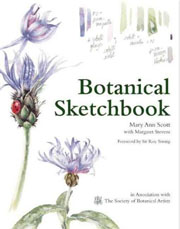 Mary Ann Scott’s Botanical Sketchbook is an open journal in which she describes her experiences as a student in the Distance Learning Diploma Course administered by the Society of Botanical Artists in the UK. Scott presents actual assignments, as well as the marks she earned for each assignment. Readers are given a front row seat to Scott’s insecurities, decisions, mistakes and successes. This book’s format is unique and provides a level of insight into the SBA diploma program that is not available anywhere else.
 When she was a little girl,


 ArtPlantae Today