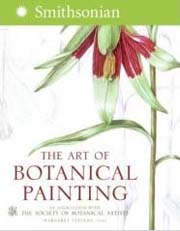
 The Art of Botanical Painting
Only 4 copies remain! Lessons in botanical art by members of the Society of Botanical Artists in the UK.
Sale $19.95 (reg. $29.95)
Table of Contents
Chapter 1 – Introduction
Chapter 2 – Materials
Chapter 3 – Plant Anatomy for a Painter
Chapter 4 – Drawing Techniques
Chapter 5 – Working with Colored Pencils
Chapter 6 – Watercolor Painting Techniques
Chapter 7 – Foliage Color
Chapter 8 – Flower Library
Chapter 9 – Composition
Chapter 10 – Flower Portraits in Watercolor
Chapter 11 – Painting in Gouache
Chapter 12 -Working in the Field
Chapter 13 – Painting Fruit
Chapter 14 – Painting Vegetables
Chapter 15 – Photography As An Aid
Chapter 16 – Flowers In The Garden
Chapter 17 – Botanical Illustration
Chapter 18 – Presentation and Framing
Chapter 19 – Exhibiting and Selling
Archive for the ‘ArtPlantae Books’ Category
Going Once… The Art of Botanical Painting
Posted in ArtPlantae Books, botanical art, botanical art books, Special Announcements on May 24, 2010|
Sarah Simblet Webinar Coming Soon!
Posted in ArtPlantae Books, botanical art, Education, Learning Opportunities, Special Announcements, Special Events on May 20, 2010|
 “Ask The Artist” goes live next week and this is very exciting. If you haven’t signed up yet for this event, please consider doing so. The book Botany for the Artist is a treat. Sarah’s live presentation will make the book extra special as you will be able to bundle it with memories of learning live from Sarah as she speaks to us from the UK. During her presentation, Sarah will discuss how she created the book and how materials were collected. She will also discuss her technique and share her preparatory sketches as she refers to pages in the book.
There is still time to register for this event. Sarah’s inspirational presentation will occur on Thursday May 27, 2010 at 12 pm (PST). Yes, you could just buy the book. However, with so many options to learn, why not choose the live version when you can?
UPDATE: Read a post-event review and learn how you can view a recording of this event.
An Elegant Blend of Botany, Botanical Art History, Art
Posted in ArtPlantae Books, book review, botanical art, Special Announcements, Special Events on May 10, 2010| 3 Comments »
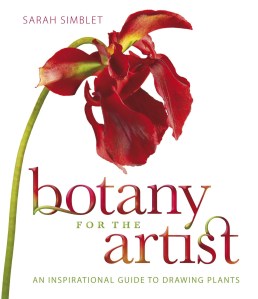 Many of you are gardeners and are probably familiar with Botany for Gardeners by Brian Capon. In his book, Capon turns a lot of the concepts and terminology from botany into easily digestible bits of information. What Capon did for gardeners, Sarah Simblet has done for artists. Botany for the Artist is a wonderful blend of general botany, botanical art history, and Art 101.
Imagine opening a book and immediately going back to the 5th century, a time when text was valued more than illustrations and when it was common for artists to work without ever looking at live plant specimens. Then journey ahead to the 14th century to learn when artists began to draw from nature. Continue on to learn about over-zealous plant collectors, personal drawing books, plant exploration, and the use of plants as a visual metaphor for life.
Now imagine entering a conversation with Sarah herself, a respected author and instructor at the National Gallery in London and the Ruskin School of Drawing at the University of Oxford. Simblet transitions readers from merely reading about botanical art to doing botanical art in her section about drawing plants. Here Simblet presents a range of materials artists may want to keep in their field bag and provides information about watercolor paper, pencils, erasers, dip pens, ink, paint, and brushes. She then demonstrates how to make lines and marks and how to mix colors using red, yellow, and blue paint. Simblet’s comments about how she creates preparatory drawings and finished drawings provides great insight into what readers will discover beyond this section — a lavishly illustrated introduction to botany. Elegant and graceful, Simblet’s illustrations depict movement, energy, and life. So much so, they really can’t be called “plant portraits.” Simblet’s plants are living and breathing and so full of form, they should make crunching sounds when the book is closed.
In her illustrated guide to plants, Simblet discusses plant diversity and the morphology and function of roots, stems, leaves, flowers, fruit, cones, and seeds. Dispersed among text about how roots work, leaf structure, pollination, and seed dispersal, are lessons in art history and botanical illustration.
Simblet’s Masterclass feature is like touring a museum with your own personal tour guide. In each section, Simblet selects one painting and provides information about the feature artist and their work. Featured artists include: Nikolaus Von Jacquin, Albrech Durer, Girolamo Pini, Kano Yukinobu, John Miller, Leonardo da Vinci, John Ruskin, Ferdinand Bauer, Arthur Harry Church, Mali Moir, Giovanna Garzoni, Mark Catesby, and Maria Sibylla Merian.
In her Drawing Class and Study sections, Simblet teaches artists how to observe and capture the morphological features of plants and how to relate each feature to each other. There are sixteen Drawing Class sections in the book and these sections address too many topics to list here.
Would you like to experience a little bit of what there is to learn in this wonderful new book? If so, read about the special event below.
Ask The Artist Goes Live!
 ArtPlantae is very excited to announce a special session with Sarah Simblet.
On Thursday May 27, 2010 at 12:00 p.m. PST, ArtPlantae will host a one-hour webinar with the very gracious Sarah Simblet. Sarah is preparing a special presentation for you and will answer your questions live from the UK. All participants will receive a copy of Botany for the Artist upon registering. The cost of this special author event is $40 (the cost of the book), plus shipping.
Registration closes Monday May 24, 2010.
UPDATE: Sarah Simblet Takes Artists Behind the Scenes
Other Titles by Sarah Simblet
- Sketchbook for the Artist
- Anatomy for the Artist
Unusual Airplants of the Bromeliaceae
Posted in ArtPlantae Books, general botany on May 6, 2010|
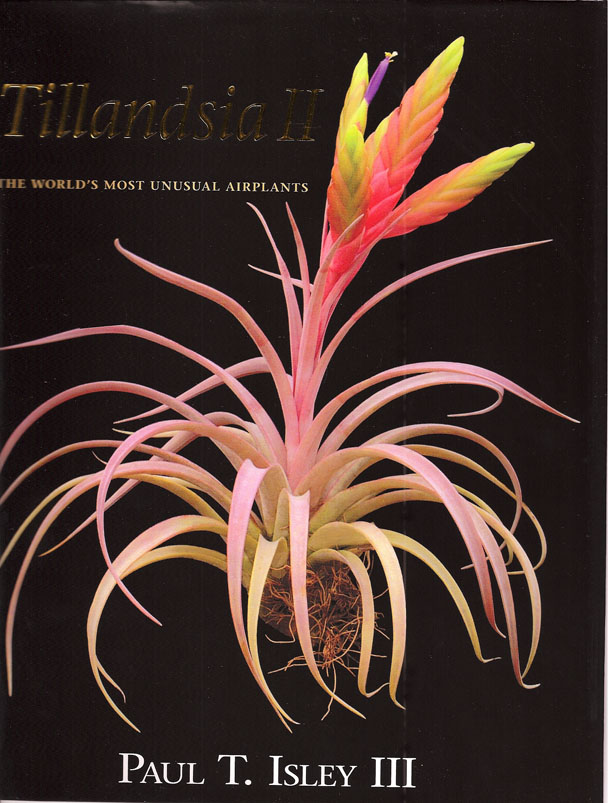 Tillandsia II was written by Paul T. Isley III, one of the co-founders of Rainforest Flora, Inc.. This book is a continuation of Isley’s Tillandsia that was published in 1987. It features updated nomenclature, wonderful color photographs, and a chapter dedicated to Tillandsia hybrids developed over the past 22 years.
The plants in this book are so fascinating, that reading happens at a snails pace because your eye is always drawn to the photograph(s) on the opposite page. Isley provides an overview of the genus Tillandsia and discusses how these plants should be cared for in both outdoor and indoor environments. Included in this discussion are instructions on how to mount a plant onto a substrate and how to incorporate Tillandsia into the landscape. Isley ends the book with a detailed chapter about Tillandsia evolution and biology. To aid the reader in his/her own studies of these intriguing plants, Isley includes a laminated ruler with each book.
Tillandsia II is a self-published title printed by Isley’s Botanical Press.
A Gardener’s Journal Includes History of Plant Exploration, Conservatories, & Gardening
Posted in ArtPlantae Books, gardening on May 6, 2010|
 Paradise Under Glass: An Amateur Creates a Conservatory Garden is the true story of an award-winning author’s transformation into an avid gardener after a spontaneous visit to the U.S. Botanic Garden Conservatory in Washington, DC during a time marked by personal loss and midlife changes.
Ruth Kassinger shares the ups and downs of her journey into gardening and the creation of a conservatory in her home. This entertaining memoir is more than an open journal. It is a fantastic history lesson. Kassinger discusses the history of plant exploration, glass houses, botany, pest control, the Biosphere, and a bit of botanical illustration too. She visits plant growers, nurseries and botanical gardens to discuss plants, gardening, and her conservatory with the experts. To assist readers with the many plant names she uses in the book, Kassinger provides a pronunciation guide in one of the appendices. In the other appendix, she supplies instructions on how to create a living wall.
Each chapter opens with a botanical illustration by artist Eva-Maria Ruhl. Ruhl is a member of the American Society of Botanical Artists and a graduate of the certificate program in botanical art at the Corcoran School of Art and Design. View Ruhl’s artwork and works-in-progress on her blog.
Ruth Kassinger’s wonderful new book is available at ArtPlantae Books.
Related
Green Living & Botanical Art at L.A. Garden Show
Posted in ArtPlantae Books, botanical art, Special Events on April 22, 2010|
The L.A. Garden Show will be held next week at the Los Angeles County Arboretum & Botanic Garden. There will be eco-gardening ideas, garden tours, garden chats, activities for children, a bustling marketplace, and the unveiling of the new Permasphere. There will also be botanical art. Lots of it.
Members of the Botanical Artists Guild of Southern California are currently showing their work in the Arboretum library, located near the main entrance. Their exhibition, Seeing the Details will be on view through June 30, 2010. The Guild will also be in the Marketplace conducting demonstrations, selling prints and cards, and discussing their work with garden show visitors.
ArtPlantae Books will be in the Marketplace as well. We hope to see you in the garden!
The L.A. Garden Show will be held April 30 – May 2, 2010. Admission is $3 (Ages 5-12), $6 (Students & Seniors), $8 Adults. Parking is free with shuttle. Preferred parking is $10. View all details here.
Directions to Arboretum
Teaching Botany & Botanical Art from the Ground, Up
Posted in ArtPlantae Books, Special Announcements on April 17, 2010|
Two summers ago, Wendy Hollender picked strawberries near the home of a fellow botanical artist. She immediately fell in love with farming and everything associated with connecting with the land and growing fruit and vegetables. Back home in Manhattan, Wendy kept having visions of a country farm where she could work the land, teach botanical art classes, and open a store with a botanical theme.
The following summer, Wendy looked for winterized homes. Realtors kept showing her weekend houses, but what Wendy really wanted was a farm where she could grow fruits, vegetables and teach classes. After eight months of searching, Wendy found her 4-acre homestead and 1860 farmhouse near the strawberry farm that first inspired her. Hollengold Farm is located in Accord, NY in a valley of farms with the Catskill Mountains on one side and the Shawangunk Mountains on the other.
Both of Wendy’s adult children studied permaculture, so they designed the 3,000 square foot vegetable garden established in the farm’s first year. About to enter its second growing season, the vegetable garden has been redesigned and is now one acre. Only hand crops will be grown and this means machinery will not be used to harvest the crops.
Managing a large garden is no easy task. Volunteers, family and friends helped to get the farm started and volunteers and interns keep the farm running. Requiring special attention and planning is the management of the farm’s water use. Last year drip hoses and sprinklers were used. Now that the garden has grown to over 10 times its original size, managing and assessing how water is harvested and used on site is a never-ending task. Recently, a new roof catchment system was established. A new roof was placed on the barn and this roof directs water runoff into special catchment buckets. This water is then used to irrigate growing crops.
Before Wendy purchased Hollengold Farm, the four-acre property was a horse farm. In fact, the barn used to be a horse stable. The former stable is currently being renovated to become the center of activity at the farm. The renovated barn will serve as the location for plant propagation, studio space, gallery space, a farm stand, a commercial kitchen, and a shop for botanical-themed items. Wendy’s daughter is a chef and she will soon be preparing tasty fresh entrees. A masonry oven is being built to make wood-fired pizza. She will also can fruits and vegetables to sell at the new store. Plans are in motion to create a “seed to grain” learning experience for children from nearby school districts. This program will be based on the children’s story The Little Red Hen and show students how seeds become wheat, how wheat becomes flour, and how flour becomes bread.
The planned studio and gallery space are where Wendy will teach her botanical art classes and showcase her work and the work of her students. Wendy is currently teaching one-day workshops at the farm. A popular teacher in-person and here at ArtPlantae Today (Wendy’s Ask The Artist Q&A is the most read article of all time), her popularity is sure to increase when her second book is released later this summer. When Wendy sat down to talk about the farm, she also talked about Botanical Drawing in Color: A Basic Guide to Mastering Realistic Form and Naturalistic Color. Here is what she had to say…
ArtPlantae: How did the idea for a new book materialize?
Wendy Hollender: I just finished the first book. I contacted Faber-Castell to tell them I recommended their pencils in my workbook. They invited me to do a demonstration at a trade convention. At the convention, many publishers were present and they expressed an interest in my workbook. Random House asked for a proposal and asked for a completed book within four months of accepting my proposal.
AP: Will the new book be similar in design to your first book? Will there be many steps broken down with descriptive illustrations?
WH: Yes. The steps will be broken down and will be very descriptive. Each step will be broken down to minute detail. Watching artists use the first book, I realized what I left out. Random House had a 25,000 word requirement, so this book has more text than the first book. I loved writing the book. I wrote in the morning. At first I began writing about my personal experiences with botanical art. I wasn’t sure if this was acceptable, so I told them what I had been doing. I was told to write the book the way I wanted to write it. In the end, all of the content and concepts I created stayed in the book. Only a few minor changes were made.
AP: What topics do you discuss in the new book?
WH: Perspective, plant structure, composition, color, drawing in the field, working with a microscope and how to draw white flowers on a white background.
AP: What would you like people to know about your new book?
WH: What is exciting about my book, and why Random House wanted to publish it, is that it focuses on botanical drawing in color. Colored pencil isn’t just a medium to use, it is also a learning tool. It allows you to teach drawing skills and teach about color at the same time.
Wendy also mentioned her new book took six months to write and six months to edit. With this book, Wendy hopes to take the struggle out of creating botanical art for artists of all levels. If you own a copy of Botanical Drawing: A Beginner’s Guide you already know how well Wendy can teach without even being in the same room with you. Join us as we anticipate the July 2010 release of Botanical Drawing in Color.
UPDATE:
Wendy Hollender to Discuss “Botanical Drawing” Live!
August 18, 2010
-

I’m curious about…
What Readers Are Reading Now
Plants & You

Featured Guests
Global Impact

Botanists and illustrators strive to document conifers around the world.
Nature Near You
 ArtPlantae Today
