Feeds:
Posts
Comments

Plants have a presence in each of the paintings created by Ruth Ava Lyons.
I asked Ruth why she chose plants to connect viewers to nature.

Ruth replied:

I like a field-based approach to my subject matter. I wander in various environments and study and synthesize and translate and interpret my impressions of the natural world. Artists like me vacillate between our direct experiences in nature and the solitary studio setting. We follow the work of biologists, botanists, ecologists, and naturalists to inform and strengthen our visions with their findings, so there is a lot of cross-cultural personal research that takes place as well. It is always challenging for me to attempt to capture the essence of plant imagery while…

Read More

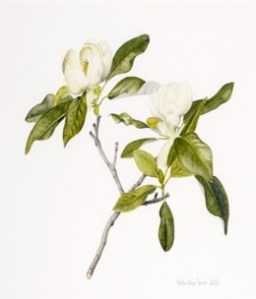
Magnolia virginiana painted by Keiko Tarver, a member of the Philadelphia Society of Botanical Artists. The magnolia is one of the American plants sent to England by John Bartram whose garden was and is still in Philadelphia.

Magnolia virginiana painted by Keiko Tarver, a member of the Philadelphia Society of Botanical Artists. The magnolia is one of the American plants sent to England by John Bartram whose garden was and is still in Philadelphia. Used with permission.

The Philadelphia Flower Show opens in only a few weeks. The world’s longest-running and largest indoor flower show will be held March 2-10, 2013 at the Pennsylvania Convention Center.

In honor of the show’s theme “Brilliant!”, the Philadelphia Society of Botanical Illustrators will present “Her Majesty’s Bouquet”, a botanical art exhibition featuring the flowers of Great Britain. Included in the exhibition will be paintings of hollyhocks and peonies, hellebores and daffodils — all flowers found in Great Britain. Many of the plants and flowers that will be on view were sent originally to England by Philadelphia naturalist, John Bartram.

Members of the Philadelphia Society of Botanical Illustrators (PSBI) will be at the show daily from 10:00 am to 6:00 pm to conduct demonstrations, distribute coloring sheets to children, and to discuss the more than 50 paintings that will be on view during the show. These paintings were selected from more than 80 that were submitted. Three judges from the fields of horticulture, botany and art chose the final pieces for this exhibition.

Botanical art is an ancient art form whose original purpose was to accurately depict the herbs and flowers important to medicine. Today it continues to aid botanists, horticulturalists, and pharmaceutical scientists with their identification of new plant species. Contemporary botanical artists celebrate nature with not only precision, but also an appreciation of its beauty and intricacy. As Virginia Fitzpatrick, president of PSBI, says, “We combine intellectual knowledge of plants and experience with art materials into our paintings and drawings.”


About the Philadelphia Society of Botanical Illustrators

The Philadelphia Society of Botanical Illustrators was formed 15 years ago and has over 75 members. The Society exhibits throughout the Delaware Valley. Past venues include The Station Gallery outside Wilmington, the Friends Hospital in Northeast Philadelphia, and the Jenkins Arboretum in Devon. Their focus is “to bring botanical illustration to the attention of many audiences”.

For more information, contact Sarah Maxwell.

A three-part series in plant identification begins this weekend at the Fullerton Arboretum.

Here’s the latest from Classes Near You > Southern California:


Fullerton Arboretum

www.fullertonarboretum.org
Located on the campus of California State University Fullerton, the Fullerton Arboretum was established in 1979 and is the largest botanical garden in Orange County.

    Introduction to Plant Identification
    Study the characteristics botanists use to classify, identify, and recognize major groups and families of plants. Examine fresh plant material, preserved specimens, photographs, and published references to learn plant parts and functions. Each class will build on the next, but they can be taken individually. Each class meets from 9 AM to 1 PM.
    To register, please call (657) 278-3407.
    Cost (a la carte): $25 members, $30 nonmembers
    Cost (full series): $70 members, $85 nonmembers

    Intro to Plant ID (Part I) – February 9, 2013
    Intro to Plant ID (Part II) – March 23, 2013
    Intro to Plant ID (Part III) – April 13, 2013

Feature guest Ruth Ava Lyons paints in oil and prefers oil over acrylic. She also applies other media to her paintings. I asked what is it about oil that captures her attention. She replied:

Oil is a very seductive medium. It has a richness of palette that is hard to simulate in acrylic which sometimes sends a visual clue that it is man-made/plastic/synthetic. In my youth, I studied the old masters and became very fond of their techniques with oil…

Ruth discusses her use of oil, metal leaf, gold leaf and more

Ruth Ava Lyons is an artist living in Charlotte, North Carolina. The botanical images she creates are not like those found in botanical art, yet they make the same connections between plants, people and nature that botanical artists hope to establish with their audience.

Ruth’s images are vibrant, emotional and pull you into Nature’s landscape. She has completed several artist residencies. Most recently in the Everglades National Park Artist in Residence Program in Florida. This year she will travel to the Great Barrier Reef in Australia to complete an artist residency at the Heron Island Research Station, supported with a Regional Artist Project Grant. This project was made possible through the support of the North Carolina Arts Council, a state agency, the Blumenthal Endowment, and the arts councils in Cabarrus, Cleveland, Gaston, Iredell, Mecklenburg, Rowan, Rutherford, Union, and York (South Carolina) counties. Ruth is represented by Hidell Brooks Gallery in Charlotte, NC.

Ruth has graciously agreed to spend time with us this month to discuss her art and her experiences as an artist in residence.

Please welcome Ruth Ava Lyons as this month’s special guest!

Jay Fitzsimmons, whose trading card activity we learned about in Friday’s teaching and learning column, has provided links to articles about plant traits associated with conservation issues. How can this new information be used to create new trading card activities?

If you are looking for more ideas about how to use trading cards in your classroom or program, read comments posted in response to Jay’s article and add your own to continue this conversation.


Related

Use Trading Cards to Teach Natural History

A new class about tree identification and care will begin at the Los Angeles County Arboretum and Botanical Garden this Saturday.

Here is what’s new at Classes Near You > Southern California:


What Tree Is That?

Dr. Jerrold Turney, Instructor
Bamboo Room: 10am – 12noon

Learn the trees of southern California in this four-session class with plant pathologist and arborist, Dr. Jerrold Turney. Participants will learn about 60 trees, 21 of them this Saturday! A one-hour lecture will be followed by a walk in the Arboretum during which participants will learn how to identify the trees they just learned about in lecture.

Pre-registration preferred, but you may register at the door. Please call the Class Registration line at 626.821.4623.
Cost: $25 Members/$30 Non-Members (includes Arboretum admission)
View Details/Register

Meeting Dates

  • Saturday, February 2
  • Saturday, March 2
  • Saturday, April 13
  • Saturday, May 11

And don’t miss…


Colored Pencil in Botanical Art with Cristina Baltayian

Learn the colored pencil techniques used by botanical artists. Special topics to be explored in 2013 include: water-soluble pencil techniques, solvents, colored pencil sticks, pen & ink with colored pencil, composition. All levels of experience are welcome. Students will receive a supply list. Registrants may bring a lunch or buy lunch at the Peacock Cafe.

Dates for 2013
February 5, 12, 19, 26
March 5, 12, 19, 23
April 2, 9, 16, 23
May 7, 14, 21, 28
June 4, 11, 18, 25
July 2, 9, 16, 23

10 AM – 2 PM (includes lunch break)
$255/mo. Arboretum members per month
$275/mo. Non-members per month
Pre-registration required; please call (626) 821-4623

Cristina Baltayian is a botanical artist with a background in drawing (graphite, charcoal, pen & ink), two-dimensional design, watercolor and colored pencil. Her work has been shown at Filoli, the Los Angeles County Arboretum and Chapman University. She is a member of the Botanical Artists Guild of Southern California and the American Society of Botanical Artists.