Feeds:
Posts
Comments

Morphology Preview copy

Five members of Amicus Botanicus, a painting group formed by graduates of the 2004 Botanical Painting Diploma Course at The English Gardening School, will take part in MOR.PHOLO.O.GY: An Exhibition of Botanical Art at the Sunbury Embroidery Gallery at Sunbury-on-Thames, near London. This exhibition opens on July 2, 2013 and will be on view through July 28, 2013.

Artist Louise Young says, “The gallery is a delightful little modern gallery within a lovely walled garden in the middle of Sunbury. It is close to Hampton Court Palace where the flower show will be held in July.”

In this exhibition, artists Linda McDonald, Mary Ellen Taylor, Louise Young, Caroline Jenkins and Shirley Slocock share their views of the natural world.

Be sure to also add to your calendar the presentation about orchids in art by Dr. Phillip Cribb, former Deputy Director and Herbarium Curator at the Royal Botanic Gardens, Kew. Dr. Cribb is the co-author of A Very Victorian Passion: The Orchid Paintings by John Day, a book about orchid enthusiast, John Day (1824-1888). This very inspiring book contains a sample of the more than 2,300 orchids painted by Day that are housed at the Royal Botanic Gardens, Kew. Dr. Cribb wrote this book with Michael Tibbs in 2004.

Mor.phol.o.gy

Sunbury Embroidery Gallery
Sunbury-on-Thames, England
July 2-28, 2013

Now at Classes Near You > Massachusetts!


Massachusetts College of Art and Design

massart.edu
Professor Saúl Nava teaches the life sciences and biology at the Massachusetts College of Art and Design (MassArt). He also teaches summer programs about art and biology. One program is called Field BIO+ART: Collaborative R.N.A. (Research in Nature and Art). The other program is about natural history and biological art and is an introduction to visualizing plants, animals and natural forms. This second class begins soon. Sign-up today!

    Natural History and Biological Art
    Monday-Wednesday, July 8 – July 31
    9:30- 1:00 PM

    This course provides an introduction to visualizing and exploring the diversity of wildlife, habitats, and biological forms of plants and animals through art and direct observation in the field. Through careful examination, illustration, microscopy, and photography, participants will study and visualize anatomical, behavioral, and ecological similarities and differences between species. Participants will use various media but will focus on classical observation and drawing/painting techniques in the field. This course involves travel to various locales, field sites and The Harvard Museum of Natural History. View the blog from the 2012 course at http://naturalhistorybiologicalillustration.blogspot.com.
    View Details/Register

Years ago when I was teaching in grad school, the SimLife game was used as an activity in the Bio 101 labs to teach non-majors about population biology. Students had control of an assortment of variables and could watch generations of their sample population change over time. Students enjoyed the exercise and it helped them understand how the traits they assigned to their sample population resulted in either their population’s survival or eventual demise.

One of the objectives of incorporating botanical drawing into studies about the environment is to use it as a way to tell Nature’s story. Botany’s story is more than complicated terminology, labels with arrows and expensive textbooks.
In today’s column, we move beyond look-see-draw and engage in a bit of storytelling.


Botanical Illustration in the Lab

How does botanical illustration fit into a lab about population biology?

How about as a game?

Educators Erik Lehnhoff, Walt Woolbaugh and Lisa Rew explain how to do this in Designing the Perfect Plant: Activities to Investigate Plant Ecology.

What Lehnhoff et al. (2008) do first is lead students in a conversation about plant ecology. They show students photographs of whole plants, leaves, seeds, growing situations and other imagery related to plant ecology (Lehnhoff et al., 2008). They then ask students to consider the advantages and disadvantages of the growth forms, growing conditions and plant traits observed in the photographs.

Student observations become the foundation of a class conversation about plant ecology. With this conversation fresh on students’ minds, Lehnhoff et al. (2008) call upon students to design a plant with traits they think will ensure their plant’s long-term survival. Instead of creating a plant using a computer program, students are asked to draw their plant and to include in their drawing every trait they assigned to their plant. The authors ask students for a detailed drawing because they have observed that the “act of drawing the plant characteristics allowed students to better comprehend each of them, and to recognize how the plant may fit into its environment.” (Lehnhoff et al., 2008).

With their plants drawn, students then engage in a competitive game of cards. The game they play enables them to live with their plants through 10 generations. The custom deck of cards they play with contains four categories of cards. These categories are Weather, Dispersal Mechanisms, Disturbance Factors and Predation/Disease. Each card drawn exposes the carefully designed plants to conditions that could impact their survival. The cards in this custom deck each have a point value. Plants with the highest points per generation survive. Plants receiving negative points in repeated generations spiral towards extinction. After living through ten generations with their plants, students are asked to write about their plant’s fate.

This clever activity provides a way to introduce botanical illustration as a tool to learn about broad ecological concepts and to move it beyond its use as a tool to learn plant morphology. Included in this paper by Lehnhoff et al. (2008) are examples of the playing cards they use in their game.

Designing the Perfect Plant is available for purchase from the National Science Teachers Association (NSTA) at the NSTA Science Store (99¢). You can also search for this article at your local college library.


Literature Cited

Lehnhoff, Erik and Walt Woolbaugh, Lisa Rew. 2008. Designing the perfect plant: Activities to investigate plant ecology. Science Scope. 32(3): 29-35.


Related

TheTradescantsOrchard There is a book about fruit that is surrounded by mystery and intrigue.

Is it a book?
Is it a catalog?
Is it a teaching tool about fruit trees?

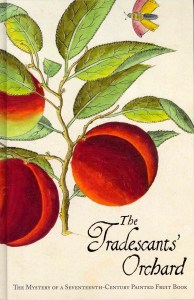
The Tradescants’ Orchard is more catalog than book and, according to evidence of how often each painting has been handled, was also a teaching tool, according to authors Barrie Juniper and Hanneke Grootenboer.

Juniper and Grootenboer, together with the Bodleian Library, have published The Tradescants’ Orchard: The Mystery of a Seventeenth-Century Painted Fruit Book — a fascinating look at plantsman John Tradescant the elder, his son John Tradescant and their contributions to horticulture and the development of fruit orchards in 17th century Europe.

Originally called A Book of Fruit Trees with their Fruits (Juniper & Grootenboer, 2013), a photograph of this 400-year old manuscript is included in their book.

You are most likely already familiar with the Tradescants. The Spiderwort plants bear their family name (Tradescantia). Does this houseplant look familiar?

The Tradescant father and son team were responsible for introducing and raising many familiar garden plants (Juniper & Grootenboer, 2013). John Tradescant the elder was a sought-after plantsman in elite circles, operated a large nursery and, because of his extensive traveling, built an impressive cabinet of curiosities (Juniper & Grootenboer, 2013). When he died in 1638, John Tradescant the younger took over the family business and eventually became acquainted with Elias Ashmole.

This is where the story of the colorful manuscript containing 66 paintings of fruit and imaginary arthropods, frogs, birds, snails, a lizard and a squirrel gets very interesting.

Thought to be created somewhere around the 1620s or 1630s, The Tradescants’ Orchard was published when interest in growing fruit and when creating horticultural information for the public became popular (Juniper & Grootenboer, 2013).

Who commissioned the manuscript?

How did it end up at the Ashmole Museum?

What is unique about the paintings?

Much is explained in the forty-one pages of text leading up to Juniper & Grootenboer’s reproduction of The Tradescants’ Orchard. Their book is yet another wonderful chapter about the history of botanical art.


Literature Cited

Juniper, Barrie and Hanneke Grootenboer. 2013. The Tradescants’ Orchard: The Mystery of a Seventeenth-Century Painted Fruit Book. Oxford: Bodleian Library.

Available at independent bookstores. ($65)
Today let’s travel through time to learn about diagrams and the role they’ve played in communicating information and scientific knowledge.

The tour guide today is Clarissa Ai Ling Lee, a PhD candidate in the Literature Program at Duke University. This spring Lee was a guest contributor to Scientific American. In her three-part series, The Art and Science of the Diagram, Lee explains how diagrams have been used to communicate information about astrology, astronomy, geography, human anatomy, the physical sciences, the life sciences and, of course, natural history.

Lee begins her series by explaining how diagrams are used in math and physics and how they help to describe the invisible. In Part II of her series, she discusses natural history art, how diagrams of organisms transitioned from being abstract to representational during the Renaissance, and how cabinets of curiosities were their own form of diagram. And finally in Part III, Lee takes a look a volvelles, pop-up books and how a new technique called perspective changed scientific illustration during the Renaissance.

An informative series about how drawing has been used in the sciences,
Lee’s series can be read online at Scientific American. Follow these links:


You May Also Enjoy Reading…

Click to download itinerary.

Click to download itinerary.

Plan now for a peaceful, creative and rejuvenating Autumn!

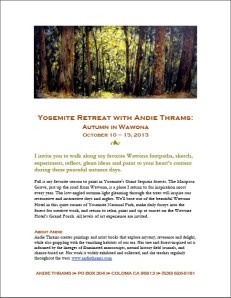
You are invited to join Andie Thrams in Yosemite National Park to learn how to capture the sounds, scents and landscape of this special place in your sketchbook.

Here is the latest at
Classes Near You > No. California:


Andie Thrams

www.andiethrams.com
Andie is a painter and book artist devoted to creative work in wild places. She teaches in California, Oregon, Alaska and Hawaii. Her work is widely exhibited and honored, and is held in many private and public collections. Get the latest news about Andie’s popular classes on her website.

    Autumn in Wawona with Andie Thrams
    Yosemite National Park
    October 10 – 13, 2013
    Upon arriving at Yosemite, meet with Andie and fellow classmates on the Grand Porch at the Wawona Hotel to enjoy an evening of sunset painting. Then get ready for daily walks through meadows and forests to learn how to make marks, create images and capture colors using watercolor, gouache, ink and pencil. Cost: $440 for the retreat, includes boxed lunches. Not included in the course fee are: lodging, transportation, food & drink (except lunch). Download itinerary


    Private Creativity Coaching & Artist Mentoring

    In addition to the workshops listed here, Andie also works privately with a limited number of students. Contact Andie Thrams

Click for directions

Click for directions

Add this plant to the mural at ArtPlantae at Aurea Vista!

Tomorrow we begin decorating one side of ArtPlantae’s display area with a small mural inspired by you and the plants you love. Visit Aurea Vista tomorrow evening any time from 6:00 – 8:30 PM during ArtsWalk to make your mark. Drawing materials will be provided.

This activity will occur at the section dedicated to plant-based education, botany and botanical art on the lower level. Enjoy the start of summer by visiting Aurea Vista and other ArtsWalk venues.

View list of ArtsWalk venues and restaurants


Related

End of School Year Sale Continues at Aurea Vista.
Huge savings. Look for the blue dot!